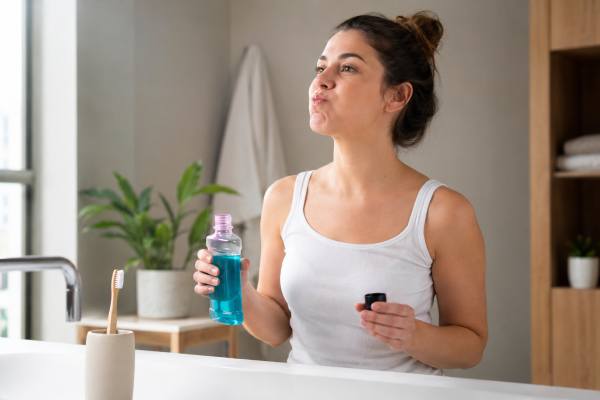
Antiviral mouthwashes became widely discussed during the COVID-19 years, when people wanted simple tools that might lower viral spread in daily life and in healthcare settings. The appeal is easy to understand. A rinse feels immediate, local, and low effort. But the real story is more narrow than the marketing often suggests.
Some mouthwashes can reduce viral material in saliva for a short time, especially against enveloped viruses such as SARS-CoV-2. That can matter in specific situations, particularly before close-contact oral care or dental procedures. What they do not do is sterilize the mouth for hours, clear viruses from the nose or lungs, or reliably prevent you from getting sick. The strongest evidence is also concentrated around a few ingredients and a few clinical settings, not everyday cold and flu prevention at home.
That makes antiviral mouthwash worth understanding, but not overestimating. Used well, it can be a practical adjunct. Used as a substitute for better-proven measures, it quickly becomes a false sense of security.
Quick Facts
- Some antiseptic mouthwashes can temporarily lower viral load in saliva, especially before close-contact oral procedures.
- The best-supported ingredients for short-term antiviral activity are usually povidone-iodine and cetylpyridinium chloride, with more mixed results for chlorhexidine and hydrogen peroxide.
- Current evidence does not show that mouthwash alone reliably prevents COVID-19, flu, RSV, or common colds in everyday life.
- Frequent or poorly chosen use can irritate the mouth, and povidone-iodine is not appropriate for everyone.
- The most sensible use is short-term, label-directed rinsing in higher-risk oral settings, not repeated use as an all-day protective strategy.
Table of Contents
- What Antiviral Mouthwash Really Means
- Which Ingredients Have the Best Evidence
- What the Studies Actually Show
- What Mouthwash Cannot Do
- When It Makes Practical Sense
- Safety, Side Effects, and Smart Use
What Antiviral Mouthwash Really Means
“Antiviral mouthwash” sounds more precise than it usually is. In most cases, these products are not antiviral drugs in the same sense as prescription medicines that block viral replication inside the body. They are antiseptic rinses used in the mouth. Some of them appear able to disrupt viral particles present in saliva or on oral surfaces, especially viruses with lipid envelopes. That is a real effect, but it is a local one, and it is usually temporary.
This distinction matters because the mouth is only one part of the upper airway. A rinse may lower viral burden in saliva for a short period, but it does not reach the nasal passages well, does not treat infection in the lungs, and does not stop fresh virus from moving back into the mouth from the throat or respiratory tract. In practical terms, that means a rinse may reduce what is sitting in the mouth at that moment, without changing the overall course of an infection very much.
The setting also matters. A mouthwash can be most useful where saliva itself is a relevant problem, such as dentistry, oral examinations, and other close-contact care around the mouth. In those situations, even a short-lived drop in salivary viral load may help reduce the amount of virus available to spray into droplets or aerosols. That is very different from claiming the rinse will keep you from catching a cold at the grocery store or protect your whole household for the rest of the day.
Another source of confusion is that “antiviral” is often used loosely. Some ingredients have broad antiseptic activity. Some are well established for gum care or plaque control and only secondarily studied for viral activity. Others have strong lab results but weaker real-world performance once saliva, timing, and human behavior are involved. That gap between laboratory promise and clinical usefulness is where many reader questions arise.
It also helps to remember that the mouth is an ecosystem, not just a surface to disinfect. Products that are harsher or used too often can irritate tissues, dry the mouth, or alter the balance of microbes that normally live there. That is why this topic sits naturally beside oral microbiome and immunity and the broader role of saliva in immune health. A rinse can be useful, but the goal is not to scrub the mouth into sterility. The goal is a measured, situation-specific reduction in risk.
Which Ingredients Have the Best Evidence
The antiviral mouthwash conversation is really a conversation about ingredients. Not all mouthwashes are studied the same way, and not all formulas with “germ-killing” claims appear equally useful against viruses.
The two ingredients with the most convincing short-term clinical support are usually povidone-iodine and cetylpyridinium chloride. Povidone-iodine, often shortened to PVP-I, has broad antiseptic activity and showed strong early interest because it performed well in laboratory studies and repeatedly looked promising in clinical studies measuring viral material in saliva. It is often discussed as a preprocedural rinse in dental and medical settings because it can act quickly. Its main drawback is not lack of activity but fit: because it adds iodine exposure, it is not an ideal choice for everyone.
Cetylpyridinium chloride, or CPC, is another leading option. It has become more attractive because several studies suggest it can reduce salivary viral load and may retain some effect for a short period after rinsing. That “substantivity,” or staying power on oral surfaces, helps explain why CPC is often mentioned as a practical choice for pre-appointment use. It also tends to be more familiar to consumers because it appears in some over-the-counter mouthwashes.
Chlorhexidine is more complicated. It is one of the best-known dental antiseptics and is widely used for bacterial control, gum inflammation, and post-procedure care. But viral evidence is less consistent. Some studies suggest benefit, while others show weaker or mixed effects compared with PVP-I or CPC. In other words, chlorhexidine is very important in oral care, but it is not the clearest “best antiviral rinse” answer.
Hydrogen peroxide had a surge of attention early in the pandemic because it was accessible and already used in oral care. Over time, it looked less impressive. It may have some short-term activity, but it has generally shown less reliable or less durable effects than the leading options. Frequent use can also irritate the mouth.
Essential oil rinses and newer combinations can have antimicrobial value, and some may have antiviral potential, but the clinical evidence is thinner and less standardized. Most of the strongest human data still center on SARS-CoV-2, and even there the results vary by concentration, rinse time, study design, and the outcome measured.
That is why ingredient choice should start with purpose, not hype. If the aim is routine mouth care, the best product may not be the one with the strongest short-term antiviral signal. If the aim is brief risk reduction before close oral contact, the balance may shift toward ingredients with faster and more consistent salivary effects.
What the Studies Actually Show
The central finding in this field is fairly consistent: some mouthwashes can temporarily reduce viral load in saliva, but the effect is narrower and shorter than many people assume. That short sentence captures both the promise and the limitation.
Most clinical studies have focused on SARS-CoV-2. Researchers usually ask participants who are already infected to rinse with a specific product, then compare saliva samples before and after use. In many of these studies, viral levels in saliva drop after rinsing. The change is often seen within minutes, and the best effects are usually reported in the short window after use. Some studies describe benefit at 15 to 30 minutes, and some suggest a longer effect, but the durability is inconsistent across trials.
That matters because saliva is only a moving snapshot. It changes with swallowing, talking, coughing, eating, and fresh secretions entering the mouth from deeper parts of the upper airway. A rinse can lower what is there now without meaningfully shutting down what appears next. This is one reason the stronger papers and reviews frame mouthwash as an adjunctive measure rather than a stand-alone prevention tool.
The other limitation is the outcome itself. Lower salivary viral load is not the same as lower transmission in everyday life. It is a reasonable intermediate marker, but it is not the final question most people care about. Readers usually want to know whether rinsing helps stop them from infecting a partner, protects them on a flight, or prevents a cold after exposure. Those real-world outcomes are harder to study and much less well established.
The evidence is also uneven across viruses. SARS-CoV-2 dominates the literature because it drove urgent research. Evidence for influenza, RSV, herpes simplex virus, and ordinary cold viruses is much thinner in humans. So while it is biologically plausible that some antiseptic rinses may act against other enveloped viruses, we should not pretend the everyday evidence is equally solid across the board.
A final nuance is the difference between in vitro and in vivo results. A rinse may look impressive in the lab, where viral particles are directly exposed under controlled conditions. Human mouths are far messier. Saliva dilutes chemicals, contact times are shorter, and tissues are constantly replenished. This gap is one reason reviews repeatedly find more confidence in transient viral reduction than in broad claims about prevention.
For readers, the practical takeaway is simple. These products may buy a short, local reduction in oral viral burden. They do not create lasting protection, and they have not earned the status of a primary anti-infection strategy.
What Mouthwash Cannot Do
A good article on antiviral mouthwash should spend as much time on limits as on benefits. Without that, it is too easy to turn a modest tool into a misleading one.
First, mouthwash does not prevent infection in any dependable all-purpose way. It may reduce virus in saliva for a short period, but exposure can still occur through the nose, through inhaled aerosols, and through contact that has nothing to do with the mouth at all. That is why mouthwash does not replace mask use in higher-risk respiratory settings or the value of cleaner indoor air and ventilation.
Second, it does not treat the whole infection. If you already have COVID-19, flu, RSV, or another viral illness, a rinse may change what is measurable in your saliva for a while, but it is not the same as reducing viral replication throughout the respiratory tract. It is not an antiviral medicine, and it should not be framed as one.
Third, it does not work equally well for every virus. Most of the better evidence comes from SARS-CoV-2 studies, especially in dental or clinical contexts. That is a narrower evidence base than “antiviral mouthwash” implies. For common-cold viruses in daily life, the data are far less robust.
Fourth, it is not a substitute for ordinary prevention habits. If a person rinses before a crowded indoor event but sleeps badly, ignores symptoms, shares drinks, and stays in stale air for hours, the mouthwash is unlikely to be the deciding factor. The basics still do more heavy lifting. That includes the habits covered in simple ways to avoid getting sick and the question of handwashing versus hand sanitizer when transmission is happening through contact as well as air.
Finally, mouthwash is not risk-free just because it is sold over the counter. Irritation, altered taste, dryness, staining, and ingredient-specific cautions all matter. Repeated use “just in case” is not automatically smarter than targeted use. In fact, it may push people toward exactly the kind of immune-health overreach and misleading claims that this topic needs to avoid.
The honest position is not that mouthwash is useless. It is that its utility is conditional. It can make sense as a narrow, short-term, local measure. The moment it is presented as a substitute for evidence-based infection control, it stops being a helpful tool and starts being a distraction.
When It Makes Practical Sense
So where does antiviral mouthwash actually fit? The clearest answer is before close-contact care involving the mouth. That is the setting where a temporary drop in salivary viral load may have the most practical value.
Dental visits are the best example. Cleanings, drilling, scaling, suction, and prolonged face-to-face work can generate droplets and aerosols from saliva. In that environment, a preprocedural rinse is sensible because even a short-lived local effect may reduce the viral material entering the room at the start of care. Many clinicians already think about rinses this way: not as magic, but as one layer in a bundle that includes protective equipment, room airflow, scheduling, and symptom screening.
Short-term use may also make sense before oral exams, some ENT assessments, or home caregiving tasks that require close face-to-face contact around the mouth. For example, if someone is sick and a caregiver needs to help with oral care or examine the mouth, a labeled rinse may be a reasonable add-on. Still, that should be understood as a practical risk-reduction step, not a proven household transmission blocker.
Another reasonable use is when a clinician or dentist specifically recommends a rinse for a defined situation. Some products are chosen not only for possible antiviral effects but also for oral bacterial control around procedures. That combined benefit can be useful in real practice.
Where it makes less sense is routine all-day preventive use by healthy people who want a simple substitute for harder habits. Rinsing several times a day before errands, travel, meetings, or classrooms is not supported strongly enough to justify broad claims of protection. In those situations, the more proven measures still dominate: symptom awareness, staying home when clearly sick, air quality, and ordinary hygiene.
It is also worth separating mouthwash from other upper-airway measures. The mouth is not the nose, and oral rinsing is not the same as strategies aimed at nasal passages or mucus clearance. If a reader is mainly focused on congestion or nasal exposure, topics like mucosal immunity or saline nasal irrigation are closer to that problem, even though they serve different purposes.
In short, antiviral mouthwash makes the most sense when the question is local and immediate: “Can I lower oral viral burden briefly before close contact around the mouth?” Outside that frame, the benefit becomes less certain, and the temptation to overuse it becomes stronger.
Safety, Side Effects, and Smart Use
The safest way to use an antiviral mouthwash is to think like a label reader, not a health hacker. Choose a product for a clear reason, use it as directed, and do not assume more frequent or stronger use is automatically better.
Povidone-iodine deserves extra caution. It can be a strong option for short-term preprocedural use, but it is not ideal for everyone. People with thyroid disease, those who have been told to avoid excess iodine, and some people who are pregnant or undergoing specific thyroid-related care should not start frequent PVP-I rinsing casually. One reason is simple: even though you spit it out, iodine exposure is not zero. For short, occasional use the risk may be acceptable for many adults, but repeated daily use is a different question.
Chlorhexidine has a different safety profile. It is commonly used in dentistry, but repeated use can stain teeth, alter taste, and increase tartar buildup in some people. It is a dental tool, not a neutral daily rinse to use indefinitely. Hydrogen peroxide can irritate the mouth, especially with stronger concentrations or frequent use. Essential oil and CPC rinses may sting or dry the mouth in sensitive users.
A few general rules make sense across products:
- Do not swallow the rinse.
- Do not improvise concentrations at home.
- Do not use adult antiseptic rinses in children who cannot spit reliably.
- Do not keep switching between multiple strong antiseptic products in the hope of creating a stronger effect.
- Stop if you develop significant burning, swelling, mouth sores, or worsening irritation.
It is also wise to consider what repeated antiseptic use may do to the oral environment. Saliva and healthy mucosal surfaces are part of frontline defense, not obstacles to eliminate. The same is true of the broader relationship between the mouth and mucosal immune defense. A mouthwash that helps in one narrow situation can still be the wrong choice if it leaves your mouth drier, more irritated, or harder to tolerate day after day.
The best mental model is this: use antiviral mouthwash like you would use gloves for a messy task. It can be useful when the job fits. It should not become an all-purpose answer to every infectious concern. Short-term, targeted, label-directed use is where these rinses are most defensible. Beyond that, the benefits thin out faster than many people realize.
References
- The Role of Saliva and Mouthwashes in the Detection and Reduction of Oral Viral Load: A Scoping Review 2025 (Scoping Review)
- A Cetylpyridinium Chloride Oral Rinse Reduces Salivary Viral Load in Randomized Controlled Trials 2025 (RCT)
- Preprocedural mouthwashes for infection control in dentistry-an update 2023 (Review)
- Efficacy of mouthwash on reducing salivary SARS-CoV-2 viral load and clinical symptoms: a systematic review and meta-analysis 2023 (Systematic Review)
- High Ingestion Rate of Iodine from Povidone-Iodine Mouthwash 2021 (Safety Study)
Disclaimer
This article is for educational purposes only and is not a substitute for medical or dental advice, diagnosis, or treatment. Mouthwashes can irritate the mouth, interact with individual health circumstances, and may be inappropriate for children or for people with certain thyroid conditions or other medical concerns. Ask a dentist, pharmacist, or clinician before using antiseptic mouthwashes frequently, especially if you are pregnant, have thyroid disease, are managing a chronic illness, or are trying to use them during an active infection.
If this article was useful, please share it on Facebook, X, or your preferred platform.