Arsenic testing is usually done with urine, not blood, when the purpose is to check recent exposure. A blood arsenic test can help in a narrow window soon after a major acute exposure, but arsenic leaves the bloodstream quickly and moves into tissues or urine. That makes blood less useful for most people who are worried about contaminated well water, workplace exposure, rice-based diets, seafood-related results, or a possible exposure that happened several days ago.
The most useful test often depends on the timing, the suspected source, and whether the lab separates inorganic arsenic from less harmful organic seafood arsenic. A high “total arsenic” result can sound alarming, but it may be misleading after fish, shellfish, kelp, or seaweed. For many non-emergency situations, a 24-hour urine arsenic test with speciation gives the clearest picture of clinically important exposure.
- Urine arsenic is usually the preferred test for exposure within the last few days.
- Blood arsenic is mainly useful very soon after a significant acute exposure.
- A 24-hour urine collection is often more informative than a random urine sample.
- Arsenic speciation separates inorganic arsenic and its metabolites from seafood-related organic arsenic.
- Seafood can raise total urine arsenic without proving toxic inorganic exposure.
- Severe vomiting, diarrhea, confusion, fainting, abnormal heart rhythm symptoms, or suspected poisoning needs urgent care, not routine outpatient testing.
Table of Contents
- Which Test Is Usually Used?
- Why Urine Shows Recent Exposure Better
- When Blood Arsenic Testing Helps
- Total Arsenic vs Arsenic Speciation
- How to Prepare for Arsenic Testing
- How Results Are Interpreted
- Follow-Up After an Abnormal Result
- Common Mistakes and Limitations
Which Test Is Usually Used?
Urine arsenic testing is the test most often used to evaluate recent arsenic exposure. This is especially true when the concern is contaminated drinking water, workplace exposure, pesticides, treated wood, industrial sources, or a possible ingestion that happened within the last several days.
A blood arsenic test has a more limited role. It may be ordered when a clinician suspects a very recent, significant exposure and needs evidence while the exposure is still close in time. Blood testing can also be part of a broader toxicology evaluation in the hospital, especially if the person has severe symptoms. Outside that early window, blood arsenic may fall even when exposure was real.
The simplest comparison is:
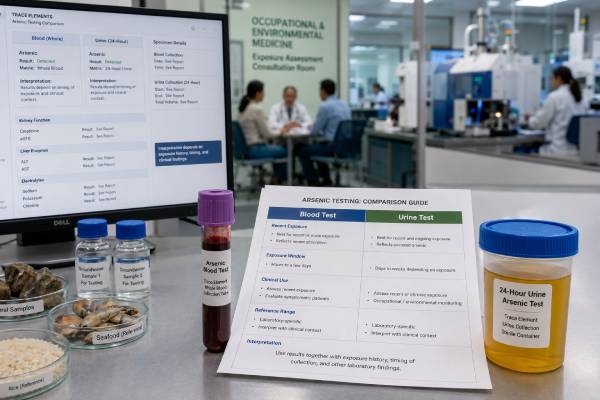
| Test | Best use | Main limitation |
|---|---|---|
| Urine arsenic | Recent exposure over the last few days, especially from water, food, or occupational sources | Total arsenic can be misleading after seafood unless speciation is done |
| Blood arsenic | Very recent acute exposure, often in urgent or hospital settings | Arsenic clears from blood quickly, so timing is critical |
| Hair or nail arsenic | Possible past exposure over weeks to months | External contamination can make interpretation difficult |
For most outpatient questions, the better starting point is a urine test, ideally with speciation if the total arsenic result is high or seafood exposure is possible. A person asking whether an arsenic blood test is the right test is often really asking whether arsenic is still circulating in the blood. In many cases, urine gives a better answer because the body removes arsenic through urine after it is absorbed and metabolized.
Arsenic can exist in different chemical forms. Inorganic arsenic is the form of greatest medical concern in drinking water and many occupational settings. Organic arsenic compounds are common in seafood and are often much less toxic. A test that reports only “total arsenic” adds these forms together, which can blur the distinction between a harmless seafood-related increase and a concerning inorganic exposure.
Why Urine Shows Recent Exposure Better
Urine shows recent arsenic exposure better because absorbed arsenic is processed and excreted mainly through the kidneys. After inorganic arsenic enters the body, it is converted into methylated metabolites, mainly monomethylarsonic acid, often shortened to MMA, and dimethylarsinic acid, often shortened to DMA. These compounds leave the body in urine.
That pattern makes urine testing useful for exposures that happened in the past few days. It does not prove that every symptom is caused by arsenic, and it does not predict exactly who will develop long-term health effects. It does show whether arsenic excretion is higher than expected and, when speciation is included, whether the increase is coming from inorganic-related forms.
A 24-hour urine collection is often preferred because it measures the amount excreted over a full day. That smooths out normal ups and downs caused by hydration, meal timing, and urine concentration. A random urine sample can still be useful, especially when results are corrected for creatinine, but it is more vulnerable to dilution. Someone who drank a lot of water may have a lower concentration in a random sample, while someone who is dehydrated may have a higher concentration.
Urine testing is especially useful when the exposure source continues over time. A private well with arsenic, for example, may expose a household every day. A single blood test might miss the exposure if it is not drawn at the right moment, while urine testing can better reflect ongoing intake. The same idea applies to some workplace exposures, contaminated dust, and regular consumption of foods grown or prepared with arsenic-contaminated water.
Urine arsenic testing is commonly discussed with a heavy metals test panel, but panel testing can create confusion. Some panels measure arsenic in blood, some in urine, and some include only total arsenic. The specimen type and the method matter as much as the word “arsenic” on the order.
24-hour urine vs random urine
A 24-hour urine arsenic test measures all urine passed during a full 24-hour period. It can be inconvenient, but it gives a more complete estimate of daily excretion. The person usually collects every urine sample after discarding the first morning void, then includes the first void the next morning at the same time.
A random urine test uses one sample. It is easier and faster, but interpretation depends more on urine concentration. A random result may be reported in micrograms per liter, or it may be adjusted to creatinine and reported as micrograms per gram of creatinine. Creatinine correction helps account for dilution, but it is not perfect in people with unusual muscle mass, kidney disease, pregnancy, or very dilute urine.
Why timing still matters
Urine is better than blood for recent exposure, but it is not a permanent record. If the exposure stopped weeks ago, urine levels may have already fallen. That is why clinicians ask when the exposure happened, whether it is still happening, and whether the person changed diet or water sources before testing.
For long-term concerns, urine results are interpreted alongside exposure history. A person who used high-arsenic well water for years may need water testing, medical evaluation, and sometimes skin or neurologic assessment even if a urine result taken after switching water sources is lower than expected.
When Blood Arsenic Testing Helps
A blood arsenic test is most helpful soon after a large acute exposure. This might include suspected poisoning, accidental ingestion of an arsenic-containing product, severe workplace exposure, or a hospitalized patient with symptoms that fit acute arsenic toxicity.
Acute arsenic poisoning can cause severe gastrointestinal symptoms such as vomiting, abdominal pain, and watery diarrhea. It may also affect blood pressure, heart rhythm, nerves, kidneys, liver, and mental status. In that setting, clinicians do not rely on one arsenic number alone. They may order blood and urine arsenic along with electrolytes, kidney tests, liver tests, an electrocardiogram, and other toxicology tests.
The main weakness of blood testing is that arsenic does not stay in blood for long. A low or normal blood arsenic result several days after exposure does not always rule out exposure. This is why a clinician may order urine testing even if blood testing has already been done.
Blood testing can still be useful when timing is very recent. If a person arrives in the emergency department soon after suspected ingestion, a blood arsenic level may support the diagnosis while treatment decisions are being made. In some cases, treatment starts before confirmatory results return, because serious poisoning is time-sensitive.
A blood test may also be considered when urine collection is not possible or when clinicians want several specimen types for documentation. For example, occupational or forensic evaluations sometimes use multiple samples. Even then, urine often carries more weight for recent absorbed dose.
Because arsenic toxicity can affect organs beyond the exposure marker itself, clinicians may also check related blood tests. Kidney function can be important because arsenic and its metabolites leave the body through urine, and severe illness can affect fluid and electrolyte balance. A kidney function blood test panel may be used when symptoms, dehydration, or toxic exposure raise concern. Liver enzymes may also be checked in serious illness or overdose-like presentations, similar to other toxicology evaluations that use liver function tests to assess organ stress.
Total Arsenic vs Arsenic Speciation
Arsenic speciation is often the difference between a useful result and a misleading one. Total arsenic measures all arsenic forms together. Speciation separates the forms into categories that help show whether the result is likely from inorganic exposure or from organic seafood compounds.
This matters because seafood can contain organic arsenic compounds such as arsenobetaine. These compounds can raise total urine arsenic substantially, sometimes enough to look alarming on a report. But arsenobetaine is much less concerning than inorganic arsenic from contaminated water or certain industrial sources.
Inorganic-related urine arsenic usually includes:
- Arsenite
- Arsenate
- Monomethylarsonic acid, or MMA
- Dimethylarsinic acid, or DMA
Organic seafood-related forms may include:
- Arsenobetaine
- Arsenocholine
- Trimethylarsine oxide
- Arsenosugars, especially from seaweed and some marine foods
A total urine arsenic result can be high after a seafood meal even when the inorganic-related fraction is not high. This is why many clinicians ask patients to avoid fish, shellfish, kelp, seaweed, and seafood supplements before testing when it is safe and practical to do so. If total arsenic is high and seafood was eaten recently, the next step is often repeat testing after seafood avoidance or arsenic speciation.
Speciation is also useful when the exposure source is unclear. Suppose a person has a high total urine arsenic result after eating sushi, seaweed snacks, shrimp, and fish oil. Without speciation, the result cannot clearly separate seafood-related arsenic from toxic inorganic exposure. If speciation shows mostly arsenobetaine, the concern is very different from a result showing elevated inorganic arsenic plus MMA and DMA.
The word “organic” can be confusing here. In arsenic chemistry, organic means the arsenic compound contains carbon. It does not mean “healthy,” “natural,” or “pesticide-free.” Organic arsenic compounds vary in toxicity. Many seafood-related forms are much less toxic, while some methylated metabolites are part of inorganic arsenic metabolism and still matter in interpretation.
Why seafood changes the report
After seafood, total urine arsenic may rise because the body absorbs and quickly excretes organic arsenic. The result may return to a lower level after a few days without seafood. That is why a clinician may recommend avoiding seafood for 48 to 72 hours before a urine arsenic test, although instructions vary by laboratory and clinical situation.
Seaweed deserves special attention. Some seaweed and kelp products can contain arsenosugars or other arsenic species that may increase DMA in urine. This can make interpretation harder because DMA can come from metabolism of inorganic arsenic, but it can also rise after some marine foods. A clinician or toxicologist may interpret the full pattern, not just one number.
How to Prepare for Arsenic Testing
Preparation depends on why the test is being done. In an emergency, testing should not be delayed to avoid seafood or perfect the collection. In a non-urgent outpatient setting, preparation can reduce false alarms and make the result easier to interpret.
For a planned urine arsenic test, the clinician or lab may recommend avoiding seafood before collection. Commonly avoided items include fish, shellfish, seaweed, kelp, sushi, seafood powders, fish sauce, and some marine-based supplements. The exact avoidance period should follow the ordering clinician or laboratory instructions, but 48 to 72 hours is often used.
Do not stop medically necessary treatments, occupational safety reporting, or urgent evaluation just to prepare for a test. If a person feels very ill after possible arsenic exposure, the priority is urgent medical care.
For a 24-hour urine collection, accuracy depends on collecting the full sample. Missing one void can make the result falsely low. Adding urine from outside the collection period can make it inaccurate. The collection container may need refrigeration or special handling, depending on the lab.
A careful exposure history is just as important as the sample. Before testing, write down:
- The date and time of the suspected exposure
- Drinking water source, including private well use
- Recent seafood, seaweed, kelp, or fish oil intake
- Rice-heavy diet or rice-based products
- Occupational exposure, such as smelting, glass work, pesticide work, wood treatment, mining, or semiconductor work
- Hobbies such as metal work, taxidermy, old pesticide handling, or use of treated wood
- Supplements, traditional remedies, or imported products
- Symptoms and when they started
Private well users should test the water itself. A urine test can show recent body exposure, but it does not identify the source by itself. If well water contains arsenic above the relevant drinking water standard or local action level, the long-term solution is exposure reduction, not repeated body testing alone.
Testing children needs special care. Children may have different exposure patterns because they drink more water per body weight, have hand-to-mouth behavior, and may be more vulnerable to developmental effects from chronic exposure. Pediatric interpretation should use a clinician familiar with environmental exposures.
How Results Are Interpreted
Arsenic results are interpreted by specimen type, timing, units, reference range, and arsenic species. A number that looks high in one context may be less concerning in another, especially if the result is total urine arsenic after seafood.
Urine arsenic may be reported as micrograms per liter, micrograms per 24 hours, or micrograms per gram of creatinine. Blood arsenic may be reported as micrograms per liter. Hair arsenic may be reported as micrograms per gram of hair. These units are not interchangeable.
The lab’s reference range should be used first. Different labs use different methods, specimen requirements, and reporting cutoffs. A result slightly above a reference interval does not automatically mean poisoning. A very high result, a high inorganic-related fraction, or a result paired with symptoms is more concerning.
| Finding | Possible meaning | Common next step |
|---|---|---|
| High total urine arsenic after seafood | May reflect organic seafood arsenic | Speciation or repeat urine test after seafood avoidance |
| High inorganic arsenic plus MMA and DMA | More consistent with inorganic arsenic exposure | Source investigation, exposure reduction, medical evaluation |
| Normal blood arsenic days after exposure | Does not fully rule out earlier exposure | Consider urine testing if timing fits |
| High hair or nail arsenic | May suggest past exposure, but contamination is possible | Confirm with exposure history and appropriate urine testing when relevant |
Symptoms can change how urgently a result is handled. Mildly elevated urine arsenic in an otherwise well person with recent seafood intake is very different from severe gastrointestinal illness, dehydration, low blood pressure, abnormal heart rhythm symptoms, or neurologic problems after a suspected toxic ingestion.
Chronic inorganic arsenic exposure can be associated with skin color changes, thickened skin on the palms and soles, numbness or tingling, anemia, cardiovascular effects, and higher risk of some cancers. These findings usually develop from ongoing exposure, often through drinking water or occupational sources. A single urine test helps assess recent exposure, but it does not replace a full clinical evaluation when long-term exposure is possible.
A complete blood count may be ordered when symptoms or chronic exposure raise concern for anemia or changes in blood cells. If anemia is present, a clinician may compare arsenic history with other patterns on a complete blood count, iron studies, kidney tests, and nutritional markers rather than assuming arsenic is the only cause.
Results that need faster attention
Urgent medical attention is needed if possible arsenic exposure is followed by severe vomiting, profuse diarrhea, fainting, confusion, chest pain, shortness of breath, severe weakness, seizures, or signs of dehydration. Severe acute poisoning can progress quickly and may require hospital treatment, poison control guidance, intravenous fluids, heart rhythm monitoring, and sometimes chelation therapy.
A high arsenic result should also be addressed promptly when the person is pregnant, a child is exposed, multiple household members are affected, the exposure source is still present, or the result suggests inorganic arsenic rather than seafood-related organic arsenic.
Follow-Up After an Abnormal Result
The first step after an abnormal arsenic result is to confirm what was measured. Was it blood, random urine, 24-hour urine, hair, or nail? Was it total arsenic or speciated arsenic? Was seafood eaten recently? Was the collection complete? Did the lab report inorganic-related species separately?
A high total urine arsenic result without speciation often needs clarification. The clinician may order arsenic speciation on the same sample if possible, repeat urine testing after seafood avoidance, or collect a 24-hour urine sample. If the result already shows elevated inorganic-related arsenic, the focus moves toward finding and stopping the source.
Common source checks include:
- Testing private well water for arsenic
- Reviewing workplace exposure and protective equipment
- Checking whether household members have similar exposure
- Reviewing diet, especially rice, seaweed, and water used for cooking
- Looking for imported remedies, supplements, pigments, pesticides, or industrial products
- Contacting local health or environmental agencies when a community source is possible
Water testing is especially important because a person can keep absorbing arsenic every day if the source remains in use. Boiling water does not remove arsenic and can concentrate it slightly as water evaporates. Some filters remove arsenic well, but not all household filters do. The filter must be rated for arsenic removal and maintained correctly.
If a private well has high arsenic, exposure reduction may include using bottled water or a verified treatment system for drinking and cooking. Bathing and laundry are usually less important sources than drinking and cooking, but local public health guidance should be followed, especially when levels are high.
Medical follow-up depends on the level, symptoms, and duration of exposure. A clinician may check kidney function, liver enzymes, electrolytes, blood counts, neurologic symptoms, skin findings, and cardiovascular risk. People with occupational exposure may need workplace health evaluation and repeat monitoring after controls are improved.
Chelation is not a routine response to a mildly abnormal test. Chelating medicines can have risks and are generally reserved for significant poisoning under medical supervision. The most effective step for chronic environmental exposure is usually stopping the exposure source.
For comparison with other toxicology markers, arsenic testing differs from drug level monitoring because there is no simple “therapeutic range.” Medication tests such as lithium level monitoring are interpreted against dosing targets, while arsenic testing is interpreted against exposure history, species, timing, symptoms, and source control.
Common Mistakes and Limitations
One common mistake is ordering a blood arsenic test for an exposure that happened days or weeks ago. Blood may already be low by then. A urine test is usually more useful for recent exposure, and hair or nail testing may be considered for older exposure questions when interpreted cautiously.
Another mistake is treating total urine arsenic as if it always means toxic inorganic arsenic. Seafood can raise total urine arsenic, and some seaweed products can complicate the pattern. Speciation or repeat testing after seafood avoidance can prevent unnecessary alarm.
A third mistake is testing the person but not the source. If the suspected source is private well water, the water must be tested. If the suspected source is workplace dust or fumes, the workplace needs industrial hygiene review. If the source is a supplement or traditional remedy, the product may need investigation. Body testing can show exposure, but source testing helps stop it.
Hair and nail tests can be useful in selected cases, but they are not simple proof of internal poisoning. Hair and nails can pick up arsenic from dust, water, hair products, or the environment. They may help document past exposure over weeks to months, but they should not replace urine testing when recent exposure is the main concern. This limitation is similar to other toxic metal comparisons where the specimen type changes the meaning, such as mercury blood versus hair testing.
False reassurance is also possible. A normal urine result after a person has already stopped exposure may not describe what was happening months earlier. A normal blood result several days after suspected exposure may not rule out earlier absorbed arsenic. This is why timing and exposure history are part of the result.
Testing can also miss the larger health picture. Arsenic biomarkers do not predict exactly who will develop cancer, neuropathy, skin findings, or cardiovascular disease. They show exposure pattern and support medical decisions. Long-term health monitoring depends on the exposure duration, level, age, symptoms, and other risks.
The most useful interpretation usually comes from three pieces of information together: a well-collected specimen, arsenic speciation when needed, and a clear exposure history. When those pieces fit, the test can guide the next decision: repeat testing, source control, workplace action, public health reporting, medical monitoring, or urgent treatment.
References
- Arsenic | ToxFAQs™ | ATSDR 2015 (Official Page)
- Biomonitoring Summary | CDC 2017 (Official Page)
- Arsenic 2022 (Official Fact Sheet)
- Chemical Contaminant Rules | US EPA 2026 (Official Page)
- Arsenic | Toxicological Profile | ATSDR 2007 (Toxicological Profile)
- ASHA – Overview: Arsenic, Hair 2026 (Test Catalog)
Disclaimer
Arsenic testing should be interpreted by a qualified clinician, toxicologist, occupational medicine specialist, or public health professional. Results depend on timing, specimen type, arsenic species, diet, kidney function, and the suspected exposure source. Suspected poisoning, severe symptoms, pregnancy, child exposure, or ongoing household exposure should be handled urgently through medical care and local poison control or public health guidance.