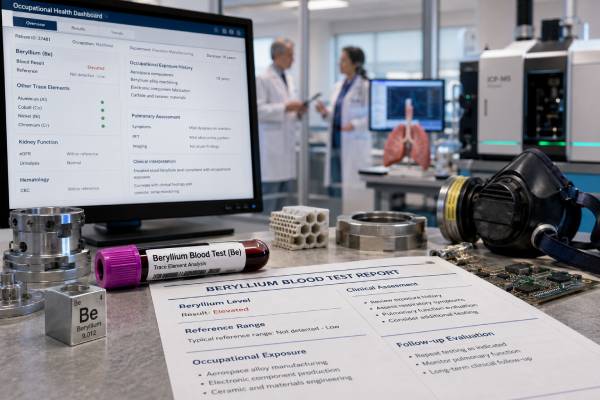
A beryllium blood test is used when beryllium exposure is possible, usually through work with beryllium metal, beryllium alloys, ceramics, electronics, aerospace parts, dental alloys, nuclear materials, or abrasive blasting dust. The phrase can mean two different tests: a quantitative blood beryllium level, which measures beryllium in the blood, or the beryllium lymphocyte proliferation test, often called the BeLPT, which checks whether the immune system has become sensitized to beryllium. That distinction matters because beryllium-related disease is usually not diagnosed by the amount of beryllium in the blood alone. The major concern is chronic beryllium disease, a lung condition that can develop after beryllium sensitization. A high blood beryllium result can support a recent exposure concern, but symptoms, job history, BeLPT results, lung testing, and specialist evaluation usually guide the next steps.
- A beryllium blood level measures the metal itself; a BeLPT measures immune sensitization to beryllium.
- High blood beryllium usually suggests recent or ongoing exposure, sample contamination, or unusual occupational contact, not a stand-alone diagnosis.
- BeLPT results are usually reported as normal, borderline, or abnormal rather than as a simple numeric “level.”
- A normal blood beryllium level does not rule out beryllium sensitization or chronic beryllium disease.
- Follow-up matters most if exposure continues, the BeLPT is abnormal or borderline, or symptoms such as persistent cough or shortness of breath are present.
Table of Contents
- What a Beryllium Blood Test Measures
- When Beryllium Testing Is Used
- Normal Range, High Results, and What They Mean
- BeLPT Results and Beryllium Sensitization
- Common Sources of Beryllium Exposure
- Beryllium Toxicity, Lung Disease, and Symptoms
- Follow-Up After Abnormal Results
- Reducing Exposure and Preventing Further Risk
What a Beryllium Blood Test Measures
A beryllium blood test can refer to two related but very different kinds of testing.
The first is a quantitative beryllium blood level. This test measures how much beryllium is present in a blood sample, usually reported in very small units such as micrograms per liter or nanograms per milliliter, depending on the laboratory. It is a direct exposure test. If the level is above the lab’s reference interval, it suggests that beryllium entered the body recently or that contamination occurred during collection or handling.
The second is the beryllium lymphocyte proliferation test, or BeLPT. This is not a metal concentration test. Instead, it looks at how a person’s immune cells respond when they are exposed to beryllium in the laboratory. If the immune cells multiply more than expected, the result may be abnormal. That pattern suggests beryllium sensitization, meaning the immune system has learned to recognize beryllium and react to it.
These two tests answer different questions:
| Test | What it checks | Most useful for | What it cannot prove alone |
|---|---|---|---|
| Quantitative blood beryllium level | Amount of beryllium in blood | Recent or ongoing exposure concern | Whether the immune system is sensitized or whether chronic beryllium disease is present |
| BeLPT | Immune-cell response to beryllium | Beryllium sensitization screening and medical surveillance | The exact amount of exposure or the severity of lung disease |
This distinction prevents a common misunderstanding. A person can have a low or normal quantitative blood beryllium level and still have beryllium sensitization, especially if the exposure happened in the past. Likewise, a high blood beryllium level does not automatically mean chronic beryllium disease has developed.
Beryllium testing is usually interpreted alongside a work and exposure history, respiratory symptoms, physical examination, pulmonary function tests, chest imaging when appropriate, and sometimes bronchoscopy with bronchoalveolar lavage. In practice, the BeLPT often matters more than the metal level when the concern is beryllium sensitization or chronic beryllium disease.
When Beryllium Testing Is Used
Beryllium testing is most often used in occupational health. Beryllium is not a routine environmental blood test for the general public because most people do not have meaningful exposure. Testing becomes relevant when a person has worked around beryllium dust, fumes, mist, powders, alloys, ceramics, or contaminated abrasive blasting material.
A clinician, occupational medicine program, or workplace medical surveillance program may order testing when:
- A worker has known or suspected beryllium exposure.
- Workplace air monitoring shows exposure above action levels.
- A person develops respiratory symptoms after working with beryllium-containing materials.
- A worker is part of a required medical surveillance program.
- An abnormal prior BeLPT needs confirmation.
- A specialist is evaluating possible chronic beryllium disease.
- There was an accidental release, spill, fire, machining event, or uncontrolled dust exposure.
The BeLPT is commonly used in medical surveillance because beryllium sensitization can appear before a person has obvious symptoms. Early detection gives the worker and clinician a chance to reduce further exposure, monitor lung health, and evaluate for chronic beryllium disease before advanced damage occurs.
A quantitative beryllium blood level may be used when the immediate question is different: “Was there recent exposure?” This can be helpful after an incident or when workplace controls may have failed. However, it is less useful as a long-term disease screen because beryllium disease risk is driven by immune sensitization and lung response, not only by the measured blood concentration on one day.
Beryllium may also be included in a broader heavy metals blood test panel, although many standard heavy metal panels focus on metals such as lead, mercury, arsenic, and cadmium. When beryllium is the main concern, the order should clearly specify beryllium and, when appropriate, BeLPT.
Normal Range, High Results, and What They Mean
There is no single universal “normal range” for beryllium blood testing that applies to every lab and every clinical situation. The most reliable reference interval is the one printed on the report from the laboratory that performed the test. Methods, units, detection limits, and contamination-control procedures can vary.
For a quantitative blood beryllium level, many people without known exposure have results that are undetectable or very low. A result above the laboratory’s reference interval usually means one of three things:
- Recent or ongoing beryllium exposure occurred. This is more likely when the person works in a setting where beryllium is machined, ground, melted, welded, blasted, polished, recycled, or handled as powder.
- The sample was contaminated. Trace metal testing is sensitive. Collection tubes, dust on skin or clothing, workplace contamination, or improper handling can affect results.
- Exposure is unusual but real. Less common sources include contaminated dust from abrasive blasting, take-home contamination from work clothing, or contact with beryllium-containing materials in specialized industries.
A high quantitative level does not tell the whole story. It does not prove chronic beryllium disease, and it does not reliably predict whether a person is sensitized. It should be treated as an exposure signal that needs context.
| Result pattern | Possible meaning | Typical next step |
|---|---|---|
| Within the lab’s reference interval | No measurable recent elevation, or exposure below the test’s detection threshold | Review exposure history; consider BeLPT if workplace exposure or symptoms are present |
| Slightly above the reference interval | Possible low-level exposure or contamination | Repeat with careful trace-metal collection and assess workplace controls |
| Clearly elevated | Recent or ongoing exposure is more likely | Remove or reduce exposure, evaluate the workplace source, and consider occupational medicine follow-up |
| Normal blood level but abnormal BeLPT | Immune sensitization may be present even without a high current metal level | Confirm the BeLPT pattern and evaluate for chronic beryllium disease if indicated |
Because trace metal results can be confusing, it is important to check the exact unit. A value reported in micrograms per liter is not the same as a value reported in micrograms per deciliter. Small differences in units can make a result look larger or smaller than it really is.
A high result should also be compared with other findings. For example, a worker with a high blood beryllium level but no symptoms and a normal BeLPT needs a different plan than a worker with shortness of breath, abnormal pulmonary function tests, and repeated abnormal BeLPT results.
BeLPT Results and Beryllium Sensitization
The BeLPT is central to beryllium medical surveillance because it looks for immune sensitization. Beryllium sensitization means the immune system reacts to beryllium. It is not the same as having chronic beryllium disease, but it raises concern because sensitized people are at risk of developing the disease.
BeLPT results are usually reported as:
- Normal: The immune cells did not show an abnormal response to beryllium in the test system.
- Borderline: The response was not clearly normal or abnormal.
- Abnormal: The immune cells showed a stronger-than-expected response to beryllium.
A single abnormal or borderline result often needs confirmation. Medical surveillance programs commonly repeat testing because the BeLPT can vary from sample to sample and lab to lab. A confirmed positive pattern may involve two abnormal results, one abnormal and one borderline result, or repeated borderline results, depending on the protocol being used.
The BeLPT can be performed on blood. In some diagnostic evaluations, a similar immune-response test may be performed on cells collected from the lungs during bronchoalveolar lavage. Lung-cell testing is more specialized and is generally part of a pulmonary or occupational medicine evaluation, not a routine screening test.
A normal BeLPT is reassuring, but it is not perfect. False-negative and false-positive results can occur. A clinician may repeat testing if the exposure history is strong, symptoms continue, or another part of the evaluation raises concern.
The BeLPT also does not measure disease severity. It helps identify sensitization. To diagnose chronic beryllium disease, clinicians look for a combination of beryllium exposure history, beryllium sensitization, and lung findings consistent with the disease. These lung findings may include abnormal pulmonary function tests, imaging changes, bronchoalveolar lavage findings, or biopsy evidence of granulomatous inflammation.
Common Sources of Beryllium Exposure
Beryllium is valued because it is light, strong, heat-stable, electrically conductive in certain alloys, and transparent to X-rays. Those same properties explain why it appears in specialized workplaces rather than everyday consumer exposure.
Higher-risk work settings can include:
- Primary beryllium production
- Beryllium-copper alloy manufacturing
- Machining, grinding, cutting, polishing, or sanding beryllium-containing parts
- Aerospace and defense manufacturing
- Electronics and semiconductor-related ceramics
- Nuclear materials and research facilities
- Dental laboratories using certain alloys
- Foundries, smelting, and recycling operations
- Abrasive blasting where blasting media or blasted surfaces contain trace beryllium
- Maintenance work around contaminated dust, ventilation systems, or old equipment
The most concerning route is inhalation of airborne beryllium dust, fume, mist, or particles. Skin contact can also matter because beryllium particles on the skin may contribute to sensitization, especially if there are cuts, abrasions, or poor hygiene controls.
Finished consumer products that contain beryllium are usually not the main risk when they are intact and used as designed. Risk rises when the material is processed in a way that creates airborne particles. Cutting, grinding, welding, polishing, burning, or blasting can turn a stable material into an inhalation hazard.
People sometimes compare beryllium exposure with other metal exposures, but each metal behaves differently. A blood lead test directly reflects a well-established toxic exposure marker, while beryllium testing often requires immune testing and lung evaluation. Likewise, cadmium blood testing may focus on kidney and long-term body burden concerns, while beryllium testing focuses heavily on sensitization and lung disease risk.
Take-home exposure is another concern in industrial settings. Dust on work clothing, shoes, hair, tools, or vehicles can expose household members. Workplace controls such as clean changing areas, laundry procedures, showers, respirators, ventilation, and dust suppression are designed to reduce both worker and household risk.
Beryllium Toxicity, Lung Disease, and Symptoms
Beryllium can affect health in several ways, but the best-known long-term condition is chronic beryllium disease, often shortened to CBD. CBD is a granulomatous lung disease. Granulomas are small clusters of immune cells that form when the immune system reacts to something it cannot easily clear. In CBD, the trigger is beryllium exposure in a person who has become sensitized.
CBD can be mild at first. Some people have abnormal surveillance tests before they feel sick. Others develop symptoms gradually over months or years. Symptoms can include:
- Shortness of breath, especially with exertion
- Persistent dry cough
- Fatigue
- Chest discomfort
- Night sweats
- Unexplained weight loss
- Fever
- Reduced exercise tolerance
- Joint aches or general malaise
These symptoms are not specific to beryllium. Asthma, infections, sarcoidosis, smoking-related lung disease, hypersensitivity pneumonitis, autoimmune disease, and other occupational lung diseases can cause overlapping symptoms. That is why exposure history is so important.
Acute beryllium disease is different. It is a chemical pneumonitis-like illness that occurred more often with high historical exposures. It is now uncommon in regulated workplaces but may still be considered after intense uncontrolled exposure. Acute illness can involve cough, breathing difficulty, chest symptoms, and lung inflammation after a high exposure event.
Beryllium is also considered a lung cancer hazard in occupational exposure settings. That does not mean every exposed worker will develop cancer, but it does mean exposure prevention is important even for workers who feel well. Smoking history matters because smoking can add independent lung risk and can complicate the interpretation of respiratory symptoms and imaging findings.
Beryllium disease can resemble sarcoidosis, another granulomatous lung condition. In a person who has worked with beryllium, a diagnosis of sarcoidosis should prompt a careful exposure review. Missing beryllium exposure can lead to the wrong label and continued workplace risk.
Beryllium is not usually evaluated with routine liver or kidney panels alone. Those tests may be ordered to assess general health or medication safety, but they do not rule in or rule out beryllium sensitization. When respiratory symptoms are present, pulmonary function testing and specialist assessment are usually more relevant than standard chemistry panels.
Follow-Up After Abnormal Results
The right follow-up depends on which test is abnormal.
If a quantitative blood beryllium level is high, the first step is to confirm that the sample was collected correctly and that the result fits the exposure history. Trace metal samples should be collected with appropriate tubes and careful skin cleaning. If the result is unexpected, repeating the test may help distinguish true exposure from contamination.
Next, the exposure source should be identified. A clinician may ask about job tasks, materials handled, dust controls, ventilation, respirator use, clothing changes, abrasive blasting media, maintenance work, and recent incidents. Workplace industrial hygiene review may be needed if the result suggests ongoing exposure.
If the BeLPT is borderline or abnormal, repeat or confirmatory testing is usually important. A confirmed positive result often leads to occupational medicine or pulmonary referral. The purpose is to determine whether the person has sensitization alone or signs of chronic beryllium disease.
Follow-up may include:
- Detailed occupational and environmental exposure history
- Symptom review focused on cough, breathlessness, fatigue, fever, and weight loss
- Physical examination with attention to the lungs and skin
- Pulmonary function tests
- Chest imaging when clinically appropriate
- Repeat BeLPT testing
- Referral to a clinician experienced in beryllium-related disease
- Evaluation at a chronic beryllium disease diagnostic center in workplace surveillance programs
- Bronchoalveolar lavage or lung biopsy in selected cases
Workers should not ignore abnormal surveillance results just because they feel well. Beryllium sensitization and early CBD may be detected before symptoms become obvious.
At the same time, abnormal results should not cause panic. A borderline BeLPT is not the same as a confirmed diagnosis. A high blood beryllium level is not the same as lung disease. The purpose of follow-up is to sort out exposure, immune response, and lung health in a structured way.
Urgent medical care is appropriate if a person has severe shortness of breath, chest pain, blue lips, confusion, fainting, high fever, or rapidly worsening breathing after a known exposure event. Those symptoms need immediate evaluation and should not wait for routine occupational follow-up.
Reducing Exposure and Preventing Further Risk
Beryllium risk is best managed by controlling exposure at the source. Medical testing can detect problems, but it cannot make an unsafe workplace safe. The most effective prevention comes from engineering controls, work practices, respiratory protection when needed, and careful dust control.
Common exposure-reduction measures include:
- Substituting non-beryllium materials when possible
- Using enclosed machining or wet methods to reduce dust
- Installing effective local exhaust ventilation
- Using high-efficiency filtration where appropriate
- Avoiding dry sweeping or compressed-air cleaning
- Cleaning surfaces with approved wet methods or HEPA-filtered equipment
- Wearing appropriate respiratory protection when required
- Using protective clothing and gloves when skin contact is possible
- Keeping contaminated clothing and shoes out of personal vehicles and homes
- Showering or changing before leaving contaminated work areas when workplace procedures call for it
- Training workers to recognize beryllium-containing materials and high-risk tasks
Workers should follow their workplace medical surveillance program if one is required. Medical surveillance is not a punishment or a sign that disease is already present. It is a way to detect sensitization or early disease and to identify workplace processes that need better control.
Personal habits also matter. Do not eat, drink, smoke, vape, or apply cosmetics in contaminated work areas. Wash hands and exposed skin before breaks. Keep respirators clean and fit-tested. Report damaged ventilation, visible dust, unexpected spills, or tasks that generate more dust than usual.
If beryllium exposure is confirmed, it may be helpful to review related occupational testing and respiratory findings with a clinician rather than focusing on one number. For example, a worker with abnormal breathing tests may also have a complete blood count or metabolic testing as part of a broader evaluation, but those tests do not replace BeLPT-based assessment when beryllium sensitization is the concern.
People with possible beryllium exposure should keep copies of their test results, job descriptions, exposure records, respirator fit-test records, and any workplace air-monitoring reports. These documents can be very useful if symptoms appear years later or if the person changes jobs.
References
- Toxicological Profile for Beryllium 2023 (Toxicological Profile)
- Worker Information on the BeLPT 2021 (Guidance)
- Beryllium Medical Surveillance Information for Workers 2021 (Guidance)
- Guidance on Medical Surveillance for Beryllium Exposed Workers 2021 (Guidance)
- Protecting Workers from Exposure to Beryllium and Beryllium Compounds: Final Rule Overview 2021 (Fact Sheet)
Disclaimer
Beryllium test results should be interpreted by a qualified clinician, preferably one familiar with occupational medicine or work-related lung disease. A normal result does not always rule out past exposure or sensitization, and an abnormal result does not automatically mean chronic beryllium disease is present. Seek urgent medical care for severe or rapidly worsening breathing symptoms, chest pain, fainting, confusion, or blue lips after a possible exposure.