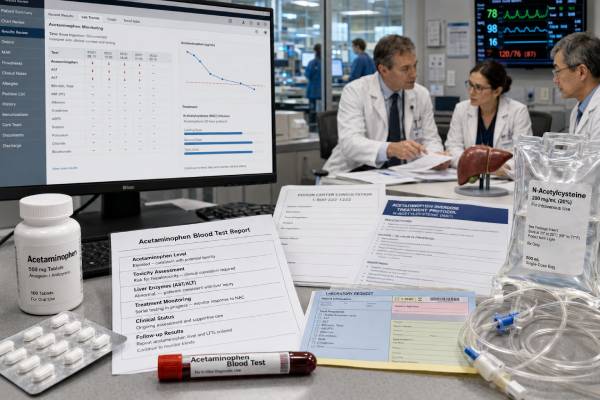
An acetaminophen blood test measures how much acetaminophen, also called paracetamol or APAP, is in the bloodstream. It is most often used after a possible overdose, because early symptoms can be mild even when liver injury is developing. The result is not read like a routine “normal versus abnormal” lab. It must be matched to the time the medicine was taken, the dose pattern, the formulation, and other liver and kidney tests.
This test helps clinicians decide whether treatment with N-acetylcysteine, often called NAC, is needed and whether it is working. A low or falling acetaminophen level can be reassuring in the right setting, but it does not always rule out risk if the timing is unknown, the overdose was repeated over many hours or days, or liver enzymes are already rising.
- An acetaminophen level is most useful 4 or more hours after a single overdose, because earlier levels may be too low before absorption is complete.
- A 4-hour level at or above about 150 mcg/mL, also written 150 mg/L, usually meets the treatment line for NAC in acute single-ingestion overdose assessment.
- A “normal” therapeutic level is not enough to judge safety after overdose; the same number can mean different things at 4, 12, or 24 hours after ingestion.
- ALT, AST, INR, bilirubin, creatinine, glucose, electrolytes, and acid-base markers help show whether the liver or kidneys are being injured.
- Seek urgent medical advice after any possible overdose, even if the person feels well, because serious liver injury often appears later.
Table of Contents
- What the Acetaminophen Blood Test Measures
- When and How the Test Is Done
- How Acetaminophen Results Are Interpreted
- Overdose Patterns That Change Interpretation
- Liver Damage Risk and Follow-Up Labs
- Treatment Monitoring and Recovery
- Common Mistakes and Next Steps
What the Acetaminophen Blood Test Measures
The acetaminophen blood test measures the concentration of acetaminophen in serum or plasma. Serum and plasma are the liquid parts of blood after cells are removed. Results are usually reported as mcg/mL or mg/L. These units are numerically the same: 150 mcg/mL equals 150 mg/L.
Acetaminophen is a widely used pain reliever and fever reducer. It is found in many single-ingredient products and combination medicines for colds, flu, headache, sinus symptoms, sleep, and prescription pain relief. The blood test becomes urgent when a person may have taken too much at once, taken too much over several doses, taken an unknown amount, or combined several products without realizing they all contained acetaminophen.
At usual doses, the body clears most acetaminophen through safe liver pathways. A small amount is changed into a toxic metabolite called NAPQI. Under normal conditions, glutathione helps neutralize NAPQI. In overdose, safe pathways become overwhelmed, glutathione stores fall, and NAPQI can injure liver cells.
The blood level does not directly measure liver damage. It measures exposure. Liver injury is checked with other tests, especially ALT and AST. This is why an acetaminophen result is often ordered with a liver function tests panel or a comprehensive metabolic panel.
Why timing matters more than a routine reference range
Many lab tests are compared with a reference interval. Acetaminophen overdose testing is different. A level that looks modest at one time point may be dangerous at another. For example, a level near the treatment line at 4 hours after ingestion is interpreted very differently from the same level 18 hours after ingestion.
Clinicians need three pieces of information whenever possible:
- The time the acetaminophen was first taken
- The amount taken and the product strength
- Whether it was immediate-release, extended-release, liquid, tablet, capsule, or a combination medicine
When the time is uncertain, clinicians usually interpret the case more cautiously rather than assuming the safest timeline.
When and How the Test Is Done
An acetaminophen level is commonly ordered in emergency care after a possible overdose, an intentional ingestion, an unclear medication exposure, or unexplained liver injury where acetaminophen could be involved. It is also often included when the history is incomplete, because people may not know that “APAP,” “paracetamol,” “acetaminophen,” and some brand-name products refer to the same ingredient.
For a single acute ingestion of immediate-release acetaminophen, the first useful level is usually drawn at 4 hours after ingestion. A level drawn earlier can detect whether acetaminophen is present, but it may not show the peak level yet. Food, delayed stomach emptying, opioids, anticholinergic medicines, and extended-release products can delay absorption.
If the person arrives more than 4 hours after ingestion, the level is usually drawn right away. If the level is above the treatment line, NAC is started or continued. If the ingestion was many hours earlier, the time is unclear, or the person has symptoms or abnormal liver tests, clinicians may start NAC before all results are back.
Other tests commonly ordered at the same time
The acetaminophen level answers one part of the problem: how much drug is still in the bloodstream. Other tests show whether the body is being harmed and whether complications are developing.
| Test | Why it is checked |
|---|---|
| ALT and AST | Liver cell injury; these may rise as hepatocytes are damaged |
| INR or PT | Liver synthetic function and bleeding risk; worsening INR can signal serious liver injury |
| Bilirubin | Bile processing and liver function; may rise later in severe injury |
| Creatinine and BUN | Kidney stress or acute kidney injury |
| Glucose | Low glucose can occur in severe liver failure |
| Electrolytes and bicarbonate | Metabolic disturbances, including acidosis |
| Lactate and blood gas | Severe poisoning, shock, or acute liver failure risk |
| Pregnancy test when relevant | Guides treatment and monitoring decisions |
| Salicylate or other drug levels | Checks for co-ingestions in intentional or unclear overdose |
When clinicians interpret an acetaminophen level and liver enzyme pattern, the trend often matters as much as the first result. A falling acetaminophen level is expected during treatment, but rising ALT, AST, or INR may show that liver injury is still unfolding.
How Acetaminophen Results Are Interpreted
Acetaminophen results are interpreted by matching the level to the time after ingestion. For a single acute oral ingestion with a known time, clinicians use the Rumack-Matthew nomogram or a revised version of it. The nomogram begins at 4 hours after ingestion and extends to 24 hours.
In the United States and Canada, a commonly used treatment line starts at 150 mcg/mL at 4 hours after ingestion. If the acetaminophen concentration falls on or above that line, treatment with NAC is recommended. A higher-risk line starts at 300 mcg/mL at 4 hours and signals a greater chance of liver injury and a need for specialist guidance.
These lines slope downward over time because acetaminophen should normally clear from the blood. A level that is below 150 mcg/mL at 4 hours may be reassuring in a clean, single, immediate-release ingestion with no risk factors and reliable timing. A level far below the treatment line at a later time can also be reassuring if liver tests are normal and the history fits. The same interpretation does not apply to repeated overdosing or unknown timing.
| Result pattern | Usual interpretation |
|---|---|
| Undetectable level 2 to 4 hours after ingestion | Often excludes a large ingestion, but clinical context still matters |
| Level below treatment line at 4 or more hours | Often lower risk after reliable single immediate-release ingestion |
| Level on or above treatment line | NAC treatment is usually indicated |
| Level near or above high-risk line | Higher concern; specialist toxicology input is usually needed |
| Detectable level with unknown ingestion time | Cannot be judged safely by the nomogram alone |
| Detectable level with high ALT or AST | Possible ongoing injury; treatment is usually considered or continued |
| Undetectable level with high ALT or AST | Late presentation is possible; acetaminophen may have cleared while liver injury remains |
Therapeutic, toxic, and dangerous levels
A therapeutic acetaminophen concentration after a recommended dose is often much lower than overdose treatment thresholds, but therapeutic ranges are not the main tool after overdose. A lab may list a therapeutic range around 10 to 30 mcg/mL, depending on timing and method. That range is useful for general context, not for clearing an overdose.
A toxic level depends on time. About 150 mcg/mL at 4 hours after acute ingestion is commonly used as the treatment threshold. At 8, 12, or 16 hours, the treatment threshold is much lower because the drug should be clearing. A late detectable level can be more concerning than it looks because it may mean delayed absorption, a large ingestion, slow clearance, or continued absorption from the gut.
Why the result can be low even when risk remains
A low acetaminophen level does not always mean the liver is safe. Several situations can make the level misleading:
- The sample was drawn too early, before the peak level.
- The person took extended-release acetaminophen.
- The person also took opioids or anticholinergic drugs that slowed stomach emptying.
- The overdose happened more than 24 hours ago and acetaminophen has already cleared.
- The person took repeated high doses over more than one day.
- The history of timing or dose is unreliable.
For this reason, doctors often combine the acetaminophen level with ALT, AST, INR, bilirubin, kidney function, symptoms, and the full medication history.
Overdose Patterns That Change Interpretation
A single overdose with a known time is the simplest pattern to interpret. The person took one large amount, the time is known, and a timed level can be plotted on the nomogram. Many real cases are less clean. People may take several doses over a day, use multiple products, take extended-release tablets, or arrive after the timing is uncertain.
Repeated supratherapeutic ingestion means taking too much acetaminophen over more than 24 hours. This may happen when someone is trying to control severe pain, fever, dental pain, back pain, migraine, or flu symptoms. It may also happen when a person takes a prescription pain medicine containing acetaminophen and also takes over-the-counter cold or pain products.
The nomogram is not used for repeated supratherapeutic ingestion. Instead, clinicians look at the total dose pattern, acetaminophen level, ALT, AST, INR, symptoms, and risk factors. A detectable acetaminophen level with abnormal liver enzymes is more concerning in this setting than a timed single-ingestion chart can show.
Immediate-release, extended-release, and delayed absorption
Immediate-release products usually absorb quickly enough that a 4-hour level is useful. Extended-release products can produce later peaks. In some cases, clinicians repeat the acetaminophen level several hours after the first one, especially if the first level is detectable but below the treatment line.
Delayed absorption can also occur when acetaminophen is taken with drugs that slow the gut, such as opioids or anticholinergic medicines. Some sleep, cold, allergy, nausea, and bladder medicines have anticholinergic effects. Large ingestions can also slow stomach emptying on their own.
Intentional overdose and co-ingestion
In intentional overdose, clinicians usually check for other drugs and complications even if acetaminophen is the main concern. Aspirin, sedatives, alcohol, opioids, antidepressants, antihistamines, and other substances can change symptoms, breathing, blood pressure, mental status, acid-base balance, and treatment priorities.
A broad toxicology blood test panel may be used when the exposure is unclear, but many drug screens do not reliably detect every possible medication. A negative screen does not replace a careful history, pill count, acetaminophen level, and targeted blood tests.
Liver Damage Risk and Follow-Up Labs
Acetaminophen can cause serious liver injury because the liver is where the drug is processed. In overdose, toxic metabolites can injure hepatocytes, the working cells of the liver. Early symptoms may be absent or nonspecific, which is why blood testing is so important.
The clinical course often develops over stages. During the first 24 hours, a person may feel normal or have nausea, vomiting, sweating, fatigue, or abdominal discomfort. From 24 to 72 hours, symptoms can improve while ALT and AST begin to rise. From 72 to 96 hours, severe cases may develop marked liver enzyme elevation, jaundice, confusion, bleeding problems, low blood sugar, kidney injury, and acidosis. Recovery can begin after several days if treatment is effective and liver failure does not progress.
ALT and AST show liver cell injury. INR shows whether the liver is still making clotting factors well. Bilirubin may rise when liver processing is impaired. Creatinine helps detect kidney injury, which can occur with severe acetaminophen poisoning, sometimes along with liver failure.
A rising ALT and AST pattern after acetaminophen exposure can suggest evolving liver injury even if the acetaminophen level is falling. In severe cases, albumin and INR interpretation helps separate liver cell irritation from impaired liver function.
Signs that need urgent medical attention
Medical care is urgent after any suspected overdose, not only after symptoms appear. Symptoms can lag behind injury. Immediate help is especially important with:
- Taking more than the recommended dose, even once
- Taking an unknown number of tablets or capsules
- Using several products that contain acetaminophen
- Vomiting repeatedly after an overdose
- Right upper belly pain
- Yellow skin or eyes
- Confusion, severe sleepiness, fainting, or seizure
- Trouble breathing or mixed-drug ingestion
- Intentional self-harm or uncertainty about intent
- Known liver disease, heavy alcohol use, fasting, malnutrition, or very low body weight
People should not wait for nausea, jaundice, or pain before seeking care. Treatment works best when started early.
Treatment Monitoring and Recovery
N-acetylcysteine is the antidote used for acetaminophen poisoning. NAC helps restore glutathione and supports safer handling of toxic acetaminophen metabolites. It can prevent or reduce liver injury when started early, and it may still help in late presentations or established liver injury.
Treatment may be oral or intravenous, depending on the setting, product availability, vomiting, mental status, pregnancy, severity, and local protocol. Emergency clinicians often start NAC while waiting for results if delaying treatment would push therapy beyond the safer early treatment window, especially when ingestion was more than 8 hours earlier, timing is unknown, or symptoms and abnormal labs suggest toxicity.
Monitoring during treatment usually includes repeated acetaminophen levels, ALT, AST, INR, bilirubin, creatinine, electrolytes, glucose, and sometimes lactate or blood gas testing. Clinicians want to see the acetaminophen level fall to undetectable or very low levels and liver tests stabilize or improve.
A patient may need longer treatment if acetaminophen remains detectable, ALT or AST is rising, INR is worsening, or there are signs of liver failure. NAC is not always stopped just because a preset number of hours has passed. Stopping decisions depend on the whole clinical picture.
Activated charcoal and other treatments
Activated charcoal may be considered soon after a potentially toxic ingestion if the person can safely take it and has no airway risk. It can reduce absorption from the gut, especially when given early. It is not a home remedy and should not be taken without medical direction in an overdose situation.
Severe cases may require intensive care. Doctors may treat low blood sugar, acidosis, abnormal electrolytes, kidney injury, bleeding risk, and brain swelling. Very high-risk cases may need consultation with a toxicologist, poison center, liver specialist, transplant center, or nephrologist. Dialysis is rarely needed but may be considered in selected massive ingestions with severe acidosis, altered mental status, or extremely high acetaminophen levels.
A kidney function blood test panel can be important during severe toxicity because kidney injury may develop along with liver injury or during multisystem illness.
What recovery usually looks like
If treatment starts early and liver injury is prevented, acetaminophen levels fall and follow-up labs remain normal. The person may be discharged after observation, repeat labs, mental health assessment when needed, and safety counseling.
If liver enzymes rise but liver function remains stable, recovery may take days to weeks. ALT and AST can become very high in acetaminophen injury and still improve with treatment if INR, mental status, lactate, glucose, kidney function, and overall condition remain stable.
Acute acetaminophen toxicity does not usually cause chronic cirrhosis after full recovery. The liver can regenerate after an acute injury. However, severe acute liver failure can be life-threatening and may require transplant evaluation.
Common Mistakes and Next Steps
The most common mistake is treating acetaminophen as one product instead of one ingredient that appears in many products. A person might take a cold medicine, a headache medicine, and a prescription pain pill without realizing all three contain acetaminophen. Labels may use APAP, paracetamol, or acetaminophen.
Another mistake is waiting for symptoms. Feeling well during the first day does not prove safety. Early acetaminophen toxicity can be quiet while the liver is still processing the overdose. Blood testing is needed because the treatment decision is time-sensitive.
A third mistake is using the adult maximum daily dose as a personal target. Many labels list up to 4,000 mg per day for adults, but some people are advised to use less, especially with liver disease, regular heavy alcohol use, low body weight, older age, poor nutrition, or interacting medicines. Children’s dosing must be based on weight and the exact product concentration.
People also confuse milligrams and milliliters. Liquid acetaminophen doses should be measured with the dosing device that comes with the product. Kitchen spoons are not reliable. Infants, children, and older adults are especially vulnerable to dosing errors.
How to prepare for a medical visit after possible overdose
Bring the medication containers, blister packs, bottles, or photos of labels. If possible, write down the time each dose was taken, the strength of each product, the number of pills or amount of liquid, and whether alcohol or other medicines were involved.
Helpful details include:
- Product name and strength, such as 325 mg, 500 mg, 650 mg extended-release, or liquid concentration
- Number of tablets, capsules, packets, or milliliters taken
- Earliest and latest possible ingestion time
- Whether any doses were vomited
- Other medicines, alcohol, supplements, or recreational substances
- Liver disease, kidney disease, pregnancy, fasting, eating disorder, or heavy alcohol use
- Whether the ingestion was accidental, intentional, or uncertain
For ongoing prescription medicine monitoring, acetaminophen testing is different from routine therapeutic drug monitoring. The main question is usually overdose risk and liver safety, not whether a steady daily dose is in a desired range.
Prevention after recovery
Prevention focuses on ingredient awareness and dose tracking. Check every label for acetaminophen, APAP, or paracetamol. Avoid taking more than one acetaminophen-containing product unless a clinician specifically approves it. Use a written medication list, especially after surgery, dental work, injuries, infections, or when taking cough and cold medicines.
Store acetaminophen out of sight and reach of children. Keep medicines in original containers when possible. Avoid mixing pills in unmarked bottles. For liquid products, use the provided dosing syringe or cup and confirm the concentration before each dose.
After intentional overdose, medical care should include mental health assessment and a safety plan. After accidental overdose, the follow-up conversation should focus on how the dosing error happened, because preventing a repeat event is as important as treating the first one.
References
- Management of Acetaminophen Poisoning in the US and Canada: A Consensus Statement 2023 (Consensus Statement)
- Acetaminophen Toxicity 2026 (Review)
- Acetaminophen Poisoning 2025 (Clinical Reference)
- Acetaminophen 2025 (Official Patient Drug Information)
- Interventions for paracetamol (acetaminophen) overdose 2018 (Systematic Review)
Disclaimer
This article is for general education and is not a substitute for emergency care, poison center guidance, or advice from a licensed clinician. Acetaminophen overdose can be serious even when symptoms are mild or absent. After any possible overdose, medication mix-up, intentional ingestion, or uncertain dose, seek urgent medical advice right away.