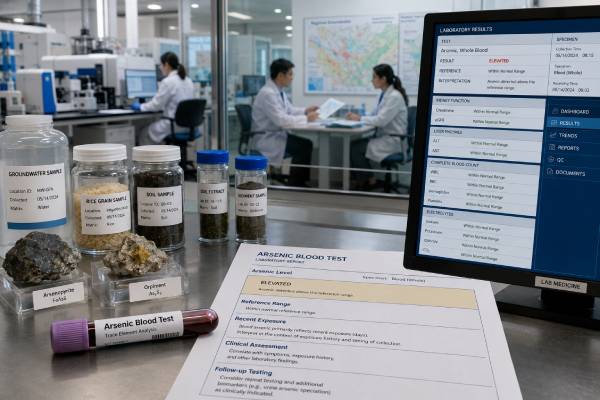
An arsenic blood test measures the amount of arsenic circulating in the blood at the time the sample is taken. It can help when a recent or severe exposure is suspected, but it is not the best test for every arsenic concern. Arsenic leaves the bloodstream quickly and moves into tissues or is excreted in urine, so a normal blood result does not always rule out exposure that happened days or weeks earlier. Urine testing, especially speciated urine testing, is often more useful for recent non-emergency exposure because it can separate more toxic inorganic arsenic from less harmful organic arsenic found in seafood. Blood results still matter when symptoms are acute, exposure was very recent, or a clinician needs rapid toxicology information. Interpreting the number requires context: symptoms, timing, source of exposure, seafood intake, kidney function, and the lab’s own reference range all affect what the result means.
- An arsenic blood test mainly reflects very recent exposure, not long-term body burden.
- A common blood reference range is often less than about 13 mcg/L, but the range can vary by laboratory.
- High arsenic in blood can occur after poisoning, workplace exposure, contaminated water, contaminated products, or recent seafood intake.
- Urine arsenic testing is usually preferred for exposure over the past few days, especially when the test is speciated.
- Severe vomiting, watery diarrhea, confusion, fainting, abnormal heartbeat, or shock after possible arsenic exposure needs urgent medical care.
- Seafood can raise total arsenic results, so many clinicians advise avoiding seafood for 48–72 hours before non-urgent testing.
Table of Contents
- What an Arsenic Blood Test Measures
- Normal Range and High Arsenic Results
- Blood, Urine, Hair, and Nail Testing
- Poisoning Symptoms and Urgent Warning Signs
- Common Causes of High Arsenic
- Preparation, Collection, and False Highs
- Follow-Up, Treatment, and Exposure Reduction
- How Results Fit With Other Tests
What an Arsenic Blood Test Measures
An arsenic blood test measures arsenic in a blood sample, usually reported in micrograms per liter (mcg/L) or nanograms per milliliter (ng/mL). These units are numerically equivalent: 1 mcg/L equals 1 ng/mL. The test may be ordered alone or as part of a heavy metals blood test panel that also checks metals such as lead, mercury, and cadmium.
Arsenic is a naturally occurring metalloid found in soil, rock, groundwater, some foods, and some industrial materials. The most important distinction is between inorganic and organic arsenic. Inorganic arsenic, often found in contaminated groundwater and certain occupational settings, is the more toxic form. Organic arsenic compounds, especially arsenobetaine from seafood, are usually much less toxic and can pass through the body quickly.
Blood testing does not always tell the full story because arsenic does not stay in blood for long. After absorption, arsenic circulates briefly, distributes into tissues, and is processed into metabolites that leave the body mainly through urine. That is why a blood test is most helpful when exposure happened recently, symptoms are active, or a clinician is evaluating possible acute poisoning.
A blood arsenic result can help answer questions such as:
- Was there a recent high-level exposure?
- Is arsenic present at a level above the lab’s expected range?
- Does the result fit the person’s symptoms and exposure history?
- Should urine speciation or environmental testing be done next?
- Is urgent toxicology consultation needed?
It should not be used as a stand-alone diagnosis. A high value may show exposure, but poisoning is diagnosed by combining the test result with symptoms, timing, exposure source, and sometimes repeat or different specimen testing. A normal value is reassuring only when the timing fits. If exposure happened several days ago, urine may be more informative than blood.
Normal Range and High Arsenic Results
A typical arsenic blood reference range is often reported as less than about 13 mcg/L, sometimes shown as less than 13 ng/mL. Some laboratories use slightly different cutoffs, units, specimen types, or reporting formats, so the reference interval printed on the actual lab report is the range to use.
“Normal range” does not mean “zero arsenic.” Small amounts may be measurable because arsenic is present in the environment and diet. The more important question is whether the level is higher than expected for the person’s situation and whether it matches a credible exposure or symptoms.
| Result pattern | Possible meaning | Common next step |
|---|---|---|
| Within the lab’s reference range | No clear evidence of elevated blood arsenic at the time of collection | Consider urine testing if exposure happened days earlier or symptoms continue |
| Mildly above range | Recent exposure, seafood effect, lab variation, or contamination may be possible | Review seafood intake, exposure sources, and consider repeat or speciated urine testing |
| Clearly elevated | Recent significant exposure becomes more likely, especially with compatible symptoms | Contact a clinician, poison center, or occupational/environmental medicine specialist |
| Elevated with acute illness | Possible arsenic poisoning or another urgent toxic exposure | Seek emergency evaluation; treatment is based on symptoms and toxicology guidance |
A high blood arsenic level does not identify the source by itself. It may come from contaminated water, certain foods, occupational exposure, old pesticides, treated wood dust, industrial processes, or contaminated supplements. It also does not prove that symptoms are caused by arsenic. Gastrointestinal illness, neuropathy, anemia, kidney problems, and heart rhythm symptoms have many possible causes.
The timing of the test is crucial. Blood is a short-window test. A person can have a normal blood arsenic result after a meaningful exposure if enough time has passed for arsenic to leave the bloodstream. In that situation, a clinician may order urine arsenic testing, ideally with arsenic speciation, to look for inorganic arsenic and its metabolites.
Very high arsenic levels are interpreted urgently when they appear with sudden vomiting, severe diarrhea, dehydration, low blood pressure, confusion, fainting, or abnormal heart rhythm. In that setting, the person needs medical assessment rather than home interpretation of the lab number.
Blood, Urine, Hair, and Nail Testing
Blood, urine, hair, and nail tests can all measure arsenic, but they answer different questions. Choosing the wrong test can lead to confusion, especially when exposure did not happen immediately before the sample was collected.
Blood is most useful for very recent exposure. It can support evaluation of acute poisoning, but arsenic clears from blood quickly. For many outpatient concerns, such as “I may have arsenic in my well water” or “I was exposed sometime this week,” urine is often the more useful test.
Urine arsenic testing usually reflects exposure over the past few days. A 24-hour urine collection can be helpful because it measures total excretion over a full day, but a spot urine sample may also be used in some situations, often with creatinine correction. Speciated urine arsenic is especially important because it separates inorganic arsenic and its metabolites from organic arsenic from seafood. A related comparison is covered in arsenic blood test vs urine test.
Hair and nail testing can reflect exposure over a longer period, often weeks to months, because arsenic can bind to keratin. These tests may help in selected occupational, environmental, or forensic questions. They are not usually the first choice for routine medical diagnosis because external contamination can be hard to separate from arsenic absorbed into the body. Hair products, dust, soil, water, and workplace residues can affect results.
| Test type | Best use | Main limitation |
|---|---|---|
| Blood arsenic | Very recent or severe exposure | Short detection window |
| Total urine arsenic | Recent exposure over the past few days | Seafood can raise total arsenic |
| Speciated urine arsenic | Distinguishing inorganic arsenic from organic seafood arsenic | May not be available in every lab |
| Hair arsenic | Possible longer-term exposure pattern | External contamination is common |
| Nail arsenic | Selected chronic or forensic questions | Timing and contamination can be difficult to interpret |
The best testing plan depends on the story. A person with sudden severe symptoms after a suspected poisoning needs emergency care and may have blood and urine collected quickly. A person with a private well concern may need water testing plus urine speciation. A worker with repeated exposure may need occupational health testing that follows workplace protocols.
Poisoning Symptoms and Urgent Warning Signs
Arsenic poisoning can be acute, chronic, or a mix of both. Acute poisoning happens after a large exposure over a short time. Chronic toxicity develops after repeated exposure, often through drinking water, workplace inhalation, or contaminated products.
Acute arsenic poisoning often begins with gastrointestinal symptoms. Vomiting, abdominal pain, and severe watery diarrhea can appear early. Diarrhea may become bloody. Fluid loss can cause dehydration, dizziness, low blood pressure, fainting, and shock. Some people develop abnormal heart rhythms, confusion, seizures, or multi-organ injury.
Urgent medical care is needed if possible arsenic exposure is followed by:
- Repeated vomiting or severe diarrhea
- Fainting, collapse, or signs of shock
- Confusion, extreme weakness, seizure, or severe drowsiness
- Chest pain, palpitations, or irregular heartbeat
- Severe dehydration or inability to keep fluids down
- Bloody diarrhea
- Exposure in a child, pregnant person, or medically fragile adult
Chronic arsenic toxicity can look different. Skin findings are classic but may take years to appear. These can include darkened patches of skin, lighter spots mixed with darker pigmentation, and thickened rough skin on the palms or soles, called hyperkeratosis. Numbness, tingling, burning pain, or weakness can occur when peripheral nerves are affected.
Long-term inorganic arsenic exposure has been linked with higher risks of skin, bladder, and lung cancers. It has also been associated with cardiovascular disease, diabetes, developmental effects, and pregnancy-related harms. These risks are most concerning with repeated or long-term exposure, especially from contaminated water.
Some symptoms overlap with other toxicology and blood-test patterns. For example, fatigue, pallor, neuropathy, or abnormal blood counts may lead a clinician to order a complete blood count, lead testing, kidney tests, or liver tests. Arsenic is only one possible explanation, so the workup should stay broad when symptoms are not specific.
Common Causes of High Arsenic
A high arsenic result is not a diagnosis by itself. It is a clue that should lead to a careful search for the exposure source. Finding and stopping the source is often the most important step.
Contaminated groundwater is one of the most important sources of inorganic arsenic worldwide. Private wells can be affected even when the water looks, smells, and tastes normal. Arsenic has no reliable taste or odor at harmful levels. Public water systems in the United States must follow arsenic standards, but private well owners usually need to arrange their own testing.
Food can contribute to arsenic exposure. Rice may contain inorganic arsenic because rice plants can take up arsenic from soil and water. Some fruit juices, seaweed products, and foods grown or processed with contaminated water may also contribute. Seafood is a special case because it often contains organic arsenic forms that are much less toxic, but they can raise total arsenic test results.
Workplace exposure may occur in industries involving smelting, mining, pesticides, pressure-treated wood, glass manufacturing, semiconductor materials, pigments, or metal processing. Workers may inhale arsenic-containing dust or fumes or bring contaminated dust home on clothing, shoes, tools, or vehicles.
Other possible sources include:
- Old pesticides or herbicides stored in sheds, farms, or industrial sites
- Dust from older chromated copper arsenate treated wood
- Contaminated soil near mining, smelting, or industrial waste sites
- Some imported traditional medicines, folk remedies, cosmetics, or supplements
- Tobacco smoke, which can contain inorganic arsenic from soil uptake
- Accidental or intentional poisoning
Testing other toxic metals may be reasonable when the source is unclear. For example, contaminated products or industrial exposure can involve more than one metal, so clinicians may also consider a blood lead test, mercury testing, or cadmium blood testing depending on the exposure history.
Preparation, Collection, and False Highs
Accurate arsenic testing starts before the sample reaches the lab. Trace metal testing measures very small amounts, so contamination, timing, and diet can change the result.
For non-urgent arsenic testing, many clinicians recommend avoiding seafood for 48–72 hours before collection. Seafood can contain organic arsenic, especially arsenobetaine, which may raise total arsenic in blood or urine without indicating dangerous inorganic arsenic exposure. If the test was done soon after seafood, a clinician may repeat testing or order arsenic speciation.
Tell the clinician or laboratory about:
- Fish, shellfish, seaweed, or kelp eaten in the past few days
- Occupational exposure to metals, dust, fumes, pesticides, or treated wood
- Private well use or recent travel to an area with known groundwater contamination
- Supplements, traditional remedies, imported products, or unusual foods
- Recent imaging contrast or medical procedures, if the lab asks about them
- Kidney disease, because arsenic metabolites leave mainly through urine
Blood for trace metals is usually collected in special tubes designed to reduce contamination. The collection site, needle, tube, and handling process all matter. Samples should be collected away from the suspected exposure area when possible. For example, a worker should not have a sample collected in a dusty work zone where arsenic-containing particles could contaminate the outside of the tube or the skin.
A false high or misleading result can happen when the sample is contaminated, the wrong specimen type is used, the person recently ate seafood, or total arsenic is measured without speciation. A misleading normal result can happen when blood is tested too late after exposure. That is why timing belongs on the lab interpretation, not just the number.
Do not start chelation or detox supplements before medical evaluation. Chelation can change test results, cause side effects, and remove essential minerals. Over-the-counter “heavy metal detox” products may also create confusion because some are poorly regulated and may contain contaminants themselves.
Follow-Up, Treatment, and Exposure Reduction
Follow-up depends on how high the result is, whether symptoms are present, and whether the exposure source is ongoing. The first step is usually to match the result to the timeline. A high blood arsenic result shortly after a suspected exposure is more concerning than a borderline result after seafood. A normal blood result several days after a suspected exposure may need urine testing rather than simple reassurance.
Clinicians may order:
- Speciated urine arsenic to separate inorganic-related arsenic from seafood-related organic arsenic
- Repeat blood or urine testing if timing or contamination is uncertain
- Kidney and liver function tests
- Electrolytes if vomiting, diarrhea, dehydration, or heart rhythm symptoms are present
- A CBC if anemia, infection-like symptoms, or unexplained fatigue is present
- ECG monitoring if acute poisoning or arrhythmia risk is suspected
- Environmental testing of well water, workplace materials, dust, soil, or products
Treatment starts with stopping exposure. For private well water, that may mean using bottled water or a verified low-arsenic source for drinking and cooking until the well is tested and treated. Boiling water does not remove arsenic and can concentrate it as water evaporates. Effective water treatment may require reverse osmosis, distillation, activated alumina, iron-based adsorption, or other systems specifically rated for arsenic removal. The system must be maintained and retested.
In acute poisoning, care may include IV fluids, correction of electrolytes, cardiac monitoring, treatment of shock, and consultation with poison control or a medical toxicologist. Chelation may be considered for significant poisoning, but the choice of agent and timing depends on the person’s condition, arsenic form, severity, and local toxicology guidance. Chelation is not a casual wellness treatment. It can cause harm when used without a clear diagnosis and proper monitoring.
For chronic exposure, the main intervention is reducing or eliminating the source. Skin, nerve, cardiovascular, kidney, liver, and cancer-related risks may require longer-term follow-up. People with occupational exposure may need workplace evaluation, personal protective equipment review, industrial hygiene testing, and repeat biological monitoring.
How Results Fit With Other Tests
Arsenic results are strongest when interpreted with other findings. A single number rarely answers every question. The right follow-up tests depend on whether the concern is acute poisoning, chronic exposure, workplace monitoring, or unexplained symptoms.
A comprehensive metabolic panel can help assess kidney function, liver enzymes, electrolytes, and acid-base clues. This matters because severe vomiting and diarrhea can disturb sodium, potassium, bicarbonate, and kidney function. A CMP blood test may also reveal liver or kidney stress that needs attention during an acute illness.
Kidney testing is important because arsenic and its metabolites are excreted mainly in urine. If kidney function is reduced, urine results and clearance may be harder to interpret. A kidney function blood test panel can help show whether dehydration, kidney injury, or chronic kidney disease is present.
A CBC may be ordered when symptoms include fatigue, weakness, pallor, infection-like illness, or concern for bone marrow effects. While arsenic is not the most common cause of abnormal blood counts, toxic exposures can overlap with anemia, inflammation, nutritional problems, or other disorders.
Other heavy metal tests may be useful when the exposure source is unknown. Lead, mercury, cadmium, and arsenic can appear in the same broad toxicology evaluation, but each metal has different best specimens and time windows. For example, mercury interpretation can depend on whether the concern is elemental, inorganic, or methylmercury exposure, which is why comparisons such as mercury blood test vs hair test require a different framework than arsenic.
The most useful interpretation usually answers four questions:
- Does the result fit the timing of exposure?
- Does the result fit the person’s symptoms?
- Could seafood, contamination, or the wrong specimen explain the result?
- Has the exposure source been found and removed?
When those questions are answered, the lab result becomes more useful. It can guide medical care, environmental testing, workplace changes, and follow-up monitoring instead of creating confusion around a single number.
References
- Arsenic 2022 (Fact Sheet)
- Chemical Contaminant Rules 2026 (Regulatory Summary)
- Heavy Metal Blood Test 2025 (Medical Test)
- Heavy Metals 2024 (Review)
- Biomonitoring Summary 2012 (Biomonitoring Summary)
- Toxicological Profile for Arsenic 2007 (Toxicological Profile)
Disclaimer
Arsenic poisoning can be serious and sometimes life-threatening. This information is for general education and cannot diagnose poisoning, identify an exposure source, or replace care from a clinician, poison center, occupational medicine specialist, or medical toxicologist. Seek urgent medical care for severe symptoms after possible arsenic exposure.