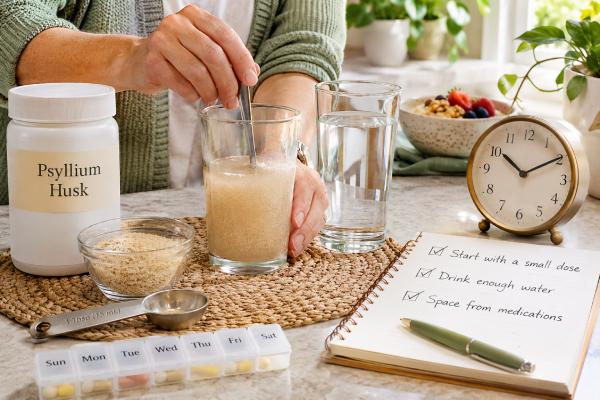
There is no proven “best” clock time to take psyllium for lowering cholesterol. Morning, afternoon, and evening can all work. What matters most is taking an effective daily amount consistently, mixing it with enough fluid, and choosing a schedule that does not interfere with medications. For many people, splitting psyllium into two doses—such as breakfast and dinner—is easier on the stomach than taking the full amount at once.
Psyllium is a viscous soluble fiber that forms a gel in the digestive tract. Regular use can modestly lower LDL cholesterol, and recent randomized-trial meta-analyses support doses around 7 to 10 g of psyllium or psyllium-derived soluble fiber per day for many adults. Bloating is common when people start too fast, take large doses immediately, or add psyllium on top of an already high-fiber diet without adjustment. The best routine is therefore less about a perfect hour and more about repeatability: start low, increase gradually, drink it promptly with plenty of water, and separate it from medications when needed.
Table of Contents
- Is Morning or Night Better for Cholesterol?
- Should You Take Psyllium With Food or on an Empty Stomach?
- A Practical Psyllium Schedule for LDL Lowering
- How to Avoid Gas, Bloating, and Cramping
- How to Time Psyllium Around Medications
- When Psyllium Timing Needs Extra Caution
- How to Know Whether Your Routine Is Working
Is Morning or Night Better for Cholesterol?
For cholesterol lowering, there is no good evidence that morning is better than night or that night is better than morning. Clinical studies of psyllium focus mainly on daily dose, duration, and lipid changes, not on comparing 8 a.m. with 8 p.m.
That is important because supplement marketing often turns routine questions into false precision. Psyllium does not behave like a medication whose effect depends on a narrow dosing window. Its LDL-lowering action comes from regular exposure of the digestive tract to viscous soluble fiber, which increases bile-acid loss and alters cholesterol metabolism over time.
A person who reliably takes 5 g with breakfast and 5 g with dinner is likely to get more benefit than someone who aims for a supposedly “optimal” time but skips doses several days a week.
The best time is therefore the time that meets four conditions:
- you remember it consistently;
- you can drink enough fluid with it;
- it does not cause uncomfortable fullness around exercise or sleep;
- it can be separated appropriately from medications and supplements.
Morning works well for people with a predictable breakfast routine. Evening works well for people who remember supplements with dinner. Splitting the dose between morning and evening often improves tolerance.
If you want the broader evidence on how much psyllium can lower LDL, see psyllium husk for cholesterol.
Should You Take Psyllium With Food or on an Empty Stomach?
Psyllium can be taken with or around meals. There is no requirement to take it on an empty stomach for cholesterol lowering.
Taking psyllium before or with a meal may be useful for people who also want more fullness or a smaller post-meal glucose rise. Because psyllium forms a viscous gel, it can slow digestion and carbohydrate absorption. A 2024 meta-analysis of randomized trials found improvements in fasting glucose, HbA1c, and insulin resistance measures in adults, although the studies varied in population and dose.
For someone using psyllium mainly for LDL cholesterol, meal timing is optional. You can choose whichever schedule causes the fewest side effects and is easiest to maintain.
There are a few practical differences:
Before a meal: May increase fullness, which can be helpful for appetite control. Some people dislike feeling too full before eating.
With a meal: Easy to remember and may fit well with cholesterol and glucose goals. You still need to mix psyllium in liquid and drink it promptly rather than stirring it into a meal and letting it become extremely thick.
Between meals: Often convenient if meals are already busy or medication timing requires separation.
Close to bedtime: Can be fine if you tolerate it, but do not take it with minimal water simply because you do not want to drink before sleep. Adequate fluid is a safety requirement.
If you experience reflux, uncomfortable fullness, or bloating when taking it late, move the dose earlier. There is no cholesterol penalty for doing so.
A Practical Psyllium Schedule for LDL Lowering
A common evidence-based target is around 7 to 10 g per day, often divided into two or three doses. The exact amount depends on the product and how many grams of actual psyllium each serving contains.
Do not confuse “grams of powder” with “grams of psyllium.” A flavored product may contain 7 or 12 g of total powder but only about 3.4 g of psyllium husk. Capsules may contain around half a gram each, meaning several capsules are needed to equal one powder serving.
Here are three workable schedules:
| Schedule | Example | Best for |
|---|---|---|
| Twice daily | About 3.5–5 g with breakfast and dinner | Most people; balances convenience and tolerance |
| Three times daily | About 3–3.5 g with three meals | People who prefer smaller doses or want meal-related fullness |
| Once daily | A smaller daily dose taken consistently | Beginners or people who cannot tolerate multiple doses yet |
If your goal is 10 g/day, you do not have to reach it on day one. A better progression is to start with about 3 to 3.5 g once daily, stay there for several days, then add a second dose if your stomach feels comfortable.
For example:
- Days 1–4: one dose after breakfast.
- Days 5–8: one dose after breakfast and one after dinner.
- After the first week: adjust toward the product-specific target only if needed and tolerated.
This gradual method often prevents the “I tried psyllium and it made me miserable” problem that happens when someone jumps from very little fiber to a large amount overnight.
Consistency matters more than exact spacing. If breakfast and dinner are 10 hours apart one day and 12 hours apart the next, that is not a problem for cholesterol.
If you already use oats, beans, barley, and other viscous fibers, you may not need the maximum supplement dose. A broader soluble-fiber stack with oats, psyllium, and legumes can help you distribute fiber across food and supplements.
What about taking psyllium before your largest meal?
Some people prefer taking psyllium before the meal that contains the most saturated fat or carbohydrate, hoping to maximize its effect. That strategy is reasonable for convenience, but it has not been proven superior for LDL lowering. Psyllium’s cholesterol benefit comes from repeated daily effects on bile-acid handling and the overall diet, not from “blocking” cholesterol from one specific meal.
If your largest meal is dinner, an evening dose may fit naturally. If breakfast is your most consistent meal, morning may be better because you are less likely to forget it. The routine should serve adherence rather than create an unnecessary rule.
People who take psyllium for both cholesterol and appetite control may find 15 to 30 minutes before a meal comfortable, while others feel overly full or bloated with that timing. There is no need to force pre-meal use if taking it during or after a meal feels better.
What if you miss a dose?
Do not double the next dose to “catch up.” Resume the normal schedule. Missing an occasional dose is unlikely to erase the benefit of an otherwise consistent routine, while doubling can increase bloating, cramping, and stool changes.
If you routinely forget one of two daily doses, simplify the routine rather than relying on willpower. Put the container where you eat breakfast, use a phone reminder, or pair the dose with a stable habit. A slightly lower dose taken reliably is usually more useful than an ambitious schedule followed inconsistently.
How to Avoid Gas, Bloating, and Cramping
Bloating is the main reason people give up on psyllium. It is usually a dose-management problem, not proof that psyllium is inherently intolerable.
Start lower than the full target
If you currently eat little fiber, your gut is not accustomed to a sudden large increase. Start with one small serving and wait several days before adding more.
A slower increase is especially helpful if you already have irritable bowel symptoms or a sensitive stomach.
Split the dose
Taking 10 g at once creates more bulk and may feel uncomfortable. Two 5 g doses or three smaller doses are often easier to tolerate.
There is no reason to force a single large dose for cholesterol. The daily total is what matters most.
Use enough water
Psyllium needs liquid to form a safe gel and move through the digestive tract. Many OTC labels direct users to mix one dose in at least 8 ounces, or about 240 mL, of water.
Stir and drink promptly. If you leave psyllium sitting in the glass, it can become very thick and unpleasant to swallow.
Do not take dry powder directly into the mouth and chase it with water. Current labeling warns that inadequate fluid can allow psyllium to swell in the throat or esophagus and cause choking.
Count the fiber you already eat
If you suddenly add psyllium while also increasing beans, oats, chia, vegetables, and high-fiber cereal, the total jump may be too much at once.
Increase one or two sources first, let your gut adapt, then add more. The goal is a sustainable fiber intake, not a one-week fiber challenge.
Adjust timing around exercise
A large psyllium dose immediately before running, cycling, or a hard gym session may cause fullness or urgency. If that happens, take it after training or several hours earlier.
Use plain products when additives are a problem
Some flavored fiber powders contain sugar alcohols, artificial sweeteners, or other ingredients that can contribute to gas. If bloating persists despite a low dose, try a simpler product before deciding psyllium itself is the cause.
If you want to increase fiber from food as well, oats for lowering LDL are an easy complementary source that many people tolerate well.
How to Time Psyllium Around Medications
Medication timing is the strongest reason not to choose psyllium timing randomly.
Because psyllium forms a gel and changes intestinal transit, it can alter the absorption of some oral medications and supplements. There is no single spacing rule that is correct for every drug.
A common practical approach is to keep psyllium at least two hours away from oral medications, but some drugs may require a longer interval. The correct spacing depends on the specific medication, formulation, and prescribing information.
That is why a pharmacist is the best person to ask. Bring the psyllium label and your full medication list. The answer is often simple once the exact drugs are known.
Do not stop a prescription medication simply because psyllium makes the schedule inconvenient. Move the fiber instead.
For example, if you take several important medications with breakfast, you might place psyllium mid-morning and after dinner. If you take a bedtime medication that needs an empty stomach, take the evening psyllium earlier.
This matters particularly for medications with narrow therapeutic windows or absorption requirements. The same caution applies to some minerals and supplements.
If you use cholesterol-lowering medication, psyllium can often be used alongside it, but the schedule should still protect drug absorption. Psyllium is an add-on, not a replacement for a statin or other prescribed therapy when medication is needed.
When Psyllium Timing Needs Extra Caution
Some people should focus on safety before trying to optimize timing.
Difficulty swallowing: Do not use psyllium without medical guidance if you have swallowing problems. Its ability to swell makes it risky in people who cannot safely move the mixture through the esophagus.
Known gastrointestinal narrowing or obstruction: Psyllium adds bulk and can worsen a blockage. Severe abdominal pain, vomiting, or inability to pass stool or gas needs medical evaluation.
Persistent constipation or rectal bleeding: These symptoms should not be treated indefinitely by escalating fiber without finding the cause.
Diabetes treated with medication: Psyllium may improve post-meal and fasting glucose, so people using glucose-lowering drugs should monitor as advised. The fiber is not a substitute for medication, but improved glucose control can change treatment needs over time.
Kidney disease or heart failure: Plain psyllium itself is mostly fiber, but flavored powders can contain sodium, potassium, or sugars. Fluid instructions may also conflict with a strict fluid restriction. Ask your clinical team before using large doses.
Pregnancy: Psyllium is commonly used as a bulk-forming fiber, but medication timing, hydration, and bowel symptoms still deserve individualized guidance.
Seek urgent medical attention if you develop chest pain, vomiting, difficulty swallowing, or trouble breathing after taking psyllium. Those symptoms may indicate choking or obstruction and should not be managed by drinking more fiber mixture at home.
How to Know Whether Your Routine Is Working
For cholesterol, judge psyllium over weeks, not days. Many trials last six weeks or longer, and lipid changes are usually modest.
A practical evaluation is to keep your routine stable for about 6 to 12 weeks, then recheck lipids if that fits your healthcare plan. During that period, track the daily grams of psyllium and any major dietary changes.
Do not overinterpret day-to-day scale weight or bowel changes as signs that LDL is falling. Psyllium can change stool bulk and temporary water balance without telling you anything about cholesterol.
Your routine is working well if:
- you can take the planned dose most days;
- bloating is mild or absent;
- bowel habits are comfortable;
- the schedule does not interfere with medications;
- the rest of your diet remains balanced;
- follow-up LDL moves in the desired direction.
If bloating remains significant after reducing the dose, changing the product, and spacing doses, you do not have to force psyllium. Other viscous fibers from oats and barley, plus legumes and a lower-saturated-fat diet, can still support LDL reduction.
If LDL remains very high despite a strong diet and fiber intake, the next step is not necessarily more psyllium. Some people need medication because genetics and baseline risk have a much larger effect than diet alone. Review causes and treatment of high LDL if your numbers stay elevated despite consistent habits.
The best psyllium timing is therefore the schedule you can safely repeat. For most people, that means one or two modest doses tied to meals or another daily routine, plenty of water, gradual dose increases, and enough distance from medications. There is no bonus for taking it at sunrise or bedtime if the routine causes side effects or missed doses. Keep the container dry, measure each serving consistently, and follow the product directions because powder density and serving size vary between brands. Those small practical details make long-term use safer, easier to evaluate, and much easier to maintain consistently over many months reliably.
When testing a schedule, change one variable at a time. Keep the dose steady for several days before shifting it from morning to evening, and avoid simultaneously changing several other fiber foods. That makes it easier to tell whether bloating comes from the timing, the dose, or a broader increase in fermentable carbohydrates. A short log of dose, time, water intake, bowel comfort, and medication spacing can be more useful than searching for a universally “best” hour. The goal is a routine that works reliably in your real day, not a theoretically perfect schedule that you often skip.
References
- Psyllium supplementation and lipid profiles: systematic review and dose-response meta-analysis of randomized controlled trials 2025 (Systematic Review)
- Plantago consumption significantly reduces total cholesterol and low-density lipoprotein cholesterol in adults: A systematic review and meta-analysis 2024 (Systematic Review)
- The effect of psyllium on fasting blood sugar, HbA1c, HOMA IR, and insulin control: a GRADE-assessed systematic review and meta-analysis of randomized controlled trials 2024 (Systematic Review)
- DailyMed – METAMUCIL THERAPY FOR REGULARITY- psyllium husk powder 2026
- Authorized Health Claims That Meet the Significant Scientific Agreement (SSA) Standard 2024
Disclaimer
This article provides general education and does not replace individualized medical advice. Ask a healthcare professional before using psyllium if you have swallowing difficulty, bowel obstruction or narrowing, significant gastrointestinal disease, kidney disease, heart failure, diabetes treated with medication, or prescriptions that may be affected by fiber. Seek urgent care for trouble swallowing or breathing after taking psyllium.