Psyllium husk is one of the better-supported fiber supplements for lowering LDL cholesterol. It is a viscous soluble fiber from the seed husk of Plantago ovata. When mixed with liquid, it forms a gel that can trap bile acids in the digestive tract. The liver then uses more circulating cholesterol to make new bile acids, which can help lower LDL over time. Recent randomized-trial meta-analyses find average LDL reductions of roughly 8 to 14 mg/dL, although response varies by dose, baseline cholesterol, and diet.
A common evidence-based amount is about 10 g of psyllium husk per day, often divided into two or three doses. That is different from the total weight of a flavored powder: check how many grams of actual psyllium each serving provides. Water matters just as much as dose because psyllium swells rapidly. Starting too high can cause gas, bloating, or cramping, while taking it with too little liquid can create a choking risk. Psyllium can support cholesterol management, but it does not replace statins or other prescribed treatment when medication is indicated.
Table of Contents
- How Psyllium Lowers LDL Cholesterol
- How Much Psyllium to Take for Cholesterol
- How Fast Psyllium Works
- How to Take Psyllium Safely
- Side Effects and Who Should Be Careful
- Psyllium Versus Food Sources of Soluble Fiber
- How to Use Psyllium in a Cholesterol-Lowering Plan
How Psyllium Lowers LDL Cholesterol
Psyllium is not simply “roughage.” Its cholesterol effect comes mainly from being viscous soluble fiber. When it absorbs water, it creates a thick gel in the intestine. That gel can interfere with the reabsorption of bile acids, which are made from cholesterol and normally recycled through the gut.
When more bile acids leave the body in stool, the liver has to replace them. One way it does that is by pulling more LDL cholesterol from the bloodstream. The result can be a modest reduction in circulating LDL.
Recent evidence supports a real but not dramatic effect. A 2025 dose-response meta-analysis of 41 randomized controlled trials involving more than 2,000 participants found that psyllium lowered LDL cholesterol by an average of about 8.6 mg/dL and total cholesterol by about 9 mg/dL. A 2024 systematic review of Plantago products also found meaningful reductions in LDL and total cholesterol, with psyllium-containing interventions contributing to the effect.
Older controlled trials often used about 10.2 g/day and reported LDL reductions around 6% to 7%. That remains a useful real-world expectation: psyllium may shave a modest amount off LDL, but it usually will not turn an LDL of 200 mg/dL into a normal value by itself.
The effect also depends on the rest of the diet. Psyllium works best as an addition to a pattern that is lower in saturated fat and rich in vegetables, fruit, legumes, whole grains, nuts, and unsaturated fats. If the diet remains high in butter, fatty meat, processed meat, and high-saturated-fat dairy, the fiber is working against a larger dietary force.
Psyllium also has effects beyond LDL. Research suggests it may modestly improve blood sugar control in people with impaired glucose regulation and may slightly lower systolic blood pressure. These are secondary benefits rather than reasons to treat psyllium as a blood pressure or diabetes medication.
For a wider look at fiber-rich options, see soluble fiber for cholesterol.
How Much Psyllium to Take for Cholesterol
For LDL lowering, about 7 to 10 g of psyllium-derived soluble fiber per day is a practical evidence-based range, and many classic trials used about 10.2 g of psyllium husk daily. Recent research includes a wider range of doses, but around 10 g/day remains a reasonable target for many adults.
That does not mean taking 10 g in one dry spoonful.
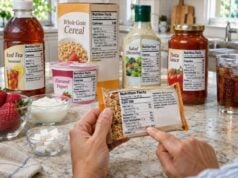
Most products provide roughly 3 to 5 g of psyllium per serving. A label may say “7 g powder” while the amount of psyllium husk is only 3.4 g because flavoring, sweetener, or other ingredients make up the rest. Read the active ingredient or fiber amount, not just the scoop weight.
A typical cholesterol-focused schedule might be:
- 3.4 g in the morning and 3.4 g in the evening, for about 6.8 g/day;
- 5 g twice daily, for about 10 g/day; or
- roughly 3 to 3.5 g three times daily, for about 10 g/day.
There is no evidence that one exact split is uniquely superior. The best schedule is one you can follow consistently without bloating and without interfering with medicines.
If you are new to psyllium, do not jump directly to a high dose. Start with one small serving daily for several days, then increase as tolerated. This gives your gut time to adapt.
A gradual example:
- Days 1–4: about 3 to 3.5 g once daily.
- Days 5–8: the same amount twice daily if comfortable.
- After about a week: increase toward the target dose only if needed and tolerated.
The exact product directions still matter because powders, capsules, wafers, and combination products can contain different amounts.
Psyllium capsules can be convenient, but they often require many capsules to reach the doses used in cholesterol trials. Check the actual grams of psyllium per capsule rather than assuming “six capsules” equals a therapeutic fiber amount.
The FDA-authorized heart-disease health claim for psyllium is built around diets low in saturated fat and cholesterol that provide 7 g/day of soluble fiber from psyllium husk. That is useful context because it shows the cholesterol claim is not based on a token sprinkle of fiber. The effective amount is measured in grams and is meant to sit inside an overall heart-healthy diet.
It also helps to distinguish psyllium husk, soluble fiber, and total dietary fiber. A product may contain several grams of psyllium husk but a smaller amount of soluble fiber, depending on how the label is written. Other foods contribute fiber too, so a person taking 7 g of psyllium-derived soluble fiber may easily reach 25 to 35 g or more of total daily fiber once oats, beans, vegetables, fruit, nuts, and whole grains are counted. That broader fiber intake can support bowel health and satiety in addition to cholesterol management.
Because LDL response varies, dose escalation should be guided by tolerance rather than the assumption that twice as much fiber will produce twice the cholesterol reduction. Once you are in the range used in trials, improving the rest of the diet usually offers more value than pushing psyllium to increasingly large doses.
One practical point: compare products by the amount of psyllium in a serving, not by teaspoon volume. Fine powder, coarse husk, capsules, and flavored mixes pack differently. Use the measuring device or weight listed on the label rather than transferring a scoop from another product. This makes both dosing and side-effect tracking more reliable over time consistently.
How Fast Psyllium Works
Psyllium can affect bowel regularity within days, but cholesterol changes should be judged over weeks, not hours.
Many cholesterol trials lasted 6 to 12 weeks or longer. Some LDL reduction may appear within the first few weeks, but a practical time to recheck a lipid panel is often 6 to 12 weeks after making a consistent change, especially if psyllium is part of a larger diet plan.
That timeline matters because people often stop too soon. Taking psyllium for four days will not tell you whether it lowers your LDL. Consistency is more important than whether the dose is taken at 8 a.m. versus 8 p.m.
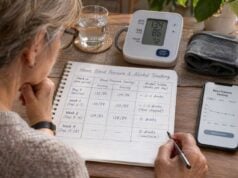
If you are using psyllium specifically for cholesterol, track three things:
- the grams of actual psyllium you take per day;
- how consistently you take it;
- what else changed in your diet during the same period.
If LDL falls, the improvement may reflect the combined effect of more soluble fiber, less saturated fat, weight change, exercise, and medication. That is still a success; you do not need to prove which single behavior caused every point of improvement.
Psyllium should also not delay necessary treatment. If your LDL is very high—especially around or above 190 mg/dL, or if you have known cardiovascular disease, diabetes, familial hypercholesterolemia, or other high-risk features—fiber alone is unlikely to be enough. Use it as an adjunct to a full plan. For context, how long it takes to lower cholesterol depends heavily on the intervention being used.
How to Take Psyllium Safely
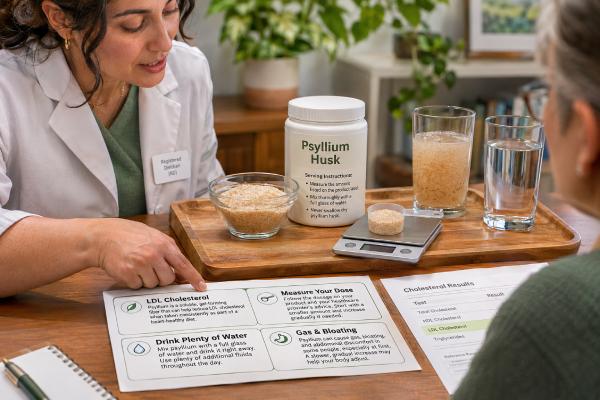
The most important safety rule is take psyllium with plenty of liquid and drink it promptly after mixing.
Psyllium expands as it absorbs water. Current OTC labeling for psyllium powders warns that taking the product without adequate fluid can allow it to swell and block the throat or esophagus. Many products direct adults to mix one dose with at least 8 ounces, or about 240 mL, of water.
A safe basic method is:
- Put the measured psyllium into an empty glass.
- Add at least 8 ounces of water, unless the product directs more.
- Stir briskly.
- Drink promptly before it becomes very thick.
- Follow with additional water if desired.
Do not take dry psyllium powder by spoon and then try to wash it down. That creates an unnecessary choking hazard.
Timing with meals is flexible. Some cholesterol studies used psyllium around mealtimes, but the most important factor is getting the daily dose consistently. Taking it before or with a meal may also help some people with post-meal glucose response and fullness.
Medication timing requires more care. Fiber can alter the absorption of some medicines and supplements. Product labels and drug references do not use one universal spacing rule for every medication, so the safest approach is to ask a pharmacist how far to separate psyllium from your specific prescriptions. A common practical strategy is to separate it from oral medications by at least a couple of hours unless a clinician gives different instructions, but some drugs require longer spacing.
If you use several prescriptions, do not assume “natural fiber” means there can be no interaction. A pharmacist can usually solve the timing issue quickly.
For a schedule-focused approach, see the best time to take psyllium for cholesterol.
Side Effects and Who Should Be Careful
The most common side effects are gastrointestinal. These usually occur because the dose is increased too quickly or because the person is not used to a higher fiber intake.
Common effects include:
- gas;
- bloating;
- abdominal fullness;
- mild cramping;
- changes in stool frequency or consistency.
Starting low and increasing gradually usually helps. So does drinking enough fluid.
Psyllium can also trigger allergic reactions in sensitive people, although this is uncommon in casual users. Occupational exposure has been described in people who repeatedly inhale psyllium dust. If you develop hives, facial swelling, wheezing, or difficulty breathing, stop using it and seek medical care.
Do not use psyllium without medical guidance if you have difficulty swallowing, known narrowing of the esophagus or intestine, suspected bowel obstruction, severe unexplained abdominal pain, or persistent vomiting. Its swelling action can be dangerous when passage through the digestive tract is impaired.
Seek urgent care if, after taking psyllium, you develop chest pain, vomiting, difficulty swallowing, or trouble breathing. Those can be warning signs of obstruction or choking.
People with diabetes who add substantial soluble fiber may see changes in glucose response. That is usually beneficial, but if you use glucose-lowering medication, monitor as advised so treatment does not become mismatched to your new diet.
People with kidney disease should also consider the full product. Plain psyllium contains little besides fiber, but flavored products may contain sodium, potassium, or other ingredients that matter in renal diets.
If constipation, rectal bleeding, or a major change in bowel habits persists, do not keep increasing the dose. Those symptoms may need evaluation rather than more fiber.
Psyllium Versus Food Sources of Soluble Fiber
Psyllium is useful because it delivers a concentrated amount of viscous fiber with relatively few calories. It is not nutritionally superior to whole foods in every respect.
Oats, barley, beans, lentils, fruit, chia, and flax contribute fiber plus vitamins, minerals, plant compounds, and food volume. Psyllium contributes mostly fiber. The best cholesterol-lowering diet often uses both.
| Source | Main advantage | Limitation |
|---|---|---|
| Psyllium husk | Concentrated viscous soluble fiber; easy to measure | Can cause bloating; requires adequate fluid; few other nutrients |
| Oats | Beta-glucan plus whole-grain nutrients | More food volume needed for a therapeutic fiber dose |
| Barley | Rich in beta-glucan and works well in meals | Less convenient than a supplement |
| Beans and lentils | Fiber plus plant protein, potassium, and magnesium | Can cause gas if intake rises quickly |
| Fruit | Fiber, potassium, vitamins, and polyphenols | Usually provides less viscous fiber per serving than psyllium |
If you dislike supplements, you can still make meaningful progress with food. Oats are particularly practical; oats for lowering LDL explains how beta-glucan fits into a cholesterol-focused plan.
If you already eat a high-fiber diet but still struggle to reach a therapeutic amount of soluble fiber, psyllium can close the gap efficiently.
How to Use Psyllium in a Cholesterol-Lowering Plan
Psyllium works best as one layer in a broader LDL-lowering strategy.
Start with the basics: reduce saturated fat, replace it with unsaturated fats, increase beans and whole grains, eat more vegetables and fruit, and maintain regular physical activity. Add psyllium when you want a predictable soluble-fiber dose on top of those habits.
A practical plan could look like this:
- breakfast: oatmeal with berries and walnuts;
- lunch: bean or lentil-based meal;
- dinner: vegetables, whole grains, and fish or another lean protein;
- psyllium: one small serving once or twice daily, building toward roughly 7 to 10 g/day as tolerated.
This “stacking” approach is more powerful than relying on a single food. The article on combining oats, psyllium, and legumes explains how several soluble-fiber sources can work together.
Recheck cholesterol after a consistent period, usually several weeks to a few months depending on your treatment plan. If LDL remains well above your goal, do not keep increasing psyllium indefinitely. More fiber can worsen bloating without solving a problem that requires medication or a different dietary change.
If a statin, ezetimibe, PCSK9-targeting therapy, bempedoic acid, or another lipid-lowering drug has been prescribed, continue it unless your prescriber changes the plan. Psyllium is an adjunct, not a substitute for appropriate long-term medical treatment. The magnitude of LDL reduction from medication can be much larger than the average effect from fiber.
Finally, choose a product you can use consistently. Plain unsweetened psyllium gives you the most control, but flavored versions can be fine if their sugar, sodium, and other ingredients fit your goals. The best product is the one that provides a known amount of psyllium, mixes reliably, and does not create side effects that make you quit after a week.
It is also useful to separate the dose that appears on a package from the amount of psyllium husk you are actually getting. Flavored powders may contain sweeteners or other ingredients, so a tablespoon of product is not always a tablespoon of fiber. Use the nutrition and drug-facts information to identify grams of psyllium or soluble fiber per serving, then build your routine around that number. Consistent measurement makes it easier to judge both cholesterol response and side effects, especially when changing brands or moving from capsules to powder.
References
- Psyllium supplementation and lipid profiles: systematic review and dose-response meta-analysis of randomized controlled trials 2025 (Systematic Review)
- Plantago consumption significantly reduces total cholesterol and low-density lipoprotein cholesterol in adults: A systematic review and meta-analysis 2024 (Systematic Review)
- Associations between dietary fiber intake and cardiovascular risk factors: An umbrella review of meta-analyses of randomized controlled trials 2022 (Systematic Review)
- The effect of psyllium consumption on blood pressure: Systematic review and dose–response meta‐analysis of randomized controlled trials 2024 (Systematic Review)
- DailyMed – METAMUCIL THERAPY FOR REGULARITY- psyllium husk powder 2026
- Authorized Health Claims That Meet the Significant Scientific Agreement (SSA) Standard 2024
Disclaimer
This article provides general education and is not a substitute for medical care. Ask a healthcare professional before using psyllium if you have difficulty swallowing, bowel narrowing or obstruction, significant gastrointestinal disease, chronic kidney disease, diabetes treated with medication, or prescriptions whose absorption could be affected by fiber. Seek urgent care for trouble swallowing or breathing after taking psyllium.