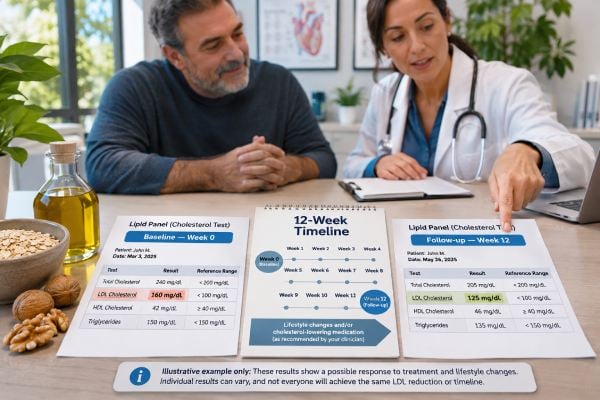
Cholesterol can start improving within a few weeks, but the timeline depends on what you change and which cholesterol number you are trying to lower. LDL cholesterol often responds to an effective statin within 2 to 6 weeks, while diet, weight loss, and exercise usually need several weeks to a few months before the full effect is clear on a blood test. Triglycerides can change faster than LDL, especially when alcohol, excess calories, refined carbohydrates, or uncontrolled blood sugar are major drivers.
The practical goal is not to chase a perfect number overnight. It is to make a change strong enough to matter, give it enough time to work, and then recheck your lipid panel at a sensible interval. A repeat test commonly falls about 4 to 12 weeks after starting or changing treatment. From there, the next step depends on your starting LDL, cardiovascular risk, family history, and how much your numbers actually moved.
Table of Contents
- How Fast Cholesterol Usually Changes
- Why Your Timeline May Be Faster or Slower
- How Long Lifestyle Changes Take
- How Fast Cholesterol Medications Work
- When to Recheck Your Cholesterol
- What Good Progress Looks Like
- When You Should Not Wait Months to Act
How Fast Cholesterol Usually Changes
For most people, meaningful cholesterol changes show up over weeks rather than days. The liver, intestines, body weight, activity level, and medications all affect how much LDL, HDL, and triglyceride circulate in the blood, and each responds on a different schedule.
A useful rule of thumb is:
| Change | When a change may begin | When the effect is easier to judge |
|---|---|---|
| Lower saturated fat / improve overall diet | About 2–4 weeks | 6–12 weeks |
| Add soluble fiber or plant sterols | Within several weeks | 4–8 weeks |
| Regular aerobic and resistance exercise | Several weeks | 8–12+ weeks |
| Weight loss | As weight and diet change | Often 8–12+ weeks |
| Statin therapy | About 1–2 weeks | Usually near maximal by 4–6 weeks |
| Ezetimibe or other LDL-lowering medication | Within weeks | Often reassessed around 4–12 weeks |
These are practical ranges, not guarantees. A person whose LDL is mainly driven by a high intake of saturated fat may see a noticeable response after a few weeks of dietary change.
Triglycerides are often the quickest number to move. Cutting back on heavy alcohol intake, sugary drinks, refined carbohydrates, and excess calories can sometimes produce a noticeable fall within weeks. LDL tends to be more tightly linked to genetics, saturated-fat intake, soluble fiber, and LDL-lowering medication, so it may move less dramatically with the same lifestyle effort. HDL usually changes slowly and is not a treatment target in the same way LDL is.
Day-to-day biology also adds noise. Hydration, recent illness, unusually hard exercise, a large change in food intake, and laboratory variation can shift results modestly. That is another reason to focus on the overall trend and percentage change rather than treating one number as a final verdict. Someone with familial hypercholesterolemia may make the same changes and still need medication because inherited LDL elevation is much harder to overcome with lifestyle alone.
It also helps to know what your lab values mean before judging progress. LDL is the main cholesterol target for preventing atherosclerotic cardiovascular disease, while triglycerides often respond strongly to calorie balance, alcohol intake, blood sugar control, and weight change. If the terms feel confusing, a basic review of LDL, HDL, and triglycerides can make your follow-up numbers easier to interpret.
Why Your Timeline May Be Faster or Slower
Two people can make similar changes and get very different results. That does not necessarily mean one person is doing something wrong. Cholesterol levels are shaped by both lifestyle and biology.
The biggest factors include:
- Your starting LDL level. A large absolute drop is easier to see when LDL starts very high, although the percentage response still matters.
- Genetics. Some people inherit variants that keep LDL high even with an excellent diet and regular exercise.
- The size of the change. Replacing butter, fatty processed meats, and high-saturated-fat snacks every day has more impact than making one small swap each week.
- Weight and metabolic health. Losing excess body fat often improves triglycerides and other metabolic markers, while the LDL response varies.
- Medication type and dose. High-intensity LDL-lowering therapy can create a much larger and faster LDL reduction than lifestyle alone.
- Adherence. Missing medication frequently or following a new eating pattern only intermittently can make the lab response smaller.
- Other medical conditions. Hypothyroidism, diabetes, kidney disease, liver disease, and some medications can affect lipids.
This is why the most useful question is not simply, “How many weeks until my cholesterol is normal?” A better question is, “What percentage reduction should I expect from the plan I am actually following, and when should I measure it?”
For example, someone with LDL of 180 mg/dL who lowers it to 145 mg/dL has improved by 35 mg/dL, or about 19%. That is meaningful progress, but it may still leave substantial untreated risk depending on age, medical history, and overall cardiovascular risk. A person starting at 120 mg/dL who drops to 95 mg/dL has a smaller absolute change but may already be near an appropriate goal for their situation.
How Long Lifestyle Changes Take
Lifestyle measures can lower cholesterol, but they work best when several high-impact habits reinforce one another. If you are trying to see whether lifestyle is enough, make the plan specific enough that you can evaluate it after 6 to 12 weeks.
Diet changes: often visible within 4–8 weeks
LDL responds most directly when you reduce foods high in saturated fat and replace them with unsaturated fats, high-fiber foods, and minimally processed plant foods. Useful swaps include olive oil instead of butter, beans or fish instead of fatty processed meat, nuts instead of pastries, and whole grains instead of refined grain products.
Soluble fiber is particularly helpful because it reduces cholesterol absorption in the gut. A large meta-analysis found that soluble-fiber supplementation lowered LDL, with greater effects as intake increased. Psyllium, oats, barley, beans, lentils, apples, citrus, and some seeds are practical sources. If you want to build this into meals, see soluble fiber for lowering LDL and foods that help lower cholesterol.
Plant sterols and stanols can also reduce LDL by limiting intestinal cholesterol absorption. Their effect can appear within several weeks and is usually additive to other dietary changes. They are most useful as one part of a broader plan rather than a substitute for an overall heart-healthy diet.
Exercise: expect modest lipid changes over 2–3 months
Exercise improves cardiovascular health even when the cholesterol change is modest. A 2025 systematic review and meta-analysis of 148 randomized trials found that exercise training produced small but significant average improvements in LDL, HDL, triglycerides, and total cholesterol, with combined aerobic and resistance exercise performing well overall.
This is important because a person can become substantially healthier without seeing a dramatic LDL drop from exercise alone. The strongest exercise-related changes may show up in fitness, blood pressure, insulin sensitivity, triglycerides, and body composition. For LDL specifically, exercise works best alongside diet and, when needed, medication.
Aim for a sustainable routine rather than a short burst before a blood test. A common target is at least 150 minutes of moderate aerobic activity each week plus muscle-strengthening activity on two or more days.
Weight loss: benefits build as the loss becomes meaningful
If you have excess weight, losing even a modest amount can improve triglycerides, blood pressure, and blood sugar regulation. LDL may improve too, especially when weight loss comes from a diet lower in saturated fat and higher in fiber. The timeline depends on the rate of weight loss; a steady 5% to 10% reduction in body weight usually takes months rather than weeks.
The key is not to delay all follow-up until you reach a final goal weight. If you are making major lifestyle changes, a lipid panel after about 8 to 12 weeks can show whether you are moving in the right direction. You can then continue the same approach, intensify it, or discuss additional treatment.
How Fast Cholesterol Medications Work
Medication generally lowers LDL faster and more predictably than lifestyle alone. The exact percentage depends on the drug, dose, and your baseline LDL.
Statins
Statins reduce the liver’s cholesterol production and increase removal of LDL from the bloodstream. LDL usually begins falling within the first couple of weeks and approaches the medication’s full effect within roughly 4 to 6 weeks.
The expected reduction is commonly described by intensity:
- Moderate-intensity statins typically lower LDL by about 30% to 49%.
- High-intensity statins typically lower LDL by about 50% or more.
Those percentages make it easier to judge whether the medicine is doing what it should. If LDL barely changes despite a prescribed high-intensity statin, clinicians may check whether doses are being missed, whether the medication is tolerated, whether another condition is raising LDL, or whether additional treatment is needed. A practical overview of statin benefits, side effects, and eligibility can help explain why the dose matters.
Nonstatin medicines
Ezetimibe, PCSK9 inhibitors, inclisiran, bempedoic acid, and other therapies can lower LDL further when statins are not enough or cannot be used at an effective dose. Their magnitude and dosing schedules differ, but clinicians still judge response by repeat lipid testing rather than by symptoms because high LDL usually does not make you feel different.
Current cardiovascular guidance emphasizes matching treatment intensity to risk. People with established atherosclerotic cardiovascular disease, very high LDL, familial hypercholesterolemia, or other high-risk features may need combination treatment sooner rather than spending many months testing lifestyle alone. If this applies to you, it can be useful to understand the main nonstatin options for high LDL before discussing choices with your clinician.
When to Recheck Your Cholesterol
A repeat lipid panel is commonly checked about 4 to 12 weeks after starting or changing cholesterol-lowering treatment. That interval gives enough time for a medication effect to stabilize and for many lifestyle changes to begin showing up.
After that, testing frequency depends on your situation. Once treatment is stable, many people are checked every few months to yearly, depending on risk, medication changes, and whether goals have been reached.
Retesting too early can create confusion. A lipid panel one week after changing your diet will not tell you the full effect of the new pattern. Waiting too long can also be a problem if your LDL is very high or you have known cardiovascular disease, because it delays needed treatment adjustments.
Try to make repeat tests comparable:
- Use the same laboratory when practical.
- Keep medication use consistent before testing unless your clinician tells you otherwise.
- Tell your clinician about major illness, rapid weight change, new medications, or supplements.
- Follow the lab’s fasting instructions. Many routine lipid panels can be done without fasting, but fasting may be useful when triglycerides are high or when a clinician specifically requests it. See fasting versus non-fasting cholesterol testing for the practical differences.
Do not try to “game” a cholesterol test with an unusually restrictive week of eating. The purpose is to measure the effect of your normal, sustainable routine.
It is also worth checking that you are comparing the same measurement. Calculated LDL can shift when triglycerides change, and some labs use different LDL equations. If a result looks surprising, especially when triglycerides are high, your clinician may repeat the panel or use non-HDL cholesterol, apolipoprotein B, or a direct LDL measurement to get a clearer picture.
For home tracking, write down the date you started each major change, your medication dose, and any meaningful weight change. When the repeat panel arrives, compare it with the true baseline rather than an older result from a different treatment period.
What Good Progress Looks Like
Good progress is not defined by one universal LDL number. The right target depends on cardiovascular risk, and the percentage reduction from baseline is often just as important as the final number.
A useful way to judge your response is to ask three questions:
- Did the change match what was expected? If a treatment should lower LDL by roughly 30% to 50% and your reduction is only 5%, something may need attention.
- Is the current LDL appropriate for your risk level? Someone with previous heart attack or stroke usually needs much more aggressive LDL lowering than a low-risk young adult.
- Is the plan sustainable and safe? A short-term diet that cannot be maintained is less useful than a realistic pattern you can follow for years.
Suppose your LDL starts at 170 mg/dL. After 10 weeks of dietary changes it falls to 150 mg/dL. That is about a 12% reduction. It shows the diet is working, but the remaining LDL may still be high enough that medication deserves discussion. If treatment later lowers LDL to 85 mg/dL, the total reduction from baseline is 50%.
You can calculate your LDL percentage change with a simple formula: subtract the new LDL from the starting LDL, divide by the starting LDL, and multiply by 100. For example, a drop from 160 to 112 mg/dL is a 30% reduction. This is often more informative than saying LDL fell by 48 points because treatment guidelines frequently describe expected response in percentages.
Do not focus only on HDL. Trying to “raise HDL” with supplements or alcohol is not a substitute for lowering LDL and controlling overall cardiovascular risk. Triglycerides also deserve attention when they are persistently elevated, especially if they are very high, but the treatment strategy may differ from LDL management.
When You Should Not Wait Months to Act
Lifestyle improvement is valuable at every risk level, but some cholesterol results call for prompt medical evaluation rather than a long self-directed trial.
Contact a clinician soon if:
- LDL is 190 mg/dL or higher. This can indicate severe primary hypercholesterolemia and may warrant medication regardless of short-term lifestyle response.
- You already have cardiovascular disease. Previous heart attack, stroke, peripheral artery disease, or coronary revascularization usually calls for intensive LDL lowering.
- There is a strong family history of very high cholesterol or early heart disease. This raises concern for inherited disorders.
- Triglycerides are 500 mg/dL or higher. Very high triglycerides can increase pancreatitis risk and need targeted management.
- Your numbers remain far above goal despite a strong plan. This may mean the treatment needs intensification or another cause should be investigated.
Also remember that cholesterol treatment is about long-term exposure. A lower LDL maintained for years is more protective than a brief improvement before each blood test. The best plan is usually the one that combines high-impact lifestyle habits with the right level of medication for your personal risk.
If you are starting with an elevated result, review the causes and treatment options for high LDL cholesterol, make a concrete 6- to 12-week plan, and schedule the follow-up test rather than leaving the timeline open-ended. That turns “I need to lower my cholesterol” into a measurable treatment cycle: act, recheck, adjust, and repeat until the result is appropriate for your risk.
References
- 2022 ACC Expert Consensus Decision Pathway on the Role of Nonstatin Therapies for LDL-Cholesterol Lowering in the Management of Atherosclerotic Cardiovascular Disease Risk 2022 (Guideline)
- Soluble Fiber Supplementation and Serum Lipid Profile: A Systematic Review and Dose-Response Meta-Analysis of Randomized Controlled Trials 2023 (Systematic Review)
- The Effect of Exercise Training on Blood Lipids: A Systematic Review and Meta-analysis 2025 (Systematic Review)
- Nutrition and Lifestyle Interventions in Managing Dyslipidemia and Cardiometabolic Risk 2025 (Review)
- Efficacy of phytosterols for reduction of cardiometabolic risk factors: An umbrella review of systematic reviews and meta-analyses and updated dose-response meta-analyses of randomized trials 2026 (Systematic Review)
Disclaimer
This article is for general education and is not a diagnosis or a personal treatment plan. Cholesterol goals and medication choices depend on your overall cardiovascular risk, medical history, and other test results. Discuss very high LDL, very high triglycerides, medication changes, or treatment targets with a qualified healthcare professional.