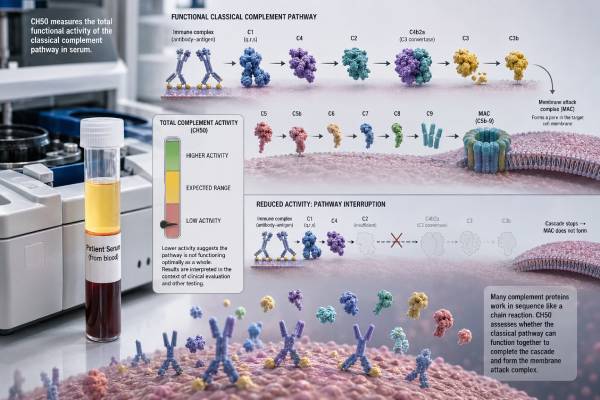
The CH50 complement test checks whether the classical complement pathway can complete a full immune reaction from start to finish. Complement proteins circulate in the blood and work in a chain: one protein activates the next until the system can tag microbes, amplify inflammation, and form a membrane attack complex that can damage susceptible bacteria. Because the test depends on many proteins working together, a low or absent result can signal complement consumption, an inherited deficiency, a medication effect, or a problem with specimen handling. CH50 is often ordered alongside C3, C4, and the alternative pathway test AH50 when clinicians are evaluating recurrent serious infections, lupus or another immune-complex disease, kidney inflammation, or treatment with a complement-blocking drug. The result is not a diagnosis by itself. Its value comes from the pattern it forms with symptoms, other complement measurements, and repeat testing under proper collection conditions.
- CH50 measures function, not just quantity: it tests the combined activity of the classical and terminal complement pathways.
- A low CH50 may reflect complement consumption or deficiency: C3, C4, AH50, clinical history, and repeat testing help separate the causes.
- An undetectable CH50 deserves careful follow-up: it can occur with a major pathway defect, strong drug blockade, or a mishandled specimen.
- Reference ranges vary by laboratory: interpret the number against the range printed on the report rather than a universal cutoff.
- No fasting is usually required: correct collection, rapid processing, and appropriate freezing are more important than food intake.
Table of Contents
- What the CH50 Test Measures
- Why a CH50 Test Is Ordered
- Understanding Normal, Low, and High CH50 Results
- How CH50, AH50, C3, and C4 Patterns Fit Together
- Testing, Preparation, and Specimen Handling
- Follow-Up After an Abnormal CH50 Result
- Limits, Pitfalls, and Common Interpretation Mistakes
What the CH50 Test Measures
CH50 stands for total hemolytic complement activity. The “50” comes from the traditional laboratory method: the result reflects the amount of serum needed to lyse, or break open, 50% of antibody-coated red blood cells under standardized conditions. Modern laboratories may use automated or nonhemolytic methods, but the clinical purpose remains the same. The assay asks whether the classical pathway and the shared terminal pathway can operate as an intact chain.
The classical pathway is usually triggered when antibodies bind to a target. This activates C1 and then a sequence that includes C2 and C4. The cascade converges at C3, continues through C5, and ends with C6, C7, C8, and C9 forming the membrane attack complex. A major defect anywhere in that required sequence can lower the final CH50 result.
That makes CH50 different from a concentration test. A C3 blood test, for example, measures the amount of C3 protein present. CH50 measures whether the overall pathway functions. A person can occasionally have a near-normal concentration of a protein that does not work properly, so a functional assay may detect a problem that a quantity measurement misses.
CH50 also differs from a general inflammation marker. CRP and ESR rise or fall with many inflammatory states, but they do not test complement pathway performance. CH50 can fall when complement proteins are being consumed faster than the body replaces them, when one component is missing or defective, or when a drug intentionally blocks the cascade.
The complement system has three major entry routes:
- The classical pathway, commonly activated by antibody-antigen complexes
- The alternative pathway, which can activate directly on microbial or other surfaces
- The lectin pathway, which starts when pattern-recognition molecules bind certain carbohydrate structures
All three routes eventually use shared terminal proteins. CH50 mainly evaluates the classical route plus that shared terminal sequence. The AH50 complement test evaluates the alternative pathway plus the terminal sequence. Comparing the two is often more informative than reading either alone.
Why a CH50 Test Is Ordered
Clinicians usually order CH50 for one of four reasons: suspected complement deficiency, suspected complement consumption, monitoring of a known immune disease, or assessment of complement-blocking treatment.
Recurrent or unusual infections
Inherited complement deficiencies are uncommon, but recognizing them matters because some carry a marked risk of invasive bacterial infection. The clinical pattern can point toward the affected part of the cascade.
Deficiencies of the terminal components C5 through C9 are strongly associated with recurrent infections caused by Neisseria, including meningococcal disease. Earlier classical pathway defects, such as C1, C2, or C4 deficiency, may appear with recurrent respiratory infections, autoimmune features, or both. C3 deficiency can cause severe, recurrent infections with encapsulated bacteria because C3 is central to tagging microbes for immune clearance.
CH50 may be appropriate when a person has:
- More than one episode of meningococcal disease
- Invasive Neisseria infection without an obvious explanation
- Recurrent serious bacterial infections beginning unusually early
- A family history of complement deficiency
- Recurrent infections plus lupus-like or immune-complex symptoms
- A specialist’s concern about a primary immune deficiency
A normal CH50 does not exclude every immune problem. It does not fully assess the lectin pathway, antibody production, white blood cell function, or many other parts of immunity. When the clinical picture suggests broader immune dysfunction, clinicians may order an immunoglobulin panel, vaccine antibody titers, lymphocyte studies, or other targeted tests.
Autoimmune and immune-complex disease
Complement proteins help clear immune complexes—clusters formed when antibodies bind antigens. In diseases such as systemic lupus erythematosus, immune complexes can activate and consume the classical pathway. CH50, C3, and C4 may therefore fall during active disease, especially when the kidneys are involved.
CH50 may support evaluation or monitoring when symptoms suggest lupus, immune-complex vasculitis, some forms of glomerulonephritis, cryoglobulinemia, or another complement-consuming condition. It is rarely used alone. In lupus care, it is usually interpreted with clinical symptoms, urinalysis, kidney function, C3, C4, anti-dsDNA antibodies, blood counts, and other findings. A lupus blood test panel provides context that CH50 cannot supply by itself.
A low value can support the possibility of active complement consumption, but the relationship is not perfect. Some people with active autoimmune disease retain normal complement results, while others have chronically low values because of inherited baseline differences or a persistent deficiency. Trends are often more useful than a single isolated measurement.
Kidney disease and systemic inflammation
The kidneys are vulnerable to immune-complex deposition and complement-driven injury. Clinicians may include CH50 in the evaluation of blood or protein in the urine, declining kidney function, swelling, high blood pressure, or biopsy-proven glomerulonephritis. The pattern of C3, C4, CH50, and other tests can help narrow the mechanism, although kidney diagnosis usually depends on a much broader workup.
A low CH50 is not specific to lupus. It may occur in other immune-complex conditions, severe infections, some liver diseases, or states in which complement production falls or consumption rises. The result must be matched to the person’s symptoms and laboratory pattern.
Complement-blocking medications
Drugs such as eculizumab and ravulizumab block C5 and prevent formation of the terminal membrane attack complex. CH50 and AH50 commonly become very low or undetectable when terminal complement blockade is effective. Some specialists use functional complement assays, drug levels, or C5-specific tests to assess whether blockade is complete, particularly when response is incomplete or dosing questions arise.
These drugs increase susceptibility to meningococcal and certain other infections even when vaccination has been given. Fever, severe headache, stiff neck, rapidly worsening illness, or a new purple rash requires urgent medical assessment in anyone receiving terminal complement inhibition.
Understanding Normal, Low, and High CH50 Results
CH50 results are reported in laboratory-specific units, such as U/mL, CH50 units, or percentage activity. Methods and reference intervals differ, so there is no single universal normal range. One laboratory may use a numerical interval while another reports normal, low, or absent activity. Always compare the result with the reference range and method on the same report.
| Result pattern | Common interpretations | Typical next step |
|---|---|---|
| Within the laboratory range | Classical and terminal pathway function is broadly intact at the time of testing | Interpret with symptoms; consider AH50 or other immune tests if suspicion remains |
| Mildly or moderately low | Possible consumption, partial deficiency, medication effect, liver-related reduction, or specimen degradation | Review C3, C4, AH50, medications, disease activity, and specimen quality; repeat when appropriate |
| Very low or undetectable | Major classical or terminal pathway defect, strong complement consumption, effective terminal blockade, or severe preanalytic error | Prompt confirmatory testing and clinical review |
| Above the laboratory range | May reflect increased complement production during inflammation; usually less diagnostically specific | Assess the clinical reason for testing and other inflammatory findings |
What a low CH50 can mean
A low result has several broad explanations.
Complement consumption occurs when the cascade is repeatedly activated. Active lupus, immune-complex kidney disease, cryoglobulinemia, severe infection, and some vasculitic or inflammatory disorders can consume complement proteins. In this setting, C3 and C4 may also be reduced, though the exact pattern depends on which pathway is active and how intense the process is.
Inherited complement deficiency means a component is absent, reduced, or functionally defective because of a genetic variant. Complete deficiencies often produce an extremely low or absent functional result. Partial deficiencies may cause a milder reduction and can be harder to distinguish from consumption.
Acquired reduced production or protein loss can also lower complement activity. Severe liver dysfunction may reduce synthesis because the liver produces many complement proteins. Significant protein-losing states may reduce circulating components. These settings usually produce other abnormal laboratory findings as well.
Medication effects are important. Terminal complement inhibitors are designed to suppress pathway function. Other therapies and acute clinical circumstances may also influence results, so the medication list and timing of treatment matter.
Specimen handling problems are a frequent technical concern. Complement proteins can activate or degrade after collection if serum is not separated, cooled, frozen, and transported according to laboratory requirements. A falsely low CH50 is especially plausible when the result conflicts with the clinical picture or when AH50 is also unexpectedly absent.
What a normal CH50 means
A normal CH50 makes a complete deficiency of a required classical or terminal pathway component less likely. It does not prove that the entire complement system is normal. The alternative pathway could still be defective, the lectin pathway may be abnormal, or a component could have a partial defect that remains above the assay threshold.
A normal result also does not rule out autoimmune disease. Complement levels fluctuate, and many autoimmune conditions do not consistently consume complement. Even in lupus, CH50 may be normal when disease is quiet or when activity affects organs without marked serum complement consumption.
What a high CH50 means
High CH50 activity is usually less specific than low activity. Complement proteins can behave as acute-phase reactants, so activity may rise during inflammation, infection, tissue injury, or recovery from a previously low state. A high number does not identify a particular autoimmune disease and usually does not indicate “overactive immunity” in a simple, stand-alone sense.
When CH50 is monitored over time, a return from low to the laboratory range may accompany improvement in a complement-consuming illness. Yet treatment decisions should follow symptoms and the full laboratory picture rather than the CH50 trend alone.
How CH50, AH50, C3, and C4 Patterns Fit Together
The most useful interpretation often comes from combining functional and concentration tests. CH50 evaluates the classical and terminal pathways. AH50 evaluates the alternative and terminal pathways. C3 and C4 measure specific protein concentrations. Together, they help distinguish a pathway defect from broad consumption.
| CH50 | AH50 | Pattern may suggest |
|---|---|---|
| Low or absent | Normal | Classical pathway defect involving C1, C2, or C4; sometimes classical-pathway consumption |
| Normal | Low or absent | Alternative pathway defect, such as factor B, factor D, or properdin abnormality |
| Low or absent | Low or absent | Shared terminal pathway defect, C3 deficiency, regulatory abnormality, broad consumption, drug blockade, or specimen problem |
| Normal | Normal | Major defects in the tested classical, alternative, and terminal pathways are less likely; lectin pathway disease remains possible |
This pattern table is a starting point, not a final diagnosis. C3 and C4 refine it further. Low C3 and low C4 together often support broad classical pathway activation and consumption, as can occur in active immune-complex disease. Low C3 with relatively preserved C4 can point more toward alternative pathway activation in the right clinical setting. A low C4 level with a low CH50 may fit classical pathway consumption or an early classical component problem.
Complete terminal component deficiency often causes both CH50 and AH50 to be absent because both assays require C5 through C9 to complete the final reaction. If C3 and C4 concentrations are normal while both functional assays are absent, clinicians may focus on terminal components and technical causes. If multiple complement concentrations are low at the same time, active consumption becomes more likely.
The distinction between deficiency and consumption matters. A hereditary deficiency may call for immunology evaluation, vaccination planning, infection education, family assessment, and sometimes genetic testing. Consumption calls for diagnosis and treatment of the underlying inflammatory, infectious, kidney, or autoimmune process.
Testing, Preparation, and Specimen Handling
CH50 requires a blood sample from a vein. The draw itself usually takes only a few minutes. Fasting is generally unnecessary unless other tests ordered at the same time require it. Usual medications should not be stopped unless the prescribing clinician gives specific instructions.
Preparation is simple for the patient, but handling is demanding for the laboratory. Complement activity can decline after blood is drawn. Many laboratories require serum to be separated promptly and frozen quickly, with transport under controlled conditions. Requirements vary, so the collection site should follow the performing laboratory’s instructions exactly.
A reliable testing process includes:
- Collecting the specimen in the correct tube
- Allowing clot formation for the required time
- Separating serum from cells promptly
- Freezing or refrigerating according to the assay protocol
- Avoiding repeated freeze-thaw cycles
- Shipping at the required temperature
These details explain why a surprising low result may be repeated before an extensive immune workup begins. Repeating the test is not dismissing the result; it is a way to confirm that the pathway was truly low in the body rather than damaged in the tube.
Tell the clinician and laboratory about complement inhibitors, recent plasma products, major infections, hospitalization, or immunosuppressive treatment. Timing can change interpretation. For example, a low CH50 during a severe infection may represent active consumption, whereas a persistently absent result after recovery raises a different concern.
Turnaround time ranges from a day to more than a week depending on whether the assay is performed locally or sent to a reference laboratory. Follow-up component tests or genetic studies usually take longer.
Follow-Up After an Abnormal CH50 Result
The next step depends on how low the value is, why the test was ordered, and whether symptoms suggest infection, autoimmunity, kidney disease, or a treatment effect. Clinicians commonly confirm an unexpected result and then map the affected pathway.
A reasonable follow-up sequence may include:
- Verify the result. Repeat CH50 if specimen degradation is possible or the result does not fit the clinical picture.
- Add pathway testing. AH50 helps determine whether the alternative pathway is intact.
- Measure individual proteins. C3 and C4 are common first choices; C1, C2, C5 through C9, factor B, factor H, factor I, or properdin may follow based on the pattern.
- Look for consumption. Urinalysis, kidney function, autoimmune antibodies, infection studies, liver tests, and inflammatory markers may reveal an acquired cause.
- Assess infection history. The organism, age at first infection, severity, recurrence, vaccination record, and family history can point toward an inherited defect.
- Consider specialist evaluation. Clinical immunology, rheumatology, nephrology, hematology, or infectious disease may be appropriate depending on the presentation.
If a hereditary terminal pathway deficiency is confirmed, prevention becomes central. Clinicians may recommend meningococcal vaccination beyond routine schedules, vaccination against other encapsulated bacteria, rapid evaluation of fever, and individualized antibiotic planning. Household members do not “catch” a complement deficiency, but close relatives may share a genetic variant and may be offered testing.
For autoimmune disease, the focus is the underlying condition rather than raising CH50 directly. Treatment that reduces immune-complex formation and inflammation may allow complement activity to recover. Serial measurements are most useful when compared with the person’s previous results from the same laboratory and viewed alongside symptoms, urine findings, C3, C4, and disease-specific antibodies.
Seek urgent medical care for signs of meningitis or bloodstream infection, including sudden fever, severe headache, stiff neck, confusion, rapidly worsening weakness, breathing difficulty, or a nonblanching purple rash. Urgent assessment is especially important for people with known terminal complement deficiency or those receiving a C5-blocking medication.
Limits, Pitfalls, and Common Interpretation Mistakes
CH50 is a powerful screening test when used for the right question, but several interpretation errors are common.
Treating CH50 as a diagnosis. A low result does not identify lupus, complement deficiency, or any other condition by itself. The same pattern can arise from inherited defects, consumption, medications, liver disease, protein loss, or preanalytic error.
Assuming “total complement” measures every pathway equally. CH50 is mainly a classical-plus-terminal pathway assay. A normal result can coexist with an alternative pathway or lectin pathway defect.
Comparing numbers across laboratories. Different assays use different units and reference intervals. A result of 45 U/mL may be normal in one laboratory and abnormal in another. Use the range printed beside the result.
Ignoring the specimen. Functional complement assays are unusually sensitive to handling. An isolated low value that conflicts with symptoms and component levels should prompt review of collection and transport conditions.
Overinterpreting a small change. Minor variation can reflect assay imprecision, biological fluctuation, recent illness, or differences in handling. Trends matter most when measurements use the same method and occur in a consistent clinical context.
Using CH50 alone to monitor lupus. Complement activity is only one part of disease assessment. Symptoms, physical examination, urinalysis, kidney function, blood counts, anti-dsDNA, C3, C4, and sometimes imaging or biopsy may be more decisive.
Forgetting drug effects. A very low result may be expected during effective anti-C5 treatment. Conversely, incomplete suppression can have treatment implications that require specialist interpretation; patients should not adjust dosing based on a lab value alone.
The most informative question is not simply whether CH50 is low. It is whether the result is persistent, whether AH50 and individual components are also abnormal, whether the patient is consuming complement because of active disease, and whether the infection or autoimmune history matches a specific pathway problem. That combined approach turns a broad screening assay into a useful clinical map.
References
- Complements and Their Role in Systemic Disorders 2024 (Review)
- The Complement System and Human Autoimmune Diseases 2022 (Review)
- Complement as a Biomarker for Systemic Lupus Erythematosus 2023 (Review)
- Complement Testing – Complement Deficiency and Anticomplement Therapeutic Response Monitoring 2025 (Guideline)
- Complement Blood Test 2024 (Official Page)
Disclaimer
CH50 results must be interpreted with the laboratory’s reference range, specimen conditions, symptoms, medications, and related complement tests. A low or absent result can have several causes and should be reviewed by a qualified clinician; sudden fever or meningitis-like symptoms require urgent medical care, especially with known complement deficiency or complement-blocking treatment.