
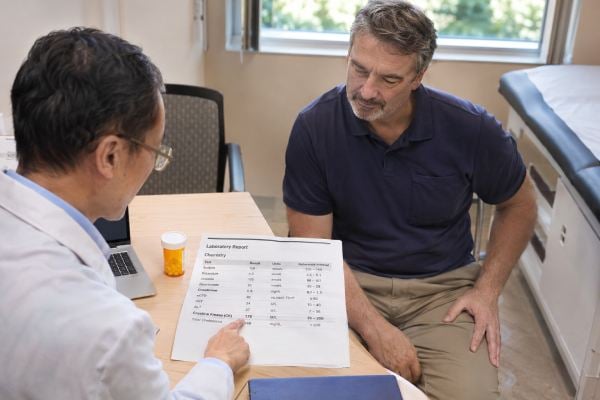
Creatine kinase (CK) is an enzyme released from muscle when muscle cells are stressed or injured. Statins can raise CK in a small number of people, but most statin-related muscle aches occur with a normal or only mildly elevated CK level. That makes the number useful but not decisive by itself. A hard workout, muscle injury, an injection, hypothyroidism, infection, kidney disease, or another medication can also raise CK. The key questions are how high the CK is compared with the laboratory’s upper limit of normal, whether you have muscle pain or weakness, whether the value is rising, and whether there are warning signs such as dark urine or kidney injury. Mild elevations often need repeat testing and context rather than an automatic stop to statin therapy. Marked elevations, especially above about 10 times the upper limit of normal, require prompt medical assessment because severe statin myopathy and rhabdomyolysis, although rare, can be dangerous.
Table of Contents
- What Creatine Kinase Measures
- How Statins Affect CK
- What Different CK Levels Can Mean
- Other Causes of Elevated CK
- What to Do If CK Is High
- When Muscle Symptoms Need Urgent Care
- How to Stay on LDL-Lowering Treatment
What Creatine Kinase Measures
Creatine kinase is an enzyme concentrated in skeletal muscle, heart muscle, and other tissues. When muscle cells are damaged or heavily stressed, CK can leak into the bloodstream. A CK blood test therefore acts as a rough marker of muscle injury, but it does not identify the cause on its own.
Laboratories report CK in units per liter (U/L) and provide an upper limit of normal, often shortened to ULN. The ULN varies by laboratory and can also differ by sex, age, body size, muscle mass, ancestry, and testing method. That is why a result such as 350 U/L cannot be interpreted accurately without the reference range printed beside it.
CK is also highly responsive to recent activity. Heavy resistance training, sprinting, a long run, or an unfamiliar workout can raise CK for several days. A person who has just completed a hard leg session may have a value that looks alarming compared with their usual baseline but has nothing to do with statin toxicity.
The test is most useful when it is paired with symptoms. Muscle pain without weakness and with normal CK is different from progressive weakness with a CK 20 times the ULN. Likewise, an isolated mild elevation in a person who feels well is different from a rapidly rising CK accompanied by dark urine and reduced urination.
Routine CK testing is not needed for every person taking a statin. Clinicians are more likely to check it when muscle symptoms appear, when a person has risk factors for myopathy, or when a previous CK was abnormal.
Baseline CK can be useful in selected people before treatment, particularly when there is a history of unexplained muscle disease, previous severe statin symptoms, or another reason to expect an abnormal value. A baseline number gives the clinician something to compare with later, but it still needs context. Some healthy people naturally run above a laboratory reference range, and a “high” baseline that is stable over time may be less concerning than a sudden jump after a medication change.
CK also does not rise and fall instantly. After a muscle insult, the value may climb for hours, peak later, and then decline over several days as the injury resolves. That means the timing of the blood draw matters. One test taken soon after symptoms begin may underestimate what happens next, while a test taken after several days of rest may already be improving. When the clinical picture is unclear, serial measurements can be more informative than a single number.
How Statins Affect CK
Statins lower LDL cholesterol by blocking HMG-CoA reductase, an enzyme involved in cholesterol production. Their cardiovascular benefit is well established, but muscle symptoms are the most common reason people stop them.
Statin-associated muscle symptoms, often called SAMS, cover a spectrum. At the mild end, people may report aching, cramping, heaviness, or stiffness with no meaningful CK elevation. At the more severe end, true muscle injury can cause a substantial CK rise. Severe rhabdomyolysis is rare.
This distinction matters because pain does not automatically mean the muscle is being damaged. In blinded trials, the excess of muscle symptoms caused by statins is smaller than the rate reported in routine practice. Some symptoms that begin during statin therapy come from exercise, arthritis, back problems, thyroid disease, vitamin deficiencies, another drug, or expectation-related effects.
Typical statin-related symptoms tend to be symmetrical and affect large muscle groups such as the thighs, hips, shoulders, or upper arms. They may begin within weeks to months of starting a statin or increasing the dose, although timing varies. Symptoms that are sharply localized to one joint or one small area are less typical.
Risk of muscle toxicity increases when statin exposure rises. Factors that can contribute include:
- Higher statin doses
- Drug interactions that slow statin metabolism
- Advanced age or frailty
- Low body mass
- Kidney or liver impairment
- Untreated hypothyroidism
- Heavy or unaccustomed exercise
- Certain genetic variants that affect statin transport
- Previous statin muscle problems
The pattern of symptoms can help with probability. Diffuse aching that begins soon after a dose increase, affects both thighs or shoulders, improves after the drug is held, and returns with a rechallenge is more suspicious than isolated knee pain that never changes when the statin is stopped. None of these clues proves causation, but together they help a clinician decide whether the statin is likely involved.
The specific statin also matters because different drugs use different metabolic pathways. For example, simvastatin and lovastatin have more interaction concerns with strong CYP3A4 inhibitors than pravastatin or rosuvastatin.
If muscle symptoms are the main problem, a broader guide to statin muscle pain can help separate common aches from patterns that deserve a medication change.
What Different CK Levels Can Mean
The safest way to interpret CK is as a multiple of the laboratory’s ULN rather than as one universal number. Exact management depends on symptoms, cardiovascular risk, kidney function, recent exercise, and the suspected cause.
| CK level | What it may mean | Typical next step |
|---|---|---|
| Normal | Muscle symptoms can still occur without measurable injury | Review symptoms, timing, exercise, thyroid status, and other causes |
| Above ULN but under about 4× ULN | Often mild and nonspecific; exercise is a common cause | Assess symptoms and context; repeat testing may be appropriate |
| About 4× to 10× ULN | More concerning for muscle injury, especially with symptoms | Clinician review is important; statin interruption or close monitoring may be needed |
| Above about 10× ULN | Marked elevation that raises concern for significant myopathy | Prompt medical assessment and usually stopping the statin while the cause is evaluated |
| Very high, especially above about 40× ULN | Can occur with rhabdomyolysis, particularly if myoglobinuria or kidney injury is present | Urgent evaluation, kidney testing, and treatment |
These ranges are guides, not do-it-yourself treatment thresholds. A person with CK 3 times the ULN and severe weakness may need more urgent evaluation than an athlete with CK 5 times the ULN after an unusually hard event and no symptoms. The trend also matters: a falling value after rest tells a different story from a value that continues to climb. Symptoms, kidney function, and the reason for testing should always be interpreted alongside that trend.
Mild CK elevation
A mild elevation is common and often not dangerous. If you feel well and exercised hard in the previous several days, a clinician may ask you to avoid strenuous activity and repeat the test. If the value normalizes, the exercise explanation becomes more likely.
Hydration status can also affect the clinical picture. Dehydration does not by itself explain every CK rise, but it can increase concern when significant muscle breakdown is present because the kidneys are then handling a larger myoglobin load with less circulating fluid. That is one reason clinicians take vomiting, heat exposure, long endurance events, and poor fluid intake seriously when CK is markedly elevated.
Stopping a statin permanently for every small CK rise can create unnecessary cardiovascular risk. The purpose of testing is to identify meaningful injury while preserving LDL-lowering therapy whenever it is safe to do so.
Moderate elevation
When CK is several times above the ULN, symptoms and cardiovascular risk become more important. A clinician may temporarily hold the statin, repeat CK, review interacting drugs, check kidney function, and look for thyroid or other causes. In a very high-risk patient, the decision to interrupt therapy may differ from that in a low-risk person, but substantial or symptomatic elevations deserve active follow-up.
Marked elevation
CK above roughly 10 times the ULN is generally treated as a significant warning sign. Severe muscle injury can release myoglobin, which can damage the kidneys. The combination of very high CK, muscle pain or weakness, dark brown or cola-colored urine, and reduced urine output raises concern for rhabdomyolysis.
Other Causes of Elevated CK
A high CK should not automatically be blamed on a statin. The differential diagnosis is broad, and several causes are more common than severe statin toxicity.
Exercise and physical work
Intense exercise is one of the most important confounders. Heavy lifting, downhill running, repeated sprints, a long endurance event, or returning to exercise after a long break can produce large CK increases. Even strenuous manual labor can do it.
If a CK test is planned because of mild symptoms, tell the clinician what exercise you performed during the previous week. Repeating the test after several days without strenuous activity can sometimes prevent a false conclusion.
Hypothyroidism
An underactive thyroid can cause muscle aches, weakness, and CK elevation. It can also make statin-related symptoms more likely. Checking thyroid-stimulating hormone is common when the symptom pattern is unclear or CK is elevated without an obvious explanation.
Medication and supplement interactions
Some drugs increase blood levels of particular statins. Examples can include certain antibiotics, antifungals, HIV medications, immunosuppressants, and cardiovascular drugs. Gemfibrozil can also raise the risk of statin muscle toxicity.
Grapefruit can interact with some statins, particularly simvastatin and lovastatin, because it affects intestinal CYP3A4. The amount and clinical importance vary, so ask about your specific medication rather than assuming all statins have the same restriction.
Bring a complete list of prescription drugs, over-the-counter medicines, and supplements to the review. “Natural” products can interact too, and red yeast rice contains statin-like compounds that can add to muscle exposure.
Infection, trauma, seizures, and other muscle diseases
Viral illness, significant trauma, prolonged immobilization, seizures, inflammatory muscle disease, and inherited muscle disorders can all increase CK. A single lab value rarely distinguishes among them without the history and examination.
One rare but important condition is statin-associated immune-mediated necrotizing myopathy. Unlike ordinary statin muscle symptoms, weakness and CK elevation persist or progress even after the statin is stopped. This condition is associated with antibodies against HMG-CoA reductase and usually requires specialist evaluation and immune treatment. Persistent proximal weakness after statin withdrawal should not be dismissed as routine soreness.
What to Do If CK Is High
If a CK result comes back elevated, the first step is to put the number in context rather than making an abrupt long-term medication decision on your own.
A clinician will often review:
- The exact CK value and laboratory ULN
- Whether muscle pain, tenderness, cramping, or weakness is present
- Recent strenuous exercise or injury
- The statin name and dose
- Any recent dose change
- New prescription drugs or supplements
- Kidney and liver function
- Thyroid status
- Urine color and hydration status
- Previous CK values, if available
If the elevation is mild and there are no warning signs, repeat testing after rest may be all that is needed. If the elevation is substantial or symptoms are significant, the statin may be held while CK and kidney function are followed.
Do not restart a statin after a severe episode without medical guidance. Once CK returns toward baseline and other causes have been addressed, clinicians may consider a lower dose, a different statin, or less frequent dosing depending on the severity of the original event.
A temporary statin hold is different from abandoning LDL treatment. If the statin is stopped while CK is being evaluated, ask what the plan is for follow-up: when to repeat the lab, what symptoms to watch for, and how LDL lowering will resume once the cause is clearer. People at high cardiovascular risk can lose meaningful protection if a short diagnostic pause turns into months or years without treatment.
It is also reasonable to ask whether creatinine, potassium, urine testing, or other blood work is needed when CK is very high. These tests help identify complications of muscle breakdown and can guide whether outpatient follow-up is safe or more urgent treatment is required.
The goal is not to prove that you can tolerate a particular brand at all costs. The goal is to lower atherogenic cholesterol safely. If LDL remains high, understanding the causes and treatment of high LDL helps keep the focus on cardiovascular risk rather than on one laboratory result.
When Muscle Symptoms Need Urgent Care
Seek urgent medical care if statin use or an elevated CK is accompanied by severe generalized muscle pain, marked weakness, dark brown or cola-colored urine, very low urine output, severe dehydration, confusion, fainting, or rapidly worsening symptoms. These signs can occur with rhabdomyolysis or kidney injury and should not wait for a routine appointment.
Weakness deserves particular attention. Soreness after exercise hurts when you move but usually does not make basic tasks progressively harder. True proximal weakness can show up as difficulty rising from a chair, climbing stairs, lifting the arms overhead, or carrying objects that were previously easy.
Persistent weakness after stopping the statin is another red flag. Typical statin-associated symptoms often improve after the drug is withdrawn, although the timing varies. Ongoing weakness and high CK can point to an inflammatory or autoimmune muscle condition that needs specialist testing.
If symptoms are mild, do not assume they are harmless, but do not assume they are an emergency either. Contact the prescriber, describe the exact pattern, and ask whether CK or other tests are appropriate. A structured evaluation is more useful than repeatedly stopping and restarting medication without a plan.
How to Stay on LDL-Lowering Treatment
Most people who report statin-associated muscle symptoms can ultimately tolerate some statin exposure. Current guidance generally favors trying to find the maximally tolerated regimen rather than labeling someone “statin intolerant” after one attempt.
Possible strategies include:
- Lowering the dose
- Switching to a different statin
- Using a statin with different metabolism
- Trying alternate-day or less frequent dosing in selected patients
- Combining a lower statin dose with a non-statin drug
- Correcting hypothyroidism or relevant drug interactions
The National Lipid Association definition of statin intolerance generally expects attempts with at least two different statins, including one at the lowest approved daily dose, before concluding that a person cannot tolerate standard therapy.
If statins remain difficult to tolerate, other LDL-lowering medications are available. Ezetimibe, PCSK9 monoclonal antibodies, inclisiran, and bempedoic acid can be used in different settings. Which option fits depends on LDL level, cardiovascular risk, cost, route of administration, side effects, and how much additional lowering is needed. A guide to statin alternatives can help you prepare for that discussion.
It is also worth understanding the benefit you are trying to preserve. For people with established atherosclerotic cardiovascular disease or high LDL-related risk, statins reduce heart attacks and strokes. Reviewing statin benefits and side effects can make the tradeoff clearer when muscle symptoms create understandable concern.
Do not use CK as a routine “safety score” if you feel well unless your clinician has a reason to monitor it. Small fluctuations can create anxiety without improving care. The more useful approach is symptom awareness, attention to drug interactions, and prompt testing when the clinical picture changes.
In short, elevated CK during statin therapy matters most when it is clearly above the laboratory range, rising, accompanied by weakness or dark urine, or persistent after the statin is stopped. Mild abnormalities often have another explanation and can usually be evaluated without giving up effective LDL lowering.
When repeat testing is planned, ask whether you should avoid unusually strenuous exercise beforehand, because hard training can temporarily raise CK and complicate interpretation. Also bring a complete list of prescriptions, over-the-counter medicines, and supplements. The combination of symptoms, timing, CK trend, kidney function, thyroid status, and medication exposures is usually more informative than any single CK value.
References
- NLA scientific statement on statin intolerance: a new definition and key considerations for ASCVD risk reduction in the statin intolerant patient 2022 (Position Statement)
- Statin Intolerance: an Overview of US and International Guidance 2023 (Review)
- Diagnosis and Management of Statin-Associated Muscle Symptoms 2025 (Review)
- Statin-Associated Muscle Symptoms and Myotoxicity: A Clinically Oriented Narrative Review with a Practical Prevention, Evaluation, and Management Algorithm 2026 (Review)
- Statin-associated muscle symptoms: impact on statin therapy-European Atherosclerosis Society Consensus Panel Statement on Assessment, Aetiology and Management 2015 (Position Statement)
Disclaimer
This article is for general education and does not replace medical advice. Do not stop or restart a prescribed statin solely because of a CK result without discussing the result with your clinician, unless you are seeking urgent care for severe symptoms. Severe weakness, dark urine, reduced urination, or rapidly worsening muscle pain needs prompt medical evaluation.





