You do not need 10,000 steps a day to improve heart health. Research consistently shows that benefits begin well below that number, especially for people who currently move very little. A practical target for many adults is to work toward about 7,000 steps per day, while recognizing that meaningful gains can start around 3,000 to 5,000 steps and that more can still be beneficial if it is comfortable and sustainable.
Step count is useful because it turns daily movement into a simple number, but it is not a perfect measure of fitness or exercise quality. A slow walk to the kitchen and a brisk uphill walk both add steps, yet they challenge the cardiovascular system differently. Your age, starting activity level, health conditions, walking speed, and total exercise all matter. The most important pattern is usually to move more than you do now and build gradually. Adding even 500 to 1,000 steps per day can be a realistic first goal, particularly if a large target would discourage you from starting.
Table of Contents
- How Many Steps per Day Support Heart Health?
- Why More Daily Steps Help the Heart
- Does Walking Speed Matter?
- How to Set a Personal Step Target
- How to Increase Steps Safely
- Steps vs Structured Exercise
- How to Make a Higher Step Count Stick
How Many Steps per Day Support Heart Health?
There is no single step count that every adult must reach. The evidence looks more like a curve: going from very few steps to a moderate amount produces a large improvement, and additional steps continue to help, but the extra benefit tends to become smaller at higher levels.
A 2025 systematic review and dose-response meta-analysis combined evidence from prospective studies that used devices to measure daily steps. Compared with about 2,000 steps per day, 7,000 steps per day was associated with a 25% lower risk of developing cardiovascular disease and a 47% lower risk of cardiovascular death. The same analysis found a nonlinear relationship for cardiovascular disease incidence, with the curve changing most noticeably around roughly 5,000 to 7,000 steps per day. That does not mean 7,001 steps is healthy and 6,999 is not. It means 7,000 is a useful, achievable benchmark supported by current evidence.
Earlier analyses tell a similar story. A 2023 meta-analysis of more than 111,000 people found statistically significant reductions in incident cardiovascular disease at roughly 2,700 steps per day compared with 2,000, with progressively lower risk up to around 7,100 steps per day in its modeled dose-response curve. Another 2024 umbrella review found that each additional 1,000 daily steps was associated with lower all-cause mortality and that benefits were apparent from relatively low step counts.
For older adults, evidence is particularly strong that moving from low step counts toward moderate levels matters. A harmonized cardiovascular analysis found progressively lower cardiovascular event risk in adults age 60 and older as daily steps increased. A separate 2022 mortality analysis found that the risk curve flattened around 6,000 to 8,000 steps per day in adults 60 and older, while adults younger than 60 showed continued mortality benefit toward roughly 8,000 to 10,000 steps.
Those age ranges are observations from population studies, not prescriptions. A healthy 72-year-old can benefit from 10,000 steps, and a 40-year-old with severe arthritis may gain a great deal from moving from 2,500 to 5,000.
A practical way to interpret the evidence is:
- Under about 3,000 steps/day: adding movement is likely to be especially valuable if health and mobility allow.
- Around 3,000–5,000: real health benefits are already possible; this is not a “failed” step count.
- Around 5,000–7,000: a strong target range for many previously inactive adults.
- Around 7,000–10,000: associated with substantial cardiovascular and mortality benefits in many studies.
- Above 10,000: can be healthy and useful, but it is not required for heart protection.
The biggest mistake is treating 10,000 as a pass-fail line. For heart health, the improvement from 2,000 to 5,000 steps may matter more than obsessing over the difference between 9,000 and 10,000.
Why More Daily Steps Help the Heart
Walking is a form of physical activity, and repeated movement affects several cardiovascular risk factors at once. More daily walking can improve aerobic fitness, insulin sensitivity, blood pressure regulation, weight management, vascular function, and triglyceride metabolism. It also reduces the amount of time spent completely sedentary.
The benefit is not limited to formal exercise sessions. Walking to a store, pacing during a phone call, taking the stairs, parking farther away, and doing household chores can all add meaningful movement. This is one reason step counts are useful: they capture activity that a traditional “minutes of exercise” log can miss.
Cardiovascular disease develops through multiple pathways. High blood pressure stresses artery walls. High LDL and other atherogenic particles contribute to plaque. Diabetes and insulin resistance damage blood vessels. Low cardiorespiratory fitness is itself associated with higher risk. Walking does not fully correct every pathway, but it can improve several at the same time.
For people with hypertension, regular walking is one of the simplest forms of aerobic activity. It can complement other approaches such as medication, weight management, and dietary changes. If blood pressure is a major concern, a guide to exercise for high blood pressure can help you choose intensity and progression safely.
Steps also provide a useful behavioral feedback loop. “Exercise more” is vague. “Average 750 more steps this week than last week” is measurable. Because most phones and watches track steps automatically, people can see progress without estimating workout minutes.
However, step count is still a proxy for movement, not a direct measure of cardiovascular health. It does not tell you blood pressure, LDL, fitness, or artery health. A person can walk 10,000 steps and still need treatment for smoking, diabetes, hypertension, or high cholesterol. Think of steps as one lever in a larger prevention plan.
Does Walking Speed Matter?
Total steps matter, and walking faster can add an extra cardiovascular training effect. But you do not need to turn every walk into a workout for steps to count.
Some observational studies find that a higher stepping cadence is associated with lower cardiovascular or mortality risk even after accounting for total steps. For example, a large UK Biobank study found that more steps were associated with lower cardiovascular disease incidence and mortality, and higher peak cadence was associated with additional risk reduction. A 2023 meta-analysis also found that moving from a low to a moderate or high cadence was associated with lower mortality.
Cadence means steps per minute. A brisk walk for many adults may fall near 100 steps per minute, but this is only a rough guide. Leg length, fitness, age, terrain, and walking mechanics all affect the number. A better everyday test is effort: during moderate-intensity walking, your breathing is noticeably faster but you can still speak in short sentences.
Use speed strategically rather than forcing it all day. For example, you might accumulate 6,000 ordinary daily steps and then add a 20-minute brisk walk. That combination provides both movement volume and a period of sustained cardiovascular challenge. A detailed walking-for-heart-health plan can help with pace, duration, and progression.
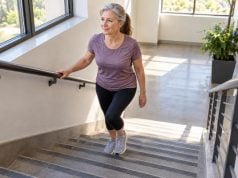
For people building fitness, hills and stairs can raise intensity without requiring running. Short bouts can be effective, but they also increase joint and cardiovascular demand. If you want to use stairs deliberately, progress gradually rather than suddenly doing many flights at maximum effort.
If you take a beta-blocker or have a heart rhythm condition, heart-rate targets may be less straightforward. Perceived exertion and clinician guidance may be more useful than a generic watch alert. For people without those issues, a target heart-rate range can provide another way to estimate exercise intensity.
How to Set a Personal Step Target
The best target starts with your current average, not with a slogan. Track a normal week before making large changes. Include weekdays and weekends because activity can differ dramatically between them.
Suppose your seven-day average is 3,200 steps. Jumping immediately to 10,000 would require more than tripling your activity and may create soreness, fatigue, or frustration. A better first target might be 3,700 to 4,200 steps. Once that feels routine, increase again.
A simple approach is to add 500 to 1,000 steps per day to your baseline, maintain that level for one or two weeks, and then decide whether to add more. At an ordinary walking pace, 1,000 steps often represents roughly 8 to 12 minutes of walking, though body size and pace vary.
Choose a goal based on function and risk:
- If you are very inactive: prioritize consistency and reduce long periods of sitting. An extra 500 daily steps is meaningful.
- If you already average 5,000–6,000: working toward 7,000–8,000 may capture additional benefit without making 10,000 mandatory.
- If you already exceed 10,000 comfortably: there is no need to reduce your steps. Focus on fitness, strength, recovery, and whether the activity is sustainable.
- If you have mobility limitations: the ideal step count may be lower, and non-walking activity can provide cardiovascular benefit.
- If you are training for performance: steps alone are too crude; use structured aerobic and strength training as well.
Do not compare wristwatch numbers too literally across devices. Phones, watches, and hip-worn trackers use different algorithms and positions, so the same walk may produce different counts. Consistency with the same device is more useful than chasing an exact universal number.
Also separate daily minimums from weekly averages. Missing a target on one busy or sick day does not erase the week. A weekly average encourages recovery when needed and reduces the urge to pace around late at night just to satisfy a device.
How to Increase Steps Safely
Most healthy adults can increase walking gradually without special testing, but the safest progression respects symptoms, joints, footwear, and medical history.
Start by spreading movement through the day. Three 10-minute walks may be easier on the feet and knees than one 30-minute session. Short walking breaks also interrupt prolonged sitting, which is useful even if your total daily step count is unchanged.
Practical ways to add 500–2,000 steps include:
- take a 5- to 10-minute walk after one or two meals;
- walk during phone calls;
- use a farther entrance or parking spot;
- add one loop around the block before going inside;
- walk part of a commute when safe;
- take stairs for one or two floors, then build gradually; or
- schedule a short evening walk instead of trying to “make up” thousands of steps at bedtime.
Increase only one major variable at a time. If you are adding both step volume and faster walking, raise one first, let your body adapt, and then change the other. Sudden increases are more likely to cause foot pain, shin soreness, tendon irritation, or flare-ups of arthritis.
Supportive shoes matter more as volume rises. Replace footwear that is badly worn, and pay attention to hot spots, blisters, swelling, or persistent pain. People with diabetes and loss of foot sensation should inspect their feet regularly and may need individualized footwear advice.
Stop exercising and seek urgent medical help for chest pressure, fainting, severe unexplained shortness of breath, or symptoms suggesting a heart attack. If walking repeatedly causes calf pain that begins with exertion and improves with rest, discuss it with a clinician because peripheral artery disease is one possible cause.
People with known cardiovascular disease, recent surgery, severe valve disease, unstable symptoms, or major mobility problems may need a clinician or cardiac rehabilitation team to set a safe starting level.
Steps vs Structured Exercise
Step count is a good activity metric, but it does not replace the broader goals of cardiovascular fitness and muscle strength. Two people can both record 8,000 steps while having very different exercise patterns: one may stroll slowly throughout the day, while the other includes a brisk 40-minute walk. Their step counts are similar, but the training stimulus is not.
Public health activity recommendations are still commonly expressed as weekly time: roughly 150 minutes of moderate-intensity aerobic activity or 75 minutes of vigorous activity for adults, plus muscle-strengthening work on at least two days per week. Steps can help you reach the aerobic portion, especially when some walking is brisk, but they do not measure strength training well.
For the strongest all-around heart-health plan, combine:
- daily movement to keep sedentary time down;
- brisk aerobic sessions that raise breathing and heart rate;
- strength training two or more days per week; and
- recovery adequate for your age, health, and training level.
If you enjoy steady aerobic training, Zone 2 cardio is one way to organize moderate-intensity sessions. If you need a practical weekly blend, combining Zone 2 and strength training can help cover fitness qualities that a step goal misses.
Strength work may produce surprisingly few steps even though it improves muscle mass, glucose handling, function, and blood pressure. Do not let a tracker convince you that a strength-training day “does not count.” The device measures what it can detect, not everything your cardiovascular system benefits from.
Likewise, cycling, swimming, rowing, and wheelchair-based exercise may register few or no steps. If one of those is your main aerobic activity, use minutes, distance, power, perceived effort, or heart rate instead of trying to convert everything into imaginary steps.
How to Make a Higher Step Count Stick
The best step target is one you can maintain for months and years. Sustainability usually comes from changing routines rather than depending on motivation.
Build “anchors” into your day: 10 minutes after breakfast, a walk at lunch, or a loop after dinner. An anchor is easier to repeat because it is attached to something that already happens. If weather or safety makes outdoor walking unreliable, identify an indoor backup such as a hallway, mall, treadmill, or short walking video.
Use your tracker as feedback, not judgment. Look at trends over one or four weeks. A rising average from 3,500 to 4,800 is meaningful progress even if the screen never displays 10,000. If your average stalls, ask what friction is getting in the way: time, pain, boredom, weather, work, or an unrealistic target.
You can also use a two-level goal. Set a minimum that you can achieve on most busy days and a stretch target for days with more time. For example, a person might use 5,500 as the minimum and 7,500 as the stretch goal. This avoids the all-or-nothing cycle in which one missed target makes the entire plan feel ruined.
Make some steps purposeful. Walk to complete an errand, meet a friend, take a pet outside, or listen to a favorite podcast only while moving. Purpose reduces the sense that walking is another chore.
Finally, remember what the number represents. The goal is not to win a step-count contest. It is to spend less of life sitting still, build enough movement to improve cardiovascular health, and maintain the capacity to walk, climb, work, travel, and live independently. For many adults, 7,000 steps is a strong evidence-based target; for someone starting at 2,000, the next 500 steps may be the most important ones.
References
- Daily steps and health outcomes in adults: a systematic review and dose-response meta-analysis 2025 (Systematic Review)
- Objectively measured daily steps and health outcomes: an umbrella review of the systematic review and meta-analysis of observational studies 2024 (Umbrella Review)
- Daily steps and all-cause mortality: An umbrella review and meta-analysis 2024 (Umbrella Review)
- Relationship of Daily Step Counts to All-Cause Mortality and Cardiovascular Events 2023 (Meta-Analysis)
- Prospective Association of Daily Steps With Cardiovascular Disease: A Harmonized Meta-Analysis 2023 (Meta-Analysis)
- Daily steps and all-cause mortality: a meta-analysis of 15 international cohorts 2022 (Meta-Analysis)
Disclaimer
This article is for general education and does not replace individualized medical advice. If you have known heart disease, severe lung disease, major mobility limitations, recent surgery, or symptoms such as exertional chest pressure or fainting, ask your clinician what level of walking is safe for you. Increase step counts gradually and stop activity for concerning symptoms.