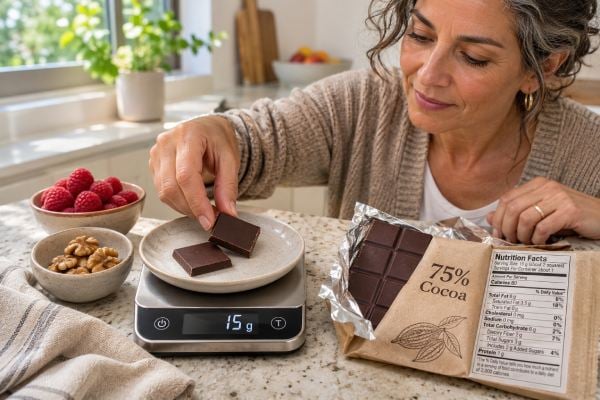
Dark chocolate can fit into a blood-pressure-friendly diet, and cocoa-rich foods may produce a small reduction in blood pressure when eaten regularly. The benefit is linked mainly to cocoa flavanols, plant compounds that can support blood-vessel function. That does not mean the darkest bar on the shelf is a treatment for hypertension. Cocoa percentage does not reliably reveal flavanol content, and chocolate also brings calories, saturated fat, and often added sugar. For most people, a practical choice is a dark chocolate around 70–85% cocoa, eaten in a modest portion of about 10–20 grams. Higher percentages can reduce sugar further if you enjoy the taste, but they are not automatically higher in flavanols or better for blood pressure. The best option is one you can enjoy in a small serving, with relatively little added sugar, without displacing more important foods such as vegetables, fruit, whole grains, beans, nuts, fish, and other staples of a heart-healthy diet.
Table of Contents
- Does Dark Chocolate Lower Blood Pressure?
- What Cocoa Percentage Should You Choose?
- Best Serving Size for Dark Chocolate
- How to Choose the Best Dark Chocolate
- Sugar, Saturated Fat, and Calorie Tradeoffs
- Safety, Caffeine, and Heavy Metals
- How to Fit Dark Chocolate Into a Heart-Healthy Diet
Does Dark Chocolate Lower Blood Pressure?
Cocoa contains flavanols, including epicatechin, that can improve signaling related to nitric oxide. Nitric oxide helps the smooth muscle in artery walls relax, which can improve endothelial function and slightly reduce vascular resistance.
Randomized trials support a modest effect rather than a dramatic one. A 2024 meta-analysis of 31 randomized trials found that cocoa products reduced systolic blood pressure by about 2.5 mmHg and diastolic pressure by about 1.6 mmHg on average. A 2022 review focused on cocoa beverages and dark chocolate also found reductions in both systolic and diastolic pressure after at least two weeks of use. The size of the effect varied widely across studies.
A 2026 review of cocoa-flavanol trials reported a similar average reduction of about 2.7 mmHg systolic and 1.8 mmHg diastolic, along with improvement in measures of vascular function. People with higher starting blood pressure may have more room to improve, but the response is not predictable for an individual.
These numbers put dark chocolate in perspective. A 2–3 mmHg average systolic reduction is useful as part of an overall pattern, but it is not enough to turn severe hypertension into normal blood pressure. It also does not mean one square of chocolate lowers pressure within minutes. Most studies examine repeated intake over weeks.
The research often uses products chosen for flavanol content, not ordinary candy bars grabbed from a supermarket shelf. Study chocolate may provide known amounts of cocoa flavanols, whereas retail bars rarely list them. The exact dose therefore matters more than the phrase “dark chocolate.”
If you have hypertension, dark chocolate should be an optional food rather than the foundation of treatment. Dietary patterns such as DASH for high blood pressure, sodium reduction, exercise, weight management when needed, and prescribed medication have stronger practical roles.
What Cocoa Percentage Should You Choose?
Cocoa percentage is the easiest number to see on a chocolate wrapper, but it is commonly misunderstood. A bar marked 70% cocoa means about 70% of the product comes from cocoa ingredients, generally cocoa solids and cocoa butter. The remaining portion may include sugar, milk ingredients, emulsifiers, flavors, nuts, fruit, or other additions.
As cocoa percentage rises, added sugar usually falls. That makes higher-percentage dark chocolate useful for people who want intense chocolate flavor with less sweetness. However, cocoa percentage is not a direct measurement of flavanols.
Processing can change flavanol content substantially. Fermentation, roasting, and alkalization can reduce these compounds. Two 80% bars can therefore contain very different flavanol amounts. A bar with 90% cocoa is not guaranteed to contain more flavanols than a carefully processed 70% bar.
For everyday shopping, these ranges are practical:
| Cocoa percentage | Typical practical use | Main tradeoff |
|---|---|---|
| 50–69% | Easier transition from milk chocolate | Usually more added sugar |
| 70–84% | Good balance of lower sugar and palatable bitterness for many people | Still calorie-dense and may contain meaningful saturated fat |
| 85–100% | Very low-sugar option for people who enjoy intense cocoa flavor | More bitter; higher percentage does not guarantee higher flavanols |
For most people, 70–85% is a sensible starting range. It is dark enough to reduce sugar compared with many milk chocolates without requiring the extreme bitterness of nearly unsweetened chocolate. If you genuinely enjoy 85–90%, that can be a good choice too.
Do not buy a 95% bar solely because you think it is medicinal. If you dislike it, you may compensate with larger portions of sweet foods later, or the bar may simply sit unused. A sustainable choice is more valuable than a theoretically “healthier” percentage you do not enjoy.
If your goal is specifically flavanols rather than chocolate, read how cocoa flavanol dose relates to blood pressure. Products that state a measured flavanol amount are more informative than cocoa percentage alone.
Best Serving Size for Dark Chocolate
There is no official therapeutic serving of dark chocolate for blood pressure. Trials have used widely different amounts, and many research products were designed to deliver a specific flavanol dose rather than mimic a normal snack.
For everyday eating, about 10–20 grams is a practical serving for most adults. Depending on the bar, that may be one or two small squares. The purpose of that range is portion control, not because 10 or 20 grams has been proven to be the ideal blood-pressure dose.
Chocolate is energy-dense. Many dark bars contain around 500–650 calories per 100 grams, although brands vary. At 600 calories per 100 grams, a 10-gram piece provides about 60 calories, 20 grams about 120 calories, and half a 100-gram bar about 300 calories. Small servings make it much easier to fit chocolate into the day without unintentionally raising total calorie intake.
A smaller serving also limits saturated fat and sugar. That matters because the cardiovascular value of cocoa can be undermined if eating large amounts of chocolate contributes to weight gain or displaces foods with better overall nutrient profiles.
If you currently eat a large dessert portion of chocolate every evening, reducing the portion may benefit your diet even if the cocoa percentage stays the same. If you rarely eat sweets, there is no need to start eating dark chocolate every day for your heart.
Frequency is flexible. A 10–20 gram portion several times per week can fit comfortably for many people. Daily intake can also fit if the calories are accounted for and the rest of the diet is strong. What matters is the whole pattern.
Avoid using chocolate as a response to a single high blood-pressure reading. Blood pressure moves with stress, recent activity, caffeine, pain, sleep, hydration, and measurement technique. If a reading is unexpectedly high, repeat it correctly rather than eating chocolate in hopes of bringing it down. Learning how to measure blood pressure at home is far more useful for understanding your actual trend.
How to Choose the Best Dark Chocolate
A good dark chocolate for heart health does not need a long list of health claims. The Nutrition Facts panel and ingredient list tell you more than marketing language.
Start with cocoa percentage. Around 70–85% is a useful range if you want less sugar while keeping the flavor approachable. Then compare products within that range.
Look at serving size and calories. Some labels list a serving as one-third of a bar; others use a few squares. Convert mentally to the amount you actually plan to eat. A modest serving should not become a large calorie source just because the product is marketed as premium dark chocolate.
Check added sugar. Higher-cocoa bars usually contain less, but brands vary. Compare grams per serving rather than assuming all 70% products are equivalent. If one 70% bar contains substantially less added sugar than another and you like both, the lower-sugar version is an easy choice.
Check saturated fat. Cocoa butter naturally contains saturated fat, so even unsweetened chocolate can have a meaningful amount. You do not need a fat-free product, but the serving should fit your overall saturated-fat target, especially if you have high LDL cholesterol or established cardiovascular disease.
Keep ingredients simple when practical. Cocoa mass, cocoa liquor, chocolate, cocoa butter, sugar, vanilla, and an emulsifier are common. Nuts can add unsaturated fats, but candy pieces, caramel, cookies, and sweet fillings can turn a small dark-chocolate snack into a much larger dessert.
Avoid assuming words such as “organic,” “artisan,” “raw,” “single origin,” or “antioxidant” guarantee a cardiovascular advantage. They may describe sourcing or processing but do not tell you the product’s blood-pressure effect.
For a more flavanol-focused choice, look for a manufacturer that states cocoa flavanols in milligrams per serving and explains how they are measured. The FDA’s qualified health claim for high-flavanol cocoa powder does not apply broadly to ordinary dark chocolate, which is another reason not to treat every high-cocoa bar as equivalent.
Sugar, Saturated Fat, and Calorie Tradeoffs
Dark chocolate has a mixed nutrition profile. Cocoa solids provide minerals and polyphenols, but chocolate also contains cocoa butter, and most bars contain sugar. Whether it improves or worsens your overall diet depends heavily on portion size and what it replaces.
Sugar generally decreases as cocoa percentage rises. If a 70% bar and an 85% bar are otherwise similar, the 85% version often has less room for sugar. But the label is still the final word. Some bars include sweet fillings or other ingredients that change the calculation.
Added sugar is most concerning when total intake is high. Frequent sugary drinks, desserts, sweetened cereals, and snack foods can raise calorie intake and contribute to higher triglycerides and metabolic risk. A small square of dark chocolate can sometimes help someone replace a larger dessert, which can be a favorable trade. For context, see how added sugar affects heart risk.
Saturated fat is different. Cocoa butter contains stearic acid, which has a more neutral effect on LDL cholesterol than several other saturated fatty acids, but dark chocolate still contributes saturated fat and calories. It should not become a major daily fat source. If you already eat a diet high in butter, fatty meats, cheese, and coconut oil, adding large amounts of dark chocolate increases the total saturated-fat burden.
The better comparison is often substitution. Ten grams of dark chocolate replacing a frosted cookie may improve the snack. Fifty grams of chocolate added on top of an already adequate diet may simply add calories. Chocolate replacing nuts, fruit, or plain yogurt is not necessarily an upgrade.
People with high LDL or ApoB should pay special attention to the total pattern. Replacing saturated fats with unsaturated fats from olive oil, nuts, seeds, and fish is more important than trying to use cocoa to offset a high-saturated-fat diet. A small chocolate portion can coexist with that pattern, but it does not neutralize it.
If weight loss is part of your blood-pressure plan, pre-portion the chocolate rather than eating from a large bar. Put one or two squares on a plate, close the package, and eat them slowly. The strong flavor of higher-cocoa chocolate makes this easier for many people.
Safety, Caffeine, and Heavy Metals
Dark chocolate is safe for most adults in normal food portions, but a few concerns are worth understanding.
Cocoa naturally contains caffeine and theobromine. The amounts vary with cocoa content and product size. Most small chocolate servings provide much less caffeine than a cup of coffee, but sensitive people can still notice stimulation, palpitations, reflux, or trouble sleeping. If dark chocolate affects your sleep, eat it earlier in the day or reduce the serving.
Chocolate can trigger reflux symptoms in some people. It is also a reported migraine trigger for some, although triggers differ from person to person. Cocoa contains oxalate, so people with recurrent calcium oxalate kidney stones may want individualized advice about large, frequent servings.
Cadmium and lead have received attention because cacao plants and cocoa products can contain these metals. The FDA notes that cadmium levels in chocolate vary with growing region and cocoa-solids percentage, and that chocolate is a relatively minor source of dietary cadmium overall in international exposure estimates. Still, eating a varied diet and avoiding very large daily chocolate portions is sensible.
The presence of detectable metals does not automatically mean a product is unsafe. Risk depends on dose, frequency, total exposure, age, pregnancy status, and the specific product. Brand-to-brand testing can also change by batch and origin, so sensational one-time rankings are not a durable way to choose chocolate.
Pregnant people and young children should be more conservative about unnecessary sources of lead and cadmium because these groups are especially vulnerable to heavy-metal exposure. For adults, portion control and dietary variety are practical safeguards.
If you take blood-pressure medication, a small chocolate serving is unlikely to cause a dangerous interaction by itself. However, if your pressure is already low or you develop dizziness or fainting, talk with your clinician. Do not reduce medication because you have added dark chocolate to your diet.
If you have a true cocoa allergy, of course, avoid it. Also check labels for milk, nuts, soy, or other allergens that may be present in chocolate products.
How to Fit Dark Chocolate Into a Heart-Healthy Diet
The easiest way to use dark chocolate well is to decide where it fits before you open the package. Treat it as a small pleasure within an eating pattern built mostly from minimally processed foods.
A practical routine might be 10–20 grams of 70–85% dark chocolate after dinner, paired with fruit, or a square alongside unsalted nuts. Another option is to shave a small amount over plain yogurt with berries. These combinations can make a modest portion feel more satisfying.
If you prefer less sugar, move gradually from 60% to 70%, then perhaps to 80–85%. Taste adapts, and there is no prize for choosing the most bitter bar. If 85% makes you reach for extra sweets afterward, a 70% bar in a controlled portion may be the better real-world choice.
If your goal is blood pressure, focus on the hierarchy of impact. First, know your actual pressure with good home measurement. Second, follow the treatment plan recommended by your healthcare professional. Third, build the larger diet around vegetables, fruit, whole grains, legumes, nuts, seeds, lean proteins, and appropriate sodium intake. Then decide whether dark chocolate fits as a small extra.
You can evaluate the effect of your overall lifestyle by tracking home blood pressure under consistent conditions. Use averages across several days, not a reading taken immediately before and after chocolate. A true dietary effect is generally small and gradual.
There is no need to search for a “blood-pressure chocolate” with extravagant promises. A good product has a cocoa percentage you enjoy, a manageable amount of added sugar, a serving size you can keep modest, and no need for oversized portions to feel satisfied. If a product states a verified flavanol amount, that is useful information, but it is not required for someone who simply wants a small piece of dark chocolate as part of a healthy diet.
The bottom line is simple: 70–85% dark chocolate in a 10–20 gram serving is a reasonable default. Choose higher cocoa percentages if you prefer them and want less sugar, not because 90% is guaranteed to lower blood pressure more. Keep the portion small, compare labels, and let the rest of your eating pattern do the heavy lifting for cardiovascular health.
One more useful shopping habit is to compare two or three bars side by side rather than relying on the front label. Use the same serving weight, such as 20 grams, to compare calories, added sugar, and saturated fat. A brand that lists nutrition for 30 grams can look very different from one that lists 15 grams even when the products are similar. Converting both to the same weight prevents that confusion. Also consider how the bar is packaged. Individually wrapped squares or clearly scored portions can make a 10–20 gram serving easier to maintain than an oversized bar with no obvious break points. These details do not change cocoa biology, but they make the healthy portion more realistic in daily life.
If you eat dark chocolate most days, count it as part of your overall calorie and saturated-fat intake rather than as a free health food. Small portions are easier to fit without displacing fruit, nuts, legumes, or other nutrient-dense foods. The best choice is one you enjoy enough to keep the serving modest and consistent.
References
- Impact of cocoa flavanols on blood pressure and vascular function: an updated systematic review and meta-analysis of randomized controlled trials 2026 (Systematic Review)
- Effects of Cocoa Consumption on Cardiometabolic Risk Markers: Meta-Analysis of Randomized Controlled Trials 2024 (Systematic Review)
- Effect of Cocoa Beverage and Dark Chocolate Consumption on Blood Pressure in Those with Normal and Elevated Blood Pressure: A Systematic Review and Meta-Analysis 2022 (Systematic Review)
- Impact of flavan-3-ols on blood pressure and endothelial function in diverse populations: a systematic review and meta-analysis of randomized controlled trials 2025 (Systematic Review)
- Cadmium in Food and Foodwares | FDA 2025
- FDA Announces Qualified Health Claim for Cocoa Flavanols in High Flavanol Cocoa Powder and Reduced Risk of Cardiovascular Disease | FDA 2023
Disclaimer
This article is for general education and is not a substitute for individualized medical or nutrition advice. Dark chocolate is not a treatment for hypertension and should not replace prescribed medication or clinician-recommended lifestyle changes. If you have cardiovascular disease, kidney disease, recurrent kidney stones, diabetes, or persistently high or low blood pressure, discuss your diet and treatment goals with a healthcare professional.