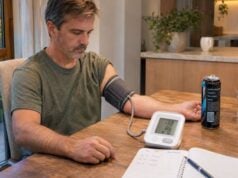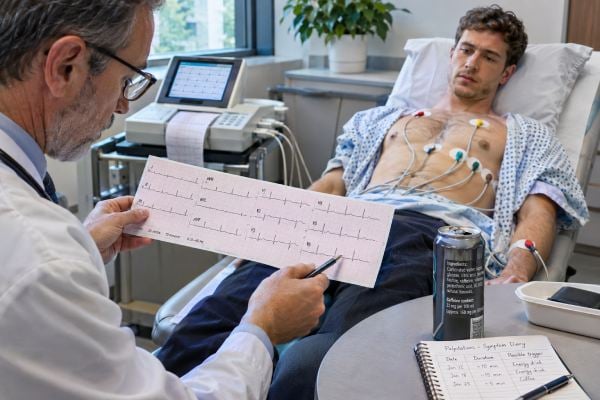
Energy drinks can trigger palpitations and measurable electrical changes in the heart, and rare reports link them to serious arrhythmias. The main concern is not that every can causes a dangerous rhythm. It is that high stimulant doses can raise sympathetic activity, alter heart rate and blood pressure, and sometimes lengthen the corrected QT interval, or QTc—the part of an EKG that reflects how long the ventricles take to electrically reset. Risk appears highest when a susceptible person combines a large energy-drink dose with an underlying rhythm disorder, certain medications, dehydration, sleep loss, nicotine, or intense exercise. Most healthy adults who consume a modest amount will not develop a life-threatening arrhythmia, but “healthy” does not always mean “no hidden electrical vulnerability.” If energy drinks repeatedly cause a racing or irregular heartbeat, the safest move is to stop the trigger rather than push through it. Chest pain, fainting, severe shortness of breath, or sustained rapid palpitations need prompt medical evaluation.
Table of Contents
- How Energy Drinks Affect Heart Rhythm
- What QT and QTc Risk Actually Mean
- Which Arrhythmias Are Reported?
- Who Is Most Vulnerable to Rhythm Problems?
- Risky Combinations and Triggers
- When Palpitations Need Medical Care
- Safer Alternatives to Energy Drinks
How Energy Drinks Affect Heart Rhythm
Energy drinks expose the heart to more than caffeine alone. A typical product may combine caffeine with guarana, taurine, sugar or noncaloric sweeteners, B vitamins, herbal extracts, and other compounds. The exact formula varies widely, which makes it difficult to treat all energy drinks as one uniform exposure.
Caffeine blocks adenosine receptors and increases sympathetic nervous system activity. In practical terms, it can make the heart beat faster or more forcefully, increase blood pressure, and make ectopic beats—extra beats arising outside the normal pacemaker—more noticeable. People who are anxious, sleep deprived, dehydrated, or unaccustomed to caffeine may feel these effects more strongly.
Energy-drink studies have found a mixture of responses. A 2025 systematic review reported increases in heart rate, blood pressure, QTc, and other EKG changes across many included studies. A 2023 meta-analysis of randomized trials confirmed acute increases in blood pressure but did not find a statistically significant overall change in resting heart rate or QT/QTc. These findings are not truly contradictory: study designs, doses, brands, sample sizes, and participant characteristics differ, and a small average effect can coexist with larger responses in a vulnerable minority.
This is why case reports of serious arrhythmias cannot establish how common the problem is, but they also should not be dismissed. A rare trigger can matter greatly to a person with an inherited channel disorder, cardiomyopathy, prior arrhythmia, or interacting medication.
If your main symptom is skipped beats, premature ventricular contractions and skipped beats explains why isolated extra beats are often benign but sometimes deserve further testing.
The absolute caffeine dose is only part of the exposure. How fast the dose arrives matters because a large can or concentrated shot can be consumed in minutes. A 200–300 mg caffeine load taken quickly may produce more noticeable sympathetic stimulation than the same amount spread across a morning. Smaller people also receive a higher dose per kilogram from the same container.
Caffeine clearance varies substantially. The average half-life is several hours, but pregnancy, liver disease, interacting medicines, and genetic differences can lengthen it. This means a second energy drink may be added while much of the first dose is still active. Late-day use also increases the chance of sleep disruption, which can create more stimulant use the next day.
Another important distinction is between palpitations and documented arrhythmia. Palpitations describe a sensation; they can occur during normal sinus rhythm, sinus tachycardia, premature beats, or a sustained arrhythmia. A person may feel dramatic pounding with a normal rhythm, while a clinically important arrhythmia can occasionally produce surprisingly little sensation. Capturing the rhythm during symptoms is therefore more useful than trying to identify the rhythm from the feeling alone.
What QT and QTc Risk Actually Mean
The QT interval is measured on an electrocardiogram, or EKG/ECG. It represents the time from the start of ventricular activation to the end of ventricular electrical recovery. Because QT changes with heart rate, clinicians usually use a corrected value called QTc.
A prolonged QTc can increase the risk of a specific dangerous ventricular rhythm called torsades de pointes, especially when QT prolongation is marked or combined with other risk factors. But QTc is not a simple on/off switch. Small changes may not be clinically important, while a large change in a susceptible person can be dangerous.
The 2022 European guideline on ventricular arrhythmias uses QTc thresholds as part of the diagnostic framework for long-QT syndrome. In clinical practice, interpretation also considers sex, heart rate, symptoms, family history, medications, electrolyte levels, and whether the QT prolongation is persistent.
Energy drinks have attracted attention because some controlled studies and reviews have found QTc lengthening after consumption. The magnitude is usually modest in healthy volunteers. The bigger concern is additive risk: an energy drink on top of another QT-prolonging drug, low potassium or magnesium, congenital long-QT syndrome, severe bradycardia, or acute illness.
A person cannot feel a long QT interval directly. Palpitations do not tell you whether the QTc is normal or prolonged. Only an EKG can measure it.
It is also important not to confuse QT prolongation with every irregular heartbeat. Atrial fibrillation, premature beats, supraventricular tachycardia, and ventricular tachycardia are different electrical problems with different mechanisms. Energy drinks may act as a nonspecific trigger by increasing catecholamines and cardiac excitability rather than causing one single type of arrhythmia.
Electrolytes are especially relevant to QT risk. Low potassium, low magnesium, and low calcium can prolong repolarization and make certain ventricular arrhythmias more likely. Vomiting, diarrhea, heavy diuretic use, eating disorders, and some kidney or endocrine conditions can create these abnormalities. A stimulant exposure that is uneventful when electrolytes are normal may be less predictable when they are not.
Medication interactions are another major source of acquired QT prolongation. Some antibiotics, antiarrhythmics, antipsychotics, antidepressants, anti-nausea drugs, and other medicines can lengthen QT. The degree of risk depends on the exact drug, dose, kidney and liver function, and whether other QT-prolonging agents are present. If a medication guide warns about QT prolongation, adding a high-dose energy drink is a good reason to ask a pharmacist or prescriber about the combination.
Clinicians become especially concerned when QTc is markedly prolonged, when the QT has increased substantially from a person’s baseline, or when prolongation appears alongside fainting or documented ventricular arrhythmia. Borderline automated values should be confirmed manually because formulas and computer measurements can be inaccurate at very fast or very slow heart rates.
Which Arrhythmias Are Reported?
The most common effect people notice is palpitations—an awareness of the heartbeat that may feel fast, pounding, fluttering, or skipped. Palpitations can occur even when the rhythm is technically normal sinus tachycardia.
Other reported rhythm disturbances include:
- Premature atrial contractions
- Premature ventricular contractions
- Supraventricular tachycardia
- Atrial fibrillation or atrial flutter
- Ventricular tachycardia
- Torsades de pointes in the setting of substantial QT prolongation
- Ventricular fibrillation or sudden cardiac arrest in rare case reports
A randomized trial in children and teenagers published in 2022 found more supraventricular extrasystoles after an energy drink than after placebo, although malignant ventricular arrhythmias were not observed. This is a useful reminder that even when a study does not show catastrophic outcomes, an energy drink can still change cardiac electrical behavior.
Case reports and forensic reports are more likely to feature dramatic events, so they cannot tell us incidence. They are most useful for identifying patterns. A recurring pattern is a “trigger-on-substrate” scenario: a stimulant exposure triggers an event in someone who later turns out to have long-QT syndrome, catecholaminergic polymorphic ventricular tachycardia, an accessory pathway, cardiomyopathy, or another underlying vulnerability.
For atrial fibrillation specifically, everyday coffee and energy drinks should not be treated as equivalent exposures. Moderate coffee use is not consistently associated with increased AF risk, while energy drinks can deliver larger caffeine doses quickly and include other stimulants. Coffee, palpitations, and AFib explains that distinction in more detail.
Who Is Most Vulnerable to Rhythm Problems?
Energy-drink risk is higher when the heart already has an electrical or structural reason to be unstable.
People who should be especially cautious include those with:
- Congenital long-QT syndrome
- Brugada syndrome or another inherited channelopathy
- Catecholaminergic polymorphic ventricular tachycardia
- Wolff-Parkinson-White syndrome or another accessory pathway
- Hypertrophic cardiomyopathy or another cardiomyopathy
- A history of atrial fibrillation, supraventricular tachycardia, or ventricular arrhythmia
- Unexplained fainting, especially during exercise or emotional stress
- A family history of unexplained sudden death at a young age
- Significant coronary artery disease or heart failure
- Recurrent low potassium or magnesium
People who take QT-prolonging medication also need caution. Many medication classes can affect QT, including certain antiarrhythmics, antibiotics, antipsychotics, antidepressants, antiemetics, and others. Risk is higher when more than one QT-prolonging drug is used, kidney or liver function is impaired, or electrolyte levels are abnormal.
If you take prescription medication and are unsure about QT risk, ask a pharmacist or clinician rather than relying on an internet list. Medication dose, kidney function, and the specific combination matter.
Children and teenagers also deserve extra caution because the same can provides a higher caffeine dose per kilogram of body weight. The randomized pediatric trial showing more supraventricular extra beats supports avoiding the assumption that energy drinks are harmless in young people.
Risky Combinations and Triggers
An energy drink is more likely to cause trouble when several stressors occur together.
Multiple energy drinks in a short period
Large caffeine doses consumed quickly produce a higher peak exposure than the same amount spread over many hours. “Binge” use is especially concerning when a person is not caffeine tolerant.
Energy drinks plus nicotine
Nicotine increases catecholamine release, heart rate, and blood pressure. Combining vaping, cigarettes, or nicotine pouches with a high-caffeine drink can intensify palpitations and sympathetic stimulation.
Energy drinks plus prescription stimulants
ADHD medications and other sympathomimetic drugs may already increase heart rate or blood pressure. Adding an energy drink can create a larger total stimulant load. A prescriber can help decide whether any caffeine is reasonable.
Dehydration and heavy exercise
Exercise raises catecholamines and heart rate. Heat and dehydration can alter electrolyte balance and increase cardiovascular strain. Using a stimulant-heavy energy drink as a “hydration” product during a long hot workout is a poor match for the goal.
If dehydration itself causes racing heart or skipped beats, hydration and heart-rate changes explains why replacing fluid may help without adding stimulants.
Sleep deprivation
A common use pattern is an energy drink after a short night, followed by another later in the day. Sleep loss increases sympathetic stress and can make palpitations more likely, while late caffeine can further delay sleep. The result can become a self-reinforcing cycle.
Alcohol
Caffeine can make a person feel less sedated without reducing alcohol impairment. The combination can promote heavier drinking and obscure warning signs of intoxication. It also adds dehydration and autonomic stress.
When Palpitations Need Medical Care
A brief flutter after a strong energy drink that stops when the caffeine wears off is often not an emergency. But some symptoms should not be watched at home.
Seek urgent or emergency evaluation for palpitations accompanied by:
- Fainting or near-fainting
- Chest pain or pressure
- Severe shortness of breath
- New weakness, confusion, or neurologic symptoms
- Sustained very rapid heartbeat that does not settle with rest
- A family history of sudden unexplained death plus new symptoms
- Palpitations during exercise with dizziness or near-collapse
You should also arrange non-emergency medical evaluation if palpitations repeatedly occur after modest caffeine doses, happen without an obvious trigger, wake you from sleep, or are becoming more frequent.
An EKG can show rhythm, conduction intervals, and QTc at one moment. If symptoms come and go, a longer monitor may be more useful. Patch monitors and other ambulatory devices can record rhythm over days or weeks. Zio patch monitoring is one example of how intermittent arrhythmias can be captured.
Do not use a smartwatch alert as a definitive diagnosis. Wearables can be useful for recording episodes, but an abnormal reading should be clinically reviewed when symptoms or risk factors are present.
When recurrent symptoms are evaluated, the testing is chosen to match how often they occur. A 12-lead EKG can reveal a rhythm problem that is present at the visit, measure PR, QRS, and QTc intervals, and show clues to structural disease. If the symptoms happen only a few times a week, a multi-day patch monitor may have a better chance of capturing the event. Very infrequent unexplained fainting may require longer monitoring.
An echocardiogram can look for structural problems such as cardiomyopathy, reduced pumping function, or significant valve disease. Blood tests may check potassium, magnesium, thyroid function, anemia, kidney function, or other contributors. Exercise testing is sometimes used when symptoms occur with exertion or when an inherited adrenergic arrhythmia is suspected.
Family history matters. Fainting during exercise, unexplained seizures, or sudden death in a first-degree relative at a young age can be clues to an inherited electrical disorder. Those histories deserve more attention than a generic “caffeine sensitivity” explanation. In selected cases, referral to an electrophysiologist or genetic evaluation is appropriate.
If energy drinks clearly trigger symptoms, stop them while the evaluation is underway. Continuing to reproduce a suspected trigger does not make the diagnosis more reliable and may add avoidable risk.
Safer Alternatives to Energy Drinks
If your goal is alertness, you can usually reduce rhythm risk by lowering the stimulant dose and simplifying the ingredient list.
Coffee or tea often provides a more predictable caffeine amount than a multi-stimulant energy drink. For people who are sensitive, half-caffeinated coffee or lower-caffeine tea may be enough. Decaffeinated coffee removes most of the stimulant while preserving the habit and flavor.
For exercise, use water for shorter sessions and a non-caffeinated electrolyte or carbohydrate drink when prolonged exercise truly requires it. “Energy” and “hydration” are different needs.
For afternoon fatigue, address the cause before escalating stimulant intake. A balanced meal, short walk, daylight exposure, and better sleep can improve alertness without producing a large catecholamine surge.
If you already know that caffeine triggers palpitations, the safest strategy is not to test your limit with progressively stronger products. Reduce or avoid the trigger and see whether symptoms resolve. If they do not, further evaluation is appropriate.
The bottom line is that serious arrhythmias from energy drinks appear uncommon, but the risk is concentrated in high doses, vulnerable people, and risky combinations. A can that is uneventful for one person may be a significant trigger for someone with an inherited electrical disorder, interacting medication, or previous arrhythmia. Choosing lower-dose caffeine—or no stimulant—provides a much wider safety margin.
If you decide to reduce caffeine after heavy daily use, tapering can be more comfortable than stopping abruptly. Sudden withdrawal can cause headache, fatigue, irritability, and poor concentration for several days. Reducing the daily dose in steps, switching one serving to tea or half-caffeinated coffee, and moving caffeine earlier in the day can lower exposure without creating a sharp withdrawal effect. This is a comfort strategy, not a requirement for someone who has had a dangerous rhythm; after a serious suspected stimulant-related arrhythmia, follow the treating clinician’s advice about complete avoidance.
References
- The Effects of Energy Drinks on the Cardiovascular System: A Systematic Review 2025 (Systematic Review)
- Caffeine and Cardiovascular Outcomes: Current Evidence and Clinical Perspectives 2026 (Review)
- Charged to death: Energy drinks, smart drugs, and sudden cardiac death 2026 (Review)
- Acute effects of energy drink consumption on cardiovascular parameters in healthy adults: a systematic review and meta-analysis of randomized clinical trials 2023 (Systematic Review)
- Energy Drinks and Their Acute Effects on Heart Rhythm and Electrocardiographic Time Intervals in Healthy Children and Teenagers: A Randomized Trial 2022 (RCT)
- 2022 ESC Guidelines for the management of patients with ventricular arrhythmias and the prevention of sudden cardiac death 2022 (Guideline)
Disclaimer
This article is for general education and does not replace medical diagnosis or treatment. People with known arrhythmias, inherited rhythm disorders, cardiomyopathy, recurrent fainting, or QT-prolonging medication should discuss energy-drink use with a clinician. Seek emergency care for palpitations with fainting, chest pain, severe shortness of breath, or persistent rapid rhythm.