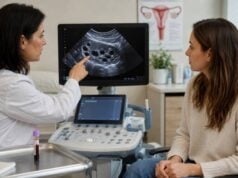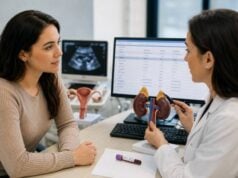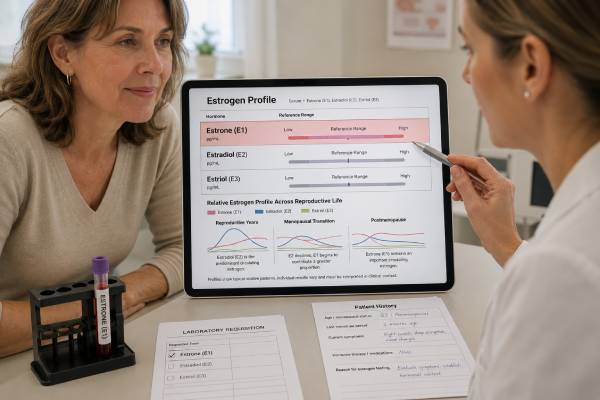
Estrone, or E1, is one of the body’s three main estrogens. It is less potent than estradiol but becomes the most abundant circulating estrogen after menopause, when the ovaries make much less estradiol and body tissues continue converting androgen precursors into estrone. An estrone blood test can help investigate unusual estrogen production, ovarian or adrenal disorders, selected tumors, unexplained menstrual changes, and specialized treatment monitoring. It is not routinely needed to diagnose natural menopause in a woman over 45 with a typical history, and it cannot confirm a vague condition called “estrogen dominance.” Results vary with age, menstrual-cycle timing, pregnancy, body composition, medicines, and the laboratory method. A high or low number therefore needs comparison with the laboratory’s own reference interval and with related tests such as estradiol, follicle-stimulating hormone, luteinizing hormone, pregnancy testing, and sometimes androgen levels. Symptoms and clinical context remain more important than an isolated E1 result.
- Estrone is the main circulating estrogen after menopause: much of it forms in fat and other tissues from androgen precursors.
- There is no universal E1 normal range: values differ by life stage, cycle phase, assay, and laboratory.
- High estrone can reflect medication, pregnancy, greater peripheral aromatization, or rarely an estrogen-producing disorder.
- Low estrone commonly accompanies menopause or reduced ovarian function: it may also occur with low energy availability or estrogen-suppressing treatment.
- Routine menopause care rarely requires E1 monitoring: the test is most useful when a specific diagnostic or treatment question exists.
Table of Contents
- What Estrone Is and How the Body Makes It
- Why an Estrone Test Is Ordered
- Testing, Preparation, and Accuracy
- Estrone Normal Ranges and Result Interpretation
- High Estrone Causes and Symptoms
- Low Estrone Causes and Symptoms
- Next Tests, Treatment, and When to Seek Care
What Estrone Is and How the Body Makes It
Estrone is a steroid hormone labeled E1 because it was the first estrogen identified. The other major natural estrogens are estradiol, or E2, and estriol, or E3. Estradiol has the strongest estrogen effect during the reproductive years. Estriol rises mainly during pregnancy. Estrone has weaker activity than estradiol but remains biologically active and can be converted back into estradiol in several tissues.
Before menopause, the ovaries produce estrone directly and make androstenedione and estradiol that can be converted into E1. After menopause, ovarian estradiol production falls sharply. Estrone then comes mainly from peripheral aromatization: the aromatase enzyme in fat, muscle, skin, bone, brain, and other tissues converts androstenedione into estrone. The adrenal glands and postmenopausal ovaries provide some of the androgen precursors used in this pathway.
This explains why estrone is often the dominant circulating estrogen after menopause even though total estrogen exposure is much lower than it was before menopause. A person with more adipose tissue may have greater aromatase activity and higher average estrone production, but body size does not predict an individual result precisely.
Estrone and estrone sulfate
Estrone moves through several related forms. The enzyme 17-beta-hydroxysteroid dehydrogenase can interconvert estrone and estradiol. Estrone can also be sulfated to form estrone sulfate, a less active circulating reservoir. Tissues with sulfatase enzymes can convert estrone sulfate back into estrone. The liver further metabolizes estrogens and helps prepare them for elimination in urine or bile.
A routine E1 blood test generally measures unconjugated estrone, not estrone sulfate and not a total of every estrogen metabolite. Commercial urine panels may report multiple metabolites and ratios, but those numbers are not interchangeable with a standard serum estrone test.
Estrogen receptors are present in reproductive tissues, bone, the brain, blood vessels, skin, and other organs. Estrone can activate these receptors, although its effect is weaker than estradiol’s. The clinical meaning of a measured E1 level therefore depends on the total hormonal setting, including estradiol, progesterone, androgens, receptor sensitivity, medication exposure, and life stage.
The term “estrogen balance” is often used in wellness marketing, but medicine does not define one ideal estrone-to-estradiol or estrogen-to-progesterone ratio for all women. A ratio calculated from two fluctuating blood values should not be used by itself to diagnose a disorder or choose supplements.
Why an Estrone Test Is Ordered
Estrone is not part of every hormone evaluation. Clinicians order it when E1 itself may clarify a specific problem or when a sensitive estrogen measurement is needed alongside estradiol.
Possible reasons include:
- investigating unexpectedly high estrogen exposure after menopause;
- evaluating an ovarian, adrenal, or other hormone-producing mass;
- assessing unexplained uterine bleeding together with imaging and other tests;
- clarifying ovarian function in selected cases of amenorrhea, early menopause, or premature ovarian insufficiency;
- monitoring estrogen suppression in some patients receiving aromatase inhibitors or ovarian-suppression treatment for hormone-sensitive cancer;
- checking exposure to an estrogen-containing medicine when absorption, adherence, or assay interference is questioned;
- evaluating unusual pubertal development or a rare disorder of estrogen synthesis or metabolism.
Menopause usually does not require an estrone test
Natural menopause is diagnosed retrospectively after 12 consecutive months without a menstrual period when no other cause explains the change. In most women older than 45 with typical cycle changes, hot flashes, night sweats, or vaginal symptoms, routine hormone testing is unnecessary. Estrone and estradiol fluctuate during perimenopause, so one blood draw can look premenopausal one week and low another week.
Testing becomes more relevant when symptoms or absent periods occur before age 40, when the history is unclear, when hormonal contraception masks the cycle, or when another illness may mimic menopause. Even then, follicle-stimulating hormone and estradiol usually have a more established role than E1. An amenorrhea hormone panel may include pregnancy testing, FSH, LH, estradiol, prolactin, and thyroid testing based on the presentation.
Cancer treatment monitoring is specialized
Aromatase inhibitors reduce estrogen formation and are commonly used for estrogen-receptor-positive breast cancer in postmenopausal women. In premenopausal patients, they may be combined with ovarian suppression. Clinicians sometimes measure very low estradiol and estrone concentrations to confirm adequate suppression, especially when ovarian function could recover. This requires a sensitive assay because ordinary immunoassays can be unreliable near their lower detection limits.
Estrone testing is not a cancer screening test. A high result does not diagnose breast, ovarian, uterine, or adrenal cancer. Likewise, a normal result does not rule out cancer. Imaging, tissue sampling, examination, and condition-specific tests determine whether a mass or bleeding pattern is concerning.
Testing, Preparation, and Accuracy
An estrone test uses blood drawn from a vein, usually without fasting. The laboratory reports E1 in picograms per milliliter, picomoles per liter, or another stated unit. Unit conversion matters: a value in pmol/L cannot be compared directly with a pg/mL reference interval.
Preparation depends on the question being asked. Tell the clinician and laboratory about:
- menstrual-cycle dates and whether periods are regular;
- pregnancy or the possibility of pregnancy;
- menopause status and date of the last natural period;
- hormonal contraception;
- oral, transdermal, vaginal, implanted, or compounded estrogen products;
- fertility medicines;
- selective estrogen receptor modulators, aromatase inhibitors, or ovarian-suppression medicines;
- supplements that contain hormones, DHEA, pregnenolone, or high-dose biotin;
- recent ovarian surgery, chemotherapy, or pelvic radiation;
- liver, adrenal, ovarian, or thyroid disease.
Do not stop prescribed hormones or cancer treatment before testing unless the treating clinician gives exact instructions. The timing of the last dose may be important because oral and transdermal products produce different concentration patterns. Vaginal estrogen usually creates less systemic exposure than systemic therapy, but dose and formulation matter.
Cycle timing
In menstruating women, estrone changes during the cycle, though estradiol generally shows the larger ovulatory rise. A clinician may request collection during the early follicular phase, often cycle days 2 through 5, when comparing ovarian hormones. For another question, random testing may be appropriate. The report should be interpreted against a phase-specific interval whenever the laboratory provides one.
Assay method matters at low levels
Estrone can be measured by immunoassay or by liquid chromatography–tandem mass spectrometry, abbreviated LC-MS/MS. Immunoassays are convenient but may have cross-reactivity and limited precision at the very low concentrations found after menopause or during aromatase-inhibitor treatment. LC-MS/MS is more specific and usually better suited to low-level measurement, although quality still depends on the laboratory’s validation.
Results from different methods are not automatically interchangeable. A small change after switching laboratories may reflect assay differences rather than a biological change. Serial monitoring is clearest when the same laboratory and method are used.
Lab interference should be considered when a result is sharply inconsistent with symptoms, related hormones, or treatment. The clinician may repeat E1 using a mass-spectrometry method, check estradiol and estrone sulfate, or ask the laboratory to investigate interference rather than acting on one surprising number.
Estrone Normal Ranges and Result Interpretation
There is no single international normal range for estrone. Reference intervals depend on age, puberty status, menstrual phase, pregnancy, menopause, assay sensitivity, and the population used by the laboratory. The range printed beside the result is the correct starting point.
Many laboratories show broad premenopausal intervals because E1 changes across the cycle. Postmenopausal intervals are lower, often extending from values near the method’s detection limit to several tens of pg/mL. Published and commercial intervals differ enough that copying a cutoff from another laboratory can misclassify a result.
A useful interpretation asks four questions:
- Was the sample collected under the expected conditions? Cycle day, pregnancy, medication timing, and menopause status can change the comparison group.
- Is the unit correct? pg/mL and pmol/L are not the same.
- Was the method sensitive enough? Low-level monitoring may require LC-MS/MS.
- Do related findings agree? Estradiol, FSH, symptoms, imaging, and medication history can support or contradict the E1 result.
| Clinical setting | Expected general pattern | Important caution |
|---|---|---|
| Reproductive years | E1 varies with ovarian activity and cycle phase | One random result does not define fertility or ovulation. |
| Perimenopause | Levels can swing from high to low | A single test cannot reliably stage the transition. |
| Postmenopause | E1 is usually low but often exceeds estradiol | Body composition, medication, and assay sensitivity affect the value. |
| Pregnancy | Estrogen production rises | Estrone is not the main prenatal screening estrogen; uE3 is used in serum screening. |
| Aromatase-inhibitor treatment | Very low estrogen may be expected | Sensitive mass-spectrometry testing may be required. |
An estrone result should not be labeled “optimal,” “toxic,” or “imbalanced” solely because it falls in a narrower range used by a wellness service. Clinical reference intervals describe where most comparable people fall; they do not identify one ideal level for energy, mood, weight, or longevity.
A normal E1 does not prove that estrogen action is normal in every tissue. Symptoms such as hot flashes or vaginal dryness can occur despite overlap with laboratory reference ranges. Conversely, a result above the interval may be explained by treatment or normal physiology rather than disease.
High Estrone Causes and Symptoms
High estrone means the concentration exceeds the relevant laboratory range for the patient’s life stage and circumstances. The first step is to confirm pregnancy status, medications, cycle timing, and the assay method.
Common and expected explanations
Pregnancy increases estrogen production, so a nonpregnant reference interval would be inappropriate. Estrogen therapy can raise E1 directly or through metabolism. Oral estradiol undergoes first-pass metabolism in the liver and can produce substantially more estrone and estrone sulfate than transdermal estradiol. This difference does not automatically mean one route is unsafe or that E1 needs treatment; route selection depends on symptoms, risks, preferences, and clinician guidance.
Greater adipose aromatase activity can contribute to higher estrone after menopause. This is a population tendency, not a reason to assume that every person with a higher body mass index has excessive E1. Liver disease may change hormone metabolism and binding, and some drugs or supplements can add hormone precursors.
Ovarian, adrenal, and other disorders
An estrogen-producing ovarian tumor, such as certain sex-cord stromal tumors, can raise estrogen levels and cause postmenopausal bleeding or endometrial thickening. Some adrenal tumors produce androgen precursors that peripheral tissues convert into estrone. These causes are uncommon and usually present with other findings.
Polycystic ovary syndrome can be associated with altered estrogen-androgen dynamics, irregular ovulation, and continuous endometrial exposure without regular progesterone. Estrone may be relatively increased in some patients, especially with greater peripheral aromatization, but E1 is not a diagnostic test for PCOS. Diagnosis uses menstrual or ovulatory dysfunction, clinical or biochemical androgen excess, and ovarian features after excluding mimicking conditions.
Rare aromatase excess, ovarian hyperthecosis, or exogenous hormone exposure may also raise E1. Laboratory interference should remain on the list when the clinical picture does not fit.
Symptoms do not identify the hormone level
Possible effects of increased estrogen exposure include breast tenderness, heavier or irregular bleeding, bloating, headaches, or endometrial stimulation. These symptoms have many causes and cannot reveal whether E1 is high. Postmenopausal bleeding is never considered a normal symptom of “estrogen balance”; it needs timely evaluation because causes range from thinning vaginal tissue and polyps to endometrial cancer.
A high E1 result is not treated by “detoxing estrogen.” Treatment targets the cause. A clinician may adjust medication, evaluate the uterus, investigate an ovarian or adrenal source, address liver disease, or repeat the test with a more specific method.
Low Estrone Causes and Symptoms
Low estrone is expected after menopause and may be appropriate during estrogen-suppressing treatment. Whether it is abnormal depends on age, reproductive goals, symptoms, and the laboratory interval.
Common causes include:
- natural menopause or perimenopause;
- premature ovarian insufficiency or surgical removal of both ovaries;
- chemotherapy or radiation that reduces ovarian function;
- functional hypothalamic amenorrhea from low energy availability, substantial weight loss, intense exercise, or stress;
- pituitary or hypothalamic disease that reduces ovarian stimulation;
- aromatase-inhibitor treatment;
- severe chronic illness or undernutrition;
- rare defects in estrogen synthesis.
Low estrogen states can cause hot flashes, night sweats, sleep disruption, vaginal dryness, pain with sex, urinary symptoms, irregular or absent periods, and reduced bone density over time. Estrone alone does not establish that these symptoms come from estrogen deficiency. Thyroid disease, pregnancy, hyperprolactinemia, medication effects, mood disorders, sleep disorders, and other conditions can overlap.
In a woman younger than 40 with at least four months of irregular or absent periods, clinicians should consider premature ovarian insufficiency. Current diagnostic approaches rely mainly on menstrual history and elevated FSH, with estradiol providing supportive evidence. E1 is not the primary diagnostic marker. Early identification matters because prolonged estrogen deficiency affects bone, cardiovascular, sexual, and reproductive health.
Functional hypothalamic amenorrhea often produces low or low-normal FSH and LH with low estradiol and estrone. Restoring adequate energy intake and addressing excessive exercise, stress, or an eating disorder is more important than chasing a target E1 number. Bone health and psychological support may also require attention.
In postmenopausal women taking aromatase inhibitors, low E1 may confirm the intended drug effect. Patients should not try to raise estrogen with over-the-counter DHEA, compounded hormones, or phytoestrogen concentrates without oncology guidance because doing so could conflict with treatment.
Next Tests, Treatment, and When to Seek Care
Follow-up starts with the reason for testing. Repeating E1 is reasonable when the value is unexpected, the sample conditions were unclear, or a low-sensitivity assay may have produced an unreliable result. A repeat should preferably use the same validated method unless the aim is to confirm the finding with LC-MS/MS.
Depending on symptoms, useful tests may include:
- estradiol, FSH, and LH for ovarian function;
- a pregnancy test for anyone who could be pregnant;
- prolactin and thyroid-stimulating hormone for absent or irregular periods;
- total and free testosterone, DHEA-S, or androstenedione when androgen excess is suspected;
- liver function tests when metabolism may be impaired;
- pelvic ultrasound for bleeding, pelvic symptoms, or a suspected ovarian source;
- endometrial evaluation for postmenopausal bleeding or persistent abnormal bleeding;
- adrenal imaging only when hormone findings and symptoms justify it.
A broad estrogen levels test can distinguish E1, E2, and E3, but ordering every estrogen is not automatically more informative. Testing should answer a defined clinical question.
Treatment never consists of correcting estrone in isolation. Menopausal hormone therapy may be offered for bothersome vasomotor or genitourinary symptoms after an individualized review of benefits, risks, route, dose, and whether a progestogen is needed to protect the endometrium. In routine menopause care, clinicians generally adjust therapy according to symptom relief, side effects, bleeding, and safety rather than aiming for a specific serum E1 target.
Premature ovarian insufficiency usually requires specialist care and often hormone replacement until around the usual age of menopause unless contraindicated. Functional hypothalamic amenorrhea calls for restoration of energy balance and treatment of contributing stress or disordered eating. An estrogen-producing tumor requires condition-specific surgical or oncology management. Medication-related elevations may resolve after a supervised dose or route change.
Seek prompt medical care for postmenopausal bleeding, very heavy bleeding, fainting, severe pelvic pain, a rapidly enlarging abdomen, or symptoms of a blood clot such as sudden shortness of breath or one-sided leg swelling. These symptoms need evaluation regardless of the estrone number.
Route of estrogen therapy changes the E1 pattern
Oral estradiol passes through the liver before reaching the systemic circulation and is converted extensively to estrone and estrone sulfate. Transdermal estradiol bypasses much of that first-pass effect, so two women using clinically appropriate therapy can have very different E1 and E1-to-E2 patterns. That difference is expected pharmacology, not proof that one person has an unhealthy “estrogen balance.”
When symptoms or adverse effects prompt testing, the useful questions are whether the prescribed product is being absorbed, whether the dose is appropriate, and whether another condition explains the problem. There is no broadly accepted E1-to-E2 ratio that should be targeted for wellness, weight control, cancer prevention, or menopausal symptom relief. Dose changes based only on a proprietary ratio can create excessive exposure or leave symptoms undertreated. Clinical indication, route, bleeding pattern, risk factors, and validated monitoring needs should lead the decision.
References
- European Society of Endocrinology clinical practice guideline for evaluation and management of menopause and the perimenopause 2025 (Guideline)
- Metabolism of endogenous and exogenous estrogens in women 2024 (Review)
- Estrogen deficiency in the menopause and the role of hormone therapy: integrating the findings of basic science research with clinical trials 2024 (Review)
- Estrogens in Adipose Tissue Physiology and Obesity-Related Dysfunction 2023 (Review)
- Simultaneous analysis of E1 and E2 by LC-MS/MS in healthy volunteers: estimation of reference intervals and comparison with a conventional E2 immunoassay 2021 (Research Article)
Disclaimer
This article provides general education and cannot diagnose an estrogen disorder or replace individualized medical care. Estrone results must be interpreted with the laboratory method, life stage, medications, symptoms, and related tests. Postmenopausal bleeding or severe symptoms require clinical evaluation even when hormone results appear normal.