
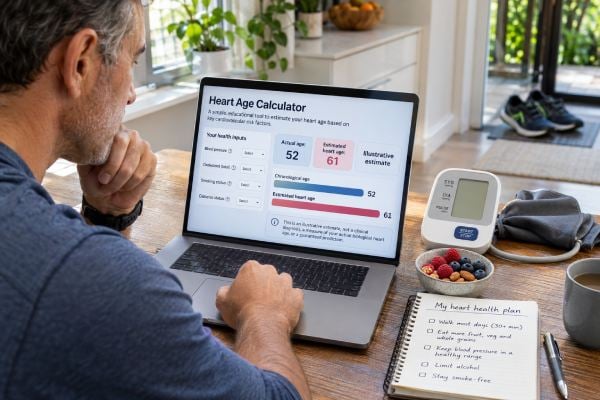
A heart age calculator turns cardiovascular risk into an age-like number. If your estimated “heart age” is older than your actual age, it means your current risk profile resembles that of an older person with a more typical set of risk factors. It does not mean your heart tissue has literally aged that many years, and it is not a diagnosis. In 2026, the American Heart Association’s PREVENT calculator added PREVENT-Age, which translates predicted cardiovascular risk into an equivalent risk age for adults eligible for the PREVENT equations. The estimate is driven by factors such as systolic blood pressure, total and HDL cholesterol, kidney function, body mass index, diabetes, smoking, and use of blood-pressure or lipid-lowering medication. The most useful response to an older heart age is not to chase the number itself. Identify which modifiable inputs are raising risk, then work on those—especially smoking, blood pressure, LDL-related risk, diabetes control, activity, weight when appropriate, and medication adherence. Absolute 10-year and 30-year risk remain more important for many treatment decisions.
Table of Contents
- What “Heart Age” Actually Means
- How Heart Age Is Calculated
- How to Interpret Your Result
- Which Factors Raise Heart Age Most
- How to Lower Your “Heart Age”
- When Heart Age Can Mislead
- What to Do With Your Number
What “Heart Age” Actually Means
Heart age is a risk-communication tool. It converts a probability—your estimated chance of developing cardiovascular disease—into a number that is easier for many people to picture.
Suppose a 45-year-old person’s risk factors produce the same modeled cardiovascular risk as a hypothetical 58-year-old reference person. The calculator might report a heart age near 58. The message is that the 45-year-old’s risk is higher than expected for their chronological age, not that the physical heart looks 13 years older on a scan.
The reverse can happen too. A person with excellent blood pressure, favorable cholesterol, no diabetes, no smoking, and good kidney function may receive a heart age below their actual age.
Heart age is not biological age
No routine heart-age calculator measures cellular aging, artery stiffness, coronary plaque age, or the microscopic condition of the heart muscle. It does not use a heart biopsy, CT scan, or MRI. The number is created mathematically from known risk factors.
That makes it useful but limited. It can motivate a conversation, yet it cannot tell whether you currently have coronary artery disease or predict the exact age at which a heart attack will occur.
Research on heart-age communication is mixed. A 2021 systematic review found that heart age often increased people’s perception and recall of risk, but it did not consistently improve lifestyle intentions more than showing absolute risk. Heart-age tools worked better when combined with counseling and practical behavior-change support.
The number should therefore be treated as a translation of risk, not a verdict. The useful question is not “How do I make this age smaller by next week?” but “Which risk factors are making my future cardiovascular risk higher than it needs to be?”
How Heart Age Is Calculated
Different heart-age calculators use different equations, so two websites can produce different answers from the same person. The underlying risk model matters.
The American Heart Association’s contemporary PREVENT equations were developed from data on more than 6.5 million U.S. adults. They estimate 10-year cardiovascular risk for adults ages 30–79 without known cardiovascular disease and can estimate 30-year risk for younger adults. PREVENT includes atherosclerotic cardiovascular disease and heart failure rather than focusing only on heart attack and stroke.
The current PREVENT calculator uses these required inputs:
- age;
- sex;
- systolic blood pressure;
- total cholesterol;
- HDL cholesterol;
- estimated glomerular filtration rate (eGFR), a measure of kidney function;
- body mass index (BMI);
- diabetes status;
- current smoking;
- use of lipid-lowering medication; and
- use of antihypertensive medication.
Optional inputs can include urine albumin-to-creatinine ratio, hemoglobin A1c, and a social deprivation measure based on ZIP code. These can refine risk when clinically relevant and available.
PREVENT-Age is based on the base equations
PREVENT-Age, added to the online calculator in 2026, translates the predicted cardiovascular risk into an equivalent risk age. If PREVENT-Age exceeds chronological age, the modeled risk is higher than expected for age; if it is lower, the profile is more favorable.
The AHA describes PREVENT-Age as complementary to absolute risk. It is not intended to replace the 10-year or 30-year percentages clinicians use when discussing prevention.
Why age strongly affects the result
Age is one of the strongest predictors of cardiovascular events because risk accumulates over time. This creates an important limitation: a young adult can have an unhealthy risk profile yet still show a low 10-year absolute risk. That is why 30-year risk and age-relative measures can be helpful in younger adults.
Conversely, an older adult can have a higher absolute risk even with good habits simply because age contributes substantially to baseline risk. A high heart age should not be treated as a moral grade.
How to Interpret Your Result
Start with the absolute risk percentage, then use heart age as context.
For example, a calculator might show a 10-year cardiovascular risk of several percent and a heart age older than your chronological age. The percentage estimates the probability of an event in a defined time frame; the heart age expresses that same risk in a more intuitive form.
The exact treatment implications depend on which outcome is being estimated. PREVENT can separately estimate total cardiovascular disease, atherosclerotic cardiovascular disease, and heart failure. These numbers are related but not interchangeable.
An older heart age is a signal to inspect the inputs
Look for the values that can be changed:
- Is systolic blood pressure high?
- Is LDL-related cholesterol risk elevated even if total cholesterol looks acceptable?
- Do you smoke?
- Is diabetes present or poorly controlled?
- Is kidney function reduced?
- Is BMI reflecting excess weight that is contributing to blood pressure or metabolic risk?
- Are indicated medications being taken consistently?
Chronological age and sex cannot be changed. The goal is to improve the modifiable factors around them.
A younger heart age is not a lifetime guarantee
A favorable result today means the modeled inputs look good now. It does not guarantee that plaque is absent, that future risk factors will not develop, or that family history and other risk enhancers are irrelevant.
Risk can change when blood pressure rises, smoking starts or stops, diabetes develops, kidney function changes, or cholesterol is treated. Recalculation is most meaningful after real health changes, not every day.
Use the right population
PREVENT is designed for adults ages 30–79 without known cardiovascular disease. It is not the right tool for someone who already has coronary heart disease, stroke, heart failure, severe subclinical disease such as very high coronary calcium, end-stage kidney disease, or certain inherited cardiovascular conditions.
Once disease is established, the question is usually how aggressively to prevent recurrence or progression, not whether a primary-prevention calculator says risk is low.
Which Factors Raise Heart Age Most
The exact contribution of each factor depends on the person, but several inputs repeatedly drive cardiovascular risk upward.
Smoking
Current smoking is one of the most powerful modifiable risk factors in a risk equation. It injures blood vessels, promotes clotting, lowers oxygen delivery, and accelerates atherosclerosis. Quitting can improve risk rapidly and continues to pay off over years.
If smoking is the main reason your risk estimate is high, the most valuable intervention is not a supplement or diet tweak. It is a structured quit plan. The cardiovascular timeline after stopping is explained in how heart risk changes after quitting smoking.
High systolic blood pressure
Blood pressure has a strong relationship with stroke, heart attack, heart failure, kidney disease, and other outcomes. A single office reading is not enough to define your usual pressure, so confirm a trend with accurate home measurements when appropriate.
If your systolic pressure is consistently elevated, improving it can change both modeled risk and real clinical risk. The larger strategy is covered in evidence-based ways to lower blood pressure, alongside medication when needed.
Cholesterol and atherogenic lipoproteins
PREVENT uses total and HDL cholesterol, while clinical lipid decisions also consider LDL cholesterol, non-HDL cholesterol, triglycerides, and in some people apolipoprotein B or lipoprotein(a).
A high HDL value does not “cancel out” very high LDL. If LDL is markedly elevated, treatment may be indicated regardless of a reassuring heart-age result. Review high LDL causes and treatment rather than focusing only on the calculator output.
Diabetes and metabolic health
Diabetes substantially increases vascular risk. Blood glucose control matters, but so do blood pressure, cholesterol, kidney protection, smoking status, activity, and medication choices with proven cardiovascular benefit.
Kidney function
PREVENT is notable for including eGFR because kidney and cardiovascular health are tightly linked. Chronic kidney disease can raise cardiovascular risk even before symptoms appear. Urine albumin may further refine risk in people with diabetes, hypertension, or kidney disease.
Body mass index
BMI is an imperfect measure of body composition, but it captures part of the metabolic burden associated with excess body fat. Weight loss is not required for every person to improve risk; better blood pressure, fitness, diet quality, glucose, and sleep can matter even before the scale changes substantially.
How to Lower Your “Heart Age”
You lower heart age by lowering real cardiovascular risk factors. Do not try to manipulate the calculator.
1. Get blood pressure under control
Measure it correctly, average multiple readings, and address persistent hypertension. Helpful steps include reducing excess sodium, eating more potassium-rich whole foods when kidney function permits, exercising, limiting alcohol, improving sleep, and losing excess weight when appropriate. Medication is often needed and should not be viewed as a failure of lifestyle.
The 2025 U.S. blood-pressure guideline uses PREVENT risk in some treatment decisions, which reinforces that overall risk and blood pressure belong in the same conversation.
2. Lower atherogenic cholesterol when needed
Diet can meaningfully help LDL, especially by replacing saturated fat with unsaturated fat and increasing soluble fiber. Oats, barley, beans, lentils, nuts, seeds, vegetables, and psyllium are useful tools. A cholesterol-lowering diet and exercise plan can be a good starting point.
Some people still need medication because genetics or baseline risk dominates. The goal is not to avoid medication; it is to reduce lifetime exposure to harmful cholesterol particles.
3. Stop smoking and avoid nicotine exposure
For a smoker, cessation can produce a larger risk improvement than most supplements or “heart-healthy” foods. Counseling plus medication or nicotine-replacement therapy often works better than willpower alone.
4. Improve diabetes control and kidney protection
If you have diabetes, track A1c and discuss medicines that reduce cardiovascular or kidney risk when appropriate. Kidney function and urine albumin deserve attention too, particularly with diabetes or hypertension.
5. Move consistently
Aim toward at least 150 minutes of moderate aerobic activity per week, or an equivalent amount of vigorous activity, plus muscle-strengthening work on at least two days if your health allows. A brisk walking habit is enough to start. See how to use walking for heart health if you need a simple plan.
6. Build a durable eating pattern
Mediterranean- and DASH-style patterns emphasize vegetables, fruit, whole grains, legumes, nuts, fish or other lean proteins, and unsaturated fats while limiting excess sodium, refined carbohydrates, and processed foods. They improve multiple calculator inputs at once.
7. Protect sleep and treat sleep apnea
Poor sleep can worsen blood pressure, appetite, glucose regulation, and weight. Loud snoring, witnessed breathing pauses, morning headaches, and severe daytime sleepiness warrant evaluation for sleep apnea.
The number may not fall instantly. Cholesterol can improve within weeks, blood pressure can change in days to months, and smoking status changes the model immediately once you are no longer a current smoker. The clinical benefit continues to accumulate after the calculator changes.
When Heart Age Can Mislead
Heart age is memorable precisely because it simplifies a complex probability. That simplification can create mistakes.
It can exaggerate emotion without improving understanding
Being told “your heart is 15 years older than you are” can sound frightening. Research shows heart-age framing can increase emotional response and perceived risk, but not necessarily make risk perception more accurate. Use the number to prompt action, not panic.
It can hide a low short-term but high lifetime risk
A 35-year-old with smoking, high blood pressure, and high cholesterol may still have a modest 10-year absolute risk because youth is protective in the short term. The same risk factors can create a much larger 30-year burden. That is why long-term estimates matter.
It does not include every risk enhancer
Family history of premature cardiovascular disease, lipoprotein(a), inflammatory disease, pregnancy-related complications, coronary calcium, and other factors can matter even when they are not fully represented in a basic calculation. Menopause-related changes can also affect long-term risk; see why cardiovascular risk often rises after menopause.
It is sensitive to measurement quality
Entering a blood pressure of 160 mmHg after running upstairs when your true average is 128 mmHg can make the result misleading. So can an outdated cholesterol panel or incorrect medication status.
Use recent, representative values. For blood pressure, average properly measured readings rather than entering the highest number you remember.
It is not a screening test for blocked arteries
A low heart age does not rule out coronary disease in a person with concerning symptoms. New chest pressure, exertional breathlessness, fainting, or other warning signs require clinical evaluation regardless of a calculator score.
What to Do With Your Number
Treat the result as the beginning of a focused prevention conversation.
First, save the inputs and the absolute 10-year and, when available, 30-year risk—not just the heart age. Then identify the two or three factors contributing most to risk. For one person that may be smoking and systolic blood pressure. For another it may be diabetes, kidney disease, and cholesterol.
Bring these questions to a routine medical visit:
- Is this the right risk calculator for me?
- Are my blood pressure and cholesterol inputs accurate and current?
- Which factor is contributing most to my risk?
- Do I meet criteria for blood-pressure or cholesterol medication?
- Would a test such as coronary artery calcium help if the treatment decision is uncertain?
- When should the risk estimate be recalculated?
Do not repeatedly recalculate after every workout or meal. Risk equations are designed around relatively stable clinical measurements, not day-to-day fluctuations.
A useful goal is to improve the inputs you can change over the next 3–12 months: stop smoking, lower average blood pressure, reduce LDL when appropriate, improve diabetes control, move more, and take prescribed medication consistently. If those changes lower the displayed heart age, that can be encouraging. If the number barely moves because chronological age dominates the equation, the health improvements still count.
The best outcome is not a specific “heart age.” It is fewer heart attacks, strokes, episodes of heart failure, and years lost to cardiovascular disease. Use the calculator to make risk more understandable, then let evidence-based prevention—not the age label—guide the work.
References
- Development and Validation of the American Heart Association’s PREVENT Equations 2024
- Novel Prediction Equations for Absolute Risk Assessment of Total Cardiovascular Disease Incorporating Cardiovascular-Kidney-Metabolic Health: A Scientific Statement From the American Heart Association 2023 (Position Statement)
- 2025 AHA/ACC/AANP/AAPA/ABC/ACCP/ACPM/AGS/AMA/ASPC/NMA/PCNA/SGIM Guideline for the Prevention, Detection, Evaluation, and Management of High Blood Pressure in Adults: A Report of the American College of Cardiology/American Heart Association Joint Committee on Clinical Practice Guidelines 2025 (Guideline)
- 2026 ACC/AHA/AACVPR/ABC/ACPM/ADA/AGS/APhA/ASPC/NLA/PCNA Guideline on the Management of Dyslipidemia: A Report of the American College of Cardiology/American Heart Association Joint Committee on Clinical Practice Guidelines 2026 (Guideline)
- Interventions Using Heart Age for Cardiovascular Disease Risk Communication: Systematic Review of Psychological, Behavioral, and Clinical Effects 2021 (Systematic Review)
Disclaimer
This article is for general education and does not provide an individualized cardiovascular risk assessment. Heart age is a risk-communication estimate, not a diagnosis or a measurement of the physical age of your heart. Review calculator results with a clinician before starting, stopping, or changing blood-pressure, cholesterol, diabetes, or other cardiovascular medication.