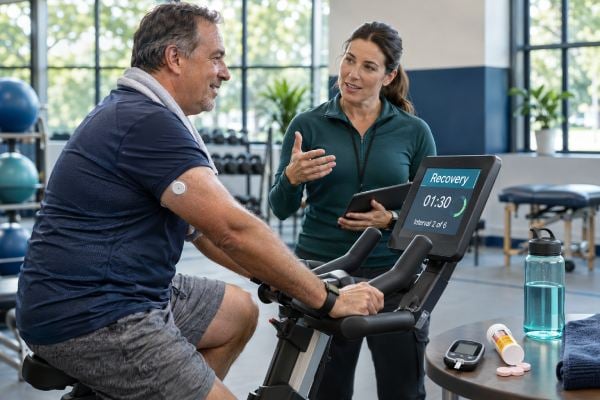
High-intensity interval training, or HIIT, alternates brief bursts of hard effort with easier recovery periods. For adults with type 2 diabetes, it can improve fitness and help lower average blood sugar over time. It can also work for people with prediabetes who already handle brisk exercise well and want a bigger challenge without making every workout longer.
The glucose response to a single session is not always what people expect. A hard bike interval may push your blood sugar up for a while, even though regular training can bring your A1C down over weeks or months. If you use insulin or take a medication that can cause low blood sugar, you may also need to watch for a drop several hours after you finish.
Whether HIIT fits depends on your fitness level, medications, and any health conditions that affect vigorous exercise. A few faster stretches during a walk or bike ride can help you learn how you respond before moving to longer or harder intervals.
Table of Contents
- What Counts as HIIT?
- What Happens to Blood Sugar During and After HIIT?
- Who Is Most Likely to Benefit?
- Who Should Be Cautious With HIIT?
- How to Manage Glucose Around a Workout
- How to Start With Short Intervals
- How to Tell Whether HIIT Is Helping
What Counts as HIIT?
A HIIT workout comes down to two repeating parts. In each work interval, you move at a vigorous effort for a set time. During recovery, you slow down or rest until you’re ready for the next round. Research protocols vary widely: a hard interval can last from about 10 seconds to 4 minutes, with recovery lasting anywhere from several seconds to several minutes.
The effort is relative to your fitness. A fast walk uphill may be vigorous for one person, while someone else needs to jog to reach a similar level of effort. The talk test is a useful starting point. At a moderate pace, you can usually speak in full sentences. At a vigorous pace, you may manage only a few words before needing to breathe again. During recovery, talking should get easier.
An exercise bike, treadmill, rowing machine, or familiar walking route can all work. A stationary bike is especially handy because you can change effort quickly, and it can suit people who find running uncomfortable. On a treadmill or outdoor route, a modest incline can make walking more challenging without requiring a jog. If you take a beta blocker or another medication that blunts your heart rate response, ask your clinician how to gauge effort accurately. A generic watch target may give you the wrong impression of how hard you’re working.
HIIT and all-out sprint interval training are often grouped together online, but most people can start with controlled changes in pace. The hardest effort in a session can still leave some room in reserve. If you’re consistently gasping through recovery or your form starts to fall apart, shorten the work interval, ease the pace, or give yourself longer to recover.
What Happens to Blood Sugar During and After HIIT?
During a workout, glucose can fall, hold steady, or rise
Working muscles pull glucose from the bloodstream for fuel. Muscle contractions help them do this even when insulin isn’t doing as much of the work. That’s one reason exercise can help people with insulin resistance, a condition in which muscle and other tissues respond less effectively to insulin.
Hard efforts also release hormones such as adrenaline. These hormones signal the liver to send more glucose into the blood so your muscles have fuel readily available. If the liver releases glucose faster than your muscles take it up, your reading can rise during or just after the session. A longer workout with plenty of easy movement may produce a different response from a series of short, hard efforts, even on the same bike.
Starting glucose, time since your last meal, and recent insulin doses can all shift the outcome. Consider two rides using the same interval timer. On a fasted morning ride, your glucose may rise as your liver supplies fuel. On an afternoon ride soon after a mealtime insulin dose, it may fall because some of that insulin is still active. These are possible patterns rather than guarantees. Your own readings and symptoms matter when deciding what to do next.
After a workout, the effects can last for hours
After exercise, your muscles work to replenish glycogen. Glycogen is the stored form of glucose that muscles draw on during activity. Your body may also respond better to insulin for hours after a session. If you take insulin or a medication that raises insulin release, that extra sensitivity can contribute to a delayed low. An evening workout may affect glucose while you sleep, even if it was steady when you left the gym.
Over weeks of regular exercise, better insulin sensitivity can help lower average glucose. That’s what makes A1C, which reflects roughly the past two to three months, a better measure of long-term change than an immediate post-workout reading. A short-lived rise after hard exercise and a lower A1C after several months can happen in the same person. A rise that is unusually high, stays high, or occurs with illness or ketones calls for a different response.
Who Is Most Likely to Benefit?
Adults with type 2 diabetes who can already exercise at a moderate pace
HIIT is a reasonable option if you’re comfortable with brisk activity and want to improve fitness or vary your routine. A review of 100 randomized trials across several kinds of exercise found that HIIT lowered A1C by about 0.7 percentage points on average compared with control groups. Continuous aerobic exercise and programs combining aerobic and strength training also lowered A1C. In a separate review of 21 trials directly comparing HIIT with steady moderate exercise, there was no clear difference in A1C or fasting glucose between the two approaches.
Those findings give you room to choose based on your schedule, preferences, and health. If you enjoy cycling and have a limited window to work out, short intervals may be easier to fit in than a longer ride. If steady walking is something you look forward to and do most days, it already supports glucose management. When deciding whether HIIT saves time, include the warm-up, recovery periods, and cool-down that a short session still requires.
Adults with prediabetes who want to improve fitness
A review of adults with prediabetes found that HIIT tended to improve aerobic fitness more than steady moderate training. It also found a small possible advantage in glucose measured two hours after a glucose tolerance test, though confidence in that result was low. The evidence for an A1C advantage was limited, and many trials were short. Taken together, those findings give a clearer reason to choose HIIT for fitness than to choose it specifically to lower A1C or prevent diabetes.
If you’ve recently learned you have prediabetes and currently spend much of the day sitting, starting with regular moderate activity is a practical way to build endurance. If you already walk briskly or cycle several days a week, adding a few faster stretches to one session is a manageable way to test your tolerance.
Adults with type 1 diabetes who have an exercise glucose plan
People with type 1 diabetes can use intervals to build fitness or prepare for sports. Glucose may hold steadier during some interval sessions than during a longer steady aerobic workout, but it can also rise or fall. A stable reading during the session provides little information about whether you’ll go low later.
A diabetes care team can help you plan around insulin that is still active, carbohydrate intake, and the kind of activity you’ll do. If you use an automated insulin delivery system, ask when its exercise setting is useful for you. A setting that helps prevent lows on long walks may be a poor fit for a short, intense session that usually raises your glucose.
Who Should Be Cautious With HIIT?
After a long stretch of inactivity, give yourself time to get comfortable with moderate exercise before trying vigorous intervals. If a brisk walk already leaves you too breathless to speak in sentences, that effort may be vigorous for you. Use a pace you can sustain comfortably and build from there.
Get medical guidance before starting vigorous intervals if you have known heart disease, poorly controlled blood pressure, or symptoms that come on with activity, such as chest pressure, unusual shortness of breath, or lightheadedness. Stop immediately and seek emergency help for symptoms suggestive of a heart attack, such as chest pressure with sweating, nausea, shortness of breath, or pain spreading to the arm or jaw. Fainting during exercise also warrants emergency evaluation.
Several diabetes complications can change which activities are appropriate.
- Advanced diabetic eye disease. Vigorous exercise may raise the risk of bleeding in the eye or retinal detachment in people with proliferative diabetic retinopathy or severe nonproliferative retinopathy. Ask your eye specialist which activities and intensities are safe, especially if you’ve recently had eye treatment.
- Foot numbness, injuries, or ulcers. Numbness can make it difficult to feel a blister or a pressure point. Check your feet and wear well-fitting shoes. If you have an active sore, ask your foot care team which non-weight-bearing activities are suitable and how to protect the area while it heals.
- Autonomic neuropathy. This type of nerve damage can change how your heart rate and blood pressure respond to exercise, and it may make it harder to regulate body temperature. A clinician can assess your heart risks before you increase the intensity and help you choose an appropriate way to measure effort.
- Frequent lows or trouble sensing low glucose. If you often need help treating lows or first recognize one when you’re confused or weak, work out a monitoring and treatment plan with your diabetes team before starting HIIT.
Your options depend on the specific problem. Someone with sore knees may be able to do controlled intervals on a stationary bike. Someone whose eye specialist has restricted vigorous effort may need to stay at a moderate pace even on that same bike. Ask about the activity you want to try and how hard you can safely do it.
How to Manage Glucose Around a Workout
Before you start
If you take insulin, a sulfonylurea such as glipizide or glimepiride, or a meglitinide such as repaglinide, talk with your care team about when to check glucose and what readings should prompt you to wait, eat, or change the session. Exercise-related lows are less common if you manage type 2 diabetes with lifestyle changes alone or take a medication such as metformin by itself.
If you’re at risk of lows, check both the number and its direction before you start. A reading of 100 mg/dL that’s steady can call for a different decision from the same reading with a downward arrow shortly after a meal and insulin dose. Some people taking insulin or similar medications need fast-acting carbohydrate when they’re below 90 mg/dL before activity. Your starting range may be higher depending on your glucose trend, medication, and history of lows.
Postpone hard exercise if your glucose is unexpectedly high and you feel unwell. If you have type 1 diabetes or are otherwise at risk of diabetic ketoacidosis, follow your care plan for when to test for ketones. Ketones can build up when the body lacks enough insulin. When ketones are elevated, skip the workout and follow your treatment plan. Seek emergency care if you suspect diabetic ketoacidosis, especially if you have vomiting, abdominal pain, deep or rapid breathing, or confusion.
During intervals and in the hours afterward
If low blood sugar is a risk for you, keep fast-acting glucose within reach. Glucose tablets stored in a locker are harder to get to when you’re shaky or confused. During your first few workouts, check as directed by your care plan, especially if the workout is longer than usual or you feel shaky, weak, or suddenly lightheaded.
A continuous glucose monitor measures glucose in the fluid beneath the skin. Its reading can lag behind blood glucose when levels are changing quickly. If the number seems out of step with how you feel, stop and use a finger-stick meter if you can. Treat a suspected low promptly if you can’t check.
For many adults, a reading below 70 mg/dL calls for stopping exercise and taking 15 g of fast-acting carbohydrate, followed by a recheck in 15 minutes. If it’s still low, repeat treatment according to your plan. Your care team may recommend a different amount, particularly if you use automated insulin delivery. If a person having a low cannot safely swallow, someone nearby should give glucagon if available and call emergency services.
Afterward, follow your plan for additional checks, especially at bedtime after an evening session or after a harder workout than you’re used to. If you see a temporary high after intervals, follow your prescribed correction plan. Ask your diabetes team how to handle repeated spikes, since taking extra insulin as glucose is starting to fall can contribute to a low later.
How to Start With Short Intervals
If you’re new to structured exercise, begin with a manageable block of walking, cycling, or another activity you can do at a conversational pace. Even 10 minutes is a workable starting point. Once that pace feels comfortable and you can recover well, try adding a few brief increases in effort. If you’ve been advised to check with a clinician before vigorous exercise, keep those early intervals within the intensity they recommend.
For someone who already tolerates brisk walking or cycling, a first session might look like this.
- Warm up for 5 to 10 minutes. Start easy and gradually build to your usual moderate pace.
- Pick up the pace for 20 to 30 seconds. Walk faster, pedal a little harder, or use a slight incline. Aim for a controlled effort you could repeat.
- Slow down for 60 to 90 seconds. Take longer if you still can’t speak comfortably. Do four rounds in total if you feel steady and your glucose is responding as expected.
- Cool down for about 5 minutes. Gradually ease your pace. If you monitor glucose for exercise, note the reading and how you feel.
Those first intervals can stay at the upper end of moderate. As you get used to them, choose one change at a time: add a round, lengthen the work period a little, or increase the pace. Keeping the other details similar helps you judge what changed your recovery or glucose. Begin with one interval session a week and keep your usual easier activity on other days. If you add a second session, leave an easier day in between at first.
Most adults with diabetes are encouraged to work toward at least 150 minutes of moderate-to-vigorous aerobic activity a week, spread over at least three days, and to do strength training on two or three nonconsecutive days. Shorter weekly durations of vigorous exercise can suit some fitter adults. Work toward the amount you can manage safely and consistently. A weekly routine might include one interval ride, several walks, and strength training. Easy movement also has a place: if your main concern is glucose after dinner, walking after meals may be easier to repeat and more closely timed to that goal.
How to Tell Whether HIIT Is Helping
If you already monitor glucose, compare several similar sessions. Record your starting glucose, the type and length of the intervals, the time of your last meal, and the timing of any medication that can cause lows. Also record the later readings your care plan calls for. If you felt unusually tired, needed extra carbohydrate, or had a low during the night, write that down too. A few notes can help you and your care team spot patterns that an isolated reading can miss.
For example, suppose you ride on Tuesday and Thursday evenings. On Tuesday, you finish at your usual glucose level but go low at bedtime. On Thursday, you finish higher and still trend down before bed. Both sessions point to the same question for your care team: how to handle the hours after your ride. Looking only at the number when you step off the bike would miss that pattern.
Track fitness in a way you can repeat. You might find that the same hill feels easier, you can keep a conversation going sooner during recovery, or you can pedal at the same resistance with less effort. If you have prediabetes and your clinician hasn’t recommended home glucose monitoring, these observations and routine lab follow-up can help you assess progress without buying a sensor.
Give A1C time to reflect a new routine. If you’re due for testing after about three months, review the result alongside changes in medication, eating habits, and your overall activity. Frequent lows, lingering pain, or workouts you regularly skip are reasons to revisit the plan even if your A1C improves. If intervals fit your schedule, you recover well, and your glucose response is manageable, they can be a useful part of the week.
References
- 5. Facilitating Positive Health Behaviors and Well-being to Improve Health Outcomes: Standards of Care in Diabetes—2026 2026 (Guideline)
- Exercise/Physical Activity in Individuals with Type 2 Diabetes: A Consensus Statement from the American College of Sports Medicine 2022 (Consensus Statement)
- The effect of exercise characteristics on HbA1c and other cardiovascular risk factors in adults with type 2 diabetes: a systematic review and meta-analysis of randomised controlled trials 2025 (Systematic Review)
- Effects of high-intensity interval training and moderate-intensity continuous training on type 2 diabetes mellitus: a meta-analysis and systematic review 2026 (Systematic Review)
- Effects of high-intensity interval training on glycemic control and cardiometabolic risk factors in adults with prediabetes: a systematic review and meta-analysis 2026 (Systematic Review)
- The use of automated insulin delivery around physical activity and exercise in type 1 diabetes: a position statement of the European Association for the Study of Diabetes (EASD) and the International Society for Pediatric and Adolescent Diabetes (ISPAD) 2025 (Position Statement)
Disclaimer
This article provides general education about vigorous exercise and blood sugar. If you use insulin or another medication that can cause lows, ask your diabetes care team to tailor your glucose monitoring, carbohydrate intake, and medication plan before you start HIIT. Get individual guidance on exercise intensity if you have heart disease or diabetes complications.