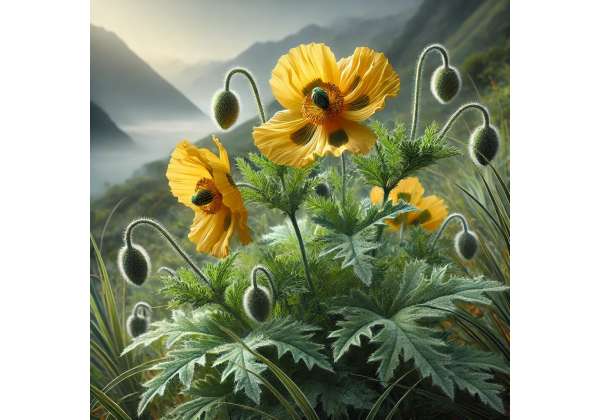
Himalayan yellow poppy, Meconopsis paniculata, is a high-altitude medicinal and edible herb from the poppy family that grows across parts of the Himalayas and southern Tibet. Many people know it first as a striking wildflower, but traditional Himalayan medicine has also treated it as a useful plant for fever patterns, digestive complaints, phlegm-related disorders, and broader “heat” conditions involving the lungs and liver. In some communities, young stems and shoots have also been eaten, which gives the plant an unusual place at the border of food, field medicine, and ethnobotanical tradition.
That said, modern readers should approach it with care. The plant does have a documented traditional reputation, and the wider Meconopsis genus contains pharmacologically active alkaloids and flavonoids. Species-specific work on M. paniculata also points to flavonol glycosides in the flowers. Still, there are no human clinical trials confirming clear therapeutic benefits, no modern standardized dose, and very limited direct safety data. So the most accurate view is neither dismissive nor exaggerated: Himalayan yellow poppy is a culturally important medicinal herb with promising chemistry, but weak clinical proof.
Quick Overview
- Traditional use centers on digestive support and fever-like lung and liver complaints.
- The plant appears chemically active, especially through flavonoids and broader Meconopsis alkaloid patterns.
- No validated single-herb dose exists; one documented traditional compound formula uses about 5 g mixed dried powder in water.
- Pregnant and breastfeeding people should avoid medicinal use because direct safety data are lacking.
- Concentrated preparations should not replace medical care for infection, liver disease, or inflammatory illness.
Table of Contents
- What is Himalayan yellow poppy
- Key compounds and properties
- Does Himalayan yellow poppy help
- How it has been used
- How much to take
- Side effects and who should avoid it
- What the evidence actually says
What is Himalayan yellow poppy
Himalayan yellow poppy is a tall, hairy, high-mountain herb in the Papaveraceae family. Botanically, it is Meconopsis paniculata, one of the yellow-flowered members of a genus better known in gardens for blue Himalayan poppies. In the wild, however, this species is not just ornamental. It grows in cold, exposed mountain environments and has long been woven into local Himalayan plant knowledge, especially in Bhutan, Tibet, Nepal, and adjoining regions.
The first thing worth understanding is that this plant is more important regionally than commercially. You are not looking at a mainstream herbal supplement with a large modern evidence base, standardized extracts, and capsule labels. Instead, this is a traditional medicinal herb whose value is preserved mostly through local practice, ethnobotanical recording, and limited scientific study. That distinction shapes almost every practical question about it, from dosage to safety.
Traditional reports describe the whole plant being used for conditions connected to fever, digestion, phlegm imbalance, and disorders involving the lungs and liver. In some Bhutanese records, the whole herb is noted for fever linked to lung and liver disorders and for digestive and phlegm complaints. In parts of the eastern Himalaya, young stems have also been eaten raw and young shoots used as a seasonal food. That food use is important because it suggests the plant has not always been treated only as a potent medicine. In some settings, it has also functioned as a gathered mountain plant with dietary value.
At the same time, species confusion is a real issue. The genus Meconopsis contains many Himalayan species, and traditional medical texts often discuss the genus more broadly than a single species. Modern studies also lean heavily toward other Meconopsis plants, especially M. integrifolia, M. betonicifolia, M. simplicifolia, and M. horridula. That means some claims made online about Himalayan yellow poppy are actually borrowed from related species. For readers, the safest approach is to keep the boundary clear: M. paniculata has traditional relevance, but much of the deeper pharmacology comes from the genus, not from strong species-specific trials.
The plant also has ecological importance. It is adapted to tough alpine or subalpine conditions, and wild populations are not something casual harvesting should take for granted. This is one reason the article should be read as guidance for understanding the plant, not as encouragement to forage or self-dose it freely. If your main goal is a more familiar digestive herb with a clearer everyday use pattern, peppermint for digestive and respiratory support is much easier to place safely.
In simple terms, Himalayan yellow poppy is a traditional high-altitude medicinal herb with limited modern clinical clarity. Its story begins in ethnobotany, not in standardized supplement science.
Key compounds and properties
The medicinal interest in Himalayan yellow poppy comes partly from what is known about M. paniculata itself, and partly from the broader chemistry of the Meconopsis genus. That is an important distinction. The plant clearly contains active secondary metabolites, but the specific compound map for this species is still incomplete compared with more heavily studied herbs.
Across Meconopsis, the major compound groups described in reviews include isoquinoline alkaloids, flavonoids, phenols, steroids, terpenes, and minor volatile components. Those classes matter because they help explain why the genus keeps appearing in discussions of inflammation, pain, microbial control, and organ-protective effects in preclinical research. Alkaloids are especially important in poppy-family plants because they often drive strong biological activity, both useful and risky. Flavonoids and phenolic compounds, by contrast, are more often tied to antioxidant and anti-inflammatory patterns.
For Meconopsis paniculata specifically, one of the clearest direct findings concerns flower pigments. The yellow flowers contain flavonol glycosides, including compounds related to kaempferol and herbacetin chemistry. That may sound like a technical footnote, but it matters for two reasons. First, it confirms that the species has a real flavonoid profile rather than just a vague medicinal reputation. Second, it helps explain why this yellow-flowered species is chemically distinct from blue or red-flowered members of the genus.
What do these compounds likely do in practical terms? Based on genus-wide and related-species research, the main plausible properties are:
- Antioxidant support
- Anti-inflammatory activity
- Mild antimicrobial or anti-infective potential
- Possible pain-modulating effects
- Traditional heat-clearing and swelling-reducing actions in Tibetan medicine language
That does not mean the plant is proven to deliver all of these effects in real clinical use. It means the chemistry gives those traditional claims a believable mechanistic foundation. In other words, the plant is not chemically empty.
One nuance that often gets missed is that yellow flower color does not equal medicinal weakness. Many readers assume deeper red, blue, or purple flowers signal stronger phytochemistry. In reality, yellow-flowered plants can still be rich in bioactive flavonols and related molecules. In M. paniculata, the yellow pigments are part of the plant’s chemical identity, not a sign of lesser value.
It is also worth separating Himalayan yellow poppy from the opium narrative that surrounds some poppy-family plants. Being in Papaveraceae does not make it an opium source, but it does justify caution about assuming the plant is completely inert or universally safe. The family is chemically capable, and that matters. Readers who want a more familiar example of how plant polyphenols shape a wellness reputation may compare this to green tea’s better-known flavonoid profile. The difference is that green tea has a far clearer human research base.
So the chemistry story here is promising but unfinished. Himalayan yellow poppy appears botanically active, with flavonoids clearly present and alkaloid-rich genus context behind it, yet its pharmacology is still far ahead of its clinical validation.
Does Himalayan yellow poppy help
The best answer is that it may help in traditional and limited ways, but strong proof is missing. Himalayan yellow poppy has a documented ethnomedical role, and that role is not random. Records connect it with digestive complaints, fever patterns, phlegm-related problems, and traditional lung and liver disorders. That is enough to take seriously. It is not enough to promise dependable outcomes for modern self-treatment.
Digestive support is probably the most realistic place to start. The plant is described in Bhutanese ethnomedicinal records as useful for digestion and for allaying phlegm disorders. In practice, that suggests traditional use for heaviness, sluggish digestion, or uncomfortable internal states that local systems describe in broader functional language rather than in narrow biomedical terms. This does not mean it is a proven remedy for indigestion, bloating, reflux, ulcers, or irritable bowel syndrome. It simply means the historical use pattern leans digestive.
Fever-related and inflammatory uses are also prominent. In traditional frameworks, Meconopsis species are often linked with “heat-clearing,” swelling reduction, and pain relief. Modern genus-level research supports the idea that this is at least chemically plausible. Newer work on related Meconopsis species suggests real anti-inflammatory potential in laboratory systems. But here is the line readers should not cross: anti-inflammatory activity in a related yellow-flowered species is not the same as clinical proof for M. paniculata.
Lung and liver support is another area where traditional language needs careful translation. In Himalayan and Tibetan medicine, “lung heat” or “liver heat” does not map neatly onto a Western diagnosis. It may overlap with inflammatory, infectious, febrile, or functional complaints, but it is not the same as saying the plant treats hepatitis, pneumonia, fatty liver disease, or chronic lung conditions. The right takeaway is that traditional systems used the herb for those broad patterns, not that modern medicine has validated it for those diseases.
Food use adds another layer. Because young stems and shoots have been eaten in some communities, the plant may offer small seasonal nutritive value beyond formal medicine. That is different from saying the plant is a health food in the modern marketing sense. It is better viewed as a regional edible-medicinal plant with context-specific use.
So what might a realistic reader expect?
- Mild traditional digestive support
- A plausible but unproven anti-inflammatory role
- Limited cultural use for fever-like and phlegm-related complaints
- No confirmed benefit for major chronic disease
This is why Himalayan yellow poppy should not be compared to better-studied modern anti-inflammatory herbs on equal terms. If someone wants a herb with far more direct research for inflammatory comfort, boswellia’s evidence base is much easier to evaluate. Himalayan yellow poppy remains interesting, but it is still closer to ethnobotanical promise than evidence-backed treatment.
How it has been used
Himalayan yellow poppy has been used in more than one way, which is one reason it resists simple labeling. It is not only a medicine, and it is not only a wild edible. Depending on region and tradition, it has appeared as a whole-plant remedy, a compound herbal ingredient, and a gathered food plant.
In Bhutanese ethnomedicinal records, the whole plant is often the relevant medicinal part. That is notable because many herbs concentrate use in roots, seeds, bark, or flowers. Whole-plant use usually points to a tradition built around field collection and broad-pattern herbal practice rather than modern compound isolation. In such systems, the plant is often chosen for its overall nature and effect profile, not because one purified molecule has been identified.
Some reported forms include:
- Whole-plant use in traditional medical contexts
- Dried leaf and flower mixtures in compound preparations
- Syrup-like preparations in multi-herb formulas
- Young shoots or stems used as seasonal food in some communities
The food use deserves special attention. In eastern Himalayan communities, young shoots have been harvested as vegetables, and in other ethnobotanical records the young stems are eaten raw. This suggests that at least some parts of the plant can be used gently and seasonally. Still, that is not the same as saying the plant should be treated as an everyday salad ingredient. Wild edible use depends on region, identification, maturity, and local knowledge.
The medicinal preparations are more complicated. One ethnopharmacological record describes a formula using dried leaves and flowers of Meconopsis paniculata together with Meconopsis grandis, mixed into a powder and then made into a syrup. This tells us something valuable: traditional use often relied on combinations, not single-herb dosing. That makes modern translation difficult. A compound syrup prepared by a local healer is not equivalent to a solo capsule, tea bag, or tincture sold online.
From a modern safety standpoint, the most cautious hierarchy is:
- Learn the plant before using it.
- Do not assume every Meconopsis species is interchangeable.
- Treat concentrated preparations as traditional medicines, not casual wellness products.
- Prefer culinary or documentary understanding over self-experimentation when evidence is thin.
It is also important not to copy old preparations mechanically. Traditional formulas often depend on local skill, fresh plant knowledge, and context that is easy to lose. When a paper says a plant was made into powder, syrup, or decoction, that does not automatically mean a modern home user should reproduce it.
A fair modern use framework would be narrow and conservative. Culinary use belongs to communities that already know the plant. Medicinal use belongs either within traditional systems or under expert guidance. That may sound restrained, but it is the right tone for a species with weak dosage data and limited human evidence. Readers who want a gentler plant for localized skin or tissue support may find witch hazel’s topical tradition much easier to apply safely than an obscure alpine poppy.
In short, Himalayan yellow poppy has been used as food, formula ingredient, and traditional remedy. What it has not yet become is a standardized herb with simple, transferable home-use rules.
How much to take
This is the most uncertain section in the entire article, because Himalayan yellow poppy does not have a validated modern medicinal dose. No human clinical trial has established a safe daily amount, no major pharmacopeia has translated it into a clear modern regimen for general use, and the traditional record mostly reflects whole-plant use or mixed formulas rather than clean single-herb dosing.
That means the safest answer is not a number. It is a principle: this is not a herb with a modern self-prescribing dose.
Still, readers searching for dosage usually want some concrete orientation, so the literature allows only a narrow one. A documented ethnopharmacological formula from the eastern Himalaya used dried leaves and flowers of Meconopsis paniculata together with Meconopsis grandis, crushed into powder, with about 5 g of the mixed herbal powder added to water to make a syrup. That is useful as a historical clue, but it does not qualify as a stand-alone dose for Himalayan yellow poppy. It was a compound preparation, not a single-species protocol.
What this means in practical terms is:
- No validated single-herb oral dose exists.
- Traditional use often involves the whole plant or multi-herb preparations.
- Published amounts should not be converted directly into modern daily self-dosing.
- Stronger is not safer, and stronger is not more evidence-based.
For edible use of young shoots or stems, the picture is different. Food use is usually seasonal, small-scale, and practical rather than measured. In that setting, the plant functions more like a wild edible gathered in modest amounts, not like a dosed medicine. That kind of use does not translate into grams per day because it depends on local culinary tradition and correct plant knowledge.
For modern readers, the most responsible dosing advice is:
- Do not invent a tincture or concentrated extract dose.
- Do not assume a tea is automatically safe because it seems mild.
- Do not use old ethnomedical weights as a substitute for clinical guidance.
- If the plant is being considered medicinally, keep the discussion within trained traditional practice or expert supervision.
This may sound less satisfying than a neat recommendation like 250 mg twice daily, but that is exactly the point. When a plant lacks reliable human dosing data, precision can become false confidence. Himalayan yellow poppy is one of those herbs where honesty matters more than neatness.
A practical reader should take away one clear message: this is not an herb for routine unsupervised dosing. If the goal is a better-established digestive or inflammatory plant with clearer practical ranges, ginger’s everyday use profile is far easier to apply responsibly.
So the real dosage conclusion is simple. Himalayan yellow poppy has documented traditional use, but no clinically validated standalone dose. That should narrow its place in modern self-care, not expand it.
Side effects and who should avoid it
There is very little direct human safety data on Himalayan yellow poppy. That lack of evidence should be treated as a warning sign, not as reassurance. When a plant belongs to a chemically active family, has traditional medicinal use, and lacks modern clinical safety studies, the safest position is careful limitation.
The first likely risk is simple uncertainty. We do not know the full adverse-effect profile of Meconopsis paniculata in standardized human use. We also do not have good modern data on long-term exposure, concentrated extracts, or herb-drug interactions. That means even a mild-looking preparation carries more ambiguity than a familiar culinary herb.
Possible issues include:
- Stomach upset with strong preparations
- Nausea or digestive discomfort
- Unpredictable effects from concentrated extracts
- Allergic reactions in sensitive individuals
- Risks linked to misidentification of the plant in the wild
Because Meconopsis belongs to the poppy family, it also makes sense to be cautious about oversimplifying its chemistry. The broader genus contains alkaloids, and alkaloid-bearing plants are not good candidates for casual high-dose experimentation. That does not mean Himalayan yellow poppy is known to be dangerously toxic in ordinary traditional use. It means the plant is pharmacologically serious enough that safety should come before curiosity.
The groups that should avoid medicinal use most clearly are:
- Pregnant people
- Breastfeeding people
- Children
- People with liver disease
- People taking multiple prescription medicines
- Anyone who cannot verify exact botanical identity
Pregnancy and breastfeeding deserve the strongest caution because there is no reliable safety evidence for either situation. Children should also be excluded from experimental medicinal use, especially outside a trained traditional context. Even where ethnomedical traditions include use in communities, that does not substitute for modern pediatric safety evaluation.
People with liver disease or complex medication schedules should also be careful. Traditional literature connects the plant with liver-related conditions, but that is not a reason to self-treat liver disease with it. In fact, the opposite is wiser: herbs with incomplete safety data should be avoided when the liver is already under strain.
Another practical concern is wild-harvest quality. Alpine medicinal plants can vary by altitude, harvest season, drying method, and species confusion. A mislabeled or poorly identified Meconopsis product is a more realistic risk than many readers appreciate.
The safest overall rule is this: edible traditional use in knowledgeable communities is one thing; concentrated medicinal experimentation is another. If a person wants a herb with a clearer safety tradition for gentle everyday use, an option such as chamomile’s better-known calming profile usually offers much more practical certainty.
Himalayan yellow poppy is not best understood as a dangerous plant. It is best understood as an under-studied medicinal plant, and under-studied is enough reason for restraint.
What the evidence actually says
The evidence on Himalayan yellow poppy is thin, uneven, and still mostly indirect. That is the clearest honest summary.
There are three evidence layers to keep separate. The first is ethnobotanical evidence. This is the strongest layer for Meconopsis paniculata itself. Multiple Himalayan sources record the species as medicinal, edible, or both. Those records support real traditional use for digestive complaints, fever-like disorders, phlegm patterns, and seasonal food use of young plant parts. Ethnobotanical evidence matters because it shows how the plant was actually used by people, not just how it behaves in a lab.
The second layer is phytochemical evidence. This is moderate in strength. For M. paniculata, species-specific work clearly identifies flavonol glycosides in the yellow flowers. Broader reviews of the Meconopsis genus describe alkaloids, flavonoids, phenols, terpenes, and related constituents across the group. This gives the plant a believable chemical basis for biological activity, especially around oxidative stress and inflammation.
The third layer is pharmacological evidence, and this is where the main limitation appears. Much of the newer laboratory work is not on M. paniculata itself. Instead, it focuses on related Meconopsis species, especially M. integrifolia and M. betonicifolia. Those studies are useful because they show the genus is pharmacologically interesting. They do not, however, prove that Himalayan yellow poppy delivers the same magnitude of effect, the same safety profile, or the same optimal dose.
That gap leads to the most important practical conclusion: modern mechanistic enthusiasm is stronger than species-specific proof. Readers should resist two opposite mistakes. One is dismissing the plant simply because it is traditional. The other is treating genus-level anti-inflammatory or liver-related findings as if they were already clinical evidence for M. paniculata.
A balanced evidence ranking looks like this:
- Well supported: traditional medicinal and edible use in Himalayan contexts
- Moderately supported: the plant contains meaningful flavonoid compounds
- Plausible but unconfirmed: anti-inflammatory or broader therapeutic effects
- Not established: human clinical efficacy, standard dose, long-term safety
This evidence pattern also explains why Himalayan yellow poppy remains mainly an ethnobotanical and phytochemical subject rather than a practical modern supplement. It is scientifically interesting, culturally important, and still under-developed from a clinical standpoint.
There is one more point worth adding: conservation and evidence are linked. Plants like M. paniculata are often most vulnerable precisely when interest rises faster than evidence. That makes careful communication part of responsible herbal writing. A rare high-altitude herb should not be promoted more aggressively than it has been studied.
So the final evidence-based position is simple. Himalayan yellow poppy deserves respect as a traditional Himalayan medicinal plant. It does not yet deserve strong medical claims. That is not a weakness in the plant. It is simply the current state of the science.
References
- An Ethnopharmacological, Phytochemical and Pharmacological Review of the Genus Meconopsis 2016 (Review)
- Medicinal plants of Dagala region in Bhutan: their diversity, distribution, uses and economic potential 2016 (Open Study)
- Traditional use and management of NTFPs in Kangchenjunga Landscape: implications for conservation and livelihoods 2016 (Review)
- Flavonol glycosides in the flowers of the Himalayan Meconopsis paniculata and Meconopsis integrifolia as yellow pigments 2018 (Phytochemical Study)
- Comparative Evaluation of the Chemical Components and Anti-Inflammatory Potential of Yellow- and Blue-Flowered Meconopsis Species: M. integrifolia and M. betonicifolia 2024 (Open Study)
Disclaimer
This article is for educational purposes only and is not medical advice. Himalayan yellow poppy is a traditional Himalayan medicinal plant with limited direct modern evidence, no validated clinical dose, and incomplete safety data. It should not be used to diagnose, treat, cure, or prevent disease without guidance from a qualified healthcare professional. Seek medical care for persistent digestive symptoms, fever, liver concerns, breathing problems, or any condition that is severe, unexplained, or worsening.
If you found this article useful, please share it on Facebook, X, or another platform you prefer so more readers can discover careful, evidence-aware herbal information.