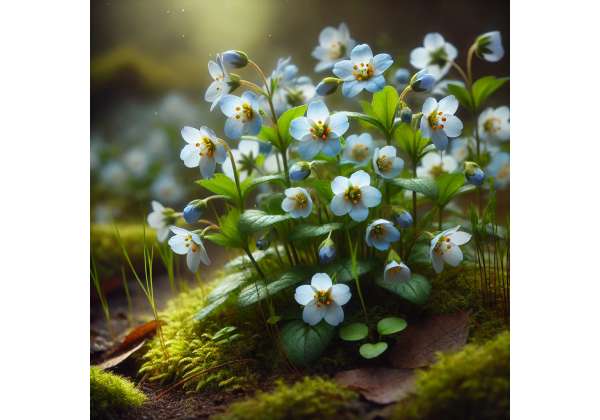
Innocence, better known to many botanists and gardeners as Houstonia caerulea, is a tiny North American wildflower with pale blue to white blossoms and a surprisingly long list of folk names, including bluets, Quaker ladies, and little bluet. It is admired far more often as a spring groundcover than as a medicinal herb, and that distinction matters. While scattered ethnobotanical records suggest limited traditional use, especially in Cherokee plant medicine, Innocence does not have the kind of established clinical, chemical, or monograph-backed profile that readers may expect from well-known healing herbs.
That makes this plant worth approaching with curiosity and restraint. The most responsible way to discuss Innocence is not to inflate uncertain claims, but to separate what is historically reported from what is scientifically demonstrated. Its possible medicinal story is narrow, gentle, and poorly standardized. Its best-known traditional use relates to bedwetting, but even there, modern evidence is absent. If you are researching Innocence as an herb, the most important takeaway is that it is a plant with ethnobotanical interest, not a validated modern remedy.
Core Points
- Innocence has one small but repeated traditional association with bedwetting support.
- It has no well-established modern clinical benefits for urinary, digestive, or general wellness use.
- No standardized medicinal dose in mg, mL, or cups has been established for modern use.
- Pregnant people, children, and anyone self-treating urinary symptoms should avoid using it without professional guidance.
Table of Contents
- What is Innocence
- Key ingredients and what is known
- Traditional benefits and realistic uses
- How Innocence is used
- How much to take
- Safety, interactions, and who should avoid it
- What the evidence says
What is Innocence
Innocence is a small perennial herb in the coffee family, Rubiaceae, native to eastern Canada and the eastern United States. Most people know it by names such as bluets, azure bluet, little bluet, or Quaker ladies. The name Innocence reflects its delicate appearance: small, four-lobed flowers with a pale center, held on thin stems above compact basal leaves. It is a plant of lawns, meadows, forest margins, rocky openings, and lightly disturbed ground, and it often appears in spring as loose carpets of tiny blue-white blossoms.
As a botanical subject, Innocence is much better documented than as a medicinal one. Its identity, habitat, flowering pattern, and distribution are well described in flora databases and plant records. Its medicinal profile is very different. Unlike herbs with strong traditional pharmacy roles, such as licorice, valerian, or nettle, Innocence does not appear in mainstream Western herbal practice as a standard remedy. It is not commonly sold as a supplement, not widely used in commercial teas, and not supported by a modern monograph that tells readers how it should be prepared or taken.
That does not mean it has no ethnobotanical history. Historical sources do preserve a small but notable traditional use: a Cherokee infusion of little bluet for bedwetting. That use is important because it gives the plant a real medicinal context instead of a purely ornamental one. At the same time, the record is narrow. One documented traditional use is not the same as broad validation for bladder health, diuresis, or urinary tract support. Modern readers often miss that difference and assume any historically used plant automatically has a wider therapeutic range than the evidence supports.
This is also why the common nickname “pissabed” deserves a careful reading. Folk names sometimes preserve how a plant was used, but they do not prove effectiveness. In some cases, they reflect a reputation rather than a tested outcome. With Innocence, the nickname points toward urinary folklore, but it does not provide the kind of modern dosing or safety detail a clinician would need.
So what is Innocence, medicinally speaking? It is best understood as a minor native wildflower with a limited recorded traditional use and no strong modern therapeutic standing. That makes it interesting, especially to readers drawn to regional plant medicine, but it also means caution matters more than enthusiasm. The honest starting point is not “What can this herb cure?” but “What is actually known, and how much is mostly historical memory?”
Key ingredients and what is known
This is the section where many herb articles usually become specific. They identify the main active compounds, explain what each one does, and connect chemistry to practical use. With Innocence, that familiar pattern breaks down. There is no widely accepted modern medicinal profile for Houstonia caerulea, and there is no standard herbal marketplace language around its active constituents. In other words, the plant may well contain biologically active compounds, as almost all plants do, but its therapeutically meaningful chemistry has not been mapped in a way that supports modern herbal guidance.
That point is not a weakness in the article. It is the key fact readers need. In plant medicine, “key ingredients” only become meaningful when at least one of these is true:
- the compounds have been identified and measured,
- the plant is standardized around them,
- the compounds are linked to a known effect in humans, or
- the herb has a long, repeated medicinal tradition that has narrowed how it is used.
Innocence does not clearly meet those thresholds. There is no common supplement standardization around the species. There are no mainstream consumer labels built around identified actives. There is no clear, species-specific clinical literature that says, for example, this plant works because of a named alkaloid, glycoside, or volatile oil. That means any article pretending to know the “top active ingredients” in a clinically relevant sense would be overselling the current state of knowledge.
The best way to interpret this is practical rather than disappointing. When a plant lacks a validated active profile, three things follow. First, product consistency becomes impossible. Even if someone were to dry or infuse the herb, there would be no established marker telling them what dose they were actually taking. Second, medicinal claims stay weak because chemistry and use cannot be matched with confidence. Third, safety becomes harder to judge, since there is no standard extract history to learn from.
Readers who are used to herbs with better-known phytochemistry may find this unusual. A more developed medicinal herb often has a trail: traditional use, phytochemical research, then some degree of modern clinical framing. Innocence mostly stops at the first step. That does not make it useless. It means it is still mostly an ethnobotanical subject, not a clinical herb.
For comparison, when someone wants a plant with a clearer nervous-system or urinary-support chemistry, it makes more sense to look at herbs such as corn silk for urinary support, where traditional use and practical form are much more developed. Innocence has not reached that level of herbal definition.
So the most accurate answer to “What are the key ingredients in Innocence?” is this: its medicinally relevant compounds have not been well characterized in public-facing herbal literature, and no evidence-based ingredient standard currently defines how the herb should be used. That may feel less exciting than a long compound list, but it is far more useful.
Traditional benefits and realistic uses
If readers search for the health benefits of Innocence, the most responsible answer is that the plant has a small traditional medicinal footprint, not a broad one. The main repeated ethnobotanical use connected to Houstonia caerulea is an infusion given for bedwetting. That is the strongest traditional claim attached to the species and the one most often repeated in native plant references and historical plant-use discussions.
From that one use, it is tempting to infer a much wider list of benefits: bladder support, mild astringency, urinary tone, diuretic action, or pediatric urinary balance. But that is exactly where accuracy matters. Traditional use does not automatically tell us mechanism. A plant used for bedwetting might have been thought to reduce nighttime urination, calm the bladder, support children in a ritual or practical way, or simply fit a broader healing framework that is not easily translated into modern physiology. Without stronger records, the safest interpretation is narrow: there is a reported traditional association with bedwetting, not a validated modern indication for urinary disorders.
That narrowness helps define what “realistic use” means today. Realistically, Innocence is not a first-line herb for urinary symptoms. It is not a known herb for urinary tract infections, kidney complaints, fluid retention, painful urination, or overactive bladder. It is not a standard herb for digestive discomfort, fever, skin issues, or wound care. Claims beyond the bedwetting association are either weakly sourced, generalized from common-name confusion, or absent from credible literature.
There is also a difference between an herb having one historical use and that use remaining appropriate now. Bedwetting in a child or adult can reflect sleep issues, urinary tract irritation, constipation, stress, neurologic conditions, diabetes, pelvic floor problems, or medication effects. In that context, a lightly documented folk infusion is not a modern substitute for evaluation. Anyone looking for herbal urinary support in a more established tradition would be better served by studying herbs with much clearer practice histories, such as uva ursi in urinary herbal traditions, though even that requires caution.
So what are the realistic benefits of Innocence? The safest answer is modest:
- It has ethnobotanical value.
- It may have had a traditional role in bedwetting care.
- It offers cultural and historical insight into regional plant medicine.
- It does not currently support strong modern health claims.
That last point matters because readers often confuse “not disproven” with “effective.” A lack of strong evidence is not the same as hidden power waiting to be rediscovered. Sometimes it simply means the plant was used in a limited way and never became a major medicinal herb. Innocence seems much closer to that category.
Its most meaningful use today may be educational: it reminds us that traditional plant medicine includes many small, local, lightly documented plants whose stories deserve respect, but not exaggeration.
How Innocence is used
Historically, Innocence appears to have been used as an infusion rather than as a strongly concentrated extract, tincture, or powder. That alone tells readers something important. Plants used as infusions are often those with a gentler folk role, where the preparation is simple and close to household practice rather than specialist pharmacy. In this case, the traditional preparation linked to the plant is usually described as an infusion for bedwetting.
Even with that information, modern practical use remains uncertain. There is no widely accepted contemporary herbal preparation for Innocence. You will not usually find it in mainstream materia medica as a standard tea herb, capsule, tincture, or fluid extract. There is no common commercial profile that tells consumers which plant part is preferred, whether the aerial portion or whole plant was historically used most often, or how long the herb should be infused for a consistent effect. That lack of preparation detail is one reason self-experimentation is a poor idea.
When a plant lacks established preparation standards, three problems appear quickly. First, plant identification matters more. Innocence is a tiny wildflower with overlapping common names, and common-name confusion can lead people toward the wrong species. Second, home preparation becomes unreliable. Even if someone identifies the plant correctly, there is no validated preparation strength to follow. Third, the absence of good preparation literature means that modern herbalists are not working from a shared protocol.
In a practical sense, this means Innocence should not be approached the way someone might approach a household infusion herb such as chamomile for mild tea-based support. Chamomile has a deep and repeated preparation history. Innocence does not. That difference makes a plant much harder to use responsibly.
If someone is researching how Innocence “should” be used, the best answer is usually not a recipe. It is a checklist of caution:
- Confirm the plant’s identity botanically, not by folk name alone.
- Do not assume ornamental abundance means medicinal safety.
- Avoid using wild-harvested material for children or urinary complaints.
- Do not infer dose from unrelated bluet species or online folklore.
- Treat the historical infusion record as ethnobotany, not as a ready-made treatment protocol.
That may sound conservative, but it is the most useful advice for a plant like this. Sometimes the responsible herbal lesson is not “here is the best way to use it,” but “this plant has not been developed enough for modern self-care use.”
Today, Innocence is best used as a subject of botanical appreciation, restoration planting, and plant-history study. As a medicinal herb, it remains mostly a historical footnote. That does not erase its cultural value. It simply places its use in the right frame.
How much to take
The most accurate dosage guidance for Innocence is also the least satisfying: there is no evidence-based modern oral dose. No standardized range in milligrams, grams, teaspoons, cups, or tincture drops has been established for Houstonia caerulea. That is not because herbalists forgot to write it down. It is because the plant never developed into a well-defined modern medicinal herb with standardized preparation and repeatable dosing.
This matters more than it may first appear. In herbal medicine, dosage is not just a number. It is the meeting point of identification, preparation, chemistry, safety, and intended use. If those earlier pieces are unclear, dosage cannot be responsibly guessed. A teaspoon of one dried plant material is not equivalent to a teaspoon of another. Even two samples of the same species may differ if one is fresh, one is dried, one includes more stem, or one was harvested in a different setting.
The traditional record of an infusion for bedwetting does not solve that problem. An ethnobotanical note may preserve that a plant was infused, but it often does not provide the kind of modern guidance people want:
- how much plant material was used,
- which part of the plant was preferred,
- how strong the infusion was,
- how frequently it was given,
- how long it was used, or
- how age and body size changed the dose.
That is why creating a confident numerical range for this article would be misleading. A made-up “safe” range might look helpful on the page, but it would not be evidence-based. For a plant with sparse medicinal documentation, invented precision is worse than admitted uncertainty.
If readers need a decision framework, this is the safest one:
- No standardized oral dose has been established.
- No modern consumer dose can be recommended with confidence.
- No child dose should be assumed from historical use.
- No long-term use pattern has been validated.
- No timing strategy, such as morning versus evening use, has been defined.
This is also why it helps to compare Innocence with herbs that do have clearer dosage traditions. Even when a urinary-support herb is imperfectly studied, it may still have a preparation history strong enough to guide use. Innocence does not. Its dosage section is really a safety section in disguise.
For readers who are disappointed by that answer, it helps to reframe the goal. The purpose of dosage guidance is not to force every plant into a measurable self-care routine. It is to protect the user from false confidence. In this case, the most protective answer is the true one: no clinically grounded or broadly accepted modern dose exists.
That is why the smartest “dose” for most people is none at all, unless a qualified ethnobotanist, herbal clinician, or other expert with species-level knowledge has a clear reason to advise otherwise.
Safety, interactions, and who should avoid it
The safety profile of Innocence is defined less by known toxicity than by lack of data. That distinction is important. Some herbs are clearly risky because adverse effects are well described. Others are clearly gentle because they have been used repeatedly in food or tea form. Innocence sits in a third category: it is underdocumented enough that safety cannot be assumed with confidence.
When a plant has little modern medicinal use, the biggest risk is often not dramatic toxicity. It is uncertainty. There is no established oral dose. There is no common extract history. There is no widely used pediatric protocol, even though the best-known traditional use is connected with bedwetting. There is no modern interaction literature strong enough to predict how it might combine with bladder medications, diuretics, sedatives, or other herbs. That means the safe default is caution.
A few groups should especially avoid medicinal use of Innocence unless there is expert guidance:
- Pregnant people.
- Breastfeeding people.
- Children.
- Anyone treating bedwetting without medical evaluation.
- Anyone with urinary pain, fever, blood in the urine, or frequent nighttime urination.
- Anyone taking multiple herbs or medications for bladder, sleep, or kidney-related concerns.
That advice is not alarmist. It reflects a simple rule in herbal safety: the less a plant is characterized, the less confident self-use should be. People sometimes assume that a delicate native flower must also be gentle in the body. Botanical appearance tells us almost nothing about pharmacologic behavior. Even if a plant seems mild, the lack of safety data still matters.
There is also a harvesting issue. Innocence is primarily a native wildflower, not a mainstream cultivated medicinal crop. Harvesting it for uncertain home use can create ecological downsides, especially in local patches where it contributes to early-season habitat and pollinator value. In many cases, the ethical question arrives before the dosage question: is it worth disturbing a native plant for a use that is neither established nor necessary?
Another practical concern is common-name drift. Plants called bluets, little bluet, or similar names may not always be the same species in casual conversation. Using the wrong plant because of name overlap can create avoidable safety problems. If a person is serious enough to consume a plant, they need serious enough identification to be sure of what it is.
Readers who want a general lesson from this plant can apply it widely. When an herb is poorly documented, safety starts with restraint. That same principle appears with other lightly studied or strongly active botanicals, where safety must come before folklore.
Innocence may or may not be intrinsically hazardous in small amounts, but the real-world message is clearer than that: unknowns are themselves a risk factor. Until more is known, avoidance is the safer option for medicinal use.
What the evidence says
The evidence for Innocence as a medicinal plant is extremely limited. That is the central conclusion around which every other section should be read. The plant is real, the traditional reference is real, and the cultural history matters. But there is no meaningful body of modern clinical evidence showing that Houstonia caerulea is an effective treatment for bedwetting, urinary complaints, or any other health condition.
In fact, the plant is much better represented in botanical and ecological literature than in medicinal literature. Researchers and plant databases describe its taxonomy, range, habitat, flowering form, and reproductive biology in detail. Those are strong kinds of evidence, but they are evidence about the plant as a species, not about the plant as a therapy. This difference often gets lost online, where a species with a real folk use can quickly be reshaped into a “healing herb” article that implies much more than the evidence justifies.
The traditional-use evidence is also limited in scope. The repeated Cherokee note about an infusion for bedwetting is meaningful because it appears in reputable ethnobotanical contexts, but it is still a narrow historical record. It does not establish efficacy. It does not define dose. It does not prove safety in children. It does not tell us whether the effect was direct, symbolic, supportive, or variable from case to case.
From a modern evidence standpoint, Innocence falls into a very specific category:
- documented species,
- limited ethnobotanical use,
- minimal medicinal characterization,
- no established clinical benefit.
That places it far from herbs that have enough literature to support practical modern self-care decisions. Some plants remain primarily plants of place rather than plants of therapy. Innocence appears to be one of them.
This is not a reason to dismiss it. Cultural plant knowledge often starts with species like this, small and local, carrying uses that never became widely commercialized. But responsible herbal writing has to resist the temptation to fill every silence with speculation. The absence of evidence here is not a gap that marketing should rush to occupy. It is a boundary.
The strongest evidence-based statements readers can take away are simple. Innocence is a native wildflower with one small but repeated traditional medicinal association. It does not have modern clinical support for health claims. It does not have a standardized dosage framework. It should not be treated as an established herbal remedy.
That may be less glamorous than many herb profiles, but it is also more helpful. When evidence is thin, honesty becomes the most valuable therapeutic property in the whole article.
References
- Houstonia caerulea L. | Plants of the World Online | Kew Science 2026
- Houstonia caerulea L. – PLANTS Database – USDA 2026
- Houstonia caerulea (little bluet): Go Botany 2026
- Ethnobotany of the Cherokee Indians 1953
- Houstonia caerulea – Native Plant Search 2026
Disclaimer
This article is for educational purposes only and is not medical advice. Innocence is not a well-studied medicinal herb, and modern evidence does not support using it as a standard treatment for bedwetting, urinary symptoms, or other health conditions. Because dosing, safety, and interactions are not well established, do not use this plant medicinally without qualified professional guidance.
If this article helped clarify a confusing or little-known herb topic, please share it on Facebook, X, or any platform you prefer.