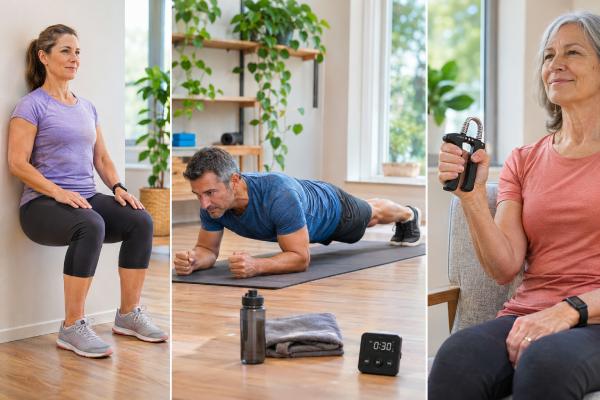
Isometric exercise—contracting a muscle without much joint movement—can lower resting blood pressure when practiced regularly. Wall sits and handgrip training have the strongest direct evidence, while planks are useful for strength but are less specifically studied as a blood-pressure treatment. Large reviews of exercise trials suggest isometric training can produce meaningful reductions in clinic blood pressure, although effects on 24-hour ambulatory readings may be smaller. The goal is not to strain as hard as possible. Research protocols generally use repeated moderate-to-hard holds, several times per week, for at least eight weeks. Breathing continuously is essential because breath-holding and maximal effort can cause large temporary blood-pressure spikes. Isometric exercise should complement aerobic activity, resistance training, a heart-healthy diet, and prescribed medication—not replace them. People with very high or unstable blood pressure, recent cardiovascular events, significant heart disease, aneurysm, or symptoms such as chest pain or fainting should get medical guidance before starting a demanding static-exercise program.
Table of Contents
- How Isometric Exercise Affects Blood Pressure
- Wall Sits for Blood Pressure
- Isometric Handgrip Training
- Planks and Other Isometric Exercises
- Safety, Breathing, and When to Avoid Isometrics
- How to Build a Weekly Blood-Pressure Plan
- How to Track Results and Know If It Is Working
How Isometric Exercise Affects Blood Pressure
An isometric contraction happens when a muscle produces force while its length changes very little. Holding a wall sit, squeezing a handgrip device, or maintaining a plank are familiar examples. During the hold, blood pressure rises temporarily because contracting muscle compresses blood vessels and the nervous system increases cardiovascular drive. With repeated training over weeks, however, resting blood pressure can decrease.
A large network meta-analysis of randomized exercise trials found that isometric training produced some of the largest average reductions in resting clinic blood pressure among exercise categories. In pooled estimates, reductions were roughly 8 mm Hg systolic and 4 mm Hg diastolic, although those numbers should not be treated as a guaranteed personal result. Studies differed in participants, methods, baseline blood pressure, exercise dose, and quality.
More recent reviews of handgrip training have found smaller or less consistent changes in 24-hour ambulatory blood pressure. That distinction matters because a clinic reading and an all-day average are not the same outcome. The overall evidence is promising, but it does not justify claiming that four wall sits are universally better than all other exercise.
For comparison, regular dynamic exercise remains strongly recommended for cardiovascular health. Walking, cycling, swimming, and conventional resistance training improve fitness, metabolic health, function, and long-term cardiovascular risk. A guide to the best exercises for high blood pressure can help put isometrics into a broader routine.
Why training may lower resting pressure
Researchers have proposed several mechanisms:
- Improved function of the blood-vessel lining, or endothelium.
- Better ability of arteries to dilate.
- Reduced resting activity of the sympathetic nervous system.
- Changes in baroreflex function, which helps regulate blood pressure.
- Improved local blood flow and vascular remodeling.
The exact contribution of each mechanism is still being studied. What matters practically is that adaptation requires repeated sessions over time. One wall sit may raise blood pressure during the effort; a program performed several times per week can lower resting pressure after weeks of adaptation.
Wall Sits for Blood Pressure
Wall sits are among the best-studied lower-body isometric exercises for blood-pressure reduction. They recruit large muscles in the thighs and hips while allowing intensity to be adjusted simply by changing knee angle and hold duration.
How to perform a wall sit
- Stand with your back against a sturdy wall and your feet about 1½ to 2 feet in front of you.
- Slide down until you reach a knee angle you can hold with good control. Beginners do not need to reach 90 degrees.
- Keep your back supported by the wall and feet flat.
- Breathe normally. Do not brace and hold your breath.
- Hold for the planned duration, then stand gradually and rest.
Research programs often use four 2-minute holds separated by roughly 2 minutes of rest, performed about three times per week. That is a training target, not a sensible starting point for everyone.
A beginner can start with 20 to 30 seconds for three or four sets, resting one to two minutes between efforts. Increase the hold by 10 to 15 seconds as it becomes comfortable. Over several weeks, work toward longer holds without turning each set into an all-out test.
How hard should the wall sit feel?
Aim for a hard but controlled effort. By the end of a set, your thighs should feel challenged, but you should still be able to breathe continuously and stop with good control. If your face is straining, you are grunting, or you have to hold your breath to finish, make the exercise easier by sliding higher on the wall.
Some research protocols prescribe intensity from a person’s peak heart rate or a standardized wall-squat test, but that requires supervised assessment. For home training, perceived effort and technique are more practical.
Common wall-sit mistakes
- Sliding too low on the first session and developing knee pain.
- Holding the breath during the hardest portion.
- Locking the feet too close to the wall so the knees move excessively forward.
- Treating every hold as a maximal endurance challenge.
- Standing up abruptly when lightheaded.
- Doing isometrics immediately before measuring resting home blood pressure.
Wall sits should create muscular fatigue, not joint pain. If the knees hurt, reduce the depth or choose another exercise.
Isometric Handgrip Training
Handgrip training has been studied for decades because it is simple, portable, and easy to standardize. A typical research protocol uses repeated squeezes at a percentage of maximum voluntary contraction, or MVC.
One evidence-based pattern is:
- Intensity: about 30% of MVC.
- Hold: 2 minutes.
- Sets: 4.
- Rest: about 1 minute between holds.
- Frequency: around 3 sessions per week.
- Duration: at least 8 weeks.
Some protocols alternate hands; others train one hand at a time. Newer reviews suggest that a program near this range can lower resting blood pressure, although study methods vary.
How to find 30% of maximum grip
An electronic or calibrated handgrip dynamometer can measure your maximum squeeze and display a target contraction level. For example, if your measured maximum is 40 kg of force, 30% is 12 kg.
Do not try to estimate a precise 30% target by squeezing a cheap spring gripper as hard as possible. Without feedback, you cannot know the actual percentage. Instead, use a submaximal grip that feels sustainable for the full hold and does not force you to strain or hold your breath.
What if you do not have a dynamometer?
A stress ball or adjustable gripper can still be used for general isometric exercise, but the session will be less standardized. Choose resistance that feels moderately hard and allows you to hold steady pressure. The grip should not cause numbness, sharp hand pain, or forearm cramping.
If your main goal is evidence-based hypertension treatment rather than general hand strength, a device that displays force or target intensity makes the program easier to reproduce.
What does the evidence show?
Systematic reviews have reported reductions in clinic systolic and diastolic blood pressure after several weeks of handgrip training. One meta-analysis in adults with hypertension found average reductions of roughly 7 mm Hg systolic and 4 to 5 mm Hg diastolic across included trials. However, a 2024 review focused on ambulatory blood pressure found a significant reduction in awake diastolic pressure but not a clear reduction in 24-hour systolic pressure.
That mixed picture is a good reason to view handgrip training as an adjunct, not a medication replacement.
Planks and Other Isometric Exercises
Planks are excellent for trunk endurance and can be part of a balanced strength program, but the blood-pressure evidence is not as specific or extensive as it is for wall squats and handgrip training. If lowering blood pressure is the main goal, use planks as a supporting exercise rather than assuming they are equivalent to the best-studied protocols.
A basic front plank
Start on your forearms and knees or toes. Keep your body in a straight line, gently brace the abdomen, and breathe continuously. A beginner might hold for 15 to 30 seconds, rest, and repeat two or three times. Build toward 30 to 60 seconds only if form remains good.
Stop the set when the lower back sags, the shoulders collapse, or you have to hold your breath. Longer is not always better.
Easier plank variations
If a floor plank is too demanding, try:
- A standing plank with hands on a wall.
- An incline plank with hands on a countertop or sturdy bench.
- A forearm plank from the knees.
These variations reduce the force needed while preserving the isometric nature of the exercise.
Other useful isometrics
Calf-raise holds, glute-bridge holds, static split squats, and isometric chest or row contractions can build strength. The problem is that they do not all have the same direct evidence for blood-pressure reduction. More variety is fine for fitness, but do not assume every static hold has been proven to lower blood pressure by a specific amount.
Conventional strength training also has strong cardiovascular value. If you want a broader program, strength exercises for high blood pressure can help you combine dynamic and static work safely.
Safety, Breathing, and When to Avoid Isometrics
Blood pressure rises during an isometric contraction. The increase becomes larger with higher intensity, more muscle mass involved, longer holds, and especially breath-holding. That acute rise is why technique matters.
Never use the Valsalva maneuver on purpose
The Valsalva maneuver means forcefully exhaling against a closed airway, as if straining while holding your breath. It can cause marked swings in blood pressure. Heavy lifters sometimes use it intentionally for trunk stability, but it is not appropriate for a home hypertension-lowering isometric program.
Use a simple rhythm: inhale gently, exhale gently, and keep breathing throughout the hold. If you cannot breathe normally, reduce the intensity.
Who should get medical clearance first?
Talk with a clinician before starting demanding isometric training if you have:
- Severely elevated or poorly controlled blood pressure.
- A recent heart attack, unstable angina, recent stroke, or recent cardiovascular procedure.
- Known aortic aneurysm or another condition in which pressure surges may be dangerous.
- Significant heart valve disease or advanced heart failure.
- Recurrent fainting, unexplained chest pain, or exercise-triggered arrhythmias.
- A medical condition for which your cardiology team has placed activity restrictions.
The 2025 U.S. hypertension guideline continues to emphasize lifestyle treatment, including physical activity, but exercise should be individualized when blood pressure is severe or cardiovascular disease is unstable.
If your resting blood pressure is around 180/120 mm Hg or higher, do not use a hard wall sit to try to lower it immediately. Recheck the reading after quiet rest using correct technique and follow your clinician’s plan for severely elevated pressure. If that level occurs with chest pain, severe shortness of breath, neurologic symptoms, confusion, or other concerning symptoms, seek emergency care.
Stop during exercise for warning symptoms
End the session if you develop chest pressure, faintness, severe shortness of breath, a new sustained irregular heartbeat, severe headache, or neurologic symptoms. Mild muscle burning is expected. Cardiovascular warning symptoms are not.
People taking blood pressure medication may become lightheaded when standing after a wall sit. Rise gradually and use the wall for support if needed.
How to Build a Weekly Blood-Pressure Plan
Isometrics work best as one part of a complete exercise schedule. A practical week might include three isometric sessions, regular walking or other aerobic activity, and two conventional strength sessions.
For example:
| Day | Activity | Example |
|---|---|---|
| Monday | Isometric + walking | Wall sits, then a 20–30 minute easy walk |
| Tuesday | Strength | Full-body resistance session |
| Wednesday | Isometric + aerobic | Handgrip protocol plus brisk walking or cycling |
| Thursday | Light activity | Easy walking and mobility |
| Friday | Isometric + strength | Wall sits or handgrips plus a shorter resistance workout |
| Weekend | Aerobic/recreation | Longer walk, cycling, swimming, or another enjoyable activity |
You do not need both wall sits and handgrips in every session. Pick one primary protocol and follow it consistently for eight to 12 weeks. That makes it easier to judge whether it helps.
A conventional target of at least 150 minutes per week of moderate aerobic activity remains useful for most adults. If that sounds far beyond your current level, build gradually. Ten-minute walks are a valid starting point.
For people who enjoy weights, strength training and blood pressure explains how dynamic resistance exercise can fit beside isometrics.
Progression matters more than suffering
During the first two weeks, focus on technique and breathing. Increase duration or difficulty only after you can complete every set without straining. A wall sit can be made harder by sliding slightly lower; a grip can be made harder by increasing the target force.
Change one variable at a time. If you lengthen the hold and deepen the wall sit simultaneously, you may overshoot your safe training level.
How to Track Results and Know If It Is Working
Blood pressure fluctuates from minute to minute, so one low reading after several weeks does not prove the exercise worked. Use a standardized home-measurement routine and look at averages.
A validated upper-arm cuff is preferable for most people. If you need help choosing one, see how to choose a home blood pressure monitor.
For consistent home readings:
- Measure at similar times of day.
- Avoid exercise, nicotine, and caffeine for about 30 minutes beforehand when possible.
- Sit quietly for five minutes.
- Keep feet flat, back supported, and the cuffed arm supported at heart level.
- Take two readings about one minute apart.
- Record the results rather than relying on memory.
Do not measure immediately after wall sits, planks, or handgrips to see whether pressure “dropped.” Blood pressure can be temporarily elevated during and shortly after static exercise. You are trying to detect a change in resting baseline pressure over weeks.
Give the program enough time
Most training studies last at least several weeks, often eight weeks or more. Compare a week of baseline home readings with another week after eight to 12 weeks of consistent training. Keep medication, caffeine, measurement technique, and timing as similar as reasonably possible.
If your average home blood pressure drops meaningfully, tell your clinician—especially if you take medication. Improved fitness, weight loss, lower sodium intake, and isometric training together may eventually make the previous drug dose more than you need. Medication changes should be supervised rather than based on one low reading.
If blood pressure does not change, the exercise is not necessarily useless. You may still gain leg endurance, grip strength, physical confidence, and a more consistent exercise habit. But if hypertension remains above target, intensifying evidence-based treatment is more important than repeatedly adding longer wall sits.
The most useful takeaway is straightforward: wall sits and handgrip training are legitimate, low-cost additions to a blood-pressure program, but they work through regular training, not heroic single efforts. Choose moderate intensity, breathe continuously, train several times per week, and judge the result with standardized resting measurements. Combine that with aerobic activity, strength training, healthy food choices, sleep, weight management when needed, and prescribed medication for a far stronger cardiovascular plan than any one exercise can provide.
References
- 2025 AHA/ACC/AANP/AAPA/ABC/ACCP/ACPM/AGS/AMA/ASPC/NMA/PCNA/SGIM Guideline for the Prevention, Detection, Evaluation and Management of High Blood Pressure in Adults: A Report of the American College of Cardiology/American Heart Association Joint Committee on Clinical Practice Guidelines 2025 (Guideline)
- Exercise training and resting blood pressure: a large-scale pairwise and network meta-analysis of randomised controlled trials 2023 (Systematic Review and Network Meta-Analysis)
- The evidence of effectiveness of isometric resistance training on the management of hypertension in adults: an umbrella review 2023 (Umbrella Review)
- Effects of Isometric Handgrip Training on Ambulatory Blood Pressure in Individuals Over 18 Years Old: A Systematic Review and Meta-Analysis 2024 (Systematic Review and Meta-Analysis)
- The Optimal Dosage of Isometric Handgrip Exercise for Blood Pressure Reduction: Systematic Review and Meta-Analysis. 2026 (Systematic Review and Meta-Analysis)
- Isometric handgrip training, but not a single session, reduces blood pressure in individuals with hypertension: a systematic review and meta-analysis. 2023 (Systematic Review and Meta-Analysis)
Disclaimer
This article is for general education and is not a substitute for individualized exercise or hypertension care. Isometric exercise can temporarily raise blood pressure during a hold, so people with severely elevated or unstable blood pressure, recent cardiovascular events, significant heart disease, or concerning exercise symptoms should get medical guidance before starting. Do not stop or reduce prescribed blood pressure medication based on exercise results without discussing the change with your clinician.