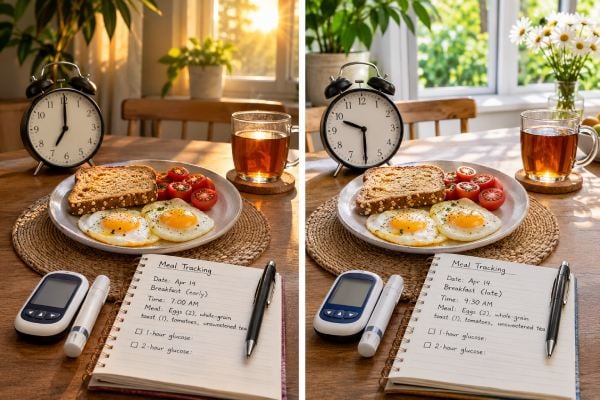
Moving breakfast from 7 a.m. to 9:30 a.m. can change how your blood sugar responds to the same meal. In one small trial of adults with type 2 diabetes, the two-hour rise after breakfast was smaller at the later time, though glucose across the full day did not clearly improve. In a different trial, skipping breakfast altogether led to higher glucose after both lunch and dinner. The distinction matters if you are deciding whether to eat before work, wait until your first break, or make lunch your first meal.
The clock tells only part of the story. Glucose may already be climbing before you take your first bite. What you eat, how long you wait for lunch, and whether you use medication that can cause low blood sugar all shape how a schedule works in practice. If you are considering a change, start with the pattern you want to improve. A high waking reading, a large rise after breakfast, and a large rise after lunch call for different questions.
Table of Contents
- What counts as an early, late, or skipped breakfast?
- What happens to glucose after an early or late breakfast?
- How breakfast timing can affect lunch, dinner, and daily glucose
- Does breakfast timing affect A1C or diabetes risk?
- How to choose a breakfast time that fits your day
- How to compare two breakfast times
- When to get medical guidance before changing meal times
What counts as an early, late, or skipped breakfast?
There is no universal cutoff for a late breakfast. In one direct comparison of breakfast times, researchers used 7 a.m., 9:30 a.m., and noon. Those were study times, and their meaning depends on your routine. If you wake at 5:30 a.m., a 9:30 breakfast lands four hours into your day. If you wake at 8:30 a.m., the same meal comes just one hour after waking. The length of your overnight fast also depends on when you last ate the day before.
Naming what you are changing helps, especially when comparing studies or trying to make sense of your own readings.
| Change | Example | What else shifts |
|---|---|---|
| Move breakfast later | Eat the same breakfast at 9:30 a.m. instead of 7 a.m., keeping lunch at noon. | The overnight fast is longer, and the gap before lunch is shorter. |
| Skip breakfast | Have your usual lunch at noon as your first meal. | There is one fewer meal unless you make up for it later. Lunch follows an overnight fast. |
| Shift the whole eating window | Move the first and last meals from 8 a.m. and 4 p.m. to noon and 8 p.m. | The window stays eight hours long, but food intake moves later across the day. |
Even the word breakfast can describe different things. A research team may serve a standardized breakfast at noon. At home, eating at noon might mean having your usual lunch, with a different portion and different foods. If you also have a latte or toast at 7 a.m., you have already taken in calories before the midday meal. Those details matter when you are trying to figure out what changed.
Clock time is still worth recording, especially if your routine is fairly consistent. On weekends or rotating shifts, write down your wake time as well. A breakfast that looks late on the clock may arrive at your usual interval after waking. Comparing two days with similar sleep and work schedules makes it easier to see whether moving the meal itself makes a difference.
What happens to glucose after an early or late breakfast?
In a 2024 randomized trial, 11 adults with type 2 diabetes ate a standardized breakfast at 7 a.m., 9:30 a.m., and noon during different parts of the study. Each participant tried all three times. Compared with the 7 a.m. meal, the 9:30 a.m. and noon meals produced a smaller glucose rise over the following two hours, measured against the level at the start of the meal. The researchers found no clear difference between the two later times. They also found no clear difference in the highest reading within two hours of breakfast, the 6 a.m. fasting reading, or the proportion of the day spent in the study’s target range.
A meal can produce a similar peak and still have a smaller overall rise. Picture two curves that reach about the same height. One stays elevated for most of the next two hours; the other comes down sooner. A measure that adds up the rise over time can capture that difference. That is what researchers mean by incremental area under the curve. It answers a different question from “How high did my glucose go?”
Your starting level matters, too. Suppose your glucose is 125 mg/dL before an early breakfast and 155 mg/dL an hour later. On a later-breakfast day, it starts at 105 mg/dL and reaches 145 mg/dL an hour after eating. The late meal gives you a lower one-hour reading, even though the increase is larger: 40 mg/dL compared with 30 mg/dL. These are illustrative numbers, but they show why it helps to look at the value before eating alongside the value afterward.
Why glucose can rise before you eat
Your liver releases glucose overnight so your body has a steady supply between meals. In some people with diabetes, early-morning changes in hormones and insulin needs can lead to a rise before breakfast. This is called the dawn phenomenon. If your glucose climbs between waking and your first bite, part of the high reading you see later was already developing before the meal. The 2024 trial did not establish that delaying breakfast treats this early-morning rise.
Food still matters. In a study that tracked more than 7,000 meals among 514 adults without diabetes, meals with a higher glycemic load were associated with higher post-meal glucose. Glycemic load reflects both how much carbohydrate a meal contains and how rapidly that carbohydrate tends to raise glucose. If your early breakfast is cereal and juice and your late breakfast is plain yogurt with berries and nuts, the clock is only one of several differences. Keeping the meal and drink the same gives you a clearer timing comparison.
How breakfast timing can affect lunch, dinner, and daily glucose
A smaller breakfast rise tells you something about one part of the day. In the 11-person trial, the researchers found no clear difference in the glucose measure they tracked across 24 hours, even though the response to the later breakfasts improved. That small, short study leaves open the possibility that some people respond differently. It also shows why a better morning reading should not be assumed to carry through to bedtime.
A separate randomized trial asked what happens when people with type 2 diabetes skip breakfast entirely. Twenty-two adults ate the same lunch and dinner on two test days. On one day, they also ate breakfast. On the other, lunch was their first meal. When they skipped breakfast, total glucose exposure over three hours after lunch was about 37% higher, and after dinner it was about 27% higher. Their insulin response also peaked about 30 minutes later after each meal. The percentages describe the area under the glucose curve, rather than the height of a single reading.
An earlier meal can influence the response to the next one. This is often called the second-meal effect. Insulin release and how much glucose the liver puts into the bloodstream are among the processes that can change between meals. The breakfast-skipping trial found a slower insulin response alongside higher glucose after later meals. It tested two individual days in adults with type 2 diabetes, so its percentages are best understood as results from that experiment.
The findings address different decisions. A move from 7 to 9:30 a.m. still gives you a meal before lunch. Skipping breakfast makes lunch the first meal after an overnight fast. In daily life, schedules can also change portions or food choices. If waiting until noon leaves you hungry enough to have a bigger lunch and a sweet drink, the longer fast and the larger meal may both shape your afternoon readings. In the skipping trial, lunch and dinner stayed the same, so larger portions could not explain the difference.
When breakfast and lunch are close together, look at meal times alongside the readings. If you eat breakfast at 10:30 a.m. and lunch at noon, a reading at 12:30 p.m. may reflect both meals. A before-lunch reading gives you a better sense of where you started. If lunch moves later as well, pay attention to what happens at dinner. You are now trying a different daily schedule, and the result that matters is how the schedule works as a whole.
Does breakfast timing affect A1C or diabetes risk?
A short glucose study can show what happened after one meal or over a few days. A1C reflects average glucose over roughly the past two to three months. A smaller rise after a late breakfast could matter if it happens regularly and improves average glucose. The available direct breakfast trial was too small and short to establish that moving breakfast by a few hours lowers A1C.
Long-term observational research asks a different question. In a French study of more than 103,000 adults, people who usually had their first meal after 9 a.m. had a higher rate of developing type 2 diabetes than those who usually ate before 8 a.m. The relative rate was about 59% higher after adjustment for several other factors. Participants chose their own schedules, so timing may have traveled with differences in work, sleep, food choices, or other habits that the researchers could only partly account for. The 8 a.m. and 9 a.m. cutoffs were used to compare groups. They do not tell you how your risk would change if you moved breakfast across either hour.
Research on time-restricted eating adds another piece. A 2026 review of randomized trials found that earlier eating windows lowered fasting insulin more than later windows. Compared with usual diets, early windows lowered fasting glucose by about 6 mg/dL on average. The review found inconsistent A1C results across the studies. Because these plans set both when eating ends and how long the daily window lasts, their findings apply to the full schedule. Moving breakfast earlier while keeping a late dinner is a different change.
If you have prediabetes, an earlier breakfast may help you build a routine with manageable portions and a predictable lunch. If you have type 2 diabetes, a midmorning meal may suit you better when breakfast is consistently followed by a large rise. In either case, a schedule is worth judging by the pattern it produces over time, how it fits your treatment, and whether you can keep it up.
How to choose a breakfast time that fits your day
Start with what is happening on an ordinary day. An early breakfast can make sense if you wake hungry, work a physically demanding shift, or get to lunch feeling so hungry that it is hard to choose a portion that satisfies you comfortably. If a 7 a.m. meal feels rushed and tends to be a pastry on the way out the door, a planned 9 a.m. breakfast at work may be easier to put together. The meal may improve along with the timing, and both changes can be worthwhile in daily life.
Here are a few ways to match the change to the problem you are seeing.
- Your glucose is already high when you wake. Note when you last ate the night before and whether glucose is stable or rising before breakfast. If you see a recurring pattern, bring those details to your care team. It can help them decide whether to look more closely at overnight glucose, meal timing, or your treatment plan.
- Your biggest rise follows breakfast. Look first at the portion and the drink. A large sweetened coffee can add a meaningful amount of carbohydrate. If the meal already suits you and a timing change is safe, compare that same meal at your usual time and about an hour later on similar days.
- Lunch is difficult after you skip breakfast. Try a morning meal that you can manage consistently, then see how hungry you feel before lunch and what happens afterward. Plain Greek yogurt with berries and oats, or eggs or tofu with vegetables and whole-grain toast, are examples you can prepare the same way from day to day.
- A late breakfast pushes dinner close to bedtime. Consider whether the whole schedule works for you. If breakfast at 10 a.m. fits well but lunch still works at its usual time, you may have room to shift breakfast alone. If every meal moves later, assess the result as a change to your whole day.
A satisfying breakfast is useful even when timing is your main question. Pick a portion you would be happy to eat regularly and include a source of protein and a fiber-rich food you enjoy. You can use these breakfast ideas for prediabetes to find options that fit your mornings. Once you have a schedule you can follow, you can decide whether adjusting the food, the timing, or both is worth the effort.
How to compare two breakfast times
If you already check glucose and can safely move breakfast, compare two times you could actually stick with. A few comparable days at each time can give you a clearer picture than a single morning. If you do not normally monitor glucose, you can still compare hunger, energy, and how easy it is to eat regular meals. Those observations can help you choose a routine. A clinician can arrange standard testing if you are concerned about prediabetes or diabetes.
- Choose two practical breakfast times. Try your usual time and a realistic alternative, such as 7:30 and 9 a.m. Use days with similar wake times, work demands, and opportunities to move.
- Keep the breakfast and drink alike. Use the same foods and portions, including milk, sugar, or syrup in your coffee. Keep dinner timing the night before and your usual morning activity as similar as practical. Record any big differences, such as poor sleep, illness, or an unusually hard workout.
- Measure from the first bite. If your care plan includes finger-stick checks, compare readings before the meal and at the same interval afterward. For many adults with diabetes, post-meal checks are timed one to two hours after the meal begins. A 9 a.m. check means something different after a 7:30 breakfast than it does just before a 9 a.m. breakfast.
- Check what happens later. Record lunch time and how hungry you feel. If you already use a continuous glucose monitor, or CGM, review the breakfast curve alongside the lunch and dinner curves. A morning improvement carries more weight if later readings also fit your goals and the schedule feels manageable.
When reviewing the results, check the starting glucose, the size of the rise, and whether the difference repeats. An unusually short night or a change in medication can make two days hard to compare. If you start walking after breakfast on the same day you change meal times, judge how the combined routine works. To see what timing alone does, compare days with similar activity.
For many nonpregnant adults with diabetes, the American Diabetes Association lists a peak post-meal capillary glucose goal below 180 mg/dL, with checks one to two hours after the start of the meal. Individual goals vary, and that figure is a treatment target for diabetes. Home readings can reveal a pattern to discuss with a clinician. Diagnosis relies on standard clinical testing.
When to get medical guidance before changing meal times
Check with your diabetes care team before delaying or skipping breakfast if you use insulin or take a medicine that can cause low blood sugar, such as a sulfonylurea or meglitinide. Some doses are timed to food, and an extended gap before the next meal can increase the risk of a low. Ask how to handle breakfast and medication on workdays, weekends, or days when you wake late. Follow your prescribed dosing instructions until you have a plan for the new schedule.
If your glucose is below 70 mg/dL, follow your low-glucose treatment plan right away, even if breakfast is still an hour away. If someone passes out or cannot safely swallow, call emergency services and use glucagon if it is available and you know how to give it. If you are pregnant and managing diabetes, or have a history of recurrent lows, ask your clinician about the timing and glucose targets appropriate for you before experimenting.
Repeated highs before or after breakfast are worth discussing even if moving the meal sometimes helps. Bring a short record of when you wake, when you eat, what you take, and when the readings rise or fall. That gives your clinician a way to distinguish an overnight pattern from a breakfast response and see whether the change carries through to later meals.
References
- Modifying the timing of breakfast improves postprandial glycaemia in people with type 2 diabetes: A randomised controlled trial 2024 (RCT)
- Fasting Until Noon Triggers Increased Postprandial Hyperglycemia and Impaired Insulin Response After Lunch and Dinner in Individuals With Type 2 Diabetes: A Randomized Clinical Trial 2015 (RCT)
- Age, Sex, BMI, Meal Timing, and Glycemic Response to Meal Glycemic Load 2025
- Associations of meal timing, number of eating occasions and night-time fasting duration with incidence of type 2 diabetes in the NutriNet-Santé cohort 2023
- Effects of timing and eating duration of time restricted eating on metabolic outcomes: systematic review and network meta-analysis 2026 (Systematic Review)
- 6. Glycemic Goals, Hypoglycemia, and Hyperglycemic Crises: Standards of Care in Diabetes—2026 2026 (Guideline)
Disclaimer
This article provides general information about meal timing and blood sugar. If you use medication that can cause low blood sugar, are pregnant with diabetes, or have recurring highs or lows, ask your care team for guidance before changing when you eat.