A low HDL result often comes as a surprise. You can feel well, see a total cholesterol number that looks reassuring, and still find HDL flagged on the lab report. Because HDL is often called “good cholesterol,” the first thought may be how to raise it. A more useful starting point is to look at what else changed and what the numbers say about your heart and metabolic health.
Low HDL can appear by itself. More often, it shows up with high triglycerides, higher blood sugar, or extra fat around the waist. That combination can point to insulin resistance and gives you and your clinician several places to act. Regular activity, changes in what you eat, and quitting smoking can improve your health even when HDL barely moves. Some people also benefit from treatment aimed at lowering LDL cholesterol.
Here’s how to read a low HDL result, decide what deserves attention first, and tell whether your efforts are paying off.
Table of Contents
- What low HDL means on a blood test
- How low HDL relates to insulin resistance
- How to read the rest of your lipid panel
- Habits that improve cholesterol and metabolic health
- What to know about medications, supplements, and alcohol
- When to follow up and how to track progress
What low HDL means on a blood test
HDL stands for high-density lipoprotein. Lipoproteins are particles that carry cholesterol and other fats through your bloodstream. One of HDL’s jobs is to pick up excess cholesterol from cells, including cells in artery walls, and help move it toward the liver for processing.
A standard lipid panel measures HDL cholesterol, sometimes written as HDL-C. That value tells you how much cholesterol is carried inside HDL particles at the time of the blood draw. It does not answer a different question: how well those particles are removing cholesterol from cells. A routine lipid panel can’t settle that.
For adults, commonly used cutoffs for low HDL cholesterol are:
- Men: below 40 mg/dL
- Women: below 50 mg/dL
These cutoffs help identify a risk pattern rather than mark a sharp boundary. A result a point or two on either side of the cutoff has essentially the same meaning when the rest of your health picture is similar. An HDL of 49 mg/dL and a repeat result of 51 mg/dL in a woman may simply reflect normal variation.
A series of results over time gives more context, especially if triglycerides, blood pressure, or blood sugar are changing too.
Low HDL usually causes no symptoms. In many populations, it is associated with a higher risk of heart disease, partly because it often travels with other risk factors. Smoking, low physical activity, insulin resistance, and inherited differences can all influence HDL. Someone who exercises regularly and eats well can still have a low result.
A clinician may look for a medical or medication-related cause when HDL drops sharply from its usual level or stays unusually low on repeat testing.
A high HDL result also deserves context. You can have high HDL and still have enough LDL to raise your risk of plaque buildup in the arteries. The total cholesterol number alone can hide important differences in the kinds of cholesterol circulating in your blood. Treatment decisions therefore account for the full lipid panel, along with factors such as age, blood pressure, diabetes, smoking, and previous heart disease.
How low HDL relates to insulin resistance
With insulin resistance, muscle, liver, and fat cells respond less readily to insulin. The pancreas can often compensate by making more insulin for a while, so blood sugar may stay within its usual range even as other metabolic markers start to change.
Insulin resistance can lead the liver to release more triglyceride-rich particles into the blood. As those particles circulate, they exchange some of their triglycerides for cholesterol carried by HDL. The body then remodels the triglyceride-rich HDL particles and can clear them faster. That helps explain why high triglycerides and low HDL often show up together.
The same pattern can also appear with higher blood pressure, a larger waist, and rising fasting blood sugar. When at least three of those five features occur together, they can meet the criteria for metabolic syndrome. The triglyceride threshold is generally 150 mg/dL, and the fasting blood sugar threshold is 100 mg/dL. Waist cutoffs vary by population, and some criteria account for treatment already in use.
The distinction matters because low HDL alone gives limited information about blood sugar.
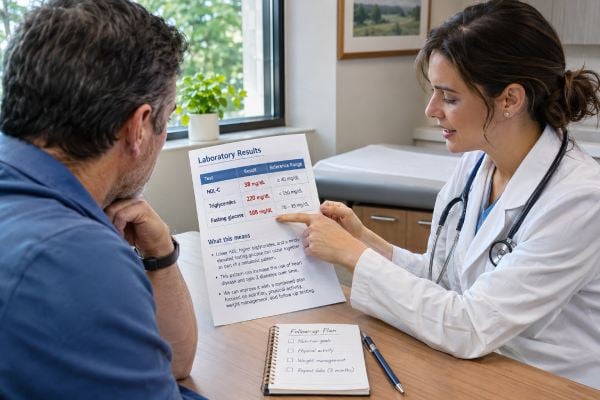
Say a man has an HDL of 38 mg/dL, fasting triglycerides of 95 mg/dL, normal blood pressure, and stable blood sugar. His clinician would consider that isolated HDL result alongside his age, family history, smoking status, and other cholesterol numbers. Now suppose his fasting triglycerides are 220 mg/dL and his fasting blood sugar is 108 mg/dL. Three metabolic syndrome features are present, which puts more emphasis on blood sugar follow-up and what may be driving the triglycerides.
Prediabetes and diabetes are diagnosed using blood sugar tests. An A1C, which estimates average blood sugar over about three months, and a fasting glucose test give different information. A clinician can help choose a test and decide whether an unexpected result needs confirmation. If you already have diabetes, improving glucose management can help bring down triglycerides when high blood sugar is contributing to them.
How to read the rest of your lipid panel
Find the HDL value, then read across the panel. The other values help you see whether the main concern is LDL cholesterol, triglycerides, or a mix of both. With higher triglycerides, non-HDL cholesterol can be especially helpful.
| Result | What it measures | Why it matters when HDL is low |
|---|---|---|
| LDL cholesterol | Cholesterol carried in LDL particles | LDL contributes to plaque buildup. The goal depends on your heart and stroke risk. |
| Triglycerides | The amount of this type of fat circulating in the blood | Fasting levels of 150 mg/dL or higher add context to a low HDL result. Levels of 500 mg/dL or higher warrant prompt follow-up because the risk of pancreatitis rises. |
| Non-HDL cholesterol | Total cholesterol minus HDL cholesterol | Includes cholesterol carried by LDL and other particles that can contribute to plaque. It’s useful even when the blood sample was taken without fasting. |
| ApoB, if measured | A marker of the number of particles that can contribute to plaque | Can clarify risk when LDL cholesterol looks acceptable but triglycerides are high or you have type 2 diabetes. |
For example, if your total cholesterol is 180 mg/dL and your HDL is 35 mg/dL, your non-HDL cholesterol is 145 mg/dL. Whether 145 mg/dL is above your goal depends on your risk. If your next test shows a lower non-HDL level and the same HDL, the drop in non-HDL can still represent progress.
LDL cholesterol reports the amount of cholesterol inside LDL particles. The amount per particle can vary, so two people with the same LDL cholesterol can have different numbers of particles. An ApoB test can help in selected cases, particularly if triglycerides stay high or if a treatment decision is uncertain after reviewing LDL and non-HDL cholesterol. Many people can make a clear plan with the standard panel and a risk assessment.
Check whether you were fasting
A nonfasting lipid panel works for many routine checks. Triglycerides can rise after a meal, so tell your clinician whether you ate before the blood draw. If nonfasting triglycerides are 400 mg/dL or higher, a clinician will generally request a fasting panel to help interpret triglycerides and estimate LDL cholesterol. Some labs leave calculated LDL blank when triglycerides are very high.
When comparing results, look at the dates and the conditions of each test. If one panel was fasting and one was taken after lunch, ask how much of the triglyceride difference may be due to timing. Mention a recent illness, any medication or supplement changes, and whether your usual alcohol intake has changed. Those details are especially useful when several values shift at once.
Habits that improve cholesterol and metabolic health
Start with the changes most likely to improve your own results. If you smoke, quitting is a priority for heart health. If you rarely move during the day, regular walks are a practical starting point. If triglycerides are high and sweetened drinks or alcohol are a regular part of your week, changing what you drink is one place to begin.
Build up to regular aerobic activity and strength training
A practical target for many adults is at least 150 minutes of moderate aerobic activity per week, plus muscle-strengthening activity on at least two days. Moderate activity, such as brisk walking, raises your breathing rate while still letting you talk.
A review of randomized trials found that exercise training raised HDL by about 2 mg/dL on average. Individual results vary. Exercise can also help lower triglycerides, improve fitness, and make muscles more responsive to insulin.
If you’re starting from little activity, try a 10-minute walk after lunch on weekdays and add time as it gets easier. Walking after meals can help with the rise in blood sugar after eating, and a regular lunch or dinner gives you a built-in reminder. For strength work, choose exercises you can repeat and gradually make more challenging: chair stands, wall push-ups, and resistance-band rows are good options.
Choose food swaps based on the lipid result you want to improve
If LDL or non-HDL cholesterol is high, replace some foods rich in saturated fat with foods that provide unsaturated fat. Cook with olive or canola oil in place of butter. Use beans or fish in a meal you usually make with sausage. Try nuts in place of a pastry. Oats, beans, lentils, fruit, and vegetables add fiber, and the soluble fiber in foods such as oats and beans can help lower LDL.
If triglycerides are high, take a closer look at sweetened drinks, refined carbohydrates, and alcohol. Plain sparkling water works well in place of soda, and whole fruit is a steadier substitute for juice. If white rice takes up most of your dinner plate, keep a smaller serving and make room for vegetables and beans, fish, or another protein. Whole grains and legumes can fit alongside a plan to lower high triglycerides.
Be careful with food advice that ranks a diet by what it does to HDL alone. A diet heavy in butter, fatty meats, or coconut oil may raise HDL in some people while also raising LDL. If LDL or non-HDL rises, that change deserves attention even if the HDL flag disappears.
Address smoking, weight, and blood sugar where they apply
If you smoke, quitting reduces cardiovascular risk and may help HDL rise. Counseling and approved quit-smoking treatments can help you quit and stay tobacco-free. If you’ve tried before, tell your clinician what made it hard, such as cravings at work or being around other smokers. That can help you choose support that fits your day.
For adults with overweight or obesity who would benefit from losing weight, a change of about 5% of starting body weight can improve triglycerides and blood sugar. That’s about 10 pounds for someone who starts at 200 pounds. HDL may respond less consistently. If weight loss isn’t a suitable goal, activity, nutrition changes, and tobacco treatment still offer ways to improve risk.
If you take insulin or another medicine that can cause low blood sugar, ask your care team how to handle glucose checks when you increase activity or substantially change what you eat. A plan for the first few weeks can help you build a routine safely.
What to know about medications, supplements, and alcohol
Niacin can change HDL without improving heart outcomes
High-dose niacin, a form of vitamin B3, can raise HDL. In a randomized trial of more than 25,000 adults with vascular disease already on statin-based treatment, extended-release niacin combined with laropiprant raised HDL by about 6 mg/dL compared with placebo. Major vascular events occurred at similar rates, and serious side effects were more frequent in the treatment group, including problems with diabetes control. Avoid starting high-dose niacin on your own to correct a low reading.
Statins work by lowering LDL and reducing the risk of heart attack and stroke in people likely to benefit. A clinician may recommend one based on LDL, age, diabetes, a history of heart attack or stroke, or an overall risk estimate. If your LDL comes down on a statin and your HDL stays low, the medication can still be doing its main job.
Prescription treatment for very high triglycerides has another purpose. When triglycerides are severely elevated, especially at 1,000 mg/dL or higher, lowering them becomes a priority because of the risk of pancreatitis. Your clinician may recommend dietary changes, evaluation for contributing conditions, and medication. An HDL supplement won’t address that risk.
Alcohol is a poor way to raise HDL
Alcohol can raise measured HDL, and it can also raise triglycerides, particularly with heavier intake. A higher HDL value from drinking does not establish a heart benefit. If you don’t drink, a low HDL result gives you no reason to start.
If you do drink and triglycerides are high, tell your clinician how much you drink in a typical week and on your heaviest drinking day. That helps you work out whether cutting back or avoiding alcohol should be part of your plan.
When to follow up and how to track progress
An isolated, mildly low HDL result usually fits a routine appointment. Bring your full lipid panel, any previous results you can find, and a list of medications and supplements. Mention a family history of early heart attack or stroke and any recent changes in smoking, alcohol intake, or blood sugar.
Arrange more prompt follow-up if your report shows triglycerides of 500 mg/dL or higher, an LDL of 190 mg/dL or higher, or a large, unexplained drop in HDL. Those findings can change what your clinician checks or treats first.
At the visit, ask which result should guide the plan. If HDL is low and everything else looks favorable, your clinician may recommend maintaining healthy habits and checking again on your usual schedule. When HDL is low alongside high triglycerides or blood pressure, the visit may include a review of metabolic health markers such as A1C, fasting glucose, and waist measurement. For someone with diabetes or established heart disease, the most important decision may be whether LDL or non-HDL is at the recommended goal.
Give changes time and compare the results that matter
When you start or change a cholesterol-lowering medicine, guidelines recommend a repeat lipid panel in 4 to 12 weeks, with later checks based on your response and risk. If you’re making lifestyle changes alone, agree on a follow-up date with your clinician. A check after several weeks to a few months can be useful when triglycerides or another result needs monitoring.
Choose one or two changes you can repeat through an ordinary week. For example, swap your weekday soda for sparkling water and walk for 15 minutes after dinner four days a week. Keep track of how often you do each one. If a plan falls apart on busy days, make it easier to repeat: move the walk to lunch, or keep a water bottle where you usually reach for soda.
At follow-up, look at the results that led to the plan. If fasting triglycerides fall from 210 to 145 mg/dL and HDL stays at 38 mg/dL, the triglycerides have moved below the usual 150 mg/dL cutoff. If LDL falls after starting a statin, compare the new value with the goal you and your clinician discussed. And if blood sugar was the main concern, use your next glucose or A1C check to see how it’s responding. Those results can show progress even when the HDL number that first caught your eye stays the same.
References
- 2026 ACC/AHA/AACVPR/ABC/ACPM/ADA/AGS/APhA/ASPC/NLA/PCNA Guideline on the Management of Dyslipidemia: A Report of the American College of Cardiology/American Heart Association Joint Committee on Clinical Practice Guidelines 2026 (Guideline)
- High-density lipoproteins, Part 1. Epidemiology, antiatherogenic effects, and therapies designed to increase their serum levels 2025 (Review)
- The Effect of Exercise Training on Blood Lipids: A Systematic Review and Meta-analysis 2025 (Systematic Review)
- Metabolic Syndrome – Diagnosis 2022
- Effects of Extended-Release Niacin with Laropiprant in High-Risk Patients 2014 (RCT)
Disclaimer
This article provides general education. A healthcare professional can interpret your HDL alongside your other lipid results, blood sugar, and medical history. Talk with your clinician before changing prescribed medication or starting high-dose niacin.