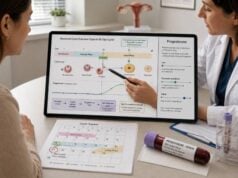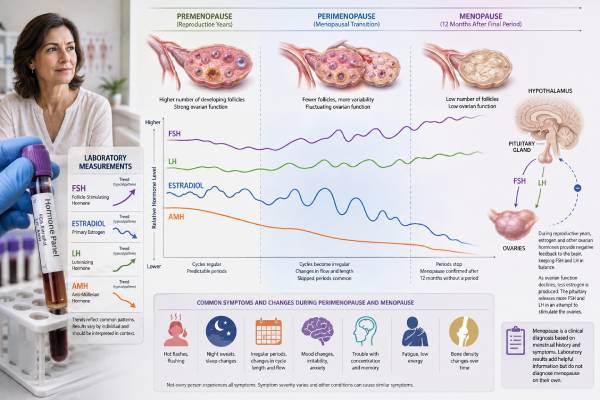
A menopause hormone test panel may include follicle-stimulating hormone (FSH), estradiol, luteinizing hormone (LH), and anti-Müllerian hormone (AMH). These markers reflect ovarian activity and pituitary feedback, but they are not usually needed to diagnose typical perimenopause or menopause in a healthy person age 45 or older. At that stage, symptoms and changes in menstrual pattern are generally more informative because hormone levels can swing widely from one week to the next.
Testing becomes more useful when periods stop before age 45, menopause is suspected before age 40, symptoms are unusual, bleeding cannot be assessed, or another condition could explain the changes. FSH tends to rise and estradiol tends to fall as ovarian function declines, while LH often rises and AMH becomes very low. No single result can determine the exact date of the final menstrual period, predict symptom severity, or decide by itself whether hormone therapy is appropriate.
- Most people age 45 or older with typical hot flashes and changing periods do not need hormone testing to diagnose perimenopause.
- High FSH with low estradiol supports reduced ovarian function, but one fluctuating result may be misleading during perimenopause.
- AMH declines before the final menstrual period but is not recommended as a routine test to diagnose menopause or primary ovarian insufficiency.
- Hormonal contraception and menopause hormone therapy can suppress or alter FSH, LH, and estradiol, making routine interpretation unreliable.
- Menopause is confirmed retrospectively after 12 months without a period when no other cause explains the amenorrhea.
- Bleeding after menopause requires medical evaluation regardless of hormone results.
Table of Contents
- How Menopause Is Identified
- When a Hormone Panel Is Useful
- What FSH, Estradiol, LH, and AMH Mean
- Timing and Preparation
- Common Result Patterns
- Symptoms and Other Possible Causes
- Follow-Up and Treatment Decisions
- Common Questions About Menopause Testing
How Menopause Is Identified
Menopause is the final menstrual period caused by loss of ovarian follicular activity. Because the final period can only be recognized after time has passed, natural menopause is diagnosed retrospectively after 12 consecutive months without menstruation when pregnancy, medication effects, surgery, and other medical causes have been excluded.
Perimenopause is the transition leading up to that point. It commonly begins with changes in cycle length, skipped periods, heavier or lighter bleeding, hot flashes, night sweats, sleep disturbance, and vaginal or urinary symptoms. Ovarian hormone production becomes irregular rather than declining in a smooth line. Estradiol may be low one month and high the next, and FSH may move in the opposite direction.
For most healthy people age 45 or older, clinicians can identify perimenopause from age, symptoms, and menstrual changes without a laboratory panel. Testing every fluctuation can create confusion because a “premenopausal” FSH value does not rule out perimenopause and a “menopausal” value does not prove that periods will never return.
| Stage | Typical clinical pattern | Typical hormone trend |
|---|---|---|
| Early perimenopause | Cycle length changes by seven days or more | FSH and estradiol fluctuate; AMH is usually lower |
| Late perimenopause | Gaps of 60 days or more between periods | FSH more often elevated; estradiol variable and often lower |
| Natural menopause | 12 months without a period | FSH and LH generally high; estradiol low; AMH very low or undetectable |
| Postmenopause | Time after the final menstrual period | Hormone pattern remains broadly hypoestrogenic, with individual variation |
Menopause caused by bilateral ovary removal is different because estrogen falls abruptly after surgery. Chemotherapy, pelvic radiation, ovarian suppression, and some medical conditions can cause temporary or permanent ovarian insufficiency. The clinical context determines whether the term is natural menopause, treatment-induced menopause, or primary ovarian insufficiency.
When a Hormone Panel Is Useful
Hormone testing may help when the diagnosis is uncertain or when early loss of ovarian function carries additional health and fertility implications.
Testing is more commonly considered when:
- Menstrual periods become irregular or stop before age 45
- Menopause-like symptoms occur before age 40
- A hysterectomy prevents menstrual tracking but the ovaries remain
- Hormonal contraception, an intrauterine system, or another treatment obscures bleeding patterns
- Symptoms are atypical or severe and thyroid, pituitary, pregnancy, or other causes are possible
- There is a history of chemotherapy, pelvic radiation, ovarian surgery, or a genetic risk for early ovarian failure
- Fertility counseling is needed because ovarian function may be declining early
- The clinician is evaluating primary ovarian insufficiency rather than typical age-related menopause
A person younger than 40 with irregular or absent periods and menopausal symptoms needs a structured evaluation. Primary ovarian insufficiency can affect bone, cardiovascular, sexual, and reproductive health. Diagnosis uses the menstrual history and biochemical evidence of ovarian insufficiency, usually elevated FSH, after pregnancy and other causes have been considered. Updated guidelines have simplified some older requirements for repeated testing, but a repeat result is still reasonable when uncertainty remains.
A perimenopause hormone panel may be ordered, yet the panel should not replace evaluation of abnormal bleeding. Fibroids, polyps, pregnancy, thyroid disease, medications, bleeding disorders, and endometrial disease can coexist with perimenopause.
Testing is usually not helpful for “balancing hormones,” predicting which symptoms will occur, selecting a personalized compounded hormone dose from one blood or saliva sample, or proving that a person is a candidate for treatment. Menopausal symptoms and health risks guide treatment more directly than a target serum estradiol level in most patients.
What FSH, Estradiol, LH, and AMH Mean
FSH
FSH is released by the pituitary gland to stimulate ovarian follicles. As the follicle pool declines, ovarian feedback from estradiol and inhibins becomes less consistent, so FSH rises. A clearly elevated FSH level can support ovarian insufficiency when the clinical context fits.
FSH fluctuates during perimenopause. One result below a laboratory’s menopausal range does not rule out the transition. Some laboratories use values above about 25–30 IU/L as evidence of ovarian insufficiency in the correct setting, while older criteria often used 30–40 IU/L. The exact cutoff depends on the guideline, assay, age, symptoms, and menstrual pattern.
An FSH blood test is most useful when investigating early amenorrhea or distinguishing ovarian failure from central pituitary-hypothalamic suppression.
Estradiol
Estradiol is the main estrogen during reproductive years. It supports the endometrium, bones, brain, blood vessels, skin, and vaginal and urinary tissues. Estradiol production becomes erratic in perimenopause and generally settles at a lower level after menopause.
Low estradiol with high FSH supports reduced ovarian function. Low estradiol with low or normal FSH suggests insufficient pituitary or hypothalamic stimulation instead. A single high estradiol value can occur during perimenopause because an active follicle may produce a strong temporary peak.
Estradiol testing is not routinely used to titrate standard menopause hormone therapy for symptom relief. Dose is usually adjusted according to symptom response, adverse effects, route, bleeding pattern, and individual risks.
LH
LH is another pituitary gonadotropin. It triggers ovulation during reproductive cycles and rises after menopause as ovarian feedback declines. LH adds less diagnostic information than FSH in most menopause evaluations. High LH is expected after menopause, but it is not specific because it also rises during the normal midcycle surge.
Low or normal LH with low estradiol may support central hypogonadism. In a person using estrogen, progestin, or a GnRH medicine, LH may be suppressed by treatment.
AMH
AMH is produced by small growing ovarian follicles. It tends to decline as the recruitable follicle pool becomes smaller and is often very low before the final menstrual period. Because AMH is more stable across the cycle than FSH, it has been studied as a predictor of time to menopause.
Individual prediction remains imprecise. A very low AMH value cannot tell a person whether the final period will occur next month or several years later. AMH is also affected by age, assay method, hormonal contraception, ovarian surgery, PCOS, and some medical treatments. Current guidance does not recommend routine AMH testing to diagnose natural menopause or primary ovarian insufficiency.
An AMH result is better suited to estimating ovarian response in fertility treatment than to confirming menopause.
Timing and Preparation
No fasting is usually required for FSH, LH, estradiol, or AMH. The blood sample is collected from a vein in the arm. Temporary bruising, soreness, or lightheadedness may occur.
For people who still menstruate, cycle timing affects FSH, LH, and estradiol. Early-cycle testing on days 2–5 gives a baseline pattern, but clinicians investigating prolonged amenorrhea may draw the panel at any time. The menstrual history and last period date should be recorded.
AMH can generally be measured on any cycle day, although it is not completely free of biological variation. Testing should not be repeated frequently because small changes may reflect assay or day-to-day variation rather than a meaningful change in ovarian function.
Before the draw, report:
- Combined or progestin-only contraception
- Menopause hormone therapy, vaginal estrogen, implants, pellets, or compounded hormones
- Fertility medicines, GnRH agonists or antagonists, and ovarian suppression
- Pregnancy possibility and breastfeeding
- Hysterectomy or ovarian surgery
- Chemotherapy, radiation, or cancer treatment
- Biotin and other supplements
- Recent acute illness, major weight change, or intensive exercise
Hormonal contraception complicates interpretation. Combined contraception suppresses FSH and LH and provides synthetic estrogen or progestin effects. A levonorgestrel intrauterine system may stop bleeding without stopping ovarian cycles. Menopause hormone therapy also changes serum hormone values. Testing while using these products may answer a specific specialist question, but it generally cannot provide a simple untreated menopausal status.
Do not stop contraception or hormone therapy without medical advice. Pregnancy prevention may still be needed during perimenopause, and abrupt discontinuation can cause symptoms or bleeding.
Common Result Patterns
The relationship among hormones is more informative than one value.
| Pattern | Possible interpretation | Important next considerations |
|---|---|---|
| High FSH and LH, low estradiol, age over 45 with typical symptoms | Ovarian function consistent with menopause | Testing may not have been necessary; manage symptoms and health risks |
| Variable FSH and estradiol with irregular periods | Perimenopause | Use symptoms and cycle pattern; rule out other causes of abnormal bleeding |
| High FSH, low estradiol, under age 40 | Possible primary ovarian insufficiency | Pregnancy test, repeat/confirm if uncertain, genetic and autoimmune evaluation when indicated |
| Low estradiol with low or normal FSH and LH | Hypothalamic or pituitary suppression | Nutrition, exercise, weight, prolactin, thyroid, iron studies, and pituitary assessment |
| Very low AMH with otherwise variable hormones | Small follicle pool, but timing of menopause remains uncertain | Age and clinical context; do not use AMH alone for diagnosis |
| “Normal” FSH while on estrogen or combined contraception | Medication-related suppression | Menopausal status cannot be inferred reliably from the value |
FSH and estradiol can be discordant. High estradiol may suppress FSH temporarily, creating a normal FSH result despite declining ovarian reserve. A very high FSH value may later fall if an ovarian follicle becomes active again. This variability is characteristic of the transition rather than proof that a laboratory made an error.
Primary ovarian insufficiency differs from permanent menopause because intermittent ovarian activity and occasional ovulation can occur. A primary ovarian insufficiency panel is only the beginning of evaluation; fertility, bone health, genetic implications, and hormone replacement needs also require attention.
Symptoms and Other Possible Causes
Symptoms associated with the menopause transition include:
- Hot flashes and night sweats
- Sleep disturbance
- Changes in cycle length or flow
- Vaginal dryness, burning, or pain with sex
- Urinary urgency, recurrent urinary infections, or discomfort
- Mood changes, irritability, or anxiety
- Difficulty concentrating or subjective memory changes
- Joint aches
- Reduced sexual desire
Symptoms vary widely and do not track neatly with serum hormone levels. Some people have severe hot flashes with similar estradiol values to people who have no symptoms. Treatment should target the person’s experience rather than an arbitrary laboratory target.
Other conditions can mimic or compound menopause symptoms:
- Pregnancy
- Thyroid disease
- High prolactin
- Iron-deficiency anemia
- Sleep apnea
- Medication adverse effects
- Anxiety or depression
- Infection or inflammatory disease
- Functional hypothalamic amenorrhea
- Pituitary disease
- Androgen excess or PCOS
Abnormal uterine bleeding deserves separate assessment. Very heavy bleeding, bleeding between periods, bleeding after sex, or any bleeding after 12 months of amenorrhea may require pelvic examination, ultrasound, endometrial sampling, or other investigation. A menopausal hormone pattern does not rule out endometrial disease.
Bone density, cardiovascular risk, blood pressure, lipids, glucose, smoking, alcohol use, family history, and cancer history may be more important for long-term care than repeated hormone panels. The menopause visit is an opportunity to address these areas.
Follow-Up and Treatment Decisions
Treatment is based on symptoms, age, time since menopause, medical history, and preferences—not solely on FSH or estradiol.
Menopause hormone therapy is the most effective treatment for bothersome hot flashes and night sweats and can help prevent bone loss. People with a uterus generally need a progestogen with systemic estrogen to protect the endometrium. Those without a uterus may be able to use estrogen alone, depending on their history. Vaginal estrogen and other local therapies can treat genitourinary symptoms with much lower systemic exposure.
Potential benefits and risks vary with age, time since menopause, dose, route, and health history. Transdermal estrogen may have a lower risk of venous thromboembolism than oral estrogen in some patients. Breast cancer history, unexplained bleeding, prior blood clots, stroke, liver disease, and cardiovascular risk require individualized review.
Nonhormonal options include certain antidepressants, gabapentin, fezolinetant where available and appropriate, cognitive behavioral strategies, and symptom-specific vaginal moisturizers or lubricants. No laboratory result identifies the single best option.
For primary ovarian insufficiency or early menopause, hormone replacement is often recommended until around the usual age of natural menopause unless contraindicated. The purpose includes symptom treatment and support for bone and cardiovascular health. This situation should not be managed as though it were identical to starting hormone therapy at age 60 or later.
Follow-up may include:
- Review of symptoms and treatment response after starting or changing therapy
- Evaluation of unscheduled bleeding
- Blood pressure and cardiovascular risk assessment
- Bone-health review and bone-density testing when indicated
- Fertility and contraception counseling
- Repeat FSH or estradiol only when a specific diagnostic question remains
Compounded “bioidentical” products are not proven safer or more effective than regulated preparations. Saliva and urine hormone testing should not be used to individualize compounded doses because hormone levels fluctuate and do not reliably reflect tissue exposure or symptom needs.
Common Questions About Menopause Testing
Can a normal FSH result rule out perimenopause?
No. FSH can return to a premenopausal range when a follicle becomes active. Age, symptoms, and menstrual changes remain more useful.
Can a high FSH result prove contraception is no longer needed?
Not by itself. Ovulation can occur unpredictably during perimenopause, and hormonal contraception changes FSH. Contraceptive decisions should follow age-, method-, and guideline-specific advice.
Does low AMH mean menopause has started?
No. Low AMH indicates a smaller recruitable follicle pool, but menstruation and ovulation may continue. It cannot date the final menstrual period precisely.
Should hormone levels be checked before starting hormone therapy?
Usually not for a person with typical menopausal symptoms. The decision is based on symptoms, age, health history, contraindications, and preferences. Testing may be appropriate when the diagnosis is uncertain or early ovarian insufficiency is suspected.
Are “optimal” estradiol levels needed during treatment?
Routine treatment does not require reaching a universal target. Symptoms, bleeding, side effects, bone indications, and safety determine dose. Selected specialists may measure levels when absorption is uncertain, a formulation is unusual, or symptoms persist despite treatment.
Seek urgent care for chest pain, sudden shortness of breath, one-sided leg swelling, stroke symptoms, or severe unexplained bleeding. Arrange prompt evaluation for any bleeding after menopause, a new breast lump, or persistent pelvic symptoms.
The most useful menopause assessment combines the clinical story with selective testing. Hormone panels can clarify early or atypical ovarian failure, but they should not turn a normal life transition into a series of confusing monthly laboratory snapshots.
Before an appointment, it can help to keep a brief record of bleeding dates, hot flashes, night sweats, sleep disruption, vaginal or urinary symptoms, and current hormones or contraception. Note whether symptoms affect work, exercise, relationships, or sleep. This record often guides care more effectively than repeating FSH. Bring the exact product names and doses of patches, pills, creams, pellets, supplements, and compounded preparations because route and dose change both safety assessment and laboratory interpretation.
People with a family history of early menopause, fragile bones, blood clots, breast or endometrial cancer, or premature cardiovascular disease should mention it. These details do not automatically rule treatment in or out, but they influence whether testing, bone-density assessment, genetic counseling, nonhormonal therapy, or specialist referral is appropriate. A clinician may also review calcium intake, vitamin D, resistance exercise, alcohol use, smoking, and fall risk as part of healthy aging and reduce preventable fracture and cardiovascular health risk.
Reassessment is appropriate when bleeding patterns, symptoms, medications, or treatment goals change, even when earlier testing was reassuring.
References
- ESE Clinical Practice Guideline for the evaluation and management of menopause and the perimenopause 2025 (Guideline)
- Menopause: identification and management 2026 (Guideline)
- The 2022 hormone therapy position statement of The North American Menopause Society 2022 (Position Statement)
- Guideline on premature ovarian insufficiency 2024 (Guideline)
- Do I need to have testing of my hormone levels during perimenopause? 2025 (Official Page)
- Compounded Bioidentical Menopausal Hormone Therapy 2023 (Clinical Consensus)
Disclaimer
This article provides general education and does not diagnose menopause, primary ovarian insufficiency, or another cause of menstrual change. Hormone results and treatment choices require individualized review of age, symptoms, medicines, bleeding pattern, medical history, and laboratory method. Seek prompt evaluation for any bleeding after menopause and urgent care for severe bleeding, chest pain, sudden shortness of breath, or stroke symptoms.