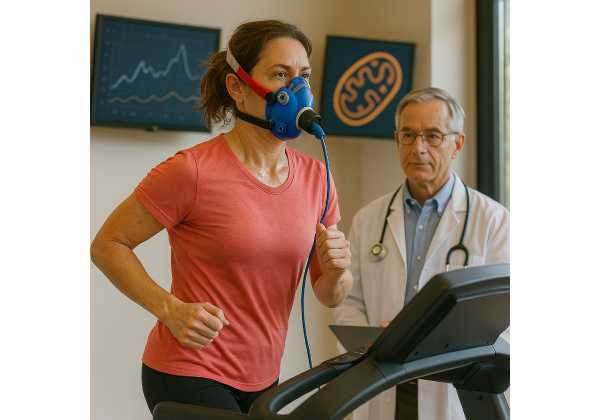
VO₂max measures the highest amount of oxygen your body uses during hard exercise. Mitochondrial efficiency describes how well your cells turn oxygen, fat, and glucose into usable energy. Together, they show how well your heart, lungs, blood vessels, muscles, and cellular “engines” work under demand.
These two systems shape healthy aging because daily life is physical. Climbing stairs, carrying groceries, recovering from illness, keeping glucose stable after meals, and staying independent all require oxygen delivery and energy production. VO₂max reflects the size of your aerobic engine. Mitochondrial efficiency reflects how smoothly that engine runs.
Aging lowers aerobic capacity and mitochondrial function unless the body receives regular signals to maintain them. The useful news is that both respond strongly to training. Brisk walking, cycling, intervals, resistance training, hills, stairs, and post-meal movement all send signals that preserve metabolic flexibility, insulin sensitivity, muscle function, and resilience.
Table of Contents
- Why VO₂max Matters for Healthy Aging
- Mitochondrial Efficiency in Plain Language
- The Metabolic Health Connection: Glucose, Insulin, and Fat Oxidation
- How to Measure VO₂max and Mitochondrial Progress
- Training That Improves VO₂max and Mitochondrial Function
- Nutrition, Recovery, and Timing That Support Adaptation
- Common Mistakes That Hold Back Aerobic Aging
- A Simple Weekly Template for Metabolic Longevity
Why VO₂max Matters for Healthy Aging
VO₂max is one of the clearest measures of cardiorespiratory fitness. It tells you how much oxygen your body takes in, transports, and uses during maximal effort. The number is usually written as milliliters of oxygen per kilogram of body weight per minute, or ml/kg/min.
A higher VO₂max means your heart pumps more blood per beat, your blood vessels deliver oxygen more effectively, your muscles extract oxygen better, and your mitochondria use that oxygen to make energy. That combination matters because aging does not only affect one organ. It affects the whole oxygen-and-energy chain.
VO₂max also gives a practical view of reserve capacity. Reserve capacity is the gap between what daily life requires and what your body is capable of producing. A person with a low aerobic ceiling uses a large share of their capacity to walk uphill, climb stairs, or recover from a respiratory infection. A person with a higher ceiling performs the same task with less strain.
A common way to understand this is through METs. One MET equals about 3.5 ml/kg/min of oxygen use at rest. Walking slowly uses roughly 2 METs. Brisk walking often uses 3–5 METs. Climbing stairs, hiking hills, or carrying loads often requires more. When VO₂max drops, normal life feels harder because routine activities sit closer to your maximum.
VO₂max tends to decline with age, especially when physical activity drops. A decline of about 5–10% per decade after early adulthood is often seen, and the pace becomes steeper with inactivity, illness, weight gain, and muscle loss. Training slows that decline and, in many adults, reverses part of it.
VO₂max also supports metabolic health. Muscles with better oxygen delivery handle glucose more effectively during and after exercise. They store more glycogen, burn more fat at lower intensities, and reduce the amount of insulin needed to move glucose out of the bloodstream. That is why aerobic fitness belongs beside A1c, fasting glucose, and fasting insulin when evaluating long-term metabolic risk.
VO₂max is not a vanity fitness number. It reflects how much physiological headroom you have for aging, illness, travel, stress, heat, cold, sleep loss, and everyday demands.
Mitochondrial Efficiency in Plain Language
Mitochondria are the parts of your cells that turn food energy into ATP, the usable energy currency of the body. They are dense in muscle because movement requires constant energy. They also influence glucose control, fat metabolism, inflammation, cellular repair, and fatigue.
Mitochondrial efficiency means your mitochondria produce enough ATP without wasting excessive energy or creating too much oxidative stress. The goal is not simply “more mitochondria.” The body needs enough mitochondrial capacity, good quality control, flexible fuel use, and clean signaling.
Efficient mitochondria do several jobs well:
- They burn fat during low-to-moderate intensity movement.
- They use carbohydrate quickly when intensity rises.
- They switch between fuels without large energy dips.
- They produce ATP with less unnecessary strain.
- They support recovery after meals, exercise, and illness.
- They help muscle stay fatigue-resistant with age.
Mitochondria respond to demand. When you regularly move at an aerobic intensity, your muscles receive a signal to build more capillaries, make more mitochondrial enzymes, improve fat oxidation, and increase oxygen extraction. When you add harder intervals, your body receives a stronger signal to improve oxygen delivery, cardiac output, and high-end aerobic power.
Aging often brings lower mitochondrial capacity, reduced muscle oxidative function, more fat inside muscle cells, and weaker insulin signaling. These changes do not happen at the same speed in everyone. Inactive muscles lose oxidative machinery faster. Active muscles keep more of their energy-producing equipment.
Mitochondrial renewal also depends on quality control. Damaged mitochondria need to be repaired, recycled, or replaced. This turnover process is one reason regular exercise acts like cellular maintenance. It creates a small, controlled stress, then the body adapts during recovery. That pattern overlaps with mitophagy and mitochondrial renewal, where old or damaged mitochondria are cleared so healthier ones function better.
Mitochondrial efficiency is felt before it is measured. People often notice they recover faster between efforts, tolerate hills better, have steadier energy through the day, and experience fewer large glucose swings after meals. Those changes show that the muscle is becoming a better metabolic sink.
| Feature | VO₂max | Mitochondrial efficiency |
|---|---|---|
| Main idea | Maximum oxygen use during hard effort | How well cells turn oxygen and fuel into ATP |
| Main tissues involved | Heart, lungs, blood, vessels, skeletal muscle | Skeletal muscle cells and their mitochondria |
| Best training signal | Intervals, hills, vigorous aerobic work, sustained conditioning | Zone 2 work, strength training, frequent movement, intervals |
| Metabolic effect | Improves oxygen delivery and exercise capacity | Improves fat oxidation, glucose handling, and fatigue resistance |
| Everyday sign | Stairs and hills feel easier | Energy feels steadier and recovery improves |
The Metabolic Health Connection: Glucose, Insulin, and Fat Oxidation
Aerobic fitness and mitochondrial function directly affect glucose control. Skeletal muscle is one of the largest places where the body stores and uses glucose. When muscles are active and well trained, they pull glucose from the bloodstream more efficiently, store it as glycogen, and burn it during movement.
Insulin resistance often begins when muscle cells stop responding well to insulin. Several factors contribute: excess visceral fat, inactivity, poor sleep, chronic stress, fatty liver, inflammation, and low muscle mass. Mitochondrial dysfunction also plays a role because poorly conditioned muscle struggles to oxidize fat and carbohydrate cleanly.
Training improves this system through several routes. Muscle contractions move glucose into cells through pathways that do not rely entirely on insulin. After exercise, muscles replenish glycogen, which creates a larger storage space for glucose. Over time, aerobic training increases mitochondrial enzymes and capillary density, helping muscle burn fuel more effectively.
This is where VO₂max and metabolic flexibility meet. Metabolic flexibility means the body shifts between fat and carbohydrate based on demand. At rest and during easy movement, a flexible system burns more fat. During harder efforts, it burns more carbohydrate. After a mixed meal, it handles glucose without a prolonged spike. During an overnight fast, it maintains energy without stress-driven glucose swings.
Poor mitochondrial fitness narrows that flexibility. A person may feel drained when meals are delayed, spike high after refined carbohydrates, struggle with exercise intensity, and rely heavily on frequent snacking. Improving aerobic fitness widens the range.
Post-meal movement provides a simple example. A 10–20 minute walk after a carbohydrate-containing meal gives working muscle an immediate reason to use glucose. This does not require intense training. Even light walking changes the glucose curve because muscle contraction creates demand. That habit pairs well with NEAT and post-meal walking, especially for adults working at desks or managing early insulin resistance.
Zone 2 training strengthens the same system at a deeper level. Zone 2 is a sustainable aerobic intensity where breathing is faster but controlled. You can speak in short sentences, but singing would be hard. This intensity trains fat oxidation, mitochondrial density, capillary networks, and endurance without the recovery cost of frequent hard intervals. For insulin sensitivity, Zone 2 training is one of the most reliable anchors because it improves the muscle’s ability to clear and use fuel.
Higher intensity work adds another signal. Intervals push the upper end of oxygen delivery and use. They raise the ceiling while Zone 2 improves the base. Both matter. A strong aerobic base improves daily glucose handling and energy. A higher VO₂max protects reserve capacity as age-related decline presses downward.
How to Measure VO₂max and Mitochondrial Progress
VO₂max is measured most accurately in a lab with a graded exercise test. You walk, run, or cycle while wearing a mask that measures oxygen use and carbon dioxide output. The workload rises until you reach maximal effort. The result gives a direct VO₂max value.
A lab test is useful when precision matters, such as athletic programming, unexplained exercise limitation, cardiac rehabilitation, or a formal baseline. For most healthy adults, field tests and trends provide enough information to guide training.
Common options include:
- A supervised treadmill or cycling VO₂max test.
- A submaximal fitness test at a clinic or gym.
- A 6-minute walk test.
- A 1.5-mile run or walk-run test.
- A Cooper 12-minute test.
- Wearable-based VO₂max estimates.
- Resting heart rate and heart rate recovery trends.
Wearables estimate VO₂max using heart rate, pace, GPS, and personal data. They are imperfect, but they are useful for trends when the same device and similar conditions are used over time. A sudden drop after illness, poor sleep, or detraining is often meaningful. A slow upward trend across months usually reflects real improvement.
Heart rate recovery also adds insight. After hard exercise, a fitter cardiovascular system lowers heart rate faster. A simple test is to record heart rate at the end of a hard but controlled effort, then again one minute later. Bigger drops often reflect better autonomic recovery and fitness, though heat, hydration, caffeine, stress, and medications affect the result.
Mitochondrial efficiency is harder to measure directly outside research labs. Muscle biopsies, magnetic resonance spectroscopy, and specialized tests reveal mitochondrial capacity, but they are not routine health tools. Practical markers work better for everyday use.
Track the following:
- Pace or power at the same Zone 2 heart rate.
- Heart rate at the same walking route and speed.
- Ability to climb stairs without breathlessness.
- Post-meal glucose response after similar meals.
- Morning resting heart rate.
- Heart rate variability trend.
- Recovery after intervals.
- Perceived energy during long easy sessions.
- Waist circumference and body composition over time.
A continuous glucose monitor gives helpful feedback for people studying meals, stress, sleep, and exercise. It does not measure mitochondrial function directly, but it shows how muscle activity changes glucose patterns. A person using continuous glucose monitoring often sees that post-meal walking, strength training, and aerobic conditioning reduce both peak glucose and time spent elevated.
The most useful testing rhythm is simple: choose a baseline, train consistently, retest every 8–12 weeks, and compare similar conditions. Aerobic adaptations need time. Daily noise should not drive major decisions.
Training That Improves VO₂max and Mitochondrial Function
The best training plan uses three signals: frequent easy movement, sustainable aerobic work, and brief hard efforts. Strength training adds a fourth signal by preserving the muscle tissue that uses glucose and houses mitochondria.
Build the aerobic base first
Zone 2 training gives mitochondria repeated, manageable demand. Start with 2–3 sessions per week, 25–45 minutes each. Walking uphill, cycling, rowing, swimming, elliptical training, hiking, and easy jogging all work. The best choice is the one your joints tolerate and your schedule supports.
Use the talk test. Zone 2 feels like work, but it does not feel like a race. Breathing deepens. You sweat lightly or moderately. You finish feeling trained, not crushed.
Over time, progress by adding minutes before adding intensity. A beginner might start with 20 minutes twice weekly. A trained adult might build toward 150–240 minutes weekly of mostly easy-to-moderate aerobic work. More is not automatically better. The dose must fit recovery, sleep, orthopedic tolerance, and stress load.
Add intervals to raise the ceiling
VO₂max improves when the body spends time near high oxygen demand. Intervals do this efficiently. They should feel challenging, controlled, and repeatable. They should not turn into all-out survival sessions.
Good starting options include:
- 4 rounds of 3 minutes hard with 3 minutes easy.
- 6 rounds of 1 minute hard with 2 minutes easy.
- 8–10 short hill repeats of 20–40 seconds with full walk-down recovery.
- 4 rounds of 4 minutes hard with 3 minutes easy for experienced trainees.
One interval session per week is enough for many adults. Two sessions work for some people after a base is established, but the recovery cost rises. Joint pain, poor sleep, irritability, declining performance, and elevated resting heart rate signal too much intensity.
For a deeper interval structure, VO₂max interval training helps organize hard sessions without turning every workout into a test.
Use strength training as metabolic infrastructure
Muscle is the main tissue that stores glucose after meals. Losing muscle lowers metabolic reserve, reduces functional capacity, and leaves less tissue available for glucose disposal. Strength training protects that tissue.
Two to three sessions per week work well for most adults. Prioritize squat or sit-to-stand patterns, hip hinges, pushes, pulls, carries, step-ups, and calf work. Use loads that feel challenging but controlled. Most working sets should stop with 1–3 good reps left in reserve.
Strength work also improves mitochondrial health, especially in older or deconditioned adults. It creates mechanical tension, improves muscle quality, and supports insulin sensitivity. Pairing aerobic training with strength training for insulin sensitivity gives a broader metabolic effect than either one alone.
Move often between workouts
Formal exercise does not erase the effects of sitting all day. Short movement breaks keep glucose and blood flow moving. Stand up every 30–60 minutes, walk after meals, take stairs when reasonable, and use errands as low-intensity conditioning.
Frequent easy movement improves the background environment in which training adaptations occur. It lowers the pressure on formal workouts to do everything.
Nutrition, Recovery, and Timing That Support Adaptation
Training sends the signal. Recovery builds the adaptation. Mitochondria improve when the body receives enough stress to adapt and enough resources to rebuild.
Protein matters because aerobic and interval training still involve muscle remodeling. Most active midlife and older adults do well with protein spread across the day, often 25–40 g per meal depending on body size and total needs. Meals that include protein, fiber-rich plants, and minimally processed carbohydrates support training without large glucose swings.
Carbohydrate quality and timing matter more than carbohydrate fear. VO₂max intervals use carbohydrate heavily. Hard training while under-fueled often lowers output and weakens the training signal. Easy Zone 2 sessions usually need less added fuel, especially when they last under an hour. Longer sessions, hills, heat, or back-to-back training days raise carbohydrate needs.
A useful pattern is simple:
- Eat protein at each meal.
- Place more starch around harder training days.
- Choose legumes, oats, potatoes, fruit, yogurt, and whole grains more often than refined snacks.
- Walk after higher-carbohydrate meals.
- Hydrate before long or hot sessions.
- Avoid turning every aerobic workout into a fasted stress test.
Time-restricted eating and fasting require judgment. Some adults feel better training after a light meal. Others tolerate easy morning Zone 2 before breakfast. Hard intervals, long sessions, and heavy strength training usually perform better with some fuel. When fasting worsens sleep, raises evening hunger, increases injury risk, or lowers training quality, it is no longer helping the aerobic system.
Sleep is also mitochondrial support. Poor sleep reduces glucose tolerance, raises perceived effort, and lowers motivation to train. Adults usually need 7–9 hours of sleep, with enough consistency to support recovery. Resting heart rate and heart rate variability often show the strain of poor sleep before soreness does. Tracking resting heart rate and HRV helps separate productive training from accumulating fatigue.
Recovery days should still include movement. Gentle walking, mobility, easy cycling, and relaxed swimming increase blood flow without adding much stress. This fits the principle of recovery after hormetic stress: the body adapts when stress and repair alternate.
Common Mistakes That Hold Back Aerobic Aging
The most common mistake is training only in the middle. Many adults do every cardio session at a moderately hard pace: too hard for easy mitochondrial volume, too easy for a strong VO₂max signal. This creates fatigue without enough targeted adaptation.
A better split is mostly easy, sometimes hard. Easy work builds the base. Hard work raises the ceiling. Moderate work still has a place, but it should not dominate every session.
Another mistake is chasing wearable numbers without checking real-world performance. A VO₂max estimate from a watch is a trend, not a diagnosis. Outdoor temperature, hills, GPS errors, wrist heart rate accuracy, fatigue, and medication all distort the number. Use it alongside repeatable routes, heart rate, pace, and how you feel.
Ignoring strength is another problem. Aerobic fitness declines faster when muscle mass and power fall. Strong legs make walking, hills, cycling, stairs, and balance work safer. Muscle also protects glucose control. Aerobic training and strength training should support each other.
Too much intensity also backfires. Frequent HIIT with poor sleep, low calories, joint pain, and high life stress raises fatigue. Mitochondria respond to stress, but chronic overload blunts adaptation. Intervals should be dosed like medicine: enough to create a response, not so much that the system stays inflamed and tired.
Poor progression causes setbacks. Tendons, joints, and bones adapt slower than the cardiovascular system. A person often feels aerobically ready to do more before knees, Achilles tendons, hips, or feet are ready. Increase total weekly volume gradually. Use cycling, rowing, swimming, or incline walking when running impact is too much.
A final mistake is separating metabolic health from fitness. Glucose numbers, waist size, blood pressure, triglycerides, sleep, and aerobic capacity influence each other. Improving one often helps the others. When progress stalls, look at the full pattern instead of only adding more exercise.
A Simple Weekly Template for Metabolic Longevity
A good week trains oxygen delivery, mitochondrial function, muscle, balance, and daily glucose handling without draining recovery. The exact schedule should match fitness level, medical history, and available time, but the structure below works for many adults.
| Day | Session | Purpose |
|---|---|---|
| Monday | Strength training, 45–60 minutes | Build muscle for glucose storage and function |
| Tuesday | Zone 2 cardio, 35–50 minutes | Improve mitochondrial capacity and fat oxidation |
| Wednesday | Easy walking, mobility, or recovery | Lower fatigue while maintaining movement |
| Thursday | VO₂max intervals, 20–35 minutes total | Raise aerobic ceiling and oxygen delivery |
| Friday | Strength training, 45–60 minutes | Maintain muscle, tendon, bone, and insulin sensitivity |
| Saturday | Long easy Zone 2, hike, cycle, or brisk walk | Build aerobic durability and metabolic flexibility |
| Sunday | Relaxed walk, balance work, or full rest | Recover and prepare for the next week |
Beginners should reduce the number of sessions, shorten the duration, and skip hard intervals until easy aerobic work feels comfortable. A starting week might include two 20-minute brisk walks, two short strength sessions, and 10-minute post-meal walks on most days.
Experienced adults can progress by adding time to Zone 2, improving interval quality, or increasing strength volume. Only change one variable at a time. Do not increase cardio volume, add intervals, and start heavier lifting in the same week.
Use simple checkpoints every 8–12 weeks:
- Can you walk faster at the same heart rate?
- Is your resting heart rate lower?
- Are stairs easier?
- Do glucose spikes return to baseline faster?
- Is your interval pace or power improving?
- Are you recovering well enough to train consistently?
- Is waist circumference stable or improving?
- Are you maintaining strength?
The best long-term program feels repeatable. It includes enough challenge to signal adaptation and enough recovery to absorb it. VO₂max and mitochondria improve through months of steady work, not through occasional heroic sessions.
Healthy aging depends on usable capacity. A higher VO₂max gives you more aerobic headroom. Better mitochondrial efficiency helps your muscles use fuel cleanly. Together, they support insulin sensitivity, energy, mobility, resilience, and independence across the decades.
References
- Cardiorespiratory fitness is a strong and consistent predictor of morbidity and mortality among adults: an overview of meta-analyses representing over 20.9 million observations from 199 unique cohort studies 2024 (Overview of Meta-Analyses)
- Impact of aging and exercise on skeletal muscle mitochondrial capacity, energy metabolism, and physical function 2021 (Clinical Study)
- The Effect of Exercise Training Intensity on VO₂max in Healthy Adults: An Overview of Systematic Reviews and Meta-Analyses 2022 (Review)
- A mito-centric view on muscle aging and function 2024 (Review)
- International Exercise Recommendations in Older Adults (ICFSR): Expert Consensus Guidelines 2021 (Guideline)
- World Health Organization 2020 guidelines on physical activity and sedentary behaviour 2020 (Guideline)
Disclaimer
This article is educational and does not replace medical care, diagnosis, or individualized exercise guidance. Adults with chest pain, unexplained shortness of breath, fainting, known heart disease, uncontrolled blood pressure, advanced diabetes complications, or major joint problems should speak with a qualified clinician before starting vigorous training. VO₂max testing and high-intensity intervals should be matched to health status, medications, and current fitness.