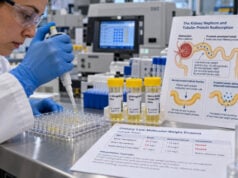
Orthostatic proteinuria is a pattern in which urine protein rises while a person is upright during the day but returns to normal after lying down for several hours. It occurs most often in children, teenagers, and young adults and is usually benign when the rest of the kidney evaluation is normal. The key diagnostic clue is a normal first-morning urine protein measurement after overnight recumbency, despite higher protein in a daytime sample. This distinction matters because persistent proteinuria can signal glomerular or tubular kidney disease, while confirmed orthostatic proteinuria generally does not require treatment. Diagnosis usually relies on a first-morning urine protein-to-creatinine ratio (UPCR), sometimes compared with a daytime sample or split urine collections. Blood pressure, urinalysis, kidney function, and symptoms help determine whether further evaluation is needed. Proteinuria accompanied by blood in the urine, reduced kidney function, hypertension, edema, or systemic symptoms should not be assumed to be orthostatic.
- Orthostatic proteinuria means protein is elevated when upright but normal after overnight lying down.
- A first-morning UPCR is the most practical test: a normal result strongly supports a benign orthostatic pattern when daytime protein is elevated.
- The condition is most common in adolescents and is uncommon after about age 30.
- Exercise, fever, dehydration, and acute illness can also cause temporary proteinuria and should be separated from a true postural pattern.
- Proteinuria with hematuria, high blood pressure, low eGFR, edema, or persistent first-morning protein needs further kidney evaluation.
Table of Contents
- What Orthostatic Proteinuria Is
- How Orthostatic Proteinuria Is Tested
- How to Read the Results
- Why Protein Rises When Standing
- How It Differs From Kidney Disease
- Follow-Up and Monitoring
- When Further Evaluation Is Needed
What Orthostatic Proteinuria Is
Protein excretion changes naturally over the day. Physical activity, posture, hydration, and blood flow through the kidneys can all affect a urine sample. In orthostatic proteinuria, that normal variation is exaggerated: protein appears in urine after a person has been standing or walking, while urine produced during sleep or prolonged lying down contains little or no excess protein.
The condition is seen mainly in school-age children, adolescents, and young adults. Estimates vary by population and testing method, but orthostatic proteinuria is often described in roughly 2%–5% of adolescents. It becomes much less common with age and is unusual after age 30.
Orthostatic proteinuria is different from persistent proteinuria. Persistent proteinuria remains elevated in a first-morning sample and throughout the day. That pattern is more likely to reflect an underlying kidney disorder and needs a broader evaluation.
Most people with true orthostatic proteinuria feel completely well. They usually do not have edema, abnormal kidney function, high blood pressure, or active urine sediment. The protein is often discovered during a school physical, sports examination, insurance test, or routine urinalysis rather than because of symptoms.
The diagnosis is useful because it can prevent unnecessary testing. A daytime dipstick showing protein in a healthy adolescent does not automatically mean chronic kidney disease. Repeating the test under controlled conditions—especially with a first-morning sample—often clarifies the situation.
How Orthostatic Proteinuria Is Tested
The simplest approach compares urine produced after overnight recumbency with urine collected after the person has been upright and active.
First-morning urine protein-to-creatinine ratio
The most practical test is a first-morning UPCR. The person should empty the bladder before going to sleep if instructed, remain lying down overnight, and collect the first urine after waking before prolonged walking or activity. The laboratory measures total urine protein and creatinine in the same specimen.
A UPCR corrects for urine concentration better than protein concentration alone. This is important because a very concentrated urine can look protein-rich even when the total amount excreted is not high.
For children age 2 years and older, many pediatric references consider a first-morning UPCR below about 0.2 mg/mg, equivalent to about 200 mg/g, normal. Some references and laboratories use slightly different thresholds, so the laboratory’s age-specific range should be used. In adults, lower reference cutoffs such as approximately 150 mg/g may be applied.
If the first-morning UPCR is normal but a later daytime sample is elevated, the pattern strongly favors orthostatic proteinuria.
Split urine collection
When the diagnosis remains unclear, a clinician may use split collections. Urine produced while lying down is collected separately from urine produced during upright activity. This directly demonstrates a low recumbent protein excretion and higher upright excretion.
A full 24-hour urine protein collection is rarely necessary just to diagnose a straightforward orthostatic pattern in a healthy adolescent. It can also obscure the distinction because upright and recumbent urine are mixed together.
Before testing, heavy exercise should be avoided if possible because vigorous activity can temporarily increase urine protein. Fever, acute illness, dehydration, and marked stress can do the same. If one of these factors is present, repeating the sample after recovery may be more informative.
How to Read the Results
The diagnosis depends on the pattern, not on a single daytime result.
| First-morning urine | Daytime urine | Likely interpretation |
|---|---|---|
| Normal protein or normal UPCR | Elevated protein | Orthostatic proteinuria is likely if the rest of the evaluation is normal |
| Elevated protein | Elevated protein | Persistent proteinuria; investigate for kidney disease |
| Normal | Normal on repeat | Previous result may have been transient or false positive |
| Variable results during fever, exercise, or dehydration | Variable | Transient proteinuria is possible; repeat when well |
A urine dipstick can be useful for screening, but it is not the best tool for confirming orthostatic proteinuria. Dipsticks respond mainly to albumin and are affected by urine concentration and pH. A concentrated sample can produce a stronger reading, while a dilute sample can understate protein. Quantitative UPCR provides a more reliable comparison.
The amount of daytime protein is usually modest in orthostatic proteinuria. Very heavy proteinuria, particularly nephrotic-range protein loss, should prompt evaluation for glomerular disease even if posture seems to affect the result. Likewise, a normal first-morning test should be interpreted alongside the full clinical picture rather than used to dismiss concerning findings.
A clinician may also order a urine albumin-to-creatinine ratio if the question is specifically albumin leakage. Total protein and albumin answer related but not identical questions, and total protein is commonly used when evaluating orthostatic proteinuria in younger patients.
Why Protein Rises When Standing
The exact mechanism is not fully settled. Several explanations have been proposed, and more than one may apply.
One idea is that standing changes kidney blood flow and glomerular pressure enough to increase protein passage in susceptible people. Upright posture activates normal circulatory responses and changes venous pressure, which may make urinary protein excretion rise temporarily.
Another proposed mechanism involves compression of the left renal vein between the aorta and superior mesenteric artery, sometimes called the nutcracker phenomenon. This can increase pressure in the left renal vein when upright and has been associated with orthostatic proteinuria in some children and adolescents. However, not every person with orthostatic proteinuria has clinically important renal vein compression, and imaging is not routinely necessary in an otherwise typical benign case.
Body habitus may also influence the phenomenon. Some studies have found associations with leaner body size, while others show different relationships. These findings are interesting but are not needed to make the diagnosis.
What matters clinically is that kidney function and structure generally remain normal in classic orthostatic proteinuria. Long-term observations have supported a benign course in people who have no additional abnormalities. The condition often resolves with age.
How It Differs From Kidney Disease
The main challenge is deciding whether the protein is truly postural or an early sign of persistent kidney disease.
Features that support a benign orthostatic pattern include:
- Normal first-morning UPCR
- Normal blood pressure
- Normal serum creatinine and eGFR
- No persistent blood in the urine
- No edema
- No systemic symptoms such as rash, joint swelling, unexplained fever, or weight loss
- Stable findings over time
By contrast, persistent protein in the first-morning urine suggests that the protein is being lost even when posture and activity are minimized. That pattern can occur with glomerular diseases, hereditary kidney conditions, diabetic kidney disease, inflammatory disorders, or tubular proteinuria.
Urine microscopy can add important context. Red blood cell casts, dysmorphic red cells, or significant persistent hematuria point away from uncomplicated orthostatic proteinuria. A kidney-focused urinalysis may therefore be part of the evaluation when screening abnormalities persist.
Family history also matters. A history of hereditary kidney disease, early kidney failure, hearing loss associated with renal disease, or known genetic syndromes may lower the threshold for specialist evaluation.
The term “benign proteinuria” should be used only after the pattern has been demonstrated and concerning findings are absent. It is not appropriate to label unexplained persistent proteinuria as benign based on age alone.
Follow-Up and Monitoring
Confirmed orthostatic proteinuria usually requires observation rather than treatment. There is no medicine needed to stop the postural rise in protein, and activity restriction is generally unnecessary.
Follow-up practices vary, but a clinician may recheck a first-morning urine sample, blood pressure, and kidney function periodically—often annually—until the proteinuria resolves or the person transitions out of the age group in which the condition is common. The purpose is not because orthostatic proteinuria itself is expected to damage the kidneys, but to make sure the pattern remains benign.
During follow-up, use the same collection method whenever possible. Comparing a daytime sample one year with a first-morning sample the next can create apparent changes that are due to collection timing rather than disease.
A useful home preparation checklist for a planned first-morning sample is:
- Avoid strenuous exercise the day before if the clinician recommends it.
- Collect the sample when otherwise well, not during fever or acute illness if the test can safely wait.
- Follow the laboratory’s instructions about bedtime voiding and morning collection.
- Collect before prolonged standing, walking, school, work, or exercise.
- Bring the specimen to the laboratory within the required time or store it as instructed.
If protein disappears on subsequent testing, no special long-term kidney monitoring may be needed beyond routine health care. If first-morning protein becomes elevated, the diagnosis should be reconsidered.
When Further Evaluation Is Needed
Further evaluation is appropriate when the pattern is not clearly orthostatic or when another abnormality is present. Important reasons include:
- Protein remains elevated in repeated first-morning samples
- Proteinuria is increasing or reaches a high level
- Blood is repeatedly found in urine
- Blood pressure is elevated
- Serum creatinine rises or eGFR falls
- Swelling develops around the eyes, legs, or abdomen
- The person has diabetes, autoimmune disease, recurrent infections, or another condition that raises kidney risk
- There is a strong family history of kidney disease
The workup may include repeat quantitative urine protein, urine albumin, microscopic urinalysis, serum creatinine, electrolytes, complement levels, autoimmune tests, or other studies selected from the history and examination. A pediatric or adult nephrologist may be consulted when proteinuria is persistent or accompanied by these warning signs.
Orthostatic proteinuria itself does not usually cause symptoms requiring emergency care. Urgent evaluation is instead driven by signs of a more serious condition, such as rapidly worsening edema, markedly reduced urine output, severe hypertension, breathing difficulty, or systemic illness.
For an otherwise healthy teenager or young adult with an incidental positive daytime protein test, a properly collected first-morning UPCR is often the single most useful next test. A normal result can establish the postural pattern and avoid unnecessary alarm, while an abnormal result appropriately redirects attention toward persistent kidney disease.
Why the first-morning sample matters so much
A first-morning specimen is not merely a repeat of the daytime test. It changes the physiologic conditions under which urine is produced. During several hours of recumbency, the postural effect is minimized, activity is low, and the sample is less influenced by school, sports, walking, or prolonged standing. That makes it a simple physiologic challenge test: if protein falls back into the normal range overnight, the posture-dependent explanation becomes much stronger.
Timing mistakes can blur this distinction. A sample collected after getting dressed, walking around the house, commuting, or exercising may no longer represent true overnight recumbent urine. When the result is borderline, careful adherence to collection instructions is more useful than repeatedly testing at random times.
It is also possible for transient and orthostatic proteinuria to overlap. An adolescent who has exercised heavily, had a viral illness, and provided a random afternoon specimen may show protein for more than one reason. Repeating the first-morning sample when fully recovered helps separate these effects.
What long-term follow-up is trying to detect
The purpose of periodic follow-up is not to treat orthostatic proteinuria as a progressive disease. It is to confirm that the reassuring pattern remains stable. A person who continues to have a normal first-morning UPCR, normal blood pressure, normal kidney function, and no hematuria still fits the benign profile.
The situation changes if the first-morning UPCR becomes abnormal or if another finding appears. New hypertension, persistent microscopic blood, edema, or a fall in eGFR means the earlier label should be reconsidered rather than automatically carried forward. Kidney diseases can emerge later for reasons unrelated to the original orthostatic finding.
For parents and adolescents, this distinction can reduce unnecessary anxiety. A positive dipstick during a routine physical does not by itself predict future kidney failure. The diagnosis depends on demonstrating the characteristic postural pattern and confirming that the rest of the kidney evaluation is normal.
Common interpretation mistakes
Several errors can lead to unnecessary testing or false reassurance:
- Treating any daytime protein as persistent kidney disease without checking a first-morning sample.
- Calling proteinuria “orthostatic” without proving that recumbent urine is normal.
- Using a dipstick alone when a quantitative UPCR is available.
- Ignoring repeated hematuria, elevated blood pressure, or impaired kidney function because the patient is young.
- Comparing pediatric and adult UPCR cutoffs without accounting for age and laboratory reference intervals.
- Ordering extensive imaging or biopsy before confirming a simple benign pattern in an otherwise healthy patient.
In a classic case, the evaluation is deliberately simple: confirm the first-morning normalization, document normal blood pressure and kidney function, and monitor periodically. More complex testing is reserved for cases that do not fit that pattern.
Another practical point is that normal values differ somewhat by age. Infants and very young children can excrete more protein relative to creatinine than older children because creatinine production is lower and the kidneys are still maturing. For an adolescent with suspected orthostatic proteinuria, the laboratory’s pediatric reference interval should therefore be used rather than an adult cutoff copied from another source. The same caution applies when a result is reported in mg/mmol instead of mg/g.
If the protein pattern remains clearly orthostatic, lifestyle changes are usually unnecessary. Normal sports, school activities, and hydration can generally continue. Restricting exercise simply to make the daytime urine test negative defeats the purpose of demonstrating the postural pattern and offers no known kidney benefit. Follow-up focuses on confirming continued normal first-morning results rather than suppressing daytime protein excretion.
In adults, a new diagnosis of orthostatic proteinuria deserves more caution because the condition is uncommon after young adulthood. A first-morning normalization can still be reassuring, but clinicians may review the history and kidney risk factors more closely to make sure another process is not being overlooked. The older the patient or the more atypical the presentation, the lower the threshold for a broader evaluation.
References
- KDIGO 2024 CKD Guideline 2024 (Guideline)
- Proteinuria 2026 (Review)
- Proteinuria in adolescence 2026 (Review)
- Evaluation of Proteinuria and Hematuria in Ambulatory Setting. 2022 (Review)
- Orthostatic Proteinuria 2026 (Review)
- Proteinuria in Children: Evaluation and Differential Diagnosis 2017 (Review)
Disclaimer
Orthostatic proteinuria is usually benign, but the diagnosis depends on confirming a normal recumbent or first-morning urine result and excluding other kidney abnormalities. Persistent proteinuria, hematuria, hypertension, swelling, or reduced kidney function requires medical evaluation. This information is educational and does not replace care from a qualified clinician.