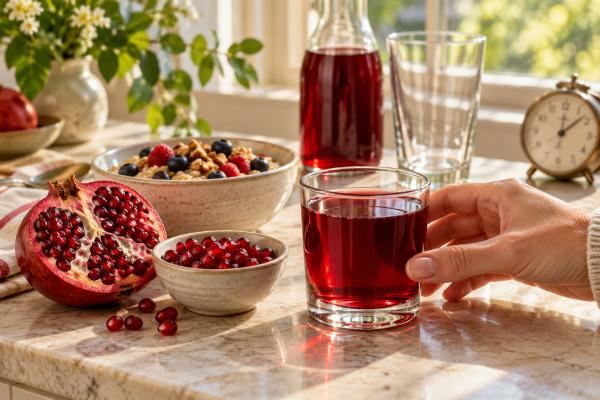
Pomegranate juice can fit into a heart-healthy diet, and the best-supported cardiovascular benefit is a modest reduction in blood pressure in some adults. The juice is rich in polyphenols, including ellagitannins and anthocyanins, that may support blood-vessel function and reduce oxidative stress. However, the evidence does not show that pomegranate juice prevents heart attacks, clears artery plaque, or reliably lowers LDL cholesterol enough to replace proven treatments.
The main practical concern is portion size. A typical 8-ounce glass of 100% pomegranate juice can contain around 30 grams of naturally occurring sugar and roughly 130 to 150 calories. That may fit easily for some people but can work against glucose, triglyceride, or weight goals when servings become large. There is also no proven “best time” of day to drink it. Consistency and total diet quality matter more than morning versus evening timing. A small serving with a meal is often the most practical choice, especially if you watch blood sugar or calories.
Table of Contents
- Why Pomegranate Juice Is Studied for Heart Health
- Blood Pressure Benefits and Realistic Expectations
- Cholesterol, Inflammation, and Artery Health
- Sugar, Calories, and Portion Size
- Best Time to Drink Pomegranate Juice
- How to Choose a Good Pomegranate Juice
- Safety, Medication Interactions, and Who Should Be Careful
Why Pomegranate Juice Is Studied for Heart Health
Pomegranate juice attracts cardiovascular research because it contains a dense mix of polyphenols. These plant compounds include punicalagins and other ellagitannins, anthocyanins, and related phenolics. After digestion, some are transformed by gut bacteria into metabolites that can circulate in the body.
Researchers are interested in several possible effects: improved nitric oxide signaling, better endothelial function, lower oxidative stress, and changes in inflammatory pathways. The endothelium is the thin cell layer lining blood vessels. Healthy endothelial function helps arteries dilate when tissues need more blood and contributes to normal blood-pressure control.
Those mechanisms sound promising, but they should not be confused with proven clinical outcomes. Many foods rich in polyphenols look favorable in laboratory experiments, while human benefits are smaller and more variable. Pomegranate juice is no exception.
Human trials have focused on blood pressure, cholesterol and triglycerides, inflammatory markers, antioxidant status, and measures of vascular function. The most consistent signal is a modest blood-pressure effect. Other outcomes are mixed.
It also matters that “pomegranate” is not a single intervention. Studies use different cultivars, processing methods, juice concentrations, daily volumes, and treatment periods. Some research includes extracts or seed products rather than juice alone. That makes it important to avoid turning one positive trial into a universal claim about every bottled pomegranate drink.
If you are deciding between a beverage and a supplement, pomegranate extract versus juice involves different tradeoffs in sugar, standardization, and how closely the product matches human research. This article focuses specifically on 100% juice as a food.
Blood Pressure Benefits and Realistic Expectations
Blood pressure is where the evidence is most encouraging. Recent systematic reviews and meta-analyses of randomized trials have found that pomegranate intake can lower systolic blood pressure, with smaller average effects on diastolic pressure. A 2023 meta-analysis limited to pomegranate juice reported an average systolic reduction of about 5 mmHg across 14 trials. A broader 2024 analysis that included multiple pomegranate forms found a larger pooled effect, but the studies varied substantially.
A 5 mmHg average reduction can be meaningful at a population level, but it does not mean every person who drinks the juice will see a 5-point drop. Some people may respond more, some less, and some not at all. Starting blood pressure matters, as do medication use, sodium intake, body weight, sleep, exercise, and how blood pressure is measured.
Many trials are also short. Some last only a few weeks, which is enough to detect a change in blood pressure but not enough to prove long-term cardiovascular protection. The studies are generally much smaller than the trials used to establish standard blood-pressure medications.
If you want to try pomegranate juice specifically for blood pressure, treat it as a measurable experiment rather than a guarantee. Keep the portion consistent for several weeks and use a validated upper-arm monitor at home. Measure under similar conditions, take two readings at a sitting, and look at averages instead of reacting to a single number. A consistent home blood-pressure routine makes small changes easier to detect.
Do not reduce or stop antihypertensive medication because your readings improve after adding a food. Medication changes should be made with the clinician who knows your overall cardiovascular risk and treatment history.
If you are testing whether the juice helps, avoid judging the effect from one morning reading. Blood pressure naturally moves with stress, sleep, caffeine, exercise, pain, bladder fullness, and measurement technique. A more useful approach is to collect readings over several days before starting the juice and repeat the same schedule after a few weeks. Compare averages rather than the single lowest number.
Pomegranate juice also should not distract from higher-impact habits. Sodium reduction, regular aerobic activity, weight loss when appropriate, limiting excess alcohol, and a DASH diet pattern have much stronger roles in long-term blood-pressure control.
Cholesterol, Inflammation, and Artery Health
Claims about cholesterol are less dependable than claims about blood pressure. Some pomegranate studies report improvements in LDL, HDL, or triglycerides, while others do not. Recent meta-analyses reach different conclusions depending on whether they include juice only or combine juice with extracts, oils, and other pomegranate products.
A newer juice-focused pooled analysis reported small improvements in LDL, triglycerides, and HDL, but the size of the changes was modest and the studies were heterogeneous. A broader 2025 meta-analysis of pomegranate products did not find a significant LDL reduction overall. That inconsistency is a good reason not to use pomegranate juice as a primary cholesterol-lowering strategy.
If LDL reduction is your goal, replacing saturated fat with unsaturated fat, adding soluble fiber, using plant sterols when appropriate, losing excess weight, and taking medication when indicated have more predictable effects. The causes and treatment of high LDL also extend beyond diet alone.
Pomegranate juice has been studied for C-reactive protein and other inflammatory markers. Some pooled analyses suggest small improvements under certain conditions, but results are inconsistent. These laboratory changes are interesting, yet they do not prove that the juice prevents atherosclerotic events.
The same distinction applies to antioxidant claims. Pomegranate contains compounds that can affect oxidative-stress markers, but “antioxidant” is not a clinical outcome. The body’s redox biology is complex, and more antioxidant activity on a laboratory test does not automatically translate into fewer heart attacks.
Research on endothelial function is potentially more relevant because blood-vessel dilation is tied directly to vascular health. Recent analyses suggest pomegranate may improve some endothelial markers. Still, the studies remain too small and short to establish pomegranate juice as a treatment for vascular disease.
Be particularly skeptical of claims that the juice “unclogs arteries,” “melts plaque,” or reverses coronary disease. No food or beverage has been proven to remove established plaque in that simple way. Cardiovascular risk falls through sustained control of LDL, blood pressure, smoking, diabetes, physical inactivity, and other major drivers.
Sugar, Calories, and Portion Size
Pomegranate juice is nutritious, but it is still juice. A typical 8-fluid-ounce serving of 100% pomegranate juice contains about 30 grams of naturally occurring sugar and roughly 130 to 150 calories, depending on the product. Because the fiber structure of whole fruit is mostly absent, those carbohydrates are easy to drink quickly.
The words 100% juice and no added sugar do not mean sugar-free. They mean the sugars came from the fruit rather than table sugar, syrups, or other sweeteners. Natural fruit sugar still counts toward total carbohydrate and calorie intake.
For many adults, 4 fluid ounces (120 mL) is a practical portion. It provides roughly half the sugar and calories of a full 8-ounce glass while still allowing pomegranate juice to function as a small dietary addition. There is no evidence that you need a large glass several times a day to obtain cardiovascular benefits.
A smaller portion is especially worth considering if you have:
- Prediabetes or diabetes
- High triglycerides
- A calorie target for weight loss
- Fatty liver disease linked to metabolic risk
- A habit of drinking several other caloric beverages each day
Juice is easy to “stack” on top of existing calories because it does not produce the same fullness as chewing whole fruit. If an 8-ounce glass is added every day without replacing anything else, that can amount to roughly 900 to 1,000 extra calories per week depending on the brand.
Whole pomegranate arils provide a different experience. They contain fiber and require chewing, which can make portions more satisfying. They are not identical to the juice preparations used in trials, but they are an excellent heart-healthy food in their own right.
If you are trying to reduce sugars overall, distinguish naturally occurring juice sugars from added sugars linked with heart risk. Both can contribute calories, but added sugars are easier to consume in large amounts and bring little nutritional value.
Juice is not nutritionally identical to whole pomegranate
Whole pomegranate arils and juice share many compounds, but they behave differently as foods. Arils keep more of the fruit’s fiber and physical structure. That slows eating, adds volume, and usually makes it harder to consume the carbohydrate equivalent of several pieces of fruit in a few minutes. Juice removes much of that structure and concentrates the drinkable carbohydrate.
This distinction matters most when weight, glucose, or triglycerides are concerns. If your overall diet already contains several liquid calorie sources—sweet coffee drinks, smoothies, alcohol, sports drinks, or other juices—adding another daily beverage can quietly raise energy intake. Replacing one of those drinks with a small amount of 100% pomegranate juice is different from simply adding juice on top of everything else.
The whole fruit also contributes to satiety in a way that juice often does not. A half-cup of arils can be mixed into oatmeal, plain yogurt, salads, or whole-grain dishes, giving sweetness and texture without turning the fruit into a large beverage. That may be the better everyday choice for someone who enjoys pomegranate but does not need to reproduce a juice-study protocol.
At the same time, whole fruit should not be advertised as an exact substitute for the juice amounts used in clinical trials. The composition, concentration, and dose of polyphenols are different. The heart-health decision is therefore practical rather than absolute: juice may be useful as a small, measured beverage, while whole pomegranate is often easier to integrate into a high-fiber eating pattern.
Best Time to Drink Pomegranate Juice
There is no proven cardiovascular advantage to drinking pomegranate juice first thing in the morning, before bed, or at a specific number of minutes before a meal. Clinical trials use different schedules, and the evidence does not identify one clock time as superior.
With a meal is a sensible default. This can make the carbohydrate load part of a mixed meal rather than an isolated sweet drink, and it may be easier on the stomach for people who find acidic juice irritating. Pairing it with protein, fiber, and healthy fat also creates a more balanced eating occasion.
If you have diabetes or prediabetes, your own glucose response can guide timing. Some people may see a sharper rise from juice taken by itself than from the same amount consumed with a meal. If you use a glucose meter or continuous glucose monitor, compare similar portions rather than guessing.
For exercise, pomegranate juice is sometimes marketed as a performance or recovery drink. That is a separate question from heart protection. Unless you have a specific sports-nutrition reason to use it before or after training, there is no cardiovascular need to time it around workouts.
Evening use is also acceptable for most people, but a large glass close to bedtime adds fluid and carbohydrate and may worsen reflux in someone who is prone to it. Again, portion and personal tolerance matter more than the time on the clock.
The most useful timing rule is therefore simple: pick a small, repeatable serving at a time that fits your meals and does not displace water or more nutrient-dense foods.
How to Choose a Good Pomegranate Juice
Start with the ingredient list. If you want the closest match to most juice research, look for 100% pomegranate juice rather than a pomegranate-flavored drink or a blend whose first ingredient is apple or grape juice.
Blends are not necessarily unhealthy, but they are not the same intervention. A bottle covered in pomegranate images may contain only a fraction of pomegranate juice. The front label is marketing; the ingredient list tells you what you are actually drinking.
Check the serving size and total carbohydrate. Some bottles look like single servings but contain two or more. If you drink the entire container, multiply the calories and sugar accordingly.
Choose products with no added sugar when possible. Added sweeteners provide no cardiovascular advantage and can make an already carbohydrate-rich beverage much easier to overconsume.
You do not need a product making aggressive antioxidant or “heart detox” claims. Processing affects polyphenol content, but consumers rarely have a practical way to verify exact levels across brands. A reputable 100% juice with a straightforward label is a better criterion than exaggerated health language.
Also consider cost. Pomegranate juice can be expensive. If buying it crowds out vegetables, whole fruit, beans, oats, nuts, fish, or other foods with strong cardiovascular evidence, it is not a good trade. Heart-smart drinks for blood pressure also include low-cost options, and plain water should remain the default beverage for hydration.
Safety, Medication Interactions, and Who Should Be Careful
For most healthy adults, a modest amount of pomegranate juice is well tolerated. The main everyday concerns are sugar, calories, acidity, and how it fits with medication.
Laboratory and animal studies suggest pomegranate compounds can influence drug-metabolizing enzymes such as CYP3A4 and CYP2C9. Human evidence for clinically important interactions is limited and inconsistent, so pomegranate should not automatically be treated like grapefruit. Still, caution is reasonable with medicines that have a narrow safety margin.
Warfarin is the best-known example because case reports have described changes in anticoagulation around pomegranate intake. These reports do not prove a predictable interaction, but if you take warfarin, large or newly introduced daily amounts of pomegranate juice should be discussed with the clinician or anticoagulation service that monitors your INR.
People taking several blood-pressure drugs should also pay attention to symptoms if they add pomegranate juice and their readings fall. Dizziness, faintness, or unusual weakness can signal that blood pressure is too low for you, especially if dehydration or medication changes are also involved.
Ask for individualized advice if you are pregnant, breastfeeding, have significant kidney or liver disease, take multiple interacting medicines, or plan to use concentrated pomegranate products in addition to juice.
For everyone else, the most sensible approach is food-sized portions, not pharmacologic quantities. Pomegranate juice can be a flavorful polyphenol-rich option, but its heart value depends on the pattern around it. A 4-ounce serving inside a high-fiber, lower-sodium diet is very different from a 16-ounce daily “health drink” added on top of excess calories.
References
- Pomegranate juice consumption and lipid profile: An updated systematic review and meta-analysis 2026 (Systematic Review)
- Effects of Pomegranate on Vascular Endothelial Function: A Systematic Review and Meta-Analysis of Clinical Trials 2025 (Systematic Review)
- The effects of pomegranate consumption on blood pressure in adults: A systematic review and meta-analysis 2024 (Systematic Review)
- The effect of pomegranate juice supplementation on C-reactive protein levels: GRADE-assessed systematic review and dose-response updated meta-analysis of data from randomized controlled trials 2024 (Systematic Review)
- Impact of pomegranate juice on blood pressure: A systematic review and meta-analysis 2023 (Systematic Review)
- Impact of Pomegranate Juice on the Pharmacokinetics of CYP3A4- and CYP2C9-Mediated Drugs Metabolism: A Preclinical and Clinical Review 2023 (Review)
Disclaimer
This article provides general educational information and is not a substitute for medical advice. If you take warfarin, blood-pressure medicine, diabetes medication, or other prescription drugs, or have a significant medical condition, discuss regular high-volume pomegranate juice use with your healthcare professional.