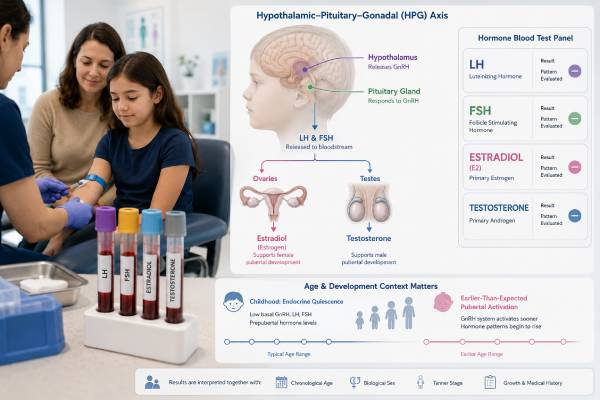
A precocious puberty hormone test panel measures luteinizing hormone (LH), follicle-stimulating hormone (FSH), estradiol, or testosterone to determine whether a child’s reproductive hormone system has activated too early. Central precocious puberty results from early activation of the hypothalamic-pituitary-gonadal axis and is traditionally defined as progressive pubertal development before age 8 in girls or before age 9 in boys. Peripheral precocious puberty occurs when sex hormones rise independently of brain-driven LH and FSH activation. Hormone results must be interpreted with physical examination, growth rate, bone age, and the speed of progression. A sensitive early-morning basal LH is often the first laboratory test for suspected central puberty. When basal results are inconclusive, a GnRH or GnRH-agonist stimulation test may be needed. Estradiol and testosterone show gonadal hormone exposure but can be low or variable early in central puberty. Because normal ranges depend on age, sex, pubertal stage, time of day, and assay sensitivity, adult reference ranges should never be applied to children.
- Early breast or testicular development is more specific than pubic hair alone.
- Basal ultrasensitive LH is the preferred first hormone test for suspected central puberty.
- A pubertal LH response after stimulation supports central precocious puberty.
- High estradiol or testosterone with suppressed LH and FSH suggests a peripheral source.
- Bone age and growth acceleration are essential parts of interpretation.
- Children with concerning early puberty should be assessed by a pediatric endocrinologist.
Table of Contents
- What Counts as Precocious Puberty
- Central Versus Peripheral Precocious Puberty
- When a Hormone Panel Is Needed
- How LH, FSH, Estradiol, and Testosterone Are Tested
- How to Interpret Result Patterns
- Additional Tests and Imaging
- Treatment, Monitoring, and Next Steps
What Counts as Precocious Puberty
Puberty is a coordinated process that includes breast development in girls, testicular and penile growth in boys, pubic and underarm hair, acne, body odor, a growth spurt, and eventually menstruation or mature sperm production. Precocious puberty means that true pubertal development begins earlier than expected and progresses.
The traditional age thresholds are:
- Breast development before age 8 in girls
- Testicular enlargement before age 9 in boys
These thresholds identify children who may need assessment; they do not mean every child below the cutoff has disease or requires treatment. Pubertal timing varies with genetics, ancestry, nutrition, body composition, adoption history, and environmental factors. The child’s age, Tanner stage, progression over several months, and growth velocity matter more than one isolated sign.
Breast tissue is the first typical sign of central puberty in girls. Testicular enlargement—usually a volume of at least 4 mL—is the first typical sign in boys. Pubic hair, underarm hair, acne, and body odor can result from adrenal androgen production called adrenarche. When these occur without breast or testicular enlargement, the pattern may be premature adrenarche rather than central precocious puberty.
Isolated breast development in a young girl is called premature thelarche. It is often benign and nonprogressive, particularly in toddlers, but follow-up is important if breast tissue increases, height accelerates, or other pubertal signs appear. Vaginal bleeding without other progressive puberty needs prompt evaluation for local causes, trauma, foreign body, infection, ovarian cysts, hormone exposure, or other disorders.
The 2026 Endocrine Society guideline emphasizes selective evaluation. Some girls with mild, slowly progressive breast development can be observed with careful examinations rather than undergoing immediate extensive testing. Boys, very young girls, children with rapid progression, and children with neurologic symptoms generally warrant a lower threshold for investigation.
A precocious puberty hormone panel is one part of this assessment. It cannot replace accurate height measurements, pubertal staging, or review of photographs and growth records over time.
Central Versus Peripheral Precocious Puberty
Central precocious puberty is gonadotropin-dependent. The hypothalamus begins releasing pulsatile gonadotropin-releasing hormone (GnRH), which stimulates the pituitary to release LH and FSH. In girls, these hormones activate the ovaries to produce estradiol. In boys, LH stimulates testicular testosterone production and FSH supports testicular growth and sperm-cell development.
Central puberty follows the normal sequence of puberty but starts early. Many cases in girls are idiopathic, meaning no structural cause is found. In boys and in children with very early onset, an underlying brain or central nervous system condition is more likely. Causes can include hypothalamic hamartoma, tumors, congenital abnormalities, hydrocephalus, prior radiation, infection, injury, or genetic changes affecting pubertal timing.
Peripheral precocious puberty is gonadotropin-independent. Estradiol or testosterone rises from a source outside normal central activation, while LH and FSH remain suppressed. Possible causes include:
- Functional ovarian cysts
- Ovarian, testicular, or adrenal tumors
- Congenital adrenal hyperplasia
- McCune-Albright syndrome
- Severe untreated hypothyroidism in a rare presentation
- Familial male-limited precocious puberty
- Exposure to estrogen, testosterone gel, creams, supplements, or medications
- hCG-producing tumors that stimulate testosterone production in boys
The distinction matters because evaluation and treatment differ. GnRH-agonist therapy suppresses central activation but does not treat an autonomous ovarian cyst, adrenal disorder, tumor, or external hormone exposure.
A child can also have mixed or sequential patterns. Long-standing peripheral sex-hormone exposure may eventually trigger central puberty. Clinicians therefore reassess growth, physical signs, and hormones over time rather than assuming the first pattern will remain unchanged.
When a Hormone Panel Is Needed
Hormone testing is considered when physical findings suggest true, progressive puberty or when the cause is uncertain. Strong reasons for prompt pediatric endocrine evaluation include:
- Breast development that progresses before age 8
- Testicular enlargement before age 9
- Rapid height acceleration or a new growth spurt
- Advanced bone age
- Menstrual bleeding at an unusually young age
- Progressive penile growth, erections, or deepening voice in a young boy
- Virilization in a girl, including clitoral enlargement or rapid coarse hair growth
- Pubertal signs with headaches, seizures, vision changes, weakness, or excessive thirst
- Puberty in a child with prior brain injury, radiation, hydrocephalus, or a known central nervous system lesion
- Exposure to an adult’s estrogen or testosterone product
Observation may be reasonable for selected children with isolated, nonprogressive signs and normal growth. Current guidance supports monitoring some girls with early Tanner stage 2 breast development for several months, especially when onset is near the lower end of the usual age range and there is no rapid progression. Follow-up should document height velocity, Tanner stage, and new symptoms.
A detailed exposure history is essential. Testosterone gel can transfer through skin contact, and estrogen creams or compounded hormone products may be accessible in the home. Supplements marketed for bodybuilding, menopause, or “hormone balance” may contain active hormones. Removing exposure can normalize the pattern, although medical evaluation is still needed.
Family history helps distinguish familial early timing from pathology but does not rule out disease. Clinicians ask when parents and siblings entered puberty, whether there are genetic syndromes, and whether the child was born small for gestational age or adopted internationally.
Testing should be ordered and interpreted by clinicians experienced with pediatric assays. Standard adult laboratory flags are often meaningless in prepubertal children, and a “normal” result from an insensitive assay can miss early central activation.
How LH, FSH, Estradiol, and Testosterone Are Tested
Basal LH and FSH
A basal blood sample is usually collected in the early morning because LH secretion first becomes pulsatile during sleep and morning values may be more informative. An ultrasensitive LH assay is preferred. A clearly pubertal basal LH supports central activation, but exact cutoffs vary by assay. Values around or above 0.3 IU/L are often considered suggestive with modern assays, while lower values do not exclude early central puberty.
FSH may rise earlier than LH in girls, but it overlaps considerably between prepubertal children, premature thelarche, and central puberty. The basal LH/FSH relationship can provide context, yet no universal ratio diagnoses the condition.
GnRH or GnRH-Agonist Stimulation Test
When basal LH is low or equivocal despite progressive signs, a stimulation test may be performed. GnRH or a GnRH agonist is administered, then LH and sometimes FSH are measured at set intervals. A pubertal peak LH response supports central precocious puberty. Many protocols use a peak LH around 5 IU/L or higher, but thresholds vary with the medication, sampling schedule, and laboratory method.
The 2026 guideline suggests starting with ultrasensitive basal LH rather than performing stimulation testing routinely in every child. Stimulation remains valuable when clinical findings and basal results disagree.
Estradiol
Estradiol is measured in girls. It may be elevated with ovarian activation, an ovarian cyst, a tumor, McCune-Albright syndrome, or external estrogen exposure. However, estradiol fluctuates and standard assays perform poorly at very low pediatric concentrations. A low estradiol level does not rule out central puberty when breast development, growth, bone age, and LH response are convincing.
Testosterone
Testosterone is measured in boys and in girls with virilization. A pubertal testosterone concentration with a pubertal LH pattern supports central testicular activation. High testosterone with suppressed LH suggests a peripheral source such as familial male-limited precocious puberty, an adrenal or testicular disorder, hCG stimulation, or external androgen exposure.
Liquid chromatography–tandem mass spectrometry is preferred for low testosterone and estradiol concentrations when available. The testosterone blood test must be interpreted using pediatric, sex- and stage-specific intervals.
How to Interpret Result Patterns
No single cutoff works for every child. The pattern below shows common interpretations:
| Hormone pattern | Possible interpretation | Important caution |
|---|---|---|
| Pubertal basal LH or stimulated LH, with rising estradiol or testosterone | Central precocious puberty | Clinical progression and bone age still guide treatment decisions |
| Low basal LH but pubertal stimulated LH | Early central puberty | Basal LH can be prepubertal early in the process |
| Low LH and FSH with high estradiol | Peripheral estrogen source | Consider ovarian cyst, tumor, McCune-Albright syndrome, or exposure |
| Low LH and FSH with high testosterone | Peripheral androgen source | Consider adrenal/testicular disease, hCG, familial condition, or exposure |
| Prepubertal hormones with isolated pubic hair | Premature adrenarche more likely | Adrenal androgen and 17-hydroxyprogesterone testing may be needed |
| Prepubertal LH with isolated stable breast tissue | Possible premature thelarche | Follow growth and progression; a single test may be inconclusive |
| High FSH relative to LH in a girl | Can occur in benign thelarche or early ovarian activity | Not diagnostic without the full pattern |
Hormone concentrations should be matched to Tanner stage. Early puberty may produce brief nighttime LH pulses that a daytime sample misses. Estradiol can be below the assay’s detection limit even when breast development is present. Conversely, a small measurable hormone concentration may be normal in a child approaching the usual age of puberty.
Rapid tempo increases concern. A child who moves through Tanner stages quickly, grows several centimeters faster than expected, or has substantial bone-age advancement is more likely to have sustained activation than a child whose signs remain unchanged over six months.
Obesity can complicate interpretation. Breast fat may be mistaken for glandular tissue, and higher body mass may blunt measured stimulated LH despite true puberty. Examination by an experienced clinician and longitudinal data are particularly important.
Additional Tests and Imaging
Hormones are combined with other assessments to confirm the pattern and identify a cause.
Bone Age X-Ray
A left hand and wrist X-ray estimates skeletal maturation. A bone age substantially ahead of chronological age supports sustained sex-hormone exposure. Mild advancement is nonspecific, and a normal bone age does not completely exclude early puberty. Predicted adult height is interpreted cautiously because formulas have error, especially in very young children.
Pelvic or Testicular Ultrasound
Pelvic ultrasound can assess uterine size, ovarian volume, follicles, cysts, or masses in girls. Pubertal uterine changes support estrogen exposure but do not by themselves distinguish central from peripheral puberty. Testicular ultrasound is considered when enlargement is asymmetric, a mass is suspected, or testosterone is high with a noncentral pattern.
Brain MRI
Brain MRI is used to look for hypothalamic or pituitary causes. It is generally recommended for boys with central precocious puberty, children with neurologic symptoms, and very young girls. For girls aged 6–8 without neurologic findings, MRI decisions can be individualized through shared decision-making because most cases are idiopathic and incidental findings can lead to additional procedures.
Adrenal and Other Laboratory Tests
Depending on the signs, testing may include DHEA-S, androstenedione, 17-hydroxyprogesterone, hCG, thyroid function, adrenal steroids, or tumor markers. A 17-hydroxyprogesterone test helps screen for congenital adrenal hyperplasia in a child with early pubic hair or virilization.
Genetic testing may be considered for familial central precocious puberty, McCune-Albright syndrome, familial male-limited precocious puberty, or syndromic findings. Testing is targeted rather than routine for every child.
The evaluation should also consider safeguarding and local causes when bleeding or genital injury is present. Clinicians approach these possibilities carefully and supportively without assuming that all bleeding is hormone-driven.
Treatment, Monitoring, and Next Steps
Treatment is not based on a hormone result alone. The goals are to address an underlying disease, protect adult height when rapid skeletal advancement threatens it, reduce distress from very early development, and support the child and family.
For progressive central precocious puberty, long-acting GnRH agonists are the standard treatment. Continuous exposure suppresses pituitary LH and FSH after an initial stimulation phase, slowing gonadal sex-hormone production and pubertal progression. Options include injections or implants with different dosing intervals. Benefits are generally greatest in younger children with rapidly progressive puberty and compromised height potential.
Not every child with early central puberty needs medication. Slowly progressive cases near the usual age range may achieve a normal adult height without treatment. The 2026 guideline emphasizes shared decision-making that considers age, tempo, bone age, predicted height, psychosocial concerns, treatment burden, cost, and family preferences.
Monitoring usually focuses on clinical findings: growth velocity, Tanner stage, bone-age progression, and whether menstruation or other signs continue. Current guidance advises against routine repeated biochemical testing during treatment when clinical suppression is adequate. LH or sex-steroid testing can be reserved for suspected treatment failure, incorrect dosing, or unusual progression.
Peripheral precocious puberty requires treatment of the cause. Management may involve removing external hormone exposure, treating congenital adrenal hyperplasia or severe hypothyroidism, addressing an ovarian cyst, or evaluating a tumor. GnRH agonists do not suppress an independent peripheral source, though they may be added if secondary central activation develops.
Parents should seek prompt care for headaches with vomiting, seizures, vision changes, weakness, rapidly progressive virilization, a testicular mass, severe abdominal pain, or significant vaginal bleeding. Otherwise, keep accurate height records and photographs or notes of progression if the clinician recommends observation.
A supportive explanation to the child is important. Use age-appropriate language, protect privacy, address teasing or body-image distress, and involve school support when needed. Early puberty can be medically manageable, but the child’s emotional experience should be treated as part of care rather than an afterthought.
Families may receive a report showing values inside a broad pediatric reference interval even when the endocrinologist considers the pattern pubertal. This is not necessarily a contradiction. Laboratory intervals can combine children of several ages and stages, while the clinician is asking whether the concentration is appropriate for this particular child’s age and physical development. Assay sensitivity also matters near the low end. A value reported as “less than” a detection limit provides less information than an accurately measured ultrasensitive result.
Growth records are especially valuable. Height should be plotted on an appropriate growth chart, and growth velocity should be calculated rather than judged from one measurement. Central puberty commonly accelerates linear growth before growth plates mature more quickly. A tall child may therefore be at risk of losing adult-height potential even though current height looks reassuring. Bone age, parental heights, and progression help estimate that risk, but predictions remain estimates rather than guarantees.
Body odor or pubic hair without breast or testicular development often leads to adrenal testing rather than an immediate full central-puberty workup. DHEA-S and androstenedione can reflect adrenarche, while 17-hydroxyprogesterone screens for nonclassic congenital adrenal hyperplasia. Rapid virilization, severe acne, or growth acceleration broadens the evaluation. In boys, hCG is considered because some tumors can stimulate testicular testosterone while LH remains suppressed.
After treatment ends, the reproductive axis usually resumes and puberty progresses. Timing varies, so follow-up continues through the expected pubertal transition and growth completion. Families should ask how treatment success will be judged, when bone age will be repeated, what side effects to report, and how the decision to stop therapy will be made.
A pediatric endocrine visit may include discussion of psychosocial concerns as well as height. Early menstruation, erections, or visible body changes can be confusing or distressing, and families may need practical plans for school, clothing, hygiene, and privacy. These concerns can support treatment discussions, but they should be considered alongside medical evidence and the child’s own experience.
Keeping copies of growth charts, bone-age reports, laboratory ranges, and medication dates makes it easier to judge progression accurately when care moves between clinicians.
References
- Central precocious puberty: an Endocrine Society clinical practice guideline 2026 (Clinical Practice Guideline)
- Critical appraisal of diagnostic laboratory tests in the evaluation of central precocious puberty 2025 (Review)
- Precocious puberty: a comprehensive review of diagnosis and clinical presentation, etiology, and treatment 2025 (Review)
- 2022 Clinical practice guidelines for central precocious puberty of Korean children and adolescents 2023 (Clinical Practice Guideline)
- Precocious Puberty 2022 (Patient Education Resource)
Disclaimer
This article is for general education and cannot diagnose a child or replace evaluation by a pediatric endocrinologist. Pediatric hormone ranges depend on age, sex, pubertal stage, time of collection, and assay method; seek prompt medical care for rapid progression, neurologic symptoms, a mass, or significant bleeding.