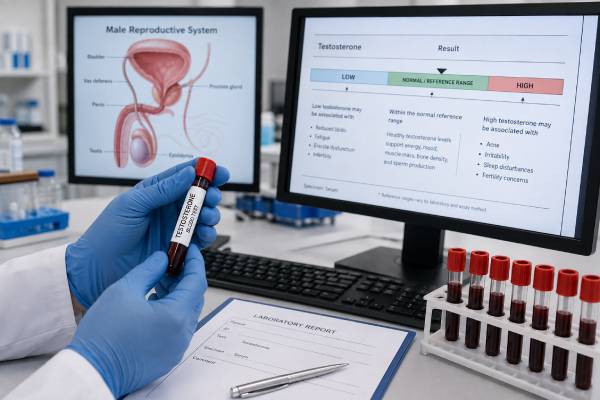
A testosterone blood test measures total testosterone and, when needed, free or bioavailable testosterone. Testosterone is produced mainly by the testes in men and in smaller amounts by the ovaries and adrenal pathways in women. It supports sexual development, libido, muscle and bone, red blood cell production, and reproductive function. A result cannot be interpreted from the number alone. Men with suspected testosterone deficiency need compatible symptoms plus consistently low morning levels, usually confirmed on two separate days. Women with acne, hirsutism, irregular periods, or virilization need an accurate assay and interpretation with sex hormone-binding globulin (SHBG), free testosterone, and other androgens. High testosterone may result from medication, anabolic steroids, PCOS, ovarian or adrenal disease, or rare tumors. Low testosterone may reflect testicular failure, pituitary suppression, illness, obesity, medication, menopause-related changes, or assay and timing issues. Exogenous testosterone can suppress sperm production, so fertility goals must be discussed before treatment. Reference ranges vary by age, sex, laboratory, assay, time of day, and hormone use.
- Men should generally have testosterone tested in the early morning.
- A low male result should be repeated before diagnosis or treatment.
- SHBG can make total and free testosterone tell different stories.
- Mildly high testosterone is common in PCOS; marked elevation needs prompt evaluation.
- Testosterone therapy suppresses LH, FSH, and often sperm production.
- Symptoms, medications, and related hormones are essential to interpretation.
Table of Contents
- What Testosterone Does
- Why Testosterone Is Tested
- Total, Free, and Bioavailable Testosterone
- Testing, Timing, and Normal Ranges
- Causes of Low Testosterone
- Causes of High Testosterone
- Fertility, Treatment, and Next Steps
What Testosterone Does
Testosterone is an androgen steroid hormone. In males, LH stimulates Leydig cells in the testes to produce it. FSH and high intratesticular testosterone then support sperm production through the Sertoli cells. In females, testosterone arises from the ovaries and adrenal androgen pathways and from conversion of precursor hormones in other tissues.
During male puberty, testosterone drives enlargement of the penis and testes, deepening of the voice, facial and body hair, muscle development, bone growth, libido, and sperm production. In adult men, it supports sexual desire, erections indirectly, energy, muscle, bone density, red blood cells, and reproductive function.
In women, smaller amounts contribute to libido, bone and muscle health, and normal androgen physiology. Excess can cause coarse facial or body hair, acne, scalp hair thinning, irregular ovulation, or virilization. Very low concentrations are difficult to measure accurately, and there is no universally accepted testosterone-deficiency syndrome in women based solely on a blood level.
Most circulating testosterone is bound to proteins. SHBG binds it tightly, albumin binds it loosely, and only a small fraction is free. Testosterone can be converted into dihydrotestosterone in androgen-sensitive tissues or aromatized into estradiol, which is important for bone health in all sexes.
The hypothalamus and pituitary regulate production through negative feedback. Low testicular testosterone normally increases LH and FSH. Testosterone or anabolic steroids taken from outside the body suppress LH and FSH, lowering intratesticular testosterone and sperm production even when the blood level is high.
A testosterone blood test is therefore a measure of one part of an endocrine feedback system. It does not directly measure sperm count, erections, fertility, athletic performance, or overall health.
Why Testosterone Is Tested
In men, testing is appropriate when symptoms or signs suggest androgen deficiency. More specific features include reduced libido, fewer spontaneous or morning erections, infertility, loss of body hair, small testes, gynecomastia, low bone density, unexplained anemia, or reduced muscle mass. Fatigue, depressed mood, weight gain, and poor concentration are common but nonspecific and should not trigger treatment without biochemical confirmation.
Testing may also be ordered for:
- Delayed or early puberty
- Pituitary disease or high prolactin
- Testicular injury, torsion, infection, chemotherapy, radiation, or surgery
- Infertility or an abnormal semen analysis
- Monitoring testosterone replacement or gender-affirming hormone therapy
- Suspected anabolic-steroid use
- Osteoporosis or repeated low-trauma fractures with other signs
In women, reasons include:
- Hirsutism or persistent severe acne
- Irregular or absent periods
- Suspected PCOS
- Infertility with signs of androgen excess
- Rapid virilization, including voice deepening or clitoral enlargement
- Suspected ovarian or adrenal androgen-producing disease
- Monitoring selected testosterone treatment
A mild androgen elevation with irregular cycles commonly supports PCOS after other conditions are excluded. A rapidly developing syndrome or a result far above the laboratory range requires urgent evaluation rather than assuming PCOS.
Children need pediatric reference intervals and specialist interpretation. Puberty stage is more important than adult cutoffs. Early high testosterone with suppressed LH may indicate peripheral precocious puberty, while a pubertal testosterone with pubertal LH suggests central activation.
Routine testing in people without symptoms is not generally recommended. Population “optimization” targets are not the same as diagnostic thresholds, and treatment of a normal result can cause infertility, erythrocytosis, acne, sleep apnea worsening, and other harms.
Total, Free, and Bioavailable Testosterone
Total testosterone is the usual first test. It includes SHBG-bound, albumin-bound, and free hormone. The result is easiest to interpret when SHBG is within its expected range.
Free testosterone is the small unbound fraction. It can be measured by equilibrium dialysis or calculated from total testosterone, SHBG, and albumin. Direct analog free-testosterone immunoassays are often inaccurate and should not be treated as equivalent to reference methods.
Bioavailable testosterone includes free and albumin-bound hormone. It may be measured or calculated, but it is used less consistently than total and calculated free testosterone.
SHBG changes the relationship:
| SHBG status | Possible total testosterone pattern | Why free testosterone helps |
|---|---|---|
| Low SHBG | Total testosterone may appear low | Free testosterone may remain normal |
| High SHBG | Total testosterone may appear normal or high | Free testosterone may be low |
| Normal SHBG | Total testosterone is usually more representative | Free testing may add little unless borderline |
Low SHBG occurs with obesity, insulin resistance, type 2 diabetes, hypothyroidism, and androgen exposure. High SHBG occurs with aging, oral estrogen, pregnancy, hyperthyroidism, some liver disorders, and certain medications. An SHBG result can prevent misdiagnosis when total testosterone conflicts with symptoms.
In women, accurate total testosterone by liquid chromatography–tandem mass spectrometry is preferred because concentrations are low. Calculated free testosterone or a validated free androgen index can identify androgen excess when SHBG is low. Results collected during combined hormonal contraception are difficult to interpret because contraception raises SHBG and suppresses ovarian androgens.
Testing, Timing, and Normal Ranges
For men, total testosterone should generally be collected early in the morning, often between 7 and 10 a.m., when levels are highest. Shift workers should test soon after their main sleep period. A low result should be confirmed on a different morning, ideally using the same laboratory. Diagnosis requires symptoms plus consistently low values.
The American Urological Association uses total testosterone below 300 ng/dL as a reasonable cutoff supporting deficiency. Other guidelines and laboratories use slightly different thresholds. The number is not sufficient by itself, and borderline results require SHBG and free testosterone context.
Approximate adult male laboratory ranges often span about 300–1,000 ng/dL, or 10.4–34.7 nmol/L. Female ranges are much lower, often roughly 15–70 ng/dL, but vary greatly by age and assay. One ng/dL equals approximately 0.0347 nmol/L.
Levels are influenced by:
- Time of day and sleep
- Acute illness or hospitalization
- Calorie restriction and major weight change
- Intense exercise
- Opioids, glucocorticoids, and other medications
- Testosterone, anabolic steroids, DHEA, or supplements
- Hormonal contraception, estrogen, or anti-androgens
- Assay method and laboratory calibration
Fasting may improve standardization in men because food intake can temporarily lower testosterone in some studies, but practices vary. Follow local instructions. Do not test during an acute illness unless the question is urgent because transient suppression can lead to a false diagnosis.
After a confirmed low result, LH and FSH distinguish primary from secondary hypogonadism. Prolactin is checked when LH is low or normal, particularly with low libido, headaches, or visual symptoms. Iron studies, pituitary testing, or MRI may be appropriate in selected cases.
In women with androgen excess, morning collection and an accurate mass-spectrometry assay improve reliability. Unexpected marked elevation should be repeated promptly before or alongside imaging. The laboratory’s age- and sex-specific range takes priority over general examples.
Causes of Low Testosterone
Low testosterone in men is classified by the LH/FSH pattern.
Primary Hypogonadism
Primary hypogonadism occurs when the testes cannot respond adequately. Testosterone is low and LH is usually high; FSH may also be high, especially when sperm-producing tissue is affected. Causes include Klinefelter syndrome, testicular injury or torsion, orchitis, chemotherapy, radiation, advanced testicular damage, or removal of both testes.
Secondary Hypogonadism
Secondary hypogonadism results from reduced hypothalamic or pituitary signaling. Testosterone is low with low or inappropriately normal LH/FSH. Causes include obesity, severe illness, opioid or glucocorticoid use, high prolactin, pituitary tumors, iron overload, traumatic brain injury, undernutrition, excessive exercise, and congenital GnRH disorders.
Functional suppression may improve when the underlying issue—such as obesity-related illness, untreated sleep apnea, medication exposure, or severe calorie deficit—is addressed. A low result should not automatically lead to lifelong replacement.
Symptoms depend on age, severity, and duration. Sexual symptoms are more specific than fatigue alone. Long-standing deficiency can reduce bone density, muscle, body hair, red blood cells, and fertility.
In women, testosterone naturally declines with age and after oophorectomy, but blood level alone does not diagnose a disorder. Low desire can be influenced by menopause symptoms, relationship factors, pain, medication, mood, sleep, and other illnesses. Testosterone treatment has a limited evidence-based role for selected postmenopausal women with hypoactive sexual desire disorder after comprehensive assessment; dosing and monitoring differ from male therapy.
Causes of High Testosterone
In men, high testosterone most commonly reflects prescribed testosterone, anabolic steroids, hCG, clomiphene-related stimulation, or supplements. The first step is to verify what products are being used and when the sample was drawn relative to a dose. Timing differs for gels, injections, pellets, patches, and oral formulations.
Excess treatment can cause acne, oily skin, elevated hematocrit, breast symptoms, reduced testicular size, infertility, edema, and possible worsening of sleep apnea. A high level from therapy should be managed by the prescriber, not by skipping or changing doses unpredictably.
Rare causes include androgen-producing testicular or adrenal tumors and disorders of steroid production. High endogenous testosterone with suppressed LH deserves further evaluation, especially when no medication is reported.
In women, common and important causes include:
- PCOS
- Nonclassic congenital adrenal hyperplasia
- Ovarian hyperthecosis
- Ovarian or adrenal androgen-producing tumors
- Cushing syndrome in a compatible presentation
- Testosterone, DHEA, anabolic-steroid, or partner-gel exposure
- Certain medications
PCOS typically causes mild to moderate biochemical elevation and gradual symptoms. Marked elevation, rapid progression over months, voice deepening, clitoral enlargement, or sudden severe hair growth is not typical and requires prompt specialist assessment. A high testosterone result in women may be followed by DHEA-S, androstenedione, 17-hydroxyprogesterone, pelvic imaging, or adrenal imaging according to the pattern.
False elevation can result from assay interference. Confirmation with LC-MS/MS is especially important when the number is unexpected or symptoms do not match.
Fertility, Treatment, and Next Steps
Testosterone is essential for sperm production inside the testes, but taking testosterone from outside the body suppresses pituitary LH and FSH. Intratesticular testosterone falls, and sperm concentration may decline severely or reach zero. Recovery after stopping can take months or longer and is not guaranteed to be rapid.
Men who want fertility now or in the future should discuss this before starting testosterone. Depending on the cause, specialists may use hCG, selective estrogen receptor modulators, aromatase inhibitors, or gonadotropins to support endogenous production. These treatments require medical supervision and are not interchangeable with testosterone replacement.
A semen analysis is necessary when fertility is the concern. Normal blood testosterone does not prove normal sperm production, and low testosterone does not reveal whether obstruction is present. The male fertility hormone panel complements semen and physical examination.
Before male testosterone therapy, clinicians confirm diagnosis and discuss fertility, prostate-related assessment as appropriate, hematocrit, cardiovascular status, sleep apnea, and treatment goals. Follow-up measures symptoms, testosterone at a formulation-specific time, hematocrit, adverse effects, and relevant prostate parameters. Treatment should be stopped or adjusted when risks outweigh benefit.
For women with high testosterone, treatment targets the cause and goals. PCOS care may include cycle protection, combined hormonal contraception, anti-androgens with reliable contraception, hair or acne treatment, and metabolic screening. A tumor or severe adrenal disorder requires specific therapy.
Seek urgent assessment for a new testicular mass, rapidly progressive virilization, severe headache or vision change with low testosterone, or signs of a blood clot or severe erythrocytosis during therapy. Otherwise, review the complete report and ask whether the sample was timed correctly, repeated, and interpreted with SHBG, LH, FSH, and prolactin.
The central rule is simple: treat a diagnosed condition and meaningful symptoms, not a single unconfirmed number or a desire to reach the top of a laboratory range.
A diagnosis of testosterone deficiency should identify the cause, not stop at the cutoff. Physical examination may assess testicular size, body hair, breast tissue, blood pressure, body composition, and signs of pituitary or systemic disease. A history of puberty, fertility, head injury, testicular injury, cancer treatment, opioid use, anabolic steroids, sleep apnea, and chronic illness can direct the workup. When fertility is relevant, semen analysis and reproductive history should be obtained before therapy changes the axis.
LH and FSH separate the major patterns but do not identify every cause. High gonadotropins point toward testicular failure. Low or normal gonadotropins can reflect pituitary disease, high prolactin, obesity-related functional suppression, medication, or acute illness. Very low testosterone, persistent hyperprolactinemia, multiple pituitary-hormone abnormalities, headaches, or visual symptoms may justify pituitary MRI. Iron studies can identify hemochromatosis, and genetic testing may be appropriate with small testes, infertility, or very high FSH.
Testosterone is not a general treatment for aging, fatigue, obesity, or erectile dysfunction when levels are normal. Erectile problems often involve vascular disease, diabetes, medication, neurologic factors, sleep, or psychological and relationship factors. Correcting confirmed deficiency can improve sexual symptoms in some men, but it does not replace cardiovascular risk assessment or first-line erectile-dysfunction treatment when those are needed.
Therapy formulations produce different peaks and troughs. A blood sample drawn soon after an injection may appear high, while one just before the next dose may be low. Gels are measured after steady use at a formulation-specific interval, and contamination of the blood-draw site by gel can cause a falsely high result. The prescriber should specify when to test and which target is appropriate.
Hematocrit is monitored because testosterone can stimulate red blood cell production. A substantial rise increases concern for hyperviscosity and may require dose adjustment, treatment interruption, or evaluation for sleep apnea, smoking, lung disease, or dehydration. Prostate-related monitoring depends on age, risk, anatomy, and shared decision-making. New breast symptoms, edema, severe acne, mood change, or worsening sleep apnea should also be reported.
In women, testosterone therapy should use physiologic female dosing when it is prescribed for an evidence-based indication. Male products can deliver excessive doses if not carefully adapted. Monitoring looks for clinical benefit and signs of androgen excess such as acne, hair growth, scalp hair loss, or voice change. Compounded pellets and injections can create prolonged supraphysiologic exposure that cannot be quickly reversed.
Recovery after anabolic-steroid or testosterone suppression varies. LH and FSH may remain low after the drug is stopped, and testosterone and sperm production recover on different timelines. Some men need specialist treatment, while others recover with observation. Using additional nonprescribed hormones to “restart” the axis can obscure testing and add thrombotic, liver, visual, or mood risks.
Finally, laboratory variation should be respected. A result near 300 ng/dL may cross the cutoff on repeat testing without any true physiologic change. The decision should integrate both measurements, free testosterone when SHBG is abnormal, and the presence of specific symptoms. The aim is a defensible diagnosis and meaningful clinical improvement—not maximizing a number.
Lifestyle and medical factors can improve functional low testosterone, but claims should remain realistic. Treating obstructive sleep apnea, reducing excessive alcohol use, improving diabetes control, building sustainable activity, and addressing severe obesity may improve symptoms and sometimes testosterone. These changes also benefit health even when the hormone level changes little. Extreme dieting, unregulated “test boosters,” and overtraining can have the opposite effect.
Testosterone values should not be used to judge masculinity, femininity, or athletic potential. Healthy ranges overlap with wide differences in body composition, sexual function, and well-being. Tissue sensitivity, age, health, relationships, sleep, and medications influence symptoms. A clinically useful test answers a defined medical question and leads to a safer next step rather than a comparison with someone else’s result.
Confirming the cause before treatment protects fertility and avoids unnecessary long-term hormone exposure.
Repeat testing under standardized conditions is often the safest response to a borderline or unexpected result.
Documenting the collection time, recent illness, medications, supplements, and treatment status helps prevent a technically valid number from being interpreted in the wrong clinical setting.
References
- Testosterone 2026 (Medical Encyclopedia Resource)
- Testosterone Levels Test 2025 (Patient Laboratory Resource)
- Testosterone Deficiency Guideline 2024 (Clinical Guideline)
- Diagnosis and Treatment of Infertility in Men: AUA/ASRM Guideline 2024 (Guideline Amendment)
- Society for Endocrinology Clinical Practice Guideline for the Evaluation of Androgen Excess in Women 2025 (Clinical Practice Guideline)
- Testosterone Therapy for Hypogonadism Guideline Resources 2018 (Clinical Practice Guideline)
Disclaimer
This article is for general education and does not replace individualized medical diagnosis or treatment. Testosterone results depend on age, sex, timing, sleep, illness, medication, SHBG, and assay; never start or change hormone therapy without qualified clinical supervision.