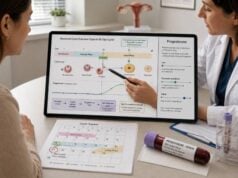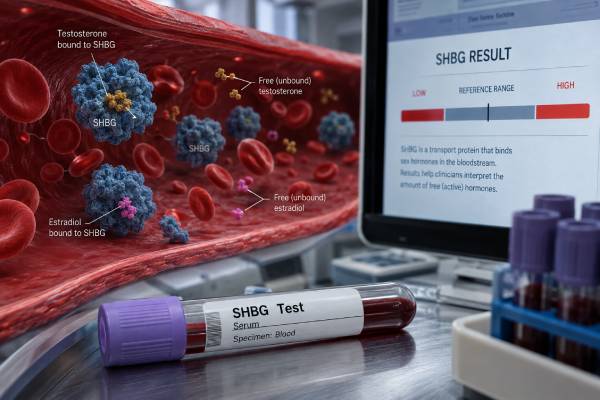
A sex hormone-binding globulin (SHBG) test measures a liver-made protein that binds testosterone, dihydrotestosterone, and estradiol in the bloodstream. SHBG helps determine how much sex hormone is free or loosely albumin-bound and available to tissues. The test is usually ordered when total testosterone does not match symptoms—for example, a man has symptoms of low testosterone despite a borderline total result, or a woman has androgen-excess symptoms with a total testosterone in range. High SHBG can make free testosterone low even when total testosterone appears normal. Low SHBG can make free testosterone relatively high or make total testosterone look low without true androgen deficiency. SHBG itself is not a diagnosis. Thyroid status, liver function, metabolic health, body weight, age, pregnancy, estrogen exposure, and medications can change it. Results should be interpreted with total testosterone, albumin, calculated free testosterone, symptoms, and the laboratory’s sex- and age-specific range. Treatment targets the cause rather than trying to raise or lower SHBG directly.
- SHBG is a transport protein, not a sex hormone.
- High SHBG usually reduces the free fraction of testosterone.
- Low SHBG can increase free testosterone or lower measured total testosterone.
- Estrogen, hyperthyroidism, liver disease, and aging can raise SHBG.
- Insulin resistance, obesity, hypothyroidism, and androgens can lower SHBG.
- Total testosterone, free testosterone, and clinical symptoms must be interpreted together.
Table of Contents
- What SHBG Does
- Why an SHBG Test Is Ordered
- How the Test Is Done and Calculated
- SHBG Normal Ranges
- Causes and Effects of High SHBG
- Causes and Effects of Low SHBG
- Interpreting Results and Next Steps
What SHBG Does
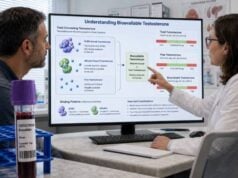
SHBG is a glycoprotein produced mainly by the liver. It binds sex steroids with high affinity, especially dihydrotestosterone and testosterone, and also binds estradiol. Hormone attached tightly to SHBG is generally less available to enter tissues. A smaller amount is bound loosely to albumin, and a very small fraction circulates unbound as free hormone.
Total testosterone includes all three fractions: SHBG-bound, albumin-bound, and free. Free testosterone is the unbound fraction. Bioavailable testosterone usually refers to free plus albumin-bound hormone. Because SHBG controls distribution, two people with the same total testosterone can have different free testosterone levels.
For example, high SHBG may hold a larger proportion of testosterone in the bound pool. Total testosterone may look normal or even high while calculated free testosterone is low. With low SHBG, total testosterone may appear low because less hormone is carried in the bound pool, yet free testosterone may remain adequate. In women, low SHBG can increase free androgen exposure and contribute to acne or hirsutism even when total testosterone is only mildly elevated.
SHBG is regulated by the liver’s metabolic and hormonal environment. Estrogen generally raises production, while androgens and insulin tend to lower it. Thyroid hormones, liver conditions, nutrition, inflammation, and genetic variation also affect the concentration.
SHBG may correlate with metabolic and cardiovascular risk, but it is not a stand-alone screening test for those diseases. A low value can accompany insulin resistance and fatty liver; it does not prove either condition. Likewise, a high value can reflect estrogen use or hyperthyroidism without causing symptoms itself.
The practical role of an SHBG test is to improve interpretation of sex hormones. Clinicians treat the underlying condition or clinically significant hormone disorder, not an isolated SHBG number.
Why an SHBG Test Is Ordered
SHBG is most useful when total testosterone and the clinical picture do not agree. It is rarely ordered alone.
In men, testing may be considered when:
- Total testosterone is borderline low
- Symptoms of androgen deficiency are present but total testosterone is in range
- Obesity, type 2 diabetes, hypothyroidism, or glucocorticoid use may lower SHBG
- Aging, hyperthyroidism, liver disease, HIV, or certain anticonvulsants may raise SHBG
- A calculated free testosterone result is needed
- Testosterone therapy is being assessed in a complex case
In women, testing may be considered for:
- Hirsutism, persistent acne, or scalp hair thinning
- Suspected PCOS
- Virilization or markedly elevated androgens
- Irregular or absent periods
- Infertility with signs of androgen excess
- Monitoring selected androgen or estrogen therapies
- Evaluating unexpectedly low or high total testosterone
SHBG is also included in some menopause, sexual-function, liver, thyroid, or metabolic evaluations. In pregnancy, SHBG rises substantially because estrogen stimulates liver production. Nonpregnant ranges do not apply.
A low total testosterone result in a man with low SHBG should not automatically lead to testosterone treatment. Guidelines require compatible symptoms and repeat morning testosterone testing. Calculated free testosterone may show that active hormone is not actually low. Conversely, high SHBG can hide low free testosterone behind a reassuring total value.
In women, total and free testosterone are the recommended biochemical tests for androgen excess. SHBG is needed to calculate free testosterone or the free androgen index. The SHBG test in women is especially useful in PCOS, where insulin resistance often lowers SHBG and increases the free androgen fraction.
Symptoms still matter. Hair growth reflects follicle sensitivity, duration of exposure, age, and ancestry as well as blood androgen concentration. A normal calculated free testosterone does not make a rapidly progressing virilizing syndrome harmless; such symptoms require specialist assessment.
How the Test Is Done and Calculated
SHBG is measured from a venous blood sample. Fasting is usually unnecessary unless glucose, insulin, or lipids are ordered at the same time. Preparation depends mainly on the accompanying hormone tests.
For men being evaluated for low testosterone, blood is generally drawn early in the morning after adequate sleep. Total testosterone should be measured on at least two separate mornings if the first result is low. Acute illness, sleep loss, undernutrition, and strenuous exercise can temporarily affect testosterone and make SHBG-based calculations less useful.
For women with androgen excess, morning testing is preferred, and early-follicular timing may improve consistency when cycles are regular. Combined hormonal contraception raises SHBG and suppresses ovarian androgen production. If biochemical confirmation is essential, clinicians may recommend stopping it for roughly three months while arranging alternative contraception. This should be medically supervised.
Tell the clinician about:
- Estrogen pills, patches, contraceptives, or pregnancy
- Testosterone, anabolic steroids, DHEA, or anti-androgens
- Thyroid medication
- Anticonvulsants and glucocorticoids
- HIV treatment
- Liver, thyroid, kidney, or metabolic disease
- Recent major weight change, fasting, or illness
Free testosterone is not always measured directly. Equilibrium dialysis is a reference method but is not widely available. More commonly, laboratories calculate free testosterone from total testosterone, SHBG, and albumin. The result is only as accurate as the component assays and the equation.
The free androgen index is calculated as total testosterone divided by SHBG, multiplied by 100, when both are in nmol/L. It can be useful in women but becomes unreliable at very low SHBG and is not preferred for assessing male hypogonadism. A free testosterone test or validated calculation is more informative than SHBG alone.
Results from different laboratories may not be directly comparable. When monitoring a trend, using the same method improves consistency.
SHBG Normal Ranges
SHBG ranges vary by laboratory, assay, age, sex, puberty, pregnancy, and hormone use. Many adult laboratories report approximate intervals such as 10–57 nmol/L for men and 18–144 nmol/L for nonpregnant women, but other laboratories use substantially different limits. The range printed on the report takes priority.
Women often have higher SHBG than men because estrogen stimulates production. Levels rise during pregnancy and with oral estrogen. SHBG may increase with age in men, while menopause, body composition, and hormone therapy create variable patterns in women.
A result inside the range does not guarantee normal free hormone. If total testosterone is near a cutoff, even a high-normal or low-normal SHBG can meaningfully change calculated free testosterone. Similarly, an out-of-range SHBG may have little clinical significance when total and free hormone levels and symptoms are appropriate.
| SHBG pattern | Effect on testosterone interpretation | Common example |
|---|---|---|
| High SHBG | Total testosterone may look normal/high while free testosterone is low | Oral estrogen, hyperthyroidism, aging |
| Low SHBG | Total testosterone may look low while free testosterone is normal | Obesity, insulin resistance, hypothyroidism |
| Low SHBG in a woman | Free androgen exposure may be high | PCOS or metabolic dysfunction |
| Normal SHBG | Total testosterone is usually easier to interpret | No major binding-protein disturbance |
SHBG should not be interpreted using a target copied from another person, an online optimization program, or a different laboratory. There is no evidence-based universal “ideal” value that applies to all ages and sexes.
Causes and Effects of High SHBG
High SHBG increases the proportion of tightly bound testosterone and estradiol. In a man, it may lower calculated free testosterone and contribute to low libido, reduced morning erections, low energy, decreased muscle mass, or low bone density when true androgen deficiency is present. In a woman, high SHBG may reduce free testosterone, but symptoms are nonspecific and the clinical importance is less well defined.
Common causes include:
- Pregnancy
- Oral estrogen-containing contraception or hormone therapy
- Hyperthyroidism
- Some liver diseases
- Aging, especially in men
- HIV infection or some HIV therapies
- Certain anticonvulsant medications
- Low body weight, undernutrition, or substantial calorie restriction
- Genetic variation
- Excess thyroid-hormone replacement
Oral estrogen raises SHBG more than transdermal estradiol because oral medication passes through the liver first. This difference can affect free testosterone and the interpretation of sex-hormone testing.
Liver disease has variable effects. Because SHBG is made in the liver, severe synthetic failure might be expected to lower it, but several chronic liver conditions—particularly those with altered estrogen metabolism—can raise it. Liver enzymes, albumin, symptoms, and diagnosis matter more than SHBG alone.
When high SHBG accompanies low free testosterone, clinicians look for a reversible cause and confirm the hormone pattern. Testosterone treatment is not indicated solely to overcome a high binding protein. In men, treatment decisions require symptoms, repeated low testosterone, and evaluation of LH, FSH, prolactin, fertility goals, and contraindications.
A markedly high result without an obvious explanation may lead to thyroid and liver testing, medication review, and repeat measurement. Treating hyperthyroidism or correcting excessive thyroid replacement can normalize SHBG over time.
Causes and Effects of Low SHBG
Low SHBG reduces the bound hormone pool. In men, this can lower total testosterone while free testosterone remains within range. In women, it can increase the free fraction and amplify androgen effects.
Common causes include:
- Obesity and insulin resistance
- Type 2 diabetes or metabolic syndrome
- Nonalcoholic fatty liver disease
- Hypothyroidism
- Androgen or anabolic-steroid exposure
- Glucocorticoids
- Cushing syndrome
- PCOS
- Acromegaly
- Nephrotic syndrome
- Genetic variation
Low SHBG is strongly associated with metabolic risk, but association is not the same as diagnosis. A low value may prompt assessment of blood pressure, waist-related risk, fasting lipids, glucose or A1c, and liver health. It does not justify supplements marketed to “fix SHBG.”
In PCOS, hyperinsulinemia can suppress liver SHBG production, while ovarian androgen excess adds to the pattern. The result may be normal total testosterone but elevated calculated free testosterone. A PCOS hormone panel also considers menstrual dysfunction and excludes other causes.
In men with obesity, a low total testosterone and low SHBG may reflect a reversible functional pattern. Repeat morning testing and calculated free testosterone help distinguish binding effects from true hypogonadism. Weight-related care, sleep apnea treatment, medication adjustment, and management of diabetes can improve the hormone environment, although changes vary.
Androgen medication lowers SHBG and suppresses LH and FSH. Nonprescribed anabolic steroids can create high androgen exposure, infertility, testicular shrinkage, acne, mood effects, and cardiovascular risk even when a later testosterone test appears low during withdrawal.
Interpreting Results and Next Steps
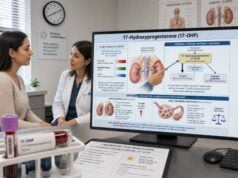
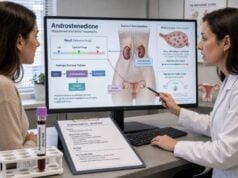
SHBG is interpreted with at least total testosterone and often albumin, calculated free testosterone, LH, FSH, and prolactin. In women with androgen excess, DHEA-S, androstenedione, 17-hydroxyprogesterone, and thyroid testing may be added. In men with suspected deficiency, repeat morning testosterone is essential.
Common patterns include:
| Pattern | Likely interpretation | Possible follow-up |
|---|---|---|
| Low total testosterone, low SHBG, normal free testosterone | Binding-protein effect; deficiency not established | Repeat morning test and assess metabolic causes |
| Normal total testosterone, high SHBG, low free testosterone | Possible true androgen deficiency hidden by SHBG | Symptoms, repeat testing, LH/FSH and cause evaluation |
| Normal total testosterone, low SHBG, high free testosterone in a woman | Biochemical androgen excess | PCOS/mimic evaluation with accurate assays |
| High SHBG after starting oral estrogen | Expected medication effect | Interpret according to therapy goal |
| Low SHBG with abnormal glucose/lipids | Possible metabolic dysfunction | Formal metabolic and liver assessment |
Do not take boron, thyroid hormone, estrogen blockers, or androgen products simply to manipulate SHBG. Such approaches can create liver, thyroid, fertility, bone, mood, or cardiovascular problems without treating the real cause.
Seek prompt assessment for rapid virilization, a new testicular mass, severe headaches or vision changes with pituitary symptoms, or markedly abnormal testosterone. Otherwise, ask the clinician whether SHBG changed the interpretation of total testosterone and whether the free testosterone method was reliable.
The most useful conclusion is not “SHBG is high” or “SHBG is low.” It is whether the binding-protein result explains symptoms and changes the diagnosis or treatment of an underlying endocrine, liver, thyroid, reproductive, or metabolic condition.
SHBG also affects interpretation of estradiol, although clinical calculations focus more often on testosterone. Changes in binding proteins can alter total hormone concentrations without producing an equivalent change at tissue level. This principle is familiar in thyroid testing, where binding proteins affect total hormone measurements; the same caution applies to sex steroids. A clinician should avoid treating a total concentration in isolation when the binding environment is clearly abnormal.
Genetic differences account for part of the wide SHBG range between healthy people. This means a stable value outside a population interval may be less important than a new change accompanied by symptoms or another abnormal test. Previous results, if measured by the same method, can help distinguish a person’s long-standing baseline from a new liver, thyroid, metabolic, nutritional, or medication effect.
Oral and transdermal estrogen illustrate why route matters. Oral estrogen reaches the liver at a high concentration before entering the general circulation and can markedly increase SHBG. Transdermal estradiol has less first-pass liver effect and usually raises SHBG less. The difference can influence free testosterone, but the choice of therapy should consider the full risk-benefit profile rather than SHBG alone.
Thyroid testing is a common follow-up because hyperthyroidism raises SHBG and hypothyroidism tends to lower it. A person taking levothyroxine may develop a high SHBG if the dose is excessive, especially when TSH is suppressed. Correcting thyroid status is safer and more logical than attempting to counter the SHBG change with an androgen supplement.
Metabolic evaluation after low SHBG should be individualized. It may include A1c or an oral glucose tolerance test, fasting lipids, blood pressure, liver enzymes, and assessment for fatty liver or sleep apnea. SHBG can add context, but diagnosis depends on established tests and clinical criteria. Improvements in insulin sensitivity or liver health may raise SHBG, yet the goal of care is reduced disease risk rather than reaching a particular SHBG target.
For fertility, the binding protein can clarify blood androgen status but cannot replace reproductive testing. Men with fertility concerns need semen analysis, and women need evaluation of ovulation and other factors. Exogenous testosterone may lower SHBG and suppress sperm production; estrogen-containing contraception may raise SHBG while intentionally suppressing ovulation. In both situations, the medication-driven value should not be mistaken for untreated physiology.
If a calculated free testosterone result seems implausible, confirm the units and method. Total testosterone must be entered in the correct units, albumin assumptions can differ, and equations perform less well at extreme SHBG concentrations. Equilibrium dialysis or a specialist laboratory may be needed when a major decision depends on an uncertain result.
SHBG changes slowly compared with the short-term pulses of some hormones, but it can still shift after a medication change, pregnancy, thyroid treatment, or major metabolic change. Repeat testing is most useful after enough time has passed for the underlying condition to stabilize. Testing every few days does not provide a meaningful trend and can magnify ordinary assay variation.
Symptoms attributed to SHBG should be investigated broadly. Low libido, fatigue, hair change, irregular periods, and erectile dysfunction have many endocrine and nonendocrine causes. Demonstrating an abnormal free hormone fraction makes the SHBG result more relevant; otherwise, clinicians should avoid assuming that the binding protein is responsible.
The final interpretation should state whether free hormone is actually abnormal and whether treatment is needed.
Repeat measurement is most valuable when a medication or underlying condition has changed enough to alter hormone interpretation.
When reports come from different laboratories, compare the assay method, units, reference interval, albumin value, and sampling conditions before deciding that SHBG or free hormone has truly changed.
References
- SHBG Blood Test 2026 (Patient Laboratory Resource)
- Society for Endocrinology Clinical Practice Guideline for the Evaluation of Androgen Excess in Women 2025 (Clinical Practice Guideline)
- Testosterone Deficiency Guideline 2024 (Clinical Guideline)
- International Evidence-based Guideline for the assessment and management of polycystic ovary syndrome 2023 2023 (Guideline)
- Testosterone Levels Test 2025 (Patient Laboratory Resource)
Disclaimer
This article is for general education and does not replace personalized medical care. SHBG ranges and calculated free testosterone depend on age, sex, medications, assay methods, and health conditions; discuss unexpected results with a qualified clinician.