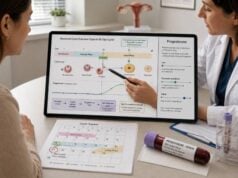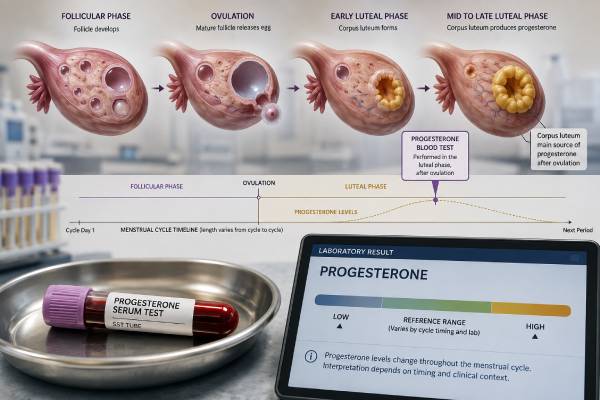
A progesterone blood test measures a hormone that rises after ovulation and supports the uterine lining in early pregnancy. The result is most useful when the reason for testing and the timing are clear. Before ovulation, progesterone is normally low. After ovulation, the corpus luteum releases progesterone in pulses, so the level can change several-fold within a few hours. A luteal result above 3 ng/mL generally supports recent ovulation, but one value cannot reliably measure egg quality, implantation potential, or the overall “strength” of the luteal phase. During pregnancy, progesterone normally rises, yet there is substantial overlap between healthy and nonviable pregnancies; serial human chorionic gonadotropin testing and ultrasound are often more informative. High progesterone is commonly caused by pregnancy, fertility medication, or prescribed progesterone. Low progesterone may reflect incorrect timing, lack of ovulation, ovarian or pituitary problems, or a pregnancy that needs further evaluation. Laboratory ranges differ by cycle phase, pregnancy stage, assay, and treatment.
- Progesterone is low before ovulation and rises afterward.
- Testing is usually timed about seven days after ovulation, not automatically on cycle day 21.
- A value above 3 ng/mL generally confirms recent ovulation.
- One result cannot diagnose luteal phase deficiency.
- Pregnancy and progesterone medication are common causes of a high level.
- Low pregnancy progesterone requires context, hCG testing, and sometimes ultrasound.
Table of Contents
- What Progesterone Does
- Why a Progesterone Test Is Ordered
- When and How to Test Progesterone
- Progesterone Normal Ranges
- What High Progesterone Means
- What Low Progesterone Means
- Ovulation, Pregnancy, and Next Steps
What Progesterone Does
Progesterone is a steroid hormone produced mainly by the corpus luteum after an ovarian follicle releases an egg. Before ovulation, blood progesterone is usually very low. The LH surge causes ovulation and transforms the emptied follicle into the corpus luteum, which then releases progesterone.
Progesterone prepares the endometrium for implantation by changing it from a proliferative lining into a secretory lining. It also reduces uterine contractility, thickens cervical mucus after the fertile window, and raises basal body temperature. If pregnancy does not occur, the corpus luteum regresses after roughly two weeks, progesterone falls, and menstruation begins.
If conception occurs, embryonic hCG rescues the corpus luteum so progesterone production continues. The placenta gradually becomes the main source later in the first trimester. Progesterone remains important throughout pregnancy for uterine stability, immune adaptation, and breast development.
Small amounts are also produced by the adrenal glands and, in people with testes, by the testes. However, progesterone testing is used most often to assess ovulation, fertility treatment, early pregnancy, or hormone therapy in people with ovaries.
Progesterone is released in pulses. A level can rise and fall markedly over a short period even during a normal luteal phase. This biology explains why one blood sample can confirm that ovulation probably occurred but cannot reliably grade luteal quality. The result is a snapshot, not a continuous measurement.
A progesterone blood test should therefore be interpreted with cycle timing, medication use, pregnancy status, and the clinical question. Values collected at different stages should not be compared as though the expected range were constant.
Why a Progesterone Test Is Ordered
Clinicians order progesterone for several distinct reasons. The same number can have different meaning in each setting.
Common indications include:
- Confirming whether ovulation occurred in an unmedicated cycle
- Evaluating irregular or absent menstrual periods
- Monitoring ovulation induction or assisted reproduction
- Checking response to an hCG trigger or luteal support plan
- Assessing an early pregnancy together with hCG and ultrasound
- Investigating bleeding or pain in pregnancy
- Monitoring prescribed progesterone in selected treatment protocols
- Evaluating rare adrenal or ovarian hormone disorders as part of a larger panel
For infertility, the main use is confirmation of recent ovulation. Regular cycles between about 21 and 35 days usually suggest ovulation, but a test may be useful when cycles vary, home LH tests are unclear, or treatment requires documentation. It does not assess ovarian reserve, fallopian tubes, sperm, or embryo quality.
In early pregnancy, a single progesterone result may contribute to risk assessment, but it cannot locate the pregnancy or prove viability. A low result can occur with miscarriage or ectopic pregnancy, yet overlap exists. A reassuring result also cannot rule out ectopic pregnancy. Symptoms, serial hCG change, and transvaginal ultrasound guide care.
People receiving progesterone after IVF, frozen embryo transfer, intrauterine insemination, or recurrent pregnancy loss evaluation may have blood monitoring based on clinic protocol. The route matters. Intramuscular progesterone often produces higher serum levels than vaginal progesterone, while vaginal treatment can deliver high tissue exposure despite a lower blood value. Clinic-specific targets should not be replaced by general internet ranges.
Testing is usually not helpful for diagnosing vague symptoms such as fatigue, mood changes, or weight gain without a defined reproductive question. Saliva and dried-urine progesterone tests marketed for “hormone balance” are not equivalent to standardized serum testing and may lead to unsupported treatment.
When and How to Test Progesterone
Timing depends on the purpose.
Confirming Ovulation
Progesterone generally peaks six to eight days after ovulation. The best blood-draw date is therefore about seven days after the suspected ovulation date or seven days before the expected next period. “Day 21” is appropriate only for a person with a roughly 28-day cycle who ovulates near day 14.
Examples:
| Typical cycle length | Possible ovulation day | Approximate progesterone test day |
|---|---|---|
| 24 days | Day 10 | Day 17 |
| 28 days | Day 14 | Day 21 |
| 32 days | Day 18 | Day 25 |
| 35 days | Day 21 | Day 28 |
These are estimates. A positive urine LH test, ultrasound, cervical mucus, or a known trigger injection can provide better timing. The day 21 progesterone test is better understood as a mid-luteal test tailored to the cycle.
Early Pregnancy
Progesterone can be drawn at any time when pregnancy is being assessed. Its interpretation depends on gestational age, hCG results, symptoms, ultrasound, and whether progesterone is being taken. Repeat testing may be used, but serial hCG and ultrasound often answer the more important questions.
Fertility Treatment
Follow the clinic’s exact schedule. Testing may occur before an embryo transfer, after an hCG trigger, on the day of transfer, or during luteal support. Do not change progesterone dose or route based on a general reference range.
Fasting is not usually required. Blood can be drawn at any time, although using a similar time for repeat tests may reduce variation. Tell the clinician about oral, vaginal, injectable, topical, or compounded progesterone; fertility medication; hormonal contraception; pregnancy; and supplements. Biotin can interfere with some assays, so follow the laboratory’s instructions about stopping high-dose biotin.
Because progesterone is pulsatile, a borderline result may warrant repeat testing if it will change management. Repeating an incorrectly timed test at the correct point is usually more useful than interpreting the original value aggressively.
Progesterone Normal Ranges
There is no single normal progesterone range for all people. Laboratories divide results by menstrual phase, pregnancy trimester, sex, and sometimes menopausal status. Common units are ng/mL and nmol/L. To convert ng/mL to nmol/L, multiply by approximately 3.18.
Approximate ranges used by many laboratories are:
| Stage | Approximate progesterone | Interpretation |
|---|---|---|
| Follicular phase | Often below 1 ng/mL | Low is expected before ovulation |
| Ovulation transition | May begin rising above 1 ng/mL | Timing changes rapidly |
| Luteal phase | Roughly 2–25 ng/mL or wider | Large normal fluctuation occurs |
| Evidence of recent ovulation | Above 3 ng/mL | Presumptive confirmation, not a fertility-quality score |
| Postmenopause | Usually below 1 ng/mL | Expected without hormone treatment |
| Pregnancy | Rises across gestation with broad overlap | Use laboratory trimester ranges and clinical context |
Some fertility practices use values such as 5 or 10 ng/mL when discussing a mid-luteal sample, but these should not be treated as universal proof of a “good” ovulation. A normally ovulating person can have a low snapshot between secretory pulses, and a higher value does not guarantee implantation.
During pregnancy, published ranges are extremely broad. A laboratory may list first-trimester values from approximately 10 to more than 40 ng/mL, with higher ranges later. Assays, gestational dating, multiple pregnancy, and supplementation all affect the number. A result should be compared only with the performing laboratory’s pregnancy interval and the clinical situation.
Reference intervals describe most values in a comparison population; they are not treatment thresholds. A result just outside the range may reflect timing or assay variation, while a result within range may still require evaluation if symptoms are concerning.
What High Progesterone Means
High progesterone is often physiologic or medication-related. Common causes include:
- Normal luteal phase after ovulation
- Pregnancy
- Multiple pregnancy, although progesterone cannot diagnose twins
- Progesterone prescribed orally, vaginally, or by injection
- Fertility medication that produces multiple corpora lutea
- Recent hCG trigger injection
- An ovarian corpus luteum cyst
A high luteal result generally confirms that the ovary has luteinized, but it does not prove that an egg was fertilized. Progesterone rises after ovulation whether or not conception occurs.
In fertility treatment, several developing follicles can create more than one corpus luteum and a higher level. During a medicated frozen embryo transfer, the value may mostly reflect the prescribed drug. Interpretation should follow the protocol and route of administration.
Less common causes include certain ovarian tumors, adrenal disorders, or congenital adrenal enzyme conditions. These are not diagnosed from progesterone alone. Other steroid hormones, symptoms, imaging, and specialist assessment are required.
High progesterone can cause sleepiness, dizziness, bloating, breast tenderness, constipation, or mood changes, especially with medication. These symptoms overlap with premenstrual and early pregnancy symptoms and cannot identify the level reliably.
A high result is usually not dangerous by itself. Seek urgent care for severe pelvic pain, fainting, shoulder pain, or heavy bleeding, particularly with a positive pregnancy test, because those symptoms require assessment regardless of the progesterone concentration.
What Low Progesterone Means
The most common explanation for a low progesterone result is that the sample was drawn before ovulation or after the luteal level had already fallen. This is especially common when a person with a long or irregular cycle is tested automatically on day 21.
Other possible explanations include:
- An anovulatory cycle
- PCOS or another ovulation disorder
- Hypothalamic suppression from undernutrition, intense exercise, stress, or chronic illness
- Thyroid disease or high prolactin
- Perimenopause or primary ovarian insufficiency
- A short luteal phase
- Incorrect gestational dating
- A failing or ectopic pregnancy
- Inadequate absorption or dosing during prescribed luteal support
A single low luteal value cannot diagnose luteal phase deficiency. Progesterone fluctuates too much, and there is no universally accepted concentration that defines a fertile luteal phase. The 2026 ASRM committee opinion describes clinically detected luteal phase deficiency primarily in relation to a luteal phase of 10 days or less, while emphasizing diagnostic uncertainty and associated conditions.
When low progesterone accompanies irregular cycles, evaluation may include pregnancy testing, TSH, prolactin, FSH, estradiol, AMH, androgen testing, and pelvic ultrasound. The luteal phase assessment should focus on cycle pattern and underlying causes rather than one cutoff.
In pregnancy, low progesterone is a risk marker, not a stand-alone diagnosis. Treatment decisions depend on symptoms, prior pregnancy history, ultrasound findings, and local guidelines. Do not start over-the-counter or compounded progesterone without medical review; it can delay diagnosis of an ectopic pregnancy and may not address the cause.
Ovulation, Pregnancy, and Next Steps
For ovulation confirmation, first verify timing. If the sample was collected about a week after a positive LH test and is above 3 ng/mL, recent ovulation is likely. If it is low, repeat the test after better tracking or use ultrasound monitoring. One anovulatory cycle can occur during illness, travel, or stress; repeated anovulation deserves evaluation.
A broader fertility workup may include semen analysis, ovarian reserve testing, tubal assessment, uterine imaging, thyroid testing, and prolactin. Confirming ovulation is useful, but it does not establish why pregnancy has not occurred.
For early pregnancy, urgent evaluation is needed for one-sided pelvic pain, shoulder pain, fainting, severe dizziness, or heavy bleeding. A clinician may order quantitative hCG 48 hours apart and transvaginal ultrasound. Progesterone can support risk assessment but cannot determine the pregnancy’s location.
When progesterone is prescribed, take it exactly as directed. Different formulations are not interchangeable milligram for milligram. Vaginal leakage does not necessarily mean the medication was not absorbed. Contact the clinic before missing doses, changing route, or stopping treatment, especially after embryo transfer or in pregnancy.
Questions to ask after receiving a result include:
- Was the test collected at the correct cycle or pregnancy stage?
- Does medication explain the number?
- Is the goal to confirm ovulation, assess pregnancy, or monitor treatment?
- Would repeat progesterone, hCG, or ultrasound change management?
- Which symptoms require urgent care?
The best interpretation connects the number to a timeline. Progesterone is expected to be low, rise, and fall at specific stages; “high” and “low” have meaning only within that sequence.
Progesterone testing has additional limitations in recurrent miscarriage and fertility “optimization” claims. Low values measured after bleeding begins may simply reflect a pregnancy that has already stopped developing rather than identify the original cause. In unassisted cycles, there is no validated serum target that proves the endometrium is perfectly receptive. Endometrial biopsy dating is no longer considered a reliable routine test for luteal phase deficiency because fertile and infertile people can show similar variation.
Symptoms cannot substitute for measurement. Breast tenderness, bloating, sleepiness, constipation, temperature change, and mood symptoms may appear during a normal luteal phase, early pregnancy, premenstrual syndrome, or progesterone treatment. Their presence does not prove a high level, and their absence does not prove a low level. Likewise, basal body temperature can support retrospective cycle tracking but is influenced by sleep, illness, alcohol, travel, and measurement technique.
When cycles are irregular, a clinician may use serial ultrasound and hormones to determine whether a follicle grows and ruptures. Ultrasound can show follicle size and later changes compatible with ovulation, while progesterone confirms luteinization. In PCOS, repeated LH surges may occur without successful ovulation, so one positive urine kit is not always enough. A combination of tracking methods can prevent mistimed progesterone testing.
Progesterone medication should be distinguished from progestins. Micronized progesterone is chemically identical to endogenous progesterone, while progestins are synthetic compounds with progesterone-receptor activity and differing effects. Many contraceptive progestins do not produce a serum progesterone result that reflects their biologic action. Therefore, a low measured progesterone while using a progestin-only contraceptive is not evidence that the medication is ineffective.
In assisted reproduction, luteal support is standard in many protocols because ovarian stimulation and egg retrieval can alter corpus luteum function. Clinics choose vaginal, intramuscular, subcutaneous, or oral formulations based on evidence and protocol. Serum targets are route-specific: vaginal progesterone can create high endometrial exposure with lower circulating concentrations. Patients should use the fertility clinic’s cutoff and sampling time rather than comparing results with an unmedicated-cycle chart.
For miscarriage risk, progesterone treatment is not universally beneficial for every low result. Evidence and recommendations depend on bleeding, ultrasound findings, prior miscarriages, and whether conception followed assisted reproduction. The priority is to confirm pregnancy location and viability, because progesterone cannot treat an ectopic pregnancy.
A careful result review should include the exact unit. Confusing nmol/L with ng/mL can make a normal result appear more than three times higher or lower. It should also include the assay’s lower limit, the time since ovulation or embryo transfer, and the last medication dose. These details turn an isolated number into clinically useful information.
Progesterone can also be measured after menopause or in people using gender-affirming or menopause hormone therapy, but routine testing is not always needed. Symptoms and standard dosing may guide care more effectively than chasing a serum target. Compounded topical creams can produce unpredictable absorption, and saliva measurements do not reliably guide systemic dosing. When bleeding occurs after menopause, evaluation of the uterine lining takes priority over assuming progesterone is low.
The corpus luteum’s lifespan helps explain cycle changes. If ovulation occurs later, the period usually shifts later because the follicular phase lengthened; the luteal phase is often more stable. Tracking only calendar day can therefore misclassify normal late ovulation. Recording LH tests and the next period creates a more accurate estimate of luteal length and identifies whether a pattern repeats across several cycles.
Clear timing and clinical context prevent most common interpretation errors.
A repeat sample should be ordered only when it will clarify timing, pregnancy assessment, or a treatment decision.
References
- Diagnosis and treatment of luteal phase deficiency: a committee opinion 2026 (Committee Opinion)
- Recurrent pregnancy loss: a committee opinion 2026 (Committee Opinion)
- Guideline for the prevention, diagnosis and treatment of infertility 2025 (Guideline)
- ESHRE evidence-based guideline on Unexplained Infertility 2023 (Guideline)
- Serial progesterone levels more accurately predict the time of ovulation in a menstrual cycle 2023 (Original Research)
- Fertility evaluation of infertile women: a committee opinion 2021 (Committee Opinion)
Disclaimer
This article is for general education and does not replace individualized medical care. Progesterone results depend on cycle timing, pregnancy stage, assay, and medication route; seek urgent care for severe pain, fainting, or heavy bleeding in pregnancy.