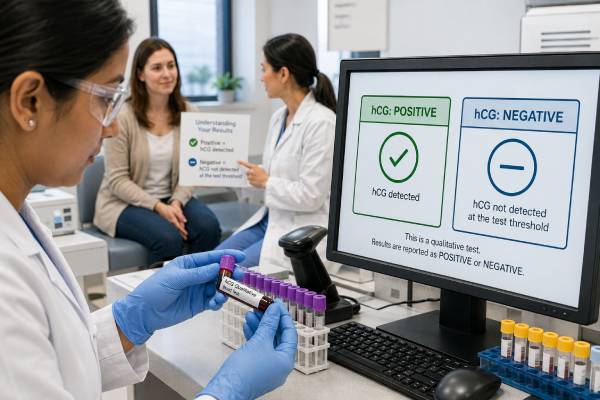
A qualitative hCG blood test answers a focused question: is human chorionic gonadotropin detected above the assay’s decision threshold? The report is usually “positive” or “negative,” rather than a number. Because serum testing can detect low concentrations, it may identify pregnancy earlier than many urine tests, but timing still matters. A negative result can occur before implantation has produced enough hCG, while a positive result confirms detectable hormone but does not establish pregnancy location, gestational age, viability, or a future normal outcome. Recent pregnancy, fertility medication containing hCG, rare assay interference, and hCG-producing medical conditions can also affect results. When symptoms, dates, or the result are unclear, a quantitative blood test and ultrasound provide more information. Severe one-sided pain, shoulder-tip pain, fainting, or heavy bleeding requires urgent evaluation even with a negative or weakly positive result, because early ectopic pregnancy cannot be excluded by one qualitative test.
- A qualitative serum hCG test reports whether hCG is detected, not the measured concentration.
- Blood testing can become positive earlier than many urine tests, but testing too soon may still be negative.
- A positive result does not confirm an intrauterine or viable pregnancy.
- A negative result may need repeating when the period is not yet due or symptoms strongly suggest pregnancy.
- Quantitative hCG and ultrasound are preferred when trends, location, or viability must be assessed.
Table of Contents
- What a Qualitative hCG Blood Test Detects
- When the Test Is Used
- Timing, Sample, and Preparation
- What a Positive Result Means
- What a Negative Result Means
- Borderline, Discordant, and False Results
- Qualitative Versus Quantitative hCG Testing
- Follow-Up, Safety, and Common Questions
What a Qualitative hCG Blood Test Detects
Human chorionic gonadotropin is a glycoprotein hormone produced mainly by placental trophoblast cells after implantation. Its alpha subunit resembles other pituitary hormones, while the beta subunit gives pregnancy assays much of their specificity. A qualitative serum test uses antibodies to determine whether hCG in the blood exceeds a preset cutoff.
The laboratory does not ordinarily report the exact concentration. Instead, the result is categorized as detected or not detected, positive or negative. Some systems also allow an indeterminate or borderline category near the decision threshold. The cutoff depends on the assay, so the report’s own interpretation takes priority over a universal internet number.
Many serum methods can detect lower hCG concentrations than routine urine devices. That sensitivity may make the blood test useful before a missed period or when urine is dilute. Detection still depends on implantation timing. Fertilization does not produce an immediate positive result, and implantation varies among pregnancies.
Qualitative hCG is not the same as a home pregnancy test simply because both provide a yes-or-no answer. A serum specimen is processed by a clinical laboratory, and its analytic sensitivity, quality controls, and threshold may differ. A urine test is affected more directly by hydration and urine concentration.
The test detects hormone, not an embryo. It cannot show where implantation occurred, whether cardiac activity is present, how far the pregnancy has progressed, or whether hCG is rising normally. Those questions require a numerical hCG assay, ultrasound, or both.
hCG can also appear outside an ongoing pregnancy. Concentrations may remain after miscarriage, abortion, childbirth, or treatment of ectopic pregnancy. Exogenous hCG used for ovulation induction can be detected temporarily. Rare trophoblastic, germ-cell, and other tumors may produce hCG. These possibilities are interpreted from history and follow-up rather than from the qualitative label alone.
When the Test Is Used
Clinicians use qualitative serum hCG when a rapid pregnancy status is needed but an exact value is not initially necessary. Examples include evaluation before certain medicines, imaging studies, anesthesia, surgery, or procedures that could affect a pregnancy. It may also be ordered for a late period, nausea, breast changes, fertility concerns, or an uncertain urine result.
Emergency and urgent-care settings may use it during assessment of abdominal pain or vaginal bleeding. In those situations, a positive result helps place ectopic pregnancy and other pregnancy complications on the differential diagnosis. However, symptoms may justify quantitative hCG and ultrasound immediately rather than stopping at a qualitative result.
A qualitative test can be appropriate for straightforward confirmation in a person with a missed period and no concerning symptoms. Once positive, routine prenatal care is commonly arranged according to dates and medical history. Repeating multiple qualitative tests does not show whether the pregnancy is progressing.
The test is less suitable when the clinical decision depends on hormone concentration or change over time. Quantitative testing is preferred for pregnancy of unknown location, suspected ectopic pregnancy, early-pregnancy bleeding, miscarriage follow-up, gestational trophoblastic disease, or monitoring after fertility treatment.
Hospitals may have policies defining when urine or serum testing is used before procedures. Pregnancy testing should be based on informed consent and clinical relevance. A result also requires privacy-sensitive communication, because pregnancy status may have major personal implications.
For newborns, children, postmenopausal patients, or people with no possibility of pregnancy, an unexpected positive hCG deserves careful laboratory and medical review. The meaning differs from routine early-pregnancy confirmation and may involve low pituitary hCG, assay interference, or a medical condition.
Timing, Sample, and Preparation
A healthcare professional collects blood from a vein, usually in the arm. Fasting is not generally required. Eating, drinking water, and taking prenatal vitamins do not ordinarily affect the result. The ordering team should know about fertility medicines, especially an hCG trigger injection, and about a recent delivery, miscarriage, abortion, or ectopic-pregnancy treatment.
The earliest reliable testing time varies because ovulation and implantation do not occur on identical days in every cycle. Serum hCG may become detectable roughly 8 to 10 days after ovulation in some pregnancies, but a result that early can still be negative. Testing on or after the expected menstrual period is more dependable.
After implantation, hCG generally rises rapidly in early pregnancy. A person who tests negative several days before the expected period may test positive later without any laboratory error. The first test simply occurred below the detection threshold.
Unlike urine testing, first-morning collection is not required for serum hCG. Hydration does not dilute blood hCG in the way it can dilute urine. The sample can usually be drawn at any time of day. Turnaround may be minutes to hours in an onsite laboratory or longer when the specimen is sent elsewhere.
Before interpreting the result, note:
- the first day of the last menstrual period;
- usual cycle length and possible ovulation date;
- date and dose of any hCG injection;
- date of embryo transfer, if applicable;
- recent pregnancy outcome;
- pain, bleeding, dizziness, or other urgent symptoms;
- results of home or urine tests.
These details can explain an apparently surprising result. They also help determine whether to repeat a qualitative test, order a quantitative hCG blood test, or perform ultrasound.
What a Positive Result Means
A positive result means the assay detected hCG at or above its decision threshold. In a reproductive-age patient with a missed period and no recent hCG exposure, pregnancy is the most likely explanation. The next step is usually to estimate gestational age from menstrual or conception dates and arrange appropriate prenatal care.
The result does not specify how much hCG is present. A faint or low positive category, if reported, should not be equated with a particular gestational week. Normal hCG concentrations overlap widely, and dating from a qualitative result is impossible.
A positive test also does not confirm that the pregnancy is inside the uterus. Both intrauterine and ectopic pregnancies produce hCG. If there is pelvic pain, vaginal bleeding, shoulder-tip pain, faintness, or important ectopic risk history, prompt clinical assessment is needed. Ultrasound and serial quantitative hCG are used to determine location.
Viability is likewise unresolved. An ongoing healthy pregnancy, early miscarriage, and some ectopic pregnancies can all produce a positive qualitative result. hCG may remain detectable for days or weeks after a pregnancy ends, depending on the starting concentration and treatment.
After fertility treatment, an hCG trigger shot can cause a temporary positive result. Testing too soon may detect the medication rather than pregnancy-produced hormone. The fertility clinic’s scheduled test date should be followed because it accounts for the drug, embryo-transfer timing, and treatment protocol.
Rarely, a positive result may arise from gestational trophoblastic disease, an hCG-producing tumor, pituitary hCG, or assay interference. These are not the first assumptions in a typical missed-period scenario, but they become relevant when quantitative levels remain persistently low, urine and blood results disagree, or the clinical picture does not fit pregnancy.
A positive qualitative test should therefore be understood as confirmation of detectable hCG. The context determines whether it represents a new pregnancy, residual hormone, medication, or another source.
What a Negative Result Means
A negative result means hCG was below the assay’s detection or decision threshold at the time of collection. It usually indicates no current pregnancy, but the reliability depends on timing and clinical circumstances.
The most common reason for a false-negative pregnancy result is testing too early. Ovulation may have occurred later than expected, implantation may not yet have happened, or hCG may still be below the cutoff. If menstruation does not begin, repeating testing in about 48 to 72 hours or after several days may be appropriate.
A negative serum result is generally more sensitive than a negative urine result, but no single test should override concerning symptoms. A very early ectopic pregnancy can initially have hCG below the qualitative threshold. If symptoms suggest internal bleeding or ectopic pregnancy, urgent evaluation may include quantitative testing and imaging even when the screen is negative.
A negative result after a prior positive may indicate a chemical pregnancy or completed early loss, but it may also reflect differences in test sensitivity. Confirm the sequence with a clinician rather than inferring the outcome from home and laboratory labels alone.
When a negative result is obtained before surgery or medication, the timing of possible conception matters. A test cannot detect a conception that occurred too recently to produce hCG. Healthcare teams may combine testing with menstrual and sexual history according to policy and the urgency of care.
After treatment for miscarriage or ectopic pregnancy, a negative qualitative test may be used as an endpoint in some protocols. Other situations require quantitative follow-up until a specified low level is reached. Follow the treating service’s instructions rather than assuming that a negative home test ends monitoring.
If pregnancy symptoms persist despite a negative result, possible next steps include repeat serum testing, quantitative hCG, clinical examination, or evaluation for nonpregnancy causes of missed periods and symptoms.
Borderline, Discordant, and False Results
Some laboratories report “indeterminate,” “equivocal,” or “borderline” when hCG is near the cutoff. This is not a diagnosis. It often means the pregnancy is extremely early, hCG is declining after a recent pregnancy, or the value is a persistent low-level signal requiring clarification. A quantitative assay repeated after an appropriate interval is usually more informative.
Discordant results include a positive blood test with a negative urine test, or repeated positive results without ultrasound evidence of pregnancy. Possible explanations include the greater sensitivity of serum testing, urine dilution, residual hCG, medication, and antibody interference.
Heterophile antibodies are human antibodies that can interact with animal-derived assay antibodies and create a false serum signal. This phenomenon is uncommon. When suspected, the laboratory may repeat the sample on another platform, perform dilution studies, use blocking reagents, or compare serum with urine. Interfering antibodies generally do not pass into urine, so a negative urine test can help in a carefully evaluated discordant case.
The “hook effect” occurs when extremely high hCG overwhelms some sandwich immunoassays and produces an unexpectedly low or negative result. It is rare and more often discussed with certain urine devices or very high-hCG conditions. A laboratory can test diluted samples when the clinical picture suggests this problem.
Low concentrations may also arise from pituitary hCG, particularly around menopause. Persistent hCG in someone who cannot be pregnant requires medical assessment rather than repeated consumer tests. Clinicians may evaluate the pattern, menopausal hormones, imaging, and tumor markers as appropriate.
Biotin and other supplements can interfere with some immunoassays, although the direction and magnitude depend on the platform. Patients should report high-dose biotin, not stop essential treatment without advice, and follow the laboratory’s preparation instructions.
False results are uncommon relative to ordinary early pregnancy and timing explanations. They should be investigated systematically when the result conflicts with symptoms, history, quantitative trends, or imaging.
Qualitative Versus Quantitative hCG Testing
Both tests detect hCG, but they answer different questions.
| Feature | Qualitative serum hCG | Quantitative serum hCG |
|---|---|---|
| Report | Positive, negative, sometimes borderline | Numerical concentration, usually mIU/mL or IU/L |
| Main use | Confirm whether detectable hCG is present | Assess level, change over time, and follow-up |
| Can assess a trend? | No | Yes, with correctly timed repeat samples |
| Can locate pregnancy? | No | No; ultrasound is required |
| Can prove viability? | No | No; trend plus ultrasound is needed |
A qualitative test is efficient when a yes-or-no result will answer the immediate clinical question. A quantitative test is preferable when clinicians need to compare values about 48 hours apart, decide the timing of ultrasound, follow a pregnancy of unknown location, monitor treatment, or investigate persistent low-level hCG.
Even a numerical hCG value has limitations. Wide normal ranges prevent accurate dating from one concentration. A rise that is slower than expected raises concern but does not identify the location. A fall suggests a noncontinuing pregnancy but does not eliminate ectopic risk until follow-up is complete.
Urine testing has its own role. It is fast, inexpensive, and convenient, but generally has a higher detection threshold and is affected by urine concentration. A negative urine test with a high clinical suspicion may be followed by serum testing.
The choice should match the decision being made. Repeating qualitative tests to monitor “line progression” or positivity does not provide a validated growth curve. When progression matters, use quantitative laboratory measurements and clinical follow-up.
Follow-Up, Safety, and Common Questions
After a positive result without concerning symptoms, contact a prenatal clinician to review medications, prenatal vitamins, health conditions, and timing of the first visit. Ultrasound is not always immediately useful when the pregnancy is earlier than expected; scheduling is based on dates, risk factors, and local practice.
After a negative result obtained early, repeat testing if the period remains absent. If cycles are irregular, the conception date may be later than assumed. A quantitative result can clarify a borderline situation.
Common questions include:
Can the test tell how many weeks pregnant I am? No. It reports only detected or not detected. Even quantitative hCG cannot date pregnancy precisely because normal ranges overlap.
Can a positive result confirm twins? No. Multiple pregnancy may produce higher average hCG, but only ultrasound establishes fetus number.
Can medication cause a positive test? Most medicines do not. Fertility drugs containing hCG can, and rare medical conditions or assay interference may do so.
Can a negative blood test exclude ectopic pregnancy? Not when testing is extremely early or symptoms are concerning. Clinical assessment takes priority.
Should I repeat the test daily? Daily qualitative testing is rarely useful. A clinician may repeat quantitative hCG after approximately 48 hours when a trend is needed.
Seek emergency care for severe or worsening abdominal or pelvic pain, one-sided pain, shoulder-tip pain, fainting, marked dizziness, weakness, shortness of breath, or heavy vaginal bleeding. Do not wait for a scheduled repeat test when these symptoms occur.
A positive result means detectable hCG, while a negative result means the concentration was below the assay threshold at that moment. Safe care depends on timing, symptoms, recent pregnancy or fertility treatment, and the choice of follow-up test.
Preprocedure testing illustrates the limits of a negative result. A qualitative serum test can only detect hCG produced after implantation; it cannot identify fertilization that occurred very recently. When the consequences of an unrecognized pregnancy are important, clinicians combine the test with menstrual timing, contraceptive use, sexual history, and the urgency of the procedure. Emergency care should not be withheld solely because pregnancy status cannot be established immediately.
After a positive result, medication review is important. Some prescriptions are safe to continue, some require adjustment, and abruptly stopping essential treatment can be harmful. The appropriate response is to contact the prescribing clinician rather than discontinue medicines based on the pregnancy test alone. Folic acid supplementation and prenatal care can be discussed at the same time.
For a recent pregnancy loss, qualitative tests may remain positive until hCG falls below the device threshold. The length of time varies with the starting concentration and whether tissue remains. A persistent positive is not automatically evidence of a new pregnancy, while a new conception can occur before the first menstrual period. Quantitative testing and dates clarify the situation.
Privacy and consent matter when testing occurs in an emergency department, workplace health setting, or before surgery. Patients should be told why the test is recommended, how results may affect care, and how the information will be communicated. A positive result can have emotional and safety implications beyond its laboratory meaning.
A laboratory may automatically reflex a borderline qualitative result to a quantitative measurement. When that occurs, the numerical value and the laboratory’s interpretation should replace attempts to infer meaning from the original label. If no reflex occurs, the ordering clinician can request a quantitative test. The repeat interval should be long enough to show biological change, commonly about 48 hours in an early-pregnancy assessment. Testing again within a few hours rarely clarifies whether the result represents a new pregnancy or residual hormone.
A test performed after heavy fluid intake is more likely to affect urine than serum. Repeating a serum qualitative test simply with less water does not solve an early-timing issue; enough time must pass for hCG production to change.
When menstruation remains absent after repeated negative tests, evaluation may include cycle history, thyroid or prolactin testing, medication review, and assessment for other causes of irregular ovulation. Continuing to repeat pregnancy tests indefinitely is less useful than addressing the missed period itself.
References
- Human Chorionic Gonadotropin 2025 (Review)
- Early Pregnancy Diagnosis 2023 (Review)
- Ectopic pregnancy and miscarriage: diagnosis and initial management 2026 (Guideline)
- β-Human Chorionic Gonadotropin Dynamics in Early Gestation 2024 (Review)
- ANTEPARTUM CARE 2025 (Clinical education review)
Disclaimer
This article is for general education and does not diagnose pregnancy, ectopic pregnancy, or pregnancy loss. A qualitative hCG result must be interpreted with timing, symptoms, recent pregnancy, fertility medicines, and other tests. Seek urgent medical care for severe pain, faintness, shoulder-tip pain, heavy bleeding, or other emergency symptoms.