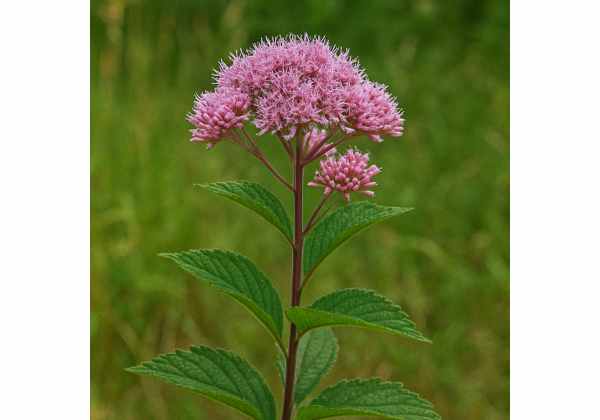
Queen’s root is an older herbal name most often applied to gravel root, the North American medicinal plant long known as Eupatorium purpureum and now more accurately classified as Eutrochium purpureum. It is also associated with Joe-Pye weed, a tall purple-flowering member of the daisy family with a long reputation in traditional urinary and rheumatic herbalism. The root and rhizome, not the showy summer flowers, are the medicinal parts. Historically, the herb was used for urinary irritation, “gravel” in the urine, sluggish urinary flow, and certain inflammatory pains, especially where dampness, swelling, or tissue irritation were thought to be involved. Modern research does not provide strong human clinical proof for all of these uses, but it does offer some support for anti-inflammatory activity and identifies distinctive benzofuran compounds such as cistifolin, euparin, and euparone. At the same time, queen’s root deserves caution because of uncertainty around pyrrolizidine alkaloids and the possibility of liver-related risk with prolonged or careless use. This makes it a herb best approached thoughtfully, not casually.
Quick Summary
- Queen’s root is traditionally used for urinary irritation, urinary gravel, and gentle wash-through support.
- Early laboratory research suggests anti-inflammatory activity from benzofuran compounds in the root and rhizome.
- A commonly cited traditional range is 2 to 4 g dried root and rhizome, 1 to 3 times daily.
- People who are pregnant, breastfeeding, have liver disease, or want long-term daily use should avoid unsupervised use.
Table of Contents
- What Queen’s Root is and why the botanical name matters
- Key ingredients and medicinal properties
- Traditional urinary uses and what benefits are most realistic
- Queen’s Root for inflammatory pain and rheumatic complaints
- How to use Queen’s Root, forms, preparation, and dosage context
- Safety, side effects, interactions, and who should avoid it
What Queen’s Root is and why the botanical name matters
Queen’s root is one of those herbal names that sounds simple until you look closely. In most English-language herbal traditions, it refers to gravel root, a medicinal root and rhizome long identified as Eupatorium purpureum. Modern botanical classification now places that plant in the genus Eutrochium, so the currently accepted scientific name is Eutrochium purpureum. That change matters because older herbal books, commercial labels, and folk references often still use the Eupatorium name, while modern taxonomic databases use Eutrochium. A reader looking for accurate information needs to know that these names point to the same plant in this context.
The plant belongs to the Asteraceae family and is closely related to other Joe-Pye weeds. It is a tall, moisture-loving perennial native to eastern and central North America, often found near streams, wet meadows, and woodland margins. Its pinkish-purple flower clusters are showy and well known to pollinator gardeners, but the medicinal part is traditionally the root and rhizome harvested in the dormant season. This is important because some modern discussions blur the difference between ornamental Joe-Pye weed in general and the root-based herbal drug historically used in medicine.
Common names add another layer of confusion. Gravel root is the name most people know from urinary-herb traditions, but Queen’s root, queen of the meadow, purple boneset, and Joe-Pye weed may also appear in older texts. These overlapping names can lead people to assume that every Joe-Pye weed species has identical medicinal value. That is not necessarily true. In real herbal practice, species identity and plant part matter, especially when the herb has a mixed reputation involving both traditional value and safety concerns.
Historically, queen’s root developed a clear personality as a urinary and rheumatic herb. It was commonly described as a diuretic, a remedy for painful urination, and a plant for “gravel,” meaning sandy sediment or small stone-like material in the urinary tract. It was also used for inflammatory joint discomfort and other conditions tied to congestion or irritation. Those uses help explain why it still appears in modern herb circles, even though it is not among the most mainstream contemporary supplements.
It also helps to compare queen’s root with better-known urinary herbs so its place becomes clearer. Unlike a strongly antimicrobial urinary herb such as uva ursi for short-term urinary support, queen’s root is more often framed as a wash-through, irritation, and gravel-rooted traditional remedy than as a direct urinary antiseptic. That difference shapes both its benefits and its limits.
The botanical name matters for one more reason: safety. Some Eupatorium and related species have raised concern because of pyrrolizidine alkaloids or contamination risk. When species identification is sloppy, safety interpretation gets sloppy too. So before talking about benefits, dosage, or uses, it is worth being precise: Queen’s root in this article means the traditional medicinal root and rhizome of the plant historically called Eupatorium purpureum, now accepted botanically as Eutrochium purpureum.
Key ingredients and medicinal properties
Queen’s root is not one of those herbs whose chemistry is mapped in detail by large modern clinical programs. Still, enough is known to explain why it developed a medicinal reputation. The plant has been described as containing benzofuran derivatives, a small amount of volatile oil, resinous constituents, and related phytochemicals that appear to contribute to anti-inflammatory and tissue-active effects. Among the names most often associated with the root and rhizome are cistifolin, euparin, and euparone. These compounds matter because modern lab work on gravel root has centered largely on them.
The best-studied constituent is cistifolin, a benzofuran compound isolated from the rhizome. In laboratory and animal models, it has shown anti-inflammatory activity and effects on integrin-mediated cell adhesion. That sounds technical, but the practical meaning is fairly straightforward: cistifolin appears to influence how inflammatory cells interact with tissues during inflammatory processes. This is one reason queen’s root acquired a traditional reputation not only for urinary problems but also for rheumatic and inflammatory discomfort.
Further phytochemical work identified additional benzofurans and related compounds, including euparin and euparone, although these did not show the same level of anti-adhesion activity in the classic experiments. Even so, their presence helps explain why herbalists have long treated the root as more than just a bland diuretic. It appears to have a distinct anti-inflammatory profile, even if the evidence remains preclinical rather than strongly clinical.
Older herbal descriptions also refer to volatile oil and resin. These are less glamorous than named isolated compounds, but they often contribute to the bitter, warming, or tissue-moving character that traditional herbalists notice. In real-world herbal medicine, a plant’s action is rarely reduced to a single molecule. Queen’s root seems to be a good example of a herb whose traditional effects likely come from a combination of constituents rather than one isolated substance alone.
From a medicinal-properties standpoint, queen’s root is usually described in four main ways. First, it is considered diuretic or urinary-moving. Second, it is regarded as anti-inflammatory. Third, it has a traditional reputation as a lithotriptic-type herb, meaning one used around gravel or small stone-like urinary irritation, although modern proof for true stone-dissolving action is lacking. Fourth, it has been viewed as a rheumatic remedy, especially where dull inflammatory discomfort and fluid congestion overlap.
These actions place it in an interesting middle ground. It is not a classic soothing mucilage herb, but it is often combined with herbs that are. It is not mainly a sharp urinary antiseptic, but it is part of the urinary-herb category. In formulations for irritated urinary tissue, it sits more comfortably beside corn silk for urinary comfort or marshmallow-like demulcents than beside harsher stimulant herbs.
The main limitation is just as important as the main promise. Queen’s root has mechanistic evidence and traditional use, but not robust modern human trials proving broad medical benefits. So its medicinal properties are best described as plausible, historically respected, and pharmacologically interesting, rather than fully clinically established. That balanced view helps keep the herb both useful and honest.
Traditional urinary uses and what benefits are most realistic
The strongest traditional identity of queen’s root is urinary. That is why the common name gravel root has stayed attached to it for so long. In older herbal medicine, “gravel” referred to small gritty deposits, urinary sediment, or irritation linked with the passage of mineral material through the urinary tract. The herb was used for painful urination, urinary frequency, irritation in the bladder region, and conditions that sounded like mild stone or sand-like complaints. It was also used when urine was described as cloudy, bloody, or carrying mucus, though those are not symptoms that should be self-treated casually today.
This does not mean queen’s root is a proven modern kidney-stone therapy. That would go too far. What it does mean is that traditional herbalists saw it as especially useful when urinary irritation and sluggish flow were present together. It was thought to encourage freer urine flow while easing the discomfort that often accompanied passage of gravel-like material. That combination helps explain its long-standing appeal.
The most realistic health claim today is that queen’s root may offer traditional urinary support in the form of gentle diuretic action and possible reduction of inflammatory irritation. It is reasonable to describe it as a herb historically used for the urinary tract, especially in cases of discomfort, mild irritation, or urinary “gravel.” It is not reasonable to say that it has been clinically proven to dissolve stones, cure urinary tract infection, or replace diagnosis when symptoms are significant.
This distinction matters because urinary symptoms can look deceptively simple. A burning bladder sensation might be mild irritation, but it could also be infection. Blood in the urine could be a historical herbal indication, but in modern care it is also a clear sign to seek evaluation. Flank pain could reflect stone movement, but it could also signal something more serious. Queen’s root fits best in the zone of traditional supportive use, not in the zone of modern do-it-yourself treatment for serious urinary disease.
That is why it helps to compare it with other urinary herbs. Someone looking for direct anti-adhesion support in recurrent urinary issues may think first of cranberry for urinary tract support. Someone wanting a stronger short-term urinary antiseptic direction may look at uva ursi. Queen’s root sits somewhere else. It is more traditional, more irritation-focused, and more associated with gravel and urinary tissue discomfort than with a simple “anti-infection” label.
It is also worth noting that much of its modern reputation comes from tradition carried forward rather than from newly generated clinical data. Some herbalists still value it for chronic urinary irritation and recurrent tendency toward sediment or irritation around stones. Others avoid it because of the safety uncertainty around pyrrolizidine alkaloids. Both positions make sense once the evidence is understood. The herb is neither imaginary nor fully proven.
So what benefit is most realistic? A fair answer is this: queen’s root may serve as a traditional urinary-support herb when the goal is gentle wash-through action and inflammatory comfort, but it should not be treated as a modern first-line solution for infection, severe stones, or undiagnosed urinary pain. That framing respects both the plant’s history and its modern limits.
Queen’s Root for inflammatory pain and rheumatic complaints
Although queen’s root is best known for urinary complaints, its historical reputation also includes rheumatic and inflammatory pain. This second identity makes sense once you look at the chemistry. The same root and rhizome that were used for urinary irritation were also described in older herbal traditions as anti-rheumatic, especially in chronic, damp, or congestion-associated patterns of pain. It was not generally framed as a quick painkiller in the modern sense. Instead, it was seen as a deeper acting herb used over time in people whose pain, swelling, urinary sluggishness, and inflammatory tendencies seemed connected.
This traditional logic may sound old-fashioned, but some of it aligns with the modern mechanistic research. The work on cistifolin and related benzofurans suggests that gravel root does have real anti-inflammatory activity in experimental settings. In practical terms, that helps justify why the herb was used not only for the urinary tract but also for painful inflammatory states. It is still not enough to place it beside well-proven modern anti-inflammatory therapies, yet it does move the herb beyond pure folklore.
The challenge is evidence quality. Nearly all of the stronger evidence here is preclinical, not clinical. There are no widely recognized modern randomized trials showing that queen’s root reliably improves arthritis, gout, chronic rheumatism, or other inflammatory pain conditions in humans. That means the anti-rheumatic claim should be presented as traditional and mechanistically plausible, not as a fully evidence-based modern indication.
This distinction becomes especially important because many people reading about an herb want to know whether it can replace a pain medicine. Queen’s root is not a substitute for diagnostic workup or evidence-based management of inflammatory arthritis, joint swelling, autoimmune pain, or severe musculoskeletal problems. It belongs, at most, in the category of supportive traditional herbs that may interest herbal practitioners, not in the category of self-prescribed stand-alone solutions.
Still, there is a reason the herb has kept this reputation. Traditional systems often noticed patterns modern readers miss. A person with urinary irritation, swelling, and rheumatic pain may have been seen as having one broader inflammatory picture rather than separate unrelated complaints. Queen’s root, with its combined urinary and anti-inflammatory character, fit that pattern well. That is part of why it remained respected in eclectic and traditional American herbalism.
For readers thinking specifically about pain support, it can help to compare queen’s root with more established pain herbs such as willow bark for pain relief. Willow bark has a much clearer modern reputation as a pain-support plant. Queen’s root does not compete with it directly. Instead, queen’s root belongs to a more specialized traditional niche where urinary function, inflammatory congestion, and rheumatic discomfort overlap.
A realistic conclusion is that queen’s root may have supportive anti-inflammatory relevance, especially in historical rheumatic use, but the evidence is too limited to market it confidently as a proven herb for joint disease or chronic inflammatory pain. Used in that modest way, the claim stays both meaningful and honest.
How to use Queen’s Root, forms, preparation, and dosage context
The medicinal part of queen’s root is the dried root and rhizome, and traditional use has usually favored decoctions, powders, and tinctures rather than casual teas made from the leafy tops. This matters because the root and rhizome carry the identity of gravel root as an herbal drug. If a label or preparation does not clearly mention root or rhizome, it may not reflect the traditional use at all.
The most classic preparation is a decoction. This makes practical sense because woody or fibrous underground plant parts often need simmering rather than a quick steep. Older herbal instructions often describe simmering the cut root in water and taking the resulting liquid in divided doses through the day. Modern herbal teaching still tends to favor decoction for this herb because it keeps the preparation grounded in tradition and avoids the more aggressive feel of concentrated extracts.
Tinctures are also widely used in contemporary herbal practice. A tincture is convenient, measurable, and easier for some people than making repeated decoctions. The caution is that convenience can make people forget the herb’s limitations. With queen’s root, the issue is not just how to take it but whether it is appropriate to take at all, especially for longer periods. A tincture may be practical, but it is not automatically safer than a decoction.
Powdered root and root capsules exist too, although they are less anchored in classic herbal practice than decoctions and tinctures. When an herb has unresolved safety questions, bulk powder use is often less ideal because people may treat it like a simple supplement and use it casually for too long.
A commonly cited traditional range is 2 to 4 g of dried root and rhizome one to three times daily, or roughly 3 to 8 mL per day of a 1:3 tincture. These are best understood as traditional herbalist ranges, not as clinically standardized, monograph-backed medicinal doses. That distinction is essential. The range is useful for context, but it should not be interpreted as proof that the dose is validated for safety and efficacy in modern long-term self-care.
The practical rules for use are simple:
- choose root or rhizome preparations, not vague aerial-part products,
- favor short courses over indefinite use,
- use it only when the symptom pattern fits the herb’s traditional role,
- stop if symptoms worsen or if significant pain, fever, or bleeding appear.
It can also be helpful to think about formulas. Queen’s root has often been paired with softer urinary herbs in traditional practice. In that context it makes sense alongside marshmallow root for soothing urinary support or corn silk, rather than as a lone aggressive herb. That pairing logic reflects experience: queen’s root is more specialized and somewhat firmer in action, while demulcent companions make the overall formula gentler.
So how should it be used today? Carefully, selectively, and with a strong awareness that the herb lives mostly in the world of traditional herbal medicine, not modern standardized therapeutics. The form matters, the part matters, and the duration matters.
Safety, side effects, interactions, and who should avoid it
Safety is the most important modern issue with queen’s root. The herb has real traditional value, but it also carries unresolved concern because of possible pyrrolizidine alkaloids and contamination or hybridization issues involving related species. Pyrrolizidine alkaloids, often shortened to PAs, are a class of compounds known for potential hepatotoxic, mutagenic, and possibly carcinogenic effects with sufficient exposure. Not every preparation of queen’s root is proven to contain harmful amounts, and the evidence remains contradictory, but the uncertainty itself is enough to justify caution.
This is why many modern herbal sources take a restrained position. Rather than saying queen’s root is definitely dangerous, they say the herb should be approached conservatively until identification and contamination issues are better resolved. That is a sensible stance. When an herb has limited human efficacy data and possible long-term toxicity questions, the safest approach is to avoid routine, prolonged, or casual use.
The most important groups who should avoid unsupervised use are:
- pregnant and breastfeeding people,
- children,
- anyone with liver disease,
- anyone seeking long-term daily use,
- people taking multiple prescription medicines without professional guidance.
Possible side effects are not well characterized in large modern trials, but traditional and practical concerns include nausea, stomach upset, and vomiting at larger amounts. The bigger concern is not a minor short-term reaction. It is the possibility of liver stress with repeated or prolonged exposure if problematic alkaloids are present. That is why short-term, selective use is the only context in which many herbalists would even consider the plant.
Interactions are also not well studied. Because queen’s root is used partly as a diuretic-style urinary herb, caution makes sense if someone already takes diuretic drugs, blood-pressure medicines, or any medication affected by hydration and kidney handling. This does not mean a documented severe interaction is established. It means the absence of strong data is not the same as a free pass.
Safety also depends on the condition being self-treated. Queen’s root is especially inappropriate when symptoms suggest something beyond the minor range. Avoid self-treatment and seek medical care if there is:
- fever,
- visible blood in the urine,
- severe flank pain,
- persistent burning,
- difficulty passing urine,
- worsening swelling or unexplained joint inflammation.
For readers comparing urinary herbs, this is one reason some practitioners prefer better-tolerated options such as horsetail for urinary support or other milder herbs when safety certainty matters more than historical specificity. Queen’s root is not a beginner herb. It is a historically important herb with enough uncertainty that it should be used only with clear purpose and real caution.
The safest conclusion is straightforward. Queen’s root may still have a place in informed traditional herbal practice, especially for short-term urinary and inflammatory support, but it should not be treated as harmless just because it is old or plant-based. With this herb, respecting the limits is part of using it wisely.
References
- Taxonomy Browser (Eutrochium purpureum) 2026
- Antiinflammatory activity of the antirheumatic herbal drug, gravel root (Eupatorium purpureum): further biological activities and constituents – PubMed 2001
- Cistifolin, an integrin-dependent cell adhesion blocker from the anti-rheumatic herbal drug, gravel root (rhizome of Eupatorium purpureum) – PubMed 1998
- Potentially toxic pyrrolizidine alkaloids in Eupatorium perfoliatum and three related species. Implications for herbal use as boneset – PubMed 2018
- Gravel root (Eutrochium purpureum): Benefits, Safety, Uses | Herbal Reality 2022
Disclaimer
This article is for educational purposes only and is not medical advice, diagnosis, or treatment. Queen’s root has a long traditional history, but modern human evidence remains limited and safety questions remain because of possible pyrrolizidine alkaloid exposure and identification issues in related species. Do not use this herb to self-treat kidney stones, urinary infection, blood in the urine, severe pain, fever, or chronic inflammatory disease without professional care. If you are pregnant, breastfeeding, have liver disease, take prescription medicines, or are considering repeated use, speak with a qualified healthcare professional before using queen’s root.
Please share this article on Facebook, X, or your preferred platform if you found it helpful.