Queen of the prairie is a tall, striking North American wildflower with frothy pink blooms, moist-meadow roots, and a medicinal reputation that is much older than its modern garden fame. Botanically known as Filipendula rubra, it belongs to the same genus as meadowsweet and shares part of that family resemblance in aroma, tannins, and likely salicylate-related compounds. Traditional records describe it as an astringent root medicine, with uses that ranged from bowel complaints and bleeding to heart-related folk applications. Modern interest, however, runs ahead of the evidence. Unlike European meadowsweet, queen of the prairie has very little direct human research behind it.
That does not make the plant unimportant. It means the most honest guide has to distinguish between species-specific tradition, likely genus-level chemistry, and modern proof. The root appears tannin-rich, the leaves may have some antimicrobial potential in laboratory work, and related Filipendula species show antioxidant, anti-inflammatory, and gastroprotective activity. Still, this is not a well-standardized supplement herb, and wild harvesting raises real conservation concerns. For most readers, the best questions are not whether queen of the prairie is powerful, but what is actually known, what is inferred, and what is safest.
Core Points
- Queen of the prairie is most credibly viewed as a traditional astringent herb with possible antioxidant and anti-inflammatory potential rather than a clinically proven modern remedy.
- Traditional use centers on the root, especially for bowel complaints, bleeding, and older heart-related folk uses, but direct human trials are lacking.
- No validated species-specific dose exists, but a cautious related-herb infusion range is about 1.5 to 3 g of dried cultivated aerial material per cup, up to 2 to 3 times daily.
- Avoid self-treatment during pregnancy, with aspirin or salicylate sensitivity, when taking blood thinners, or when the plant source is wild and uncertain.
Table of Contents
- What Queen of the Prairie Is and Why the Evidence Is Limited
- Key Ingredients in Queen of the Prairie and What Can Reasonably Be Inferred
- Queen of the Prairie Health Benefits and What Is Most Credible
- Traditional Uses, Astringency, and How the Plant Has Been Used
- Queen of the Prairie Dosage, Preparations, and Practical Use
- Common Mistakes, Conservation Concerns, and When Not to Self-Treat
- Safety, Side Effects, Interactions, and Who Should Avoid It
What Queen of the Prairie Is and Why the Evidence Is Limited
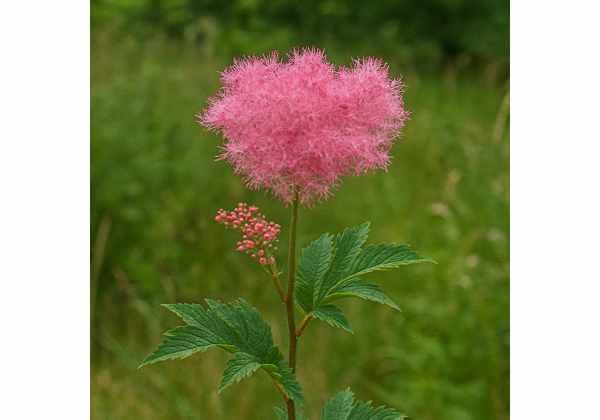
Queen of the prairie is a moisture-loving perennial in the rose family, native to parts of the central and eastern United States. It is most often recognized by its large, cotton-candy-like clusters of deep pink flowers rising above bold, lobed foliage. In gardens it is admired as an ornamental, but in ethnobotanical records it also appears as a medicinal plant with a tannin-rich root and a small but persistent folk reputation.
The first challenge in writing about Filipendula rubra is that the medicinal evidence base is thin. There are traditional references, some botanical summaries, and a small amount of preliminary lab work, but there is nothing like the clinical or monographic depth that exists for its European relative Filipendula ulmaria, often called meadowsweet. That matters because many articles blur the two species together and quietly let the stronger meadowsweet literature do the work for queen of the prairie. A careful article cannot do that without saying so plainly.
This means queen of the prairie sits in an unusual position. It is not a plant with no history. Traditional records describe it as useful for heart complaints, as a love medicine in some Indigenous ethnobotanical accounts, and as an astringent root for diarrhea, dysentery, bleeding, and skin irritation. Yet it is also not a plant with robust modern human trials. The best current approach is therefore a layered one:
- start with what is directly recorded for F. rubra,
- distinguish that from what is known for the Filipendula genus,
- and treat meadowsweet-based evidence as informative but not fully interchangeable.
That distinction also keeps the safety discussion more realistic. If a reader sees “queen of the prairie” and imagines a native alternative to aspirin, that is already too simple. Related species do contain salicylate-related compounds, and the genus clearly has phenolic and tannin-rich chemistry, but the plant is not a standardized salicylate medicine and should not be treated as one.
Another reason for caution is ecology. Queen of the prairie is considered rare or threatened across parts of its native range, and that makes casual root harvesting especially problematic. The same root that traditional medicine valued is also the part whose removal most directly harms the plant. So even before dosage questions arise, the article has to address a more basic issue: this is not a species that should be stripped from wetlands for home experimentation.
The most helpful way to understand queen of the prairie, then, is as a traditional North American astringent with likely genus-level polyphenol activity, limited species-specific research, and a stronger case for respect than for hype.
Key Ingredients in Queen of the Prairie and What Can Reasonably Be Inferred
Direct phytochemical profiling of queen of the prairie is surprisingly sparse, so the ingredient story has to be told carefully. What can be said with reasonable confidence is that traditional sources describe the root as rich in tannins, and that related Filipendula species contain a well-developed pattern of phenolic compounds, flavonoids, tannins, and salicylate-related constituents. Because F. rubra belongs to the same genus, it is reasonable to infer some overlap, but not safe to assume identical chemistry in identical proportions.
The root’s astringent reputation is the clearest starting point. Tannin-rich plant parts tend to tighten tissues, reduce weeping or secretions, and fit older uses for diarrhea, dysentery, minor bleeding, and irritated skin. That aligns well with the traditional descriptions of queen of the prairie. Astringency is not glamorous, but it is often the most practical clue to what a plant was actually doing in folk practice.
From the broader Filipendula literature, the compound groups most relevant to the article are likely these:
- Tannins, especially hydrolyzable tannins, which support the plant’s astringent profile.
- Flavonoids, which in related species are linked to antioxidant and anti-inflammatory activity.
- Phenolic acids, including salicylic-acid-related compounds in meadowsweet relatives.
- Other polyphenols, which may contribute antimicrobial and tissue-protective effects.
That last point is where people often overreach. Because related Filipendula species contain salicylates and anti-inflammatory phenolics, some writers jump to the conclusion that queen of the prairie is basically a native aspirin herb. That is too loose. It is better to say that the genus shows a recognizable chemistry associated with antioxidant, anti-inflammatory, and astringent activity, and that queen of the prairie likely shares at least part of that pattern. Readers who want a deeper look at the better-studied relative can explore meadowsweet as the classic medicinal Filipendula species, but that evidence should not be pasted onto F. rubra without caution.
There is also a small but interesting species-specific clue from laboratory screening: leaf extracts of F. rubra have been reported to inhibit Staphylococcus aureus in preliminary work. That is useful as a signal, not as a clinical claim. It suggests the plant may indeed carry active phenolic chemistry, but it does not prove that queen of the prairie tea, tincture, or wash can treat infection in people.
So the most honest ingredient picture is a modest one. Queen of the prairie appears to be a tannin-forward medicinal plant with probable genus-level polyphenols and possible salicylate-related constituents. That fits its traditional use as an astringent and likely explains why it belongs in the same broad family conversation as meadowsweet. What it does not justify is pretending the plant has a fully mapped modern phytochemistry or a ready-made supplement identity.
Queen of the Prairie Health Benefits and What Is Most Credible
The most credible health benefits of queen of the prairie come from three overlapping sources: traditional use, reasonable inference from genus chemistry, and limited species-specific laboratory evidence. The weakest approach is to treat it as a clinically validated herb for pain, inflammation, infection, or cardiovascular problems. The stronger approach is to rank the benefits by how well they are supported.
The most believable benefits are these:
- Astringent support for loose, irritated, or overactive tissues
- Possible mild anti-inflammatory and antioxidant activity
- Potential topical usefulness for minor weeping skin irritation
- Preliminary antimicrobial interest in laboratory settings
The astringent story is the strongest. If a root is repeatedly described as tannin-rich and used for diarrhea, dysentery, bleeding, and rashes, that is not random folklore. It points to a coherent traditional action. Astringent herbs often do their best work by tightening tissues and reducing excess output rather than by acting like broad-spectrum pharmacologic drugs. In that sense, queen of the prairie may have more in common with witch hazel as a classic tannin-rich astringent than with a high-powered anti-inflammatory extract.
The anti-inflammatory question is more nuanced. Related Filipendula species, especially meadowsweet and dropwort, show antioxidant, anti-inflammatory, and gastroprotective activity in preclinical work. That gives queen of the prairie a plausible family resemblance, particularly if it contains overlapping tannins and phenolics. But plausibility is not proof. It is safer to describe queen of the prairie as a plant with likely anti-inflammatory potential than as a proven anti-inflammatory medicine.
There is also a tendency to lean on salicylates too heavily. Because Filipendula relatives are associated with salicylic-acid-related compounds, some articles frame queen of the prairie as a native pain herb in the same lane as willow bark and its salicylate-linked pain support. That comparison is only partly fair. Willow bark has a much clearer identity in modern herbal medicine. Queen of the prairie does not. A reader should not expect the same level of pain evidence, standardization, or clinical familiarity.
The heart-related folk uses deserve special restraint. Ethnobotanical records do mention them, but that is not enough to recommend the herb for modern cardiovascular self-care. Heart complaints are too broad and too serious to translate directly from traditional notes into present-day use.
A good bottom line is this: queen of the prairie may offer modest astringent, tissue-toning, and likely polyphenol-driven benefits, with a little early antimicrobial interest. Those are real possibilities. But the plant’s strongest modern “benefit” is not dramatic symptom relief. It is that it gives us a careful example of how traditional use and modern evidence do not always move at the same speed.
Traditional Uses, Astringency, and How the Plant Has Been Used
Traditional use is where queen of the prairie becomes most concrete. The plant was not historically famous because of controlled trials or standardized extracts. It was valued because people observed what the root seemed to do. Those uses center on astringency, tissue tightening, and what older herbal language would have called checking excesses.
Traditional reports most often describe the root as the medicinal part. That root was used for:
- diarrhea and dysentery,
- minor bleeding,
- skin eruptions or rashes,
- and certain heart-related folk complaints.
Some records also describe a love-medicine role, which is common enough in ethnobotanical literature that it should be acknowledged, but not flattened into a modern pharmacologic claim. A plant can have ceremonial, symbolic, and interpersonal uses that matter culturally without fitting neatly into modern evidence categories.
The first point worth emphasizing is that these uses make sense together. A tannin-rich root naturally fits diarrhea, dysentery, and bleeding better than it fits, for example, cough or sleep support. This internal logic is one of the reasons traditional plant use deserves careful reading. It often reflects coherent plant actions, even when the language differs from modern biomedical terms.
The second point is that the old uses do not automatically justify present-day self-treatment. Diarrhea in older herbal practice was often approached with astringents, but modern bowel symptoms can reflect infection, inflammatory bowel disease, medication effects, or other causes that should not be simply “checked” with a strong root tea. The same is true for bleeding or heart complaints. Traditional use can guide questions. It should not always guide unsupervised action.
Topical use is perhaps easier to translate. A tannin-rich preparation used as a wash for minor rashes or irritated skin fits well with broader herbal practice. Astringent plants can sometimes be helpful when skin is damp, weepy, or inflamed rather than extremely dry. In that regard, queen of the prairie would sit closer to an astringent rinse than to a soothing oily salve. If someone mainly wants a gentler digestive or mucosal herb, chamomile is often the softer and more forgiving choice.
There is also a plant-part issue. Because the traditional medicinal material is the root, modern ethical use becomes complicated. Digging roots from a rare wetland plant is not a trivial act. That is one reason many modern writers should be more cautious than older herbals were. A traditional use can be historically real and still be a poor recommendation for contemporary wildcrafting.
So how should the traditional use record be understood today? As meaningful, coherent, and instructive, but not as a direct prescription pad. Queen of the prairie has a real ethnobotanical identity, especially as a tannin-rich root astringent. That matters. Yet the most respectful modern reading combines interest with restraint: learn the pattern, understand the action, and avoid acting as though old use automatically equals current best practice.
Queen of the Prairie Dosage, Preparations, and Practical Use
Dosage is one of the hardest parts of a queen of the prairie article to handle honestly, because there is no well-established modern dosing standard for Filipendula rubra. No major clinical guideline gives a species-specific amount, and the plant is not widely standardized in commercial herbal medicine. That means any usable dosing advice has to be clearly labeled as conservative and partly extrapolated from related Filipendula practice rather than presented as settled fact.
A cautious practical approach looks like this:
- No validated species-specific dose exists for queen of the prairie
- A low related-herb infusion range of about 1.5 to 3 g dried cultivated aerial material per cup is the most defensible starting point
- This can be used up to 2 to 3 times daily for short-term use
- Root use is best left to experienced practitioners and should not rely on wild-harvested plants
That emphasis on aerial material is deliberate. Traditional medicine focused more on the root, but the root is also the part whose harvest most directly threatens the plant, especially where populations are rare. For most modern readers, cultivated aerial use is the only practical, ethically safer category to discuss at all.
Preparation matters. A mild infusion is more realistic than an aggressive tincture or home-extracted concentrate. Queen of the prairie is not a widely standardized capsule herb, and there is no good reason for most people to push toward concentrated extracts. If the goal is gentle tissue-toning support or exploratory short-term use, a simple infusion is the least complicated place to start.
Timing depends on the purpose:
- For mild loose-stool tendencies, it would traditionally be used between or after meals in small amounts.
- For topical application, a cooled infusion could be used externally rather than taken internally.
- For speculative pain or inflammatory use, it is often wiser to choose a better-studied herb instead of forcing queen of the prairie into the role.
That last point matters. Readers sometimes look for dosage because they want the plant to do something more than its evidence supports. If the real goal is stomach or upper-digestive soothing, a gentler option such as meadowsweet in its better-studied traditional form or another well-known digestive herb may simply make more sense. Queen of the prairie is not a plant whose value increases just because a number can be assigned to it.
A few practical guardrails help:
- start low rather than aiming for an “effective” high dose,
- use cultivated material only when possible,
- avoid long-term daily use,
- and stop quickly if irritation, stomach discomfort, or unusual symptoms appear.
The most honest dosage takeaway is that queen of the prairie is not a modern precision herb. It is a traditional plant with limited dosing certainty. When an article admits that plainly, it becomes more helpful, not less.
Common Mistakes, Conservation Concerns, and When Not to Self-Treat
The biggest mistakes people make with queen of the prairie do not usually happen in the teacup. They happen earlier, in the assumptions they bring to the plant. Because it is beautiful, native, and historically medicinal, it is easy to imagine it as a harmless wetland equivalent of meadowsweet. That is exactly the shortcut to avoid.
The first mistake is assuming related species are interchangeable. Queen of the prairie and meadowsweet belong to the same genus, but they do not have the same evidence base. Much of what is written online about F. rubra is really borrowed from F. ulmaria. Borrowing can be informative when done transparently. It becomes misleading when it is hidden. A reader should know whether a claim comes from direct species data or from genus-level analogy.
The second mistake is wild harvesting the root. This is both an ethical and practical problem. Queen of the prairie is rare across parts of its native range, and the root is the traditional medicinal part. That creates exactly the wrong incentive: the part most people would want is the part the plant can least afford to lose. Wildcrafting a threatened or regionally scarce wetland species for experimental herbal use is poor practice, even if the plant is not legally protected where it grows.
The third mistake is using the herb for modern heart or bleeding issues based on ethnobotanical notes. Traditional records of heart-related use are historically interesting, but they are not a green light for present-day cardiovascular self-treatment. The same is true for bleeding. A tannin-rich plant may be astringent, but unexplained bleeding is a diagnostic issue first, not a folk-remedy experiment.
Another common mistake is expecting strong pain relief because of the Filipendula name. People familiar with salicylate-rich plant discussions may assume queen of the prairie is a hidden native pain herb. That may be tempting, but it is not well supported. If someone wants a herb with a clearer digestive or soothing profile, marshmallow root for mucosal support or another better-known plant may be a more rational choice, depending on the complaint.
A more subtle error is ignoring plant quality and identity. Because queen of the prairie is not a mainstream medicinal herb, commercial sourcing can be unclear. Material may be mislabeled, mixed with related species, or sold more as novelty than as serious botanical medicine. That alone is reason not to treat it like a routine supplement.
The best troubleshooting rule is simple: if the intended use is serious, do not self-treat with queen of the prairie. If the source is wild, do not harvest the root. If the reasoning for use depends mostly on what meadowsweet can do, choose the better-studied plant instead. Queen of the prairie deserves respect, but not projection.
Safety, Side Effects, Interactions, and Who Should Avoid It
Queen of the prairie does not have a large modern safety literature, which means the safest guidance has to combine what is known from traditional astringent herbs with what is known from related Filipendula species. That makes the safety section more cautious than precise, but that is appropriate for a plant with limited direct clinical data.
The most likely side effects come from two directions. The first is tannin-related irritation. Strong astringent plants can sometimes cause stomach tightness, nausea, constipation, or digestive discomfort, especially when taken in concentrated forms or on an empty stomach. The second is possible salicylate-related caution, inferred from related Filipendula species rather than fully established for F. rubra itself.
People who should avoid queen of the prairie or use it only with professional guidance include:
- pregnant or breastfeeding people
- anyone with aspirin or salicylate sensitivity
- people taking anticoagulants or other blood-thinning medicines
- those with active stomach irritation or chronic constipation
- children and adolescents
- anyone planning to use wild-harvested root from uncertain or vulnerable populations
The aspirin-sensitivity point deserves care. It would be too strong to declare that queen of the prairie is simply an aspirin-like herb. Yet it would also be careless to ignore the genus context. Related Filipendula preparations contain salicylate-related compounds, and official meadowsweet safety guidance advises caution in salicylate-sensitive people. For queen of the prairie, that means prudence is wiser than certainty.
Drug-interaction data are essentially absent, but that is not the same as proof of safety. When a plant may combine tannins, salicylate-related constituents, and limited direct evidence, the sensible move is to avoid stacking it with blood thinners, high-dose NSAIDs, or several unfamiliar herbs at once. If someone needs ongoing anti-inflammatory support, there are better characterized options such as boswellia in joint and inflammatory support research.
Topical use is not necessarily risk-free either. A strong astringent wash may irritate very dry, broken, or sensitive skin rather than help it. Older wound and rash uses should therefore be approached conservatively, especially in people prone to dermatitis.
The final safety issue is ecological rather than physiologic. Because the traditional medicinal part is the root and the plant is rare in parts of its range, “safe use” includes not damaging native populations for personal experimentation. That is a real part of the ethics of herbal practice.
So the bottom line is this: queen of the prairie appears relatively gentle in theory when used modestly, but direct human safety data are sparse, and caution is appropriate. The plant is best avoided by aspirin-sensitive people, pregnant or breastfeeding people, children, and anyone tempted to harvest wild roots. When in doubt, choose a better-studied herb rather than trying to force certainty from a sparse evidence base.
References
- Filipendula rubra Rare Plant Profile 2024 (Government Profile)
- Filipendula rubra (Hill) Robbis. Queen-of-the-prairie 2007 (Government Conservation Abstract)
- Assessment report on Filipendula ulmaria (L.) Maxim., herba and Filipendula ulmaria (L.) Maxim., flos 2011 (Guideline and Safety Review)
- Variation in Phenolic Compounds, Antioxidant and Antibacterial Activities of Extracts from Different Plant Organs of Meadowsweet (Filipendula ulmaria (L.) Maxim.) 2023 (Research Article)
- DNA-Protective, Antioxidant and Anti-Carcinogenic Potential of Meadowsweet (Filipendula ulmaria) Dry Tincture 2024 (Research Article)
Disclaimer
This article is for educational purposes only and is not medical advice. Queen of the prairie has a real traditional medicinal history, but direct modern clinical evidence for Filipendula rubra is limited, and some safety cautions are inferred from related Filipendula species rather than proven specifically for this one. Do not use it to self-treat heart problems, unexplained bleeding, severe diarrhea, chronic pain, or infection. If you are pregnant, breastfeeding, aspirin-sensitive, taking blood thinners, or considering wild-harvested material, speak with a qualified healthcare professional first.
If this article was useful, please consider sharing it on Facebook, X, or another platform you prefer so more readers can find careful, balanced information about queen of the prairie.