Red yeast rice supplements are unusually difficult to judge from the label alone. Their cholesterol-lowering effect depends largely on monacolins, especially monacolin K, which is chemically identical to lovastatin. Yet products can differ markedly in how much monacolin K they contain, whether the label accurately reflects that amount, and whether unwanted fermentation byproducts are present. Citrinin is the best-known contaminant because it can damage the kidneys at sufficient exposure. Recent product testing has also found labeling problems, excessive monacolin content, microbial contamination, and possible adulteration in some supplements. This means a bottle labeled simply “red yeast rice 1,200 mg” does not tell you the most important information: the active statin-like dose and the quality controls used to make it. If you are considering red yeast rice, treat product quality as a safety issue, not just a shopping preference. Look for transparent testing, avoid stacking it with cholesterol medicines, and involve a clinician when cardiovascular risk or medication interactions matter.
Table of Contents
- Why Red Yeast Rice Quality Varies
- Monacolin K Is a Statin-Like Drug
- Citrinin and Other Contamination Risks
- What Product Testing Has Found
- Red Flags on Labels and Listings
- Safety Checklist Before You Buy or Take It
- When Red Yeast Rice Is the Wrong Tool
Why Red Yeast Rice Quality Varies
Red yeast rice is made by fermenting rice with Monascus species. Fermentation can produce a mixture of compounds, including pigments and monacolins. The exact chemical profile depends on the fungal strain, fermentation conditions, raw materials, processing, and quality controls.
That is very different from manufacturing a prescription tablet with a defined amount of one active drug. With red yeast rice, two capsules that each say “600 mg” can deliver very different amounts of monacolin K. The number on the front of the bottle usually refers to the weight of red yeast rice material or extract, not the amount of the statin-like active compound.
This creates three separate quality questions:
- Potency: How much monacolin K and total monacolins are present?
- Purity: Is the product contaminated with citrinin, microbes, or undeclared substances?
- Consistency: Does each serving and each batch contain roughly what the manufacturer claims?
A product can do well on one dimension and poorly on another. For example, a supplement may be free of detectable citrinin but still contain an unexpectedly high monacolin dose. Or it may have a reasonable monacolin level but poor tablet disintegration, which could affect how much becomes available in the digestive tract.
This is why “third-party tested” is more meaningful when the company explains what was tested. Identity testing alone is not the same as testing monacolin content and citrinin. A certificate that confirms the capsule contains red yeast rice does not prove that the dose is predictable or that the product is free of relevant contaminants.
Monacolin K Is a Statin-Like Drug
Monacolin K is not merely “similar” to lovastatin; in its lactone form, it is chemically identical to lovastatin. That fact explains both red yeast rice’s ability to lower LDL cholesterol and many of its safety concerns.
The compound inhibits HMG-CoA reductase, the same liver enzyme targeted by statin drugs. When exposure is high enough, red yeast rice can therefore cause statin-type effects such as muscle pain, elevated liver enzymes, and important drug interactions.
That creates an unusual dose problem. A consumer may choose red yeast rice specifically to avoid “taking a statin,” while unknowingly taking a variable amount of a statin compound.
Historical testing illustrates the range. In one analysis of 28 brands sold by mainstream U.S. retailers, monacolin K content among products that contained it varied more than 60-fold per 1,200 mg of red yeast rice. Based on recommended daily servings, estimated monacolin K exposure ranged more than 120-fold. More recent studies in Europe have continued to find problems with product compliance and labeling.
The European Union responded to safety concerns by restricting monacolins from red yeast rice so that the recommended daily portion must provide less than 3 mg of monacolins. Required warnings include avoiding use during pregnancy and breastfeeding, in people under 18 or over 70, with cholesterol-lowering medicines, and with other red yeast rice products. The regulation reflects an important principle: even relatively small monacolin amounts can be pharmacologically active.
In the United States, the regulatory problem looks different. The Food and Drug Administration has stated that red yeast rice products containing more than trace amounts of monacolin K cannot legally be marketed as dietary supplements because lovastatin was previously approved as a drug. As a result, consumers cannot assume that a U.S. supplement provides a known effective monacolin dose.
If your main goal is to understand cholesterol benefit versus statin-like risk, see the guide to red yeast rice for cholesterol and its side effects. From a quality standpoint, the key point is simpler: the ingredient that makes a product effective is also the ingredient whose amount you most need to know.
Citrinin and Other Contamination Risks
Citrinin is a mycotoxin that can be produced by certain molds, including some Monascus strains used in red yeast rice fermentation. It is associated with kidney toxicity and is the contaminant most often discussed with red yeast rice.
Modern manufacturing can reduce citrinin formation, and many tested products have no detectable citrinin. That is reassuring, but contamination has not disappeared completely. A 2024 study that developed a sensitive method for measuring citrinin found it in six food supplements among the tested red yeast rice products, with measured concentrations ranging from less than 1 µg/kg to tens of µg/kg. Other modern product surveys have found no citrinin in the samples they tested. Taken together, the evidence suggests that contamination is preventable but still worth controlling.
The important consumer lesson is that you cannot detect citrinin by sight, smell, taste, or capsule color. Testing has to be done analytically.
Citrinin is also not the only possible quality issue. A 2024 study of 35 online-purchased red yeast rice supplements marketed to European consumers found that some products raised concern because of excessive total monacolins or severe bacterial contamination. Investigators also identified products that were likely adulterated and labels that did not meet required warning or disclosure rules.
Possible quality failures therefore include:
- Excessive or unexpectedly low monacolin content
- Citrinin contamination
- Bacterial or other microbial contamination
- Undeclared active substances
- Adulteration with pharmaceutical ingredients
- Poor tablet disintegration or dose uniformity
- Incomplete or inaccurate labeling
None of these risks means every red yeast rice supplement is poor quality. It means quality cannot be inferred from a natural-looking label, a high price, or positive reviews.
What Product Testing Has Found
Product studies consistently show that red yeast rice is not a uniform category. Results from one tested product should not automatically be applied to another.
Recent testing provides several useful examples. In a 2024 European online-market study, at least 4 of 35 products—about 11%—raised a safety concern from excessive monacolin concentrations or severe bacterial contamination. Three products, about 9%, were considered likely adulterated. Among 17 products from one EU-based e-commerce platform, six had labeling that was incomplete or noncompliant.
A 2023 Italian study evaluated several quality features of marketed red yeast rice tablets and capsules. The researchers found variation in pharmaceutical-style quality properties, including tablet disintegration, while the tested samples did not show citrinin contamination above the method’s limit. That distinction matters: a product can pass one safety test and still have other manufacturing weaknesses.
A 2026 review of authentication methods highlighted persistent concerns about monacolin variability, labeling noncompliance, and the possibility of undeclared pharmaceutical statins. Because naturally produced monacolin K and synthetic lovastatin are chemically identical, proving whether lovastatin was added rather than produced during fermentation can require a broader analytical fingerprint rather than a single measurement.
The practical implication is that meaningful testing may involve several methods:
| Quality question | What testing needs to address |
|---|---|
| Is the active dose predictable? | Quantification of monacolin K and ideally total relevant monacolins |
| Is citrinin controlled? | A validated contaminant assay with a stated detection or specification limit |
| Is the product authentic? | Chemical profiling that can identify expected fermentation compounds and suspicious undeclared substances |
| Are capsules or tablets consistent? | Serving-to-serving mass and content uniformity testing |
| Will a tablet release its contents? | Disintegration or dissolution-related testing when relevant |
A vague badge such as “lab tested” does not answer these questions. A strong manufacturer should be able to explain what specifications it uses and whether testing is done on finished batches rather than only on incoming raw material.
Red Flags on Labels and Listings
You cannot guarantee supplement quality from a label, but you can reject products that make evaluation unnecessarily difficult.
Be cautious when a product lists only the total weight of red yeast rice and gives no information about monacolins. The listed weight is not a reliable substitute for active dose. A 1,200 mg serving can contain little monacolin K or a clinically meaningful amount depending on how the product was made.
Other warning signs include:
- No clear company name, address, or way to contact the manufacturer
- No lot number or expiration date
- No mention of citrinin control
- No accessible quality-testing information
- Claims that the product is “statin free” while relying on monacolin K for cholesterol lowering
- Claims such as “no side effects” or “completely safe because natural”
- A proprietary blend that hides how much red yeast rice is present
- Multiple cholesterol-lowering ingredients bundled together without a clear rationale
- Instructions to take more capsules than the label’s established daily serving
- Marketplace listings that differ from the physical label
Third-party certification can add confidence, but know what a seal means. Some programs focus on identity, contaminants, or good manufacturing practices and do not certify that the product lowers LDL. Certification also does not convert an unstandardized supplement into a prescription-equivalent drug.
Marketing statements deserve special skepticism when they imply precise LDL reductions while the label does not disclose a reproducible active dose. A percentage claim taken from a clinical trial may have involved a different red yeast rice formulation entirely.
Safety Checklist Before You Buy or Take It
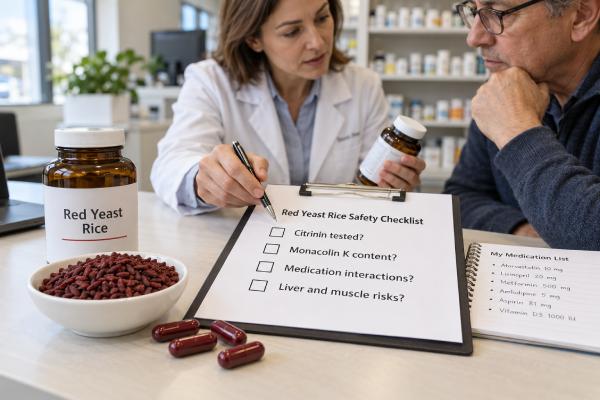
A useful red yeast rice checklist combines product quality with personal medical safety. Use it before the first dose, not after a problem occurs.
1. Know why you are taking it. Confirm that LDL cholesterol is actually elevated and understand your broader cardiovascular risk. If you have known coronary artery disease, previous heart attack or stroke, familial hypercholesterolemia, or very high LDL, a predictable evidence-based medication plan is usually more important than experimenting with an uncertain supplement.
2. Review the active-dose information. Look for disclosed monacolin content when legally available. Do not assume milligrams of red yeast rice equal milligrams of monacolin K.
3. Look for citrinin testing. Prefer a manufacturer that explicitly tests finished product for citrinin and can provide a specification or certificate of analysis.
4. Verify independent quality controls. A credible third-party program is better than a self-created badge. Confirm what the certification actually covers.
5. Check every medication and supplement. Red yeast rice should generally not be combined casually with statins or other products containing red yeast rice. Interactions that increase lovastatin exposure can increase muscle toxicity. A pharmacist can screen a full medication list.
6. Avoid use in high-risk situations. Pregnancy, breastfeeding, active liver disease, a history of serious statin muscle injury, and certain interacting medications are reasons to avoid or obtain specialist guidance. Significant kidney disease is another reason for caution because severe muscle injury and contaminants can both threaten kidney function.
7. Establish a baseline. Know your starting lipid panel. Depending on your health and medication history, a clinician may also want liver tests or other baseline information.
8. Recheck the result. If you use the product, repeat lipids after several weeks rather than assuming it works. A product with too little monacolin may have little effect.
9. Stop for concerning symptoms. Severe muscle pain or weakness, dark urine, jaundice, marked fatigue, or other serious symptoms deserve prompt evaluation.
If muscle symptoms arise, information on statin-type muscle pain and safer next steps is relevant because the active compound in red yeast rice can produce the same class of problem.
When Red Yeast Rice Is the Wrong Tool
Red yeast rice is a poor fit when you need a large, predictable LDL reduction or when the consequences of undertreatment are high.
People with established atherosclerotic cardiovascular disease generally benefit from therapies with proven cardiovascular outcome data, consistent dosing, and well-defined monitoring. Prescription statins have decades of evidence. When statins are not tolerated or are insufficient, nonstatin medicines such as ezetimibe, bempedoic acid, and PCSK9-targeting therapies can be selected based on the needed LDL reduction and overall risk.
Red yeast rice can also be the wrong choice for someone who had a serious adverse reaction to a statin. Because monacolin K is lovastatin, it may reproduce the same pharmacologic exposure that caused the problem. A structured medication strategy is usually safer than switching blindly to a supplement.
For people with modest LDL elevation and lower short-term risk, lifestyle changes may be more predictable and easier to monitor. Increasing soluble fiber, replacing saturated fat with unsaturated fat, eating nuts and legumes, improving weight when needed, and exercising regularly all address cardiovascular health without hidden statin exposure. A targeted plan using foods that lower LDL cholesterol can also be combined with medical therapy when necessary.
The key distinction is not “natural versus prescription.” It is known dose versus unknown dose, tested quality versus uncertain quality, and proven treatment versus hopeful substitution. If a red yeast rice product cannot tell you enough about its active content and contaminant controls, that uncertainty should count against it.
One extra safeguard is to keep the container, lot number, receipt, and any certificate of analysis while you are using the product. If a side effect occurs, those details can help a clinician, pharmacist, manufacturer, or regulator identify the exact batch involved. They also make it easier to compare a replacement bottle with the one that produced the expected LDL response. If a company changes its formula, supplier, serving size, or monacolin disclosure, treat the new bottle as a different product rather than assuming it will behave exactly like the old one.
References
- Approaches to Authenticating Products Containing Red Yeast Rice Extract (Monacolin K) 2026 (Review)
- Quality Control and Safety Assessment of Online-Purchased Food Supplements Containing Red Yeast Rice (RYR) 2024
- Development and validation of an analytical method for determination of citrinin in red rice and red yeast rice-based food supplements by ultra-high performance liquid chromatography tandem mass spectrometry 2024
- The Questionable Quality Profile of Food Supplements: The Case of Red Yeast Rice Marketed Products 2023
- The Impact of Red Yeast Rice Extract Use on the Occurrence of Muscle Symptoms and Liver Dysfunction: An Update from the Adverse Event Reporting Systems and Available Meta-Analyses 2024 (Review)
- Red Yeast Rice: What You Need To Know 2022
Disclaimer
Red yeast rice can expose you to a statin-like drug effect and may also carry supplement-quality risks such as dose variability or contamination. Do not combine it with cholesterol-lowering medicines or use it during pregnancy without medical guidance. Seek prompt care for severe muscle weakness, dark urine, jaundice, or other serious symptoms.