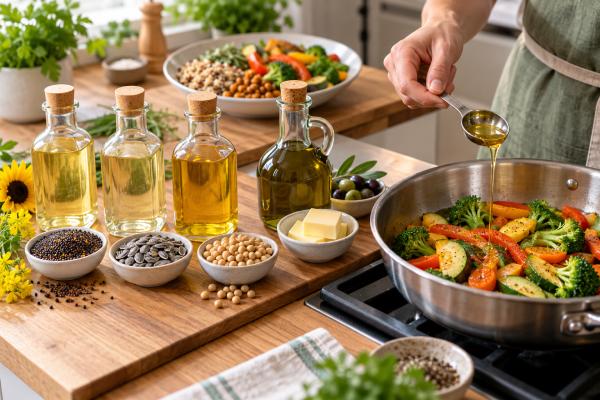
Seed oils are often discussed as if they were one ingredient with one health effect. In reality, canola, soybean, sunflower, safflower, corn, grapeseed, sesame, and other seed-derived oils differ in fatty-acid composition, processing, flavor, and cooking performance. The controversy usually centers on three questions: whether omega-6 linoleic acid promotes inflammation, whether industrial refining creates dangerous compounds, and whether heating these oils makes them harmful. Current human evidence does not support the broad claim that seed oils are inherently toxic, but that does not mean every use of every oil is equally healthful. Repeated high-temperature frying, excessive calorie intake, and diets dominated by ultra-processed foods can create problems regardless of the oil involved. Processing questions also deserve precise answers rather than slogans. This guide separates established evidence from open questions, explains what refining and extraction actually mean, and offers practical ways to choose, store, and cook with oils while keeping the bigger cardiovascular picture in view.
Table of Contents
- What Seed Oils Are and How They Differ
- How Seed Oils Are Made and Refined
- Omega-6 and Inflammation: What Human Evidence Shows
- Oxidation, High Heat, and Reused Frying Oil
- What We Know About Heart and Metabolic Health
- What Is Still Debated or Uncertain
- Practical Choices for Buying and Cooking
What Seed Oils Are and How They Differ
“Seed oil” is a popular umbrella term rather than a single scientific category. It commonly includes canola, soybean, corn, sunflower, safflower, cottonseed, rice bran, grapeseed, and sesame oils. Some lists also include oils that are botanically or commercially categorized differently. The important point is that their chemistry is not identical.
Most liquid seed oils contain more unsaturated fat than saturated fat. Conventional sunflower, safflower, corn, and soybean oils are relatively rich in linoleic acid, an omega-6 polyunsaturated fatty acid. Canola oil contains a larger share of monounsaturated fat and also provides alpha-linolenic acid, a plant omega-3 fatty acid. High-oleic sunflower and safflower oils are bred to contain much more oleic acid, the same major monounsaturated fat found in olive oil. Sesame oil contains a mixture of mono- and polyunsaturated fats plus characteristic antioxidant compounds.
Linoleic acid is essential, meaning the body cannot make enough of it and must obtain it from food. It supports cell membranes and other normal biological functions. The body can convert some linoleic acid into longer-chain omega-6 fats, including arachidonic acid, but that conversion is regulated rather than unlimited.
The cardiovascular significance of an oil depends heavily on what it replaces. Replacing butter, coconut oil, palm oil, or another saturated-fat-rich food with a liquid unsaturated oil can lower LDL cholesterol. Adding large amounts of oil without replacing anything can increase calorie intake. That is why statements such as “seed oils lower cholesterol” or “seed oils make people gain weight” need context.
A useful comparison is the broader question of saturated versus unsaturated fat and heart risk. The evidence is strongest when dietary fats are evaluated as substitutions within an overall eating pattern, not as isolated substances.
How Seed Oils Are Made and Refined
Seed oils can be produced by mechanical pressing, solvent-assisted extraction, or a combination of methods. Refined oils then go through steps designed to remove unwanted materials such as phospholipids, free fatty acids, pigments, odors, and compounds that reduce shelf stability. Depending on the oil and process, those steps can include degumming, neutralization, bleaching, filtration, and deodorization.
Solvent extraction receives particular attention online. Technical hexane may be used to improve oil recovery from crushed seeds. Most of the solvent is separated and recovered during manufacturing, and food-safety authorities set or evaluate limits for residues. The European Food Safety Authority notes that extraction solvents are largely removed during food production but that small technically unavoidable residues can remain. EFSA is also re-evaluating technical hexane using newer information, which is a reminder that safety assessment is an ongoing process rather than a one-time declaration.
It is reasonable to distinguish two questions: whether occupational or high-dose exposure to a solvent can be harmful, and whether trace residues in a regulated finished food create the same risk. Those are not equivalent exposures. Concerns about industrial chemicals should be evaluated using measured residue levels and toxicology, not simply the fact that a chemical appeared somewhere in manufacturing.
Refining can also create or concentrate certain process contaminants under high-temperature conditions. The U.S. Food and Drug Administration monitors compounds such as 3-MCPD esters and glycidyl esters, which can form during high-temperature refining of edible oils. Palm oil has often shown the highest concentrations, but these compounds can occur in other refined oils as well. Manufacturers can reduce them by changing raw materials and processing conditions, and regulators continue to study and monitor exposure.
Cold-pressed or unrefined oils avoid some refining steps and may retain more flavor and minor plant compounds. They are not automatically superior for every use. They can have lower heat tolerance, shorter shelf life, or stronger flavors. Refined oils are often chosen when neutral taste, longer storage, or higher-temperature cooking is important.
The most accurate conclusion is that “processed” is not a health verdict. Processing can remove undesirable substances, improve stability, reduce some nutrients, and create some contaminants. The net effect depends on the specific process and exposure level.
Omega-6 and Inflammation: What Human Evidence Shows
The central biological argument against many seed oils goes like this: linoleic acid is an omega-6 fat; the body can convert it to arachidonic acid; arachidonic acid can be used to make inflammatory signaling molecules; therefore, eating linoleic acid must increase chronic inflammation. The first parts describe real pathways, but the final conclusion oversimplifies human physiology.
Arachidonic acid also contributes to normal cell function and can give rise to signaling molecules with different, sometimes opposing, effects. More importantly, changing dietary linoleic acid does not translate directly into a proportionate rise in tissue arachidonic acid or systemic inflammatory markers. Human clinical studies generally have not found a consistent increase in markers such as C-reactive protein, tumor necrosis factor, or interleukins when linoleic acid intake rises within typical dietary ranges.
A 2025 systematic review of clinical studies in people with diabetes or dyslipidemia examined seed oils and measures of lipids, glucose control, inflammation, and oxidative stress. Results varied by oil and study, but the review did not identify a consistent pattern showing that seed oils worsened inflammation. Another 2025 review examining the broader seed-oil controversy concluded that available human research does not support claims that these oils are a major driver of chronic cardiometabolic disease.
The frequently discussed omega-6-to-omega-3 ratio also needs care. A high ratio may signal low omega-3 intake, but that does not prove that lowering linoleic acid is beneficial. It may be more useful to ensure adequate omega-3 intake from fish, seafood, walnuts, flax, chia, or other sources. For a closer look at long-chain omega-3 fats, see EPA versus DHA for heart health.
This is not an argument for maximizing omega-6 intake. It is an argument against treating an essential fatty acid as inherently inflammatory based only on a simplified pathway diagram.
Oxidation, High Heat, and Reused Frying Oil
Polyunsaturated fats contain multiple double bonds, which makes them more susceptible to oxidation than monounsaturated or saturated fats. Heat, oxygen, light, metal ions, and time can all accelerate that process. Oxidized oils can develop unpleasant flavors and a mixture of breakdown products. The question is not whether oxidation can happen—it can—but how much occurs under normal use and whether the exposure is meaningful for human health.
Repeated deep-frying is the clearest situation for concern. Holding oil at high temperature for long periods and cooling and reheating it over multiple cycles increases thermal degradation. Reviews of repeatedly heated oils describe formation of oxidation products, polymers, and other compounds that may have unfavorable biological effects. Much of the strongest mechanistic evidence comes from laboratory and animal studies, while long-term randomized human outcome trials are limited.
Home sautéing or roasting is a different exposure. A fresh oil used once for a short cooking period is not equivalent to oil that has spent many hours in a fryer. The oil’s fatty-acid profile also matters. High-oleic versions of sunflower or safflower oil are generally more oxidation-resistant than conventional high-linoleic versions. Antioxidants naturally present in an oil can also influence stability.
Smoke point is only one practical signal. Visible smoking means an oil is being pushed hard and can indicate breakdown, but an oil does not suddenly become toxic the instant it reaches a precise temperature. Oxidative stability depends on total time-temperature exposure, reuse, and composition. The safest everyday rule is simple: avoid burning oil and avoid routinely reusing frying oil.
Storage matters too. Keep oils capped and away from heat and direct sunlight. If an oil smells paint-like, stale, bitter, or distinctly rancid, discard it. Buying a smaller bottle may make more sense if you use a particular oil slowly.
What We Know About Heart and Metabolic Health
The strongest heart-health case for seed oils is not that they possess a special protective ingredient. It is that many are rich in unsaturated fats and can replace foods high in saturated fat. This substitution generally lowers LDL cholesterol, a well-established causal factor in atherosclerotic cardiovascular disease.
For someone who cooks daily with butter, ghee, coconut oil, or fatty drippings, switching some of that fat to canola, soybean, sunflower, safflower, or another unsaturated oil can improve the overall fatty-acid profile of the diet. The effect is more meaningful when the oil replaces saturated fat rather than simply adding extra calories.
Clinical evidence varies by individual oil. Studies of canola, flaxseed, sesame, and other seed-derived oils have reported favorable changes in some lipid or glucose measures, although results are not uniform and study quality differs. That variability is another reason not to treat all seed oils as one intervention.
Cardiovascular risk also depends on far more than cooking fat. Blood pressure, smoking, diabetes, physical activity, sleep, body weight, LDL cholesterol, ApoB, kidney health, and genetics may matter more than whether a person uses canola or olive oil for a particular meal. If your LDL is elevated, understanding LDL, HDL, and triglyceride levels provides more actionable information than trying to infer risk from one ingredient.
The food carrying the oil is equally important. Seed oil in a homemade bean-and-vegetable stir-fry comes packaged with fiber, potassium, and minimally processed foods. Seed oil in a large order of fries comes with a different calorie density, food structure, sodium load, and heating history. The oil name alone cannot tell you the cardiovascular quality of the meal.
What Is Still Debated or Uncertain
Some questions are more settled than others. The evidence is fairly consistent that replacing saturated fat with unsaturated fat lowers LDL cholesterol and that typical linoleic acid intake does not reliably raise systemic inflammatory markers. The evidence is less complete for every processing contaminant, every cooking condition, every individual oil, and every long-term health outcome.
One open area is exposure to compounds created during industrial refining. Regulators continue to refine analytical methods, assess contaminants, and set mitigation strategies. The presence of a potentially hazardous compound does not automatically mean the amount in food produces a clinically important risk, but continued surveillance is appropriate.
Another uncertainty is repeated heating in real-world restaurants. Fryer management varies widely. Temperature, oil turnover, food type, filtration, and the number of heating cycles all influence degradation. Human studies rarely capture these details well enough to isolate long-term cardiovascular effects.
Research also has limitations in the opposite direction. Many large nutrition studies are observational, meaning people who eat more of one type of fat may differ in exercise, smoking, income, food choices, or health care. Randomized feeding trials provide stronger control but are usually shorter and focus on biomarkers instead of heart attacks or strokes. Reviews can inherit the weaknesses of the studies they summarize, and some nutrition research has industry funding or author conflicts that deserve attention.
The strongest conclusions therefore come from convergence across methods rather than one paper. When controlled trials, lipid physiology, prospective cohorts, and guideline reviews point in the same direction, confidence rises. When claims depend mostly on mechanistic speculation, animal doses, or isolated studies, confidence should be lower.
The current evidence does not justify a blanket warning that all seed oils are dangerous. It also does not justify ignoring how oils are processed, stored, or repeatedly heated. Both extremes miss the more useful middle ground.
Individual responses can add another layer of uncertainty. People differ in baseline cholesterol, insulin sensitivity, body weight, total calorie intake, and the foods they substitute when changing fats. A person who replaces butter with canola oil may see a meaningful LDL reduction, while someone who adds oil to an unchanged diet may see little lipid benefit and may consume more calories. Likewise, someone who stops eating foods made with seed oils may improve simply because that change removes frequent fried or packaged foods. Personal results therefore do not identify a universal mechanism. When a dietary change is intended to improve cardiovascular risk, objective follow-up—such as body weight, blood pressure, LDL cholesterol, triglycerides, or ApoB when appropriate—can show whether the overall strategy is working better than assumptions about a single ingredient.
Practical Choices for Buying and Cooking
You can make sensible oil choices without memorizing fatty-acid charts. Start with the cooking job and your overall diet.
For everyday sautéing, roasting, baking, and neutral-flavored cooking, canola, soybean, peanut, or high-oleic sunflower oil can work well. For dressings, dips, and many stovetop dishes, extra-virgin olive oil is another strong option. If you prefer conventional sunflower, safflower, or corn oil, normal home use is reasonable; you do not need to avoid them solely because they contain more omega-6 fat.
Use enough oil to prepare satisfying food, but remember that all oils are calorie-dense. Measuring with a spoon for a week can be useful if portions tend to creep upward. If lowering LDL is a priority, focus on replacing butter, coconut oil, palm oil, and high-fat processed meats rather than merely adding “healthy” oil on top of the same diet.
For high-heat cooking, choose an oil intended for that use, avoid prolonged smoking, and do not make a habit of repeatedly cooling and reheating the same frying oil. High-oleic oils can be useful when greater heat stability is desirable. Store bottles away from the stove if that area becomes hot.
Do not judge packaged foods only by whether the label lists soybean, canola, or sunflower oil. Look at the entire product: sodium, added sugar, fiber, calorie density, whole-food ingredients, and portion size. Reducing ultra-processed foods linked with heart risk can improve diet quality without requiring a rigid ban on every food containing seed oil.
If you prefer to avoid solvent-extracted oils, cold-pressed or expeller-pressed products are available. That is a legitimate preference, but it should not be confused with proof that conventional refined oils are unsafe at normal dietary exposures. Likewise, choosing olive oil for flavor and evidence is reasonable without declaring canola or soybean oil toxic.
A heart-supportive diet can include several fat sources: olive oil, canola oil, nuts, seeds, avocado, and fish. What matters most is the pattern they create. A Mediterranean-style diet offers a practical model because it emphasizes minimally processed plant foods and unsaturated fats rather than making one oil the center of the diet.
When comparing bottles, the fatty-acid profile is only one useful detail. Freshness, storage, flavor, price, and how you actually cook matter too. A smaller bottle that you finish while it still smells and tastes fresh may be more practical than a large container kept for a long time near heat and light. Oils naturally differ in stability, and high-oleic versions of sunflower or safflower oil contain more monounsaturated fat than conventional versions. That can make them useful for higher-temperature cooking without changing the broader point that ordinary seed oils can fit into a healthy diet.
Be cautious with claims built around a single laboratory mechanism. An oil can oxidize under extreme conditions, omega-6 fats participate in biochemical pathways, and industrial processing can create trace contaminants; none of those facts alone tells you the net health effect of eating normal amounts in real diets. The relevant question is what happens in human studies at realistic exposures and what food the oil replaces. That is why conclusions from test tubes, isolated oxidation markers, or repeatedly abused fryer oil should not automatically be applied to a tablespoon of fresh oil used to roast vegetables at home. Mechanisms can generate useful hypotheses, but clinical outcomes and validated risk markers carry more weight for everyday decisions.
Seed oils are best viewed as cooking ingredients, not villains or miracle foods. Use fresh oils appropriately, limit repeatedly fried foods, favor unsaturated fats over saturated fats, and spend more attention on the quality of the whole meal than on fear-driven ingredient lists.
References
– Are Seed Oils the Culprit in Cardiometabolic and Chronic Diseases? A Narrative Review 2025 (Review) – Evaluating the effects of seed oils on lipid profile, inflammatory and oxidative markers, and glycemic control of diabetic and dyslipidemic patients: a systematic review of clinical studies 2025 (Systematic review) – Extraction solvents 2025 (Food-safety authority) – 3-Monochloropropane-1,2-diol (MCPD) Esters and Glycidyl Esters 2024 (Food-safety authority) – Impact of Vegetable Oils and the Effect of Repeatedly Heated Vegetable Oils on Cardiovascular Events: A Review. 2026 (Review)
Disclaimer
This article is for general education and does not replace medical or individualized nutrition advice. People with cardiovascular disease, very high cholesterol, diabetes, food allergies, or a medically prescribed diet should discuss major dietary changes with a qualified clinician or registered dietitian. Food-safety guidance and regulatory assessments can change as new evidence becomes available.