
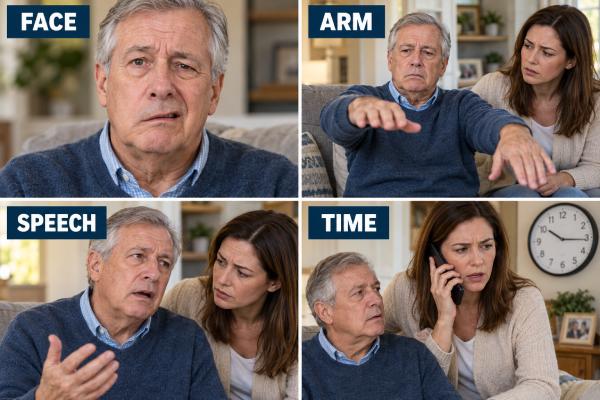
A stroke is a medical emergency caused by blocked blood flow to the brain or bleeding in or around the brain. Symptoms usually begin suddenly, and treatment works best when emergency care starts as quickly as possible. The simplest recognition tool is F.A.S.T.: Face drooping, Arm weakness, Speech difficulty, Time to call 911. You do not need to see all three symptoms before acting. One sudden warning sign is enough to call emergency services.
FAST does not capture every stroke. Sudden loss of balance, new vision problems, severe unexplained headache, numbness, confusion, or trouble walking can also signal a stroke. Symptoms that disappear after a few minutes still require emergency evaluation because they may represent a transient ischemic attack, or TIA. Do not drive yourself, wait for symptoms to improve, take aspirin on your own, or try to diagnose the type of stroke at home. Note when the person was last known well and call for an ambulance immediately.
Table of Contents
- FAST stroke warning signs
- Other stroke symptoms FAST can miss
- What to do immediately if you suspect stroke
- What not to do during a possible stroke
- Why time matters for stroke treatment
- TIA symptoms that go away are still an emergency
- Stroke risk and prevention after the emergency
FAST stroke warning signs
F.A.S.T. is designed to help a bystander recognize several common stroke symptoms quickly. The signs often appear without warning and may affect only one side of the body.
- F — Face drooping: Ask the person to smile. Does one side of the face droop, look uneven, or feel numb?
- A — Arm weakness: Ask the person to raise both arms. Does one arm drift down, feel weak, or become difficult to hold up?
- S — Speech difficulty: Ask the person to repeat a simple sentence. Is the speech slurred, strange, hard to understand, or absent? Does the person seem unable to understand you?
- T — Time to call 911: If any of these signs appears suddenly, call 911 or your local emergency number right away.
Do not wait for all three visible signs. A person can have a stroke with facial weakness but normal arm movement, or with speech trouble and no obvious facial droop. The “T” is an action step, not a reminder to watch the clock before deciding.
FAST works well because face, arm, and speech problems are common in strokes that affect areas controlling movement and language. It is also easy to remember under stress. However, it is a screening tool, not a diagnosis. A normal FAST check does not rule out stroke.
The word sudden is especially important. Someone who has always had mild facial asymmetry or chronic weakness may not be having a new stroke. A new change that appears over seconds or minutes is much more concerning. If you are unsure whether a deficit is new, treat the situation as an emergency rather than trying to prove it is a stroke at home.
A person experiencing a stroke may not recognize what is happening. Stroke can impair judgment, awareness, speech, or the ability to use a phone. Bystanders often make the difference by noticing a new problem and calling for help.
FAST versus BE-FAST
Some health organizations use BE-FAST, which adds B for Balance and E for Eyes before the familiar FAST steps. This can help people remember that sudden severe dizziness, loss of coordination, double vision, or vision loss may occur in strokes that FAST is less likely to detect.
You do not need to choose one acronym over the other in an emergency. Remembering FAST is valuable; remembering balance and vision symptoms makes the screen more complete. Either way, the response is the same: sudden neurologic symptoms require emergency evaluation.
Other stroke symptoms FAST can miss
Stroke can affect different parts of the brain, so symptoms depend on which blood vessel and brain region are involved. A stroke in the back of the brain may cause severe balance or vision problems without obvious face or arm weakness.
Call emergency services for any of these sudden symptoms, especially when they are new or unexplained:
- Numbness or weakness of the face, arm, or leg, particularly on one side
- Confusion or difficulty understanding speech
- Trouble speaking, finding words, or forming coherent sentences
- Loss of vision, blurred vision, or double vision in one or both eyes
- New trouble walking, severe dizziness, loss of balance, or poor coordination
- A sudden severe headache with no known cause
- New difficulty swallowing, marked clumsiness, or unusual drowsiness when combined with other neurologic symptoms
A “thunderclap” headache that reaches extreme intensity very quickly can occur with bleeding around the brain and needs immediate care. Not every severe headache is a stroke, and many strokes cause no headache at all. The key is the abrupt onset and accompanying neurologic change.
Stroke symptoms can be subtle. A person may suddenly drop objects, veer to one side while walking, use the wrong words, ignore one side of space, or seem unusually confused. Vision loss in one eye may be described as a curtain, shade, or dark area. Some people have isolated numbness rather than obvious weakness.
Several conditions can mimic stroke, including seizures, migraine with aura, very low blood sugar, infections, medication effects, and inner-ear disorders. That is not a reason to stay home. Emergency teams can check glucose, perform a neurologic examination, and arrange brain imaging. The safer approach is to assume a sudden neurologic deficit could be stroke until a qualified medical team determines otherwise.
Stroke can happen at any age. Older age increases risk, but young adults, pregnant or postpartum people, and children can also experience stroke. Do not dismiss sudden symptoms because someone seems “too young” or otherwise healthy.
What to do immediately if you suspect stroke
The first job is not to diagnose the stroke. It is to activate emergency care.
1. Call 911 or your local emergency number immediately. Say that you suspect a stroke and describe the symptoms. An ambulance is preferable to driving because emergency medical services can assess the person, alert the receiving hospital, and begin time-sensitive care during transport.
2. Note the time the person was last known well. If you saw the symptoms begin, record that time. If you found the person already symptomatic, identify the last time they were definitely normal. For a person who wakes with symptoms, the last-known-well time may be when they went to sleep without symptoms. This information helps the stroke team decide which treatments and imaging are appropriate.
3. Keep the person safe while help is coming. Have them sit or lie down in a safe position. Keep the area clear. If they are vomiting or very drowsy but breathing normally, position them so secretions can drain and they are less likely to choke. Follow instructions from the emergency dispatcher.
4. Watch breathing and responsiveness. If the person becomes unresponsive and is not breathing normally, follow the dispatcher’s instructions for CPR and use an automated external defibrillator if one is available. Stroke itself is a brain emergency, but cardiac arrest requires immediate resuscitation.
5. Gather useful information without delaying transport. If easy to obtain, have a medication list, allergies, major medical conditions, and emergency contacts ready. Tell EMS if the person takes blood thinners such as warfarin, apixaban, rivaroxaban, dabigatran, or other anticoagulants. That information can affect urgent treatment decisions.
Do not spend time packing, showering, changing clothes, contacting several family members, or searching online to see whether the symptoms “fit.” Emergency activation comes first.
If symptoms resolve while you are waiting, do not cancel the ambulance unless emergency professionals direct you to do so. A temporary episode can still be a TIA or warning stroke and may signal a high risk of a larger stroke soon afterward.
What not to do during a possible stroke
Several well-intended responses can delay treatment or create additional risk.
Do not drive yourself to the hospital
A person with stroke symptoms can worsen suddenly, lose consciousness, become unable to speak, or develop severe weakness. Driving also bypasses the chance for EMS to assess the person, communicate with the hospital, and choose an appropriate destination within the local stroke system.
A family member driving may seem faster, but traffic, parking, and hospital intake can cost time. In most situations, call an ambulance.
Do not wait to see whether symptoms improve
Some strokes fluctuate. A weak arm may partly recover and then worsen again. A TIA may resolve completely. Improvement does not make the event safe to ignore.
Do not “sleep it off,” schedule a routine appointment for the next day, or wait for a second symptom. Sudden neurologic symptoms deserve urgent assessment even when they are mild.
Do not take aspirin on your own
Aspirin can be useful for some ischemic strokes and TIAs after clinicians have evaluated the patient, but it is not safe to assume every stroke is caused by a clot. Some strokes are caused by bleeding from a ruptured blood vessel. Aspirin can worsen bleeding.
Brain imaging, usually a CT scan early in the evaluation, helps distinguish hemorrhage from ischemia. Unless an emergency professional specifically instructs you otherwise, do not self-treat a suspected stroke with aspirin or another blood-thinning medicine.
Do not give food, drink, or pills by mouth
Stroke can impair swallowing without the person realizing it. Food, water, or medication can enter the airway and lungs. Wait until the medical team determines that swallowing is safe.
Do not try to lower blood pressure rapidly at home
Blood pressure is often high during an acute stroke. The correct target depends on the stroke type, planned treatment, and other factors. Taking extra blood-pressure medication without instructions can reduce blood flow too much in some situations. Let the stroke team manage it.
If the person has a seizure, protect them from injury, do not restrain them, and do not put anything in their mouth. Tell EMS what you observed and how long the seizure lasted.
Why time matters for stroke treatment
Stroke damages brain tissue because cells lose normal blood flow or are injured by bleeding and pressure. The faster a stroke team identifies the cause, the sooner it can consider treatments that restore circulation, control bleeding, or prevent complications.
The two major categories are:
- Ischemic stroke: A clot or severe blockage interrupts blood flow to part of the brain. This is the most common type.
- Hemorrhagic stroke: A blood vessel ruptures and blood collects in or around the brain.
The symptoms can look similar, which is why treatment cannot be chosen safely from symptoms alone.
For eligible people with acute ischemic stroke, intravenous clot-dissolving treatment can be used within a time-limited window. Current guidelines support intravenous thrombolysis for selected patients within 4.5 hours of symptom onset or last known well, and advanced imaging can identify some patients who may benefit outside the traditional window. Treatment eligibility depends on imaging, timing, severity, bleeding risk, and other clinical factors.
Mechanical thrombectomy is a procedure that removes a clot from a blocked large brain artery. It can dramatically improve outcomes in properly selected patients. Some patients benefit when it is performed within the first several hours, while selected people with large-vessel occlusion may remain eligible up to 24 hours after they were last known well. The 2026 acute ischemic stroke guideline broadened eligibility for thrombectomy in several groups, including some patients with larger areas of early brain injury and certain basilar artery blockages.
These windows are not reasons to delay. They are maximum treatment ranges for selected patients, not safe waiting periods. Earlier treatment generally preserves more brain and leaves more options open.
A person who wakes up with stroke symptoms should still call 911 immediately. Modern imaging can sometimes estimate whether brain tissue is still salvageable even when the exact onset time is unknown.
At the hospital, evaluation commonly includes a neurologic examination, blood glucose testing, brain imaging, blood tests, and assessment of the heart and blood vessels. CT can rapidly identify bleeding. CT angiography, perfusion imaging, or MRI may be added depending on the situation and available resources.
TIA symptoms that go away are still an emergency
A transient ischemic attack causes temporary neurologic symptoms from interrupted blood flow without the lasting brain injury that defines an ischemic stroke. The symptoms can be identical to stroke: face drooping, one-sided weakness or numbness, speech trouble, vision loss, dizziness, or balance problems.
The dangerous feature is that the symptoms improve. People often decide they are fine and delay care. That can miss a critical opportunity to identify the cause and prevent a larger stroke.
The American Heart Association’s 2023 scientific statement on TIA notes that the 90-day stroke risk after TIA can be as high as 17.8%, with almost half of those subsequent strokes occurring within two days. That is why a TIA is better thought of as a warning stroke, not a harmless “mini-stroke.”
You cannot reliably tell at home whether a temporary episode was a TIA, a completed stroke with improving symptoms, or a mimic. Even clinicians often need brain and blood-vessel imaging, an ECG, laboratory tests, and a detailed history to sort out the cause.
Call emergency services for a first episode of sudden stroke-like symptoms even if the person is back to normal. Emergency assessment may look for narrowed neck or brain arteries, atrial fibrillation, a recent small infarct, or other causes that need rapid treatment.
Atrial fibrillation deserves particular attention because it can allow blood clots to form in the heart and travel to the brain. Some people know they have it; others are diagnosed only after a TIA or stroke. If you have episodes of an irregular heartbeat, fatigue, or dizziness, learning the warning signs of atrial fibrillation can help you discuss appropriate evaluation with your healthcare team. That is prevention guidance, not a substitute for emergency action during stroke symptoms.
Stroke risk and prevention after the emergency
Once an emergency has been evaluated and treated, prevention focuses on the cause of the event and the person’s overall vascular risk. The plan after an ischemic stroke or TIA can differ substantially from the plan after a brain hemorrhage, so treatment must be individualized.
High blood pressure is one of the most important modifiable stroke risk factors. Long-term control lowers the risk of both ischemic and hemorrhagic stroke. Diabetes, smoking, high cholesterol, physical inactivity, obesity, sleep apnea, atrial fibrillation, and certain artery diseases can also increase risk.
After a stroke or TIA, clinicians may recommend some combination of:
- Blood-pressure treatment and home monitoring
- Cholesterol-lowering medication when indicated
- Antiplatelet medication for appropriate non-cardioembolic ischemic events
- Anticoagulation for many patients with atrial fibrillation when the benefits outweigh bleeding risk
- Diabetes management
- Smoking cessation
- Regular physical activity and rehabilitation appropriate to ability
- A heart-healthy dietary pattern, often emphasizing vegetables, fruits, whole grains, legumes, nuts, fish, and unsaturated fats
- Treatment of sleep apnea or other contributing conditions
Do not start, stop, or change aspirin, anticoagulants, or blood-pressure medicine based only on general stroke-prevention advice. The right drug and timing depend on whether the event was caused by a clot or bleeding, the source of the clot, imaging findings, kidney function, age, and other risks.
If blood pressure is part of your prevention plan, use a validated upper-arm cuff and a consistent schedule rather than reacting to isolated readings. Tracking your heart numbers can help you organize blood pressure, cholesterol, and glucose results for follow-up visits.
Prevention matters, but recognition remains essential. Even people who take medication perfectly can have another stroke. Keep FAST visible to family members, know where your medication list is, and make sure people close to you know to call emergency services rather than driving you or waiting for symptoms to pass.
The most important rule is simple: new, sudden neurologic symptoms are an emergency. Face drooping, arm weakness, or speech difficulty should trigger FAST action, while sudden balance, vision, numbness, confusion, walking difficulty, or severe unexplained headache deserve the same urgency. Call 911 or your local emergency number, note the last-known-well time, and let the stroke team determine what happened.
References
- 2026 Guideline for the Early Management of Patients With Acute Ischemic Stroke: A Guideline From the American Heart Association/American Stroke Association 2026 (Clinical Practice Guideline)
- Signs and Symptoms of Stroke 2026 (Official Public Health Guidance)
- 2026 Heart Disease and Stroke Statistics: A Report of US and Global Data From the American Heart Association 2026 (Statistical Update)
- 2024 Guideline for the Primary Prevention of Stroke: A Guideline From the American Heart Association/American Stroke Association 2024 (Clinical Practice Guideline)
- Diagnosis, Workup, Risk Reduction of Transient Ischemic Attack in the Emergency Department Setting: A Scientific Statement From the American Heart Association 2023 (Scientific Statement)
- Aspirin and Dual Antiplatelet Therapy 2025 (Official Guidance)
Disclaimer
This article is for general education and cannot diagnose a stroke or replace emergency medical care. If you or someone else develops sudden face drooping, weakness or numbness, speech trouble, vision loss, severe dizziness, loss of balance, confusion, or a severe unexplained headache, call 911 or your local emergency number immediately, even if symptoms improve. Do not take aspirin or change prescribed medication for a suspected stroke unless an emergency professional or treating clinician directs you to do so.





