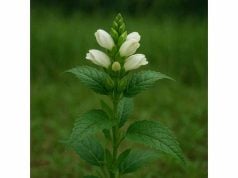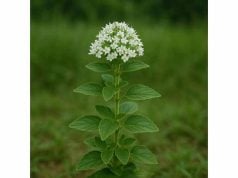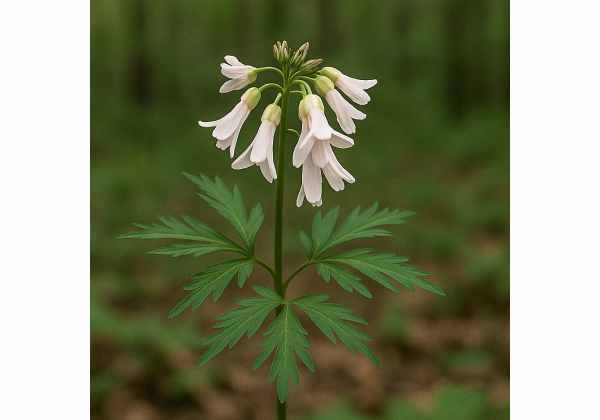
Toothwort, Cardamine concatenata, is a native North American spring ephemeral better known to botanists and foragers than to modern herbal shoppers. It rises early, flowers briefly, then disappears below ground, leaving behind a segmented rhizome with a peppery, radish-like bite. That sharp flavor hints at the plant’s chemistry. As a member of the mustard family, toothwort likely owes much of its traditional value to glucosinolate-related compounds and other pungent phytochemicals common to the group. Historically, Indigenous and folk uses included food, warming spring tonics, and remedies for colds, headaches, stomach discomfort, and other minor complaints.
What makes toothwort interesting today is not a strong body of clinical research, because that does not yet exist. Instead, its appeal comes from a combination of traditional use, edible history, and growing scientific interest in the broader Cardamine genus. That means toothwort deserves a careful, evidence-aware discussion. It may have genuine medicinal promise, but it is better treated as a lightly used traditional plant with plausible benefits than as a proven modern remedy.
Brief Summary
- Toothwort is a pungent mustard-family plant with traditional use for minor digestive discomfort and seasonal cold-related complaints.
- Its most plausible benefits relate to antioxidant, antimicrobial, and mild stimulating effects linked to glucosinolate-rich mustard-family chemistry.
- If used as food, keep it to small condiment-style amounts, such as about 1 to 2 teaspoons of finely chopped fresh rhizome.
- Pregnant or breastfeeding people, children, and anyone with strong mustard-family sensitivity should avoid medicinal-style use.
Table of Contents
- What toothwort is and why it matters
- Key ingredients and medicinal profile of Cardamine concatenata
- Toothwort health benefits and what the evidence really shows
- Traditional and modern uses of toothwort
- Forms dosage and how Cardamine concatenata is usually prepared
- How to choose toothwort and avoid common mistakes
- Safety side effects interactions and who should avoid toothwort
What toothwort is and why it matters
Toothwort, also called cutleaf toothwort or pepper root, is a woodland perennial native to eastern North America. Botanically, it belongs to the Brassicaceae, the mustard family, and older sources may list it under the former name Dentaria laciniata. Today, the accepted name is Cardamine concatenata. That taxonomic detail matters because older ethnobotanical and foraging references may use either name, and readers can easily miss useful information if they assume they are different plants.
The plant’s common name comes from its rhizome, which is segmented like a string of teeth. That rhizome is also one of the most distinctive parts from a culinary and medicinal perspective. It has a pungent, peppery, radish-like taste that immediately suggests mustard-family chemistry. The leaves and rhizome have both been eaten, and the rhizome especially has been valued in small amounts as a spicy seasonal food. In that sense, toothwort belongs in the same broad flavor family as peppery mustard-family greens such as watercress, even though it is far less common in cultivation and commerce.
Its life cycle also shapes how it should be understood. Toothwort is a spring ephemeral. It appears briefly in rich deciduous forests, flowers before the canopy closes, and then goes dormant. Because of that short window, it has never become a mainstream commercial herb. It is better known in field botany, native plant gardening, and traditional seasonal foraging than in standardized supplement markets.
Ethnobotanical records make the plant more than a botanical curiosity. Indigenous food and medicine use, especially references to the Iroquois use of the roots for food and remedies for colds, headaches, stomach pains, and even heart-related complaints, show that toothwort was part of practical local knowledge rather than an ornamental afterthought. That does not prove medical effectiveness by modern standards, but it does justify taking the plant seriously.
At the same time, toothwort is easy to romanticize. Because it is native, brief, and flavorful, people may assume it is either a hidden super-herb or a harmless wild snack. Neither assumption is strong enough. The better view is that Cardamine concatenata is an edible and traditionally medicinal woodland mustard with plausible bioactive chemistry, but with very limited direct human evidence. It matters not because it is fully understood, but because it sits at the interesting edge between folk medicine, spring nutrition, and underexplored phytochemistry.
Key ingredients and medicinal profile of Cardamine concatenata
The medicinal profile of toothwort is best understood through the chemistry of the broader Cardamine genus and the better-studied chemistry of related toothworts. Direct phytochemical work on Cardamine concatenata itself is limited, but the available evidence strongly suggests that its pungency and many of its traditional uses are tied to mustard-family defense compounds, especially glucosinolates and their breakdown products.
Glucosinolates are sulfur-rich compounds widely found in Brassicaceae plants. When plant tissue is chewed, crushed, or grated, these compounds can break down into more reactive molecules such as isothiocyanates and related substances. These are the same kinds of compounds that help explain the sharp bite of mustard, watercress, and horseradish. That is why toothwort’s rhizome tastes so peppery. It also helps explain why the plant was historically used in small, stimulating quantities rather than as a bland bulk herb.
Review work on the Cardamineae tribe, which includes Cardamine concatenata, shows that glucosinolate diversity in this group is substantial. In plain terms, toothwort belongs to a chemically sophisticated lineage. That does not automatically tell us which compound is doing what in Cardamine concatenata, but it supports the idea that the plant is pharmacologically meaningful rather than inert.
Broader Cardamine reviews also describe several recurring classes of compounds and activities:
- glucosinolates and their degradation products
- phenolic compounds
- flavonoids
- enzyme-inhibitory constituents
- antimicrobial and antioxidant activity in several species
Related toothwort research, especially on Cardamine diphylla, also points to aliphatic and indole glucosinolates and some indole alkaloids. Since C. diphylla and C. concatenata are allied North American toothworts, this is relevant context even though the species are not interchangeable.
From a practical standpoint, the medicinal profile of toothwort appears to be:
- pungent and stimulating rather than soothing
- more plausible for minor digestive and seasonal uses than for chronic disease
- chemically aligned with mustard-family antimicrobial and antioxidant themes
- likely strongest when used fresh, because glucosinolate breakdown products are often tied to tissue disruption and volatile activity
This is also why toothwort should not be described like a vitamin-rich salad green alone. Its most distinctive value is not simple nutrition, but pungent phytochemistry. If readers want a familiar comparison, it is closer in spirit to other sharp Brassicaceae condiments such as Japanese horseradish than to a mild woodland leaf. That comparison is helpful because it frames toothwort as a small-dose, high-character plant.
The limitation is obvious but important: chemistry alone does not prove clinical benefit. Toothwort’s ingredients make several traditional uses plausible, especially for warming, stimulating, and mildly antimicrobial purposes, but the step from “contains active compounds” to “works reliably in people” has not been fully taken.
Toothwort health benefits and what the evidence really shows
The health benefits most often discussed for toothwort fall into two categories: direct traditional uses of Cardamine concatenata and broader findings from related Cardamine species. These are not the same level of evidence. The first shows historical human use. The second shows laboratory and preclinical potential. Neither gives us robust modern clinical proof for Cardamine concatenata itself.
The most realistic potential benefit is mild digestive stimulation. This is the kind of effect many pungent mustard-family plants provide. Small amounts of sharp, peppery rhizome can increase salivation, wake up the palate, and make sluggish spring eating feel lighter and more active. Traditional use for stomach discomfort fits that pattern. Yet this should be understood as modest digestive support, not as treatment for serious gastrointestinal disease.
Seasonal respiratory support is another traditional theme. Indigenous and folk uses mention colds and sore-throat-type complaints, which again make sense for a pungent Brassicaceae plant. Mustard-family chemistry is often linked with warming, stimulating, and antimicrobial actions. The catch is that these are plausibility-based benefits. Toothwort has not been tested in modern human trials for upper respiratory infections.
Antioxidant and antimicrobial potential are stronger from a research perspective, but mostly at the genus level. Reviews of Cardamine species describe antibacterial, antifungal, antiviral, antioxidant, and enzyme-inhibitory activity. Some species have shown anti-inflammatory and metabolically relevant effects in animal or cell models. These findings make it reasonable to describe toothwort as a plant with medicinal potential, but not as a proven medicinal solution.
The evidence becomes even thinner when people push toothwort toward larger claims. There is no good reason to present Cardamine concatenata as a validated herb for cardiovascular disease, chronic inflammatory disorders, or immune dysfunction. Historical mention of heart complaints is interesting, but it is not enough to support a modern cardiology claim. The same goes for strong anti-cancer or liver-protective language. Those ideas may be inspired by glucosinolate research across Brassicaceae, but they are not established outcomes for toothwort.
A balanced summary looks like this:
- plausible mild digestive and warming action
- traditional use for colds, headaches, and stomach pains
- likely mustard-family antimicrobial and antioxidant activity
- possible broader phytochemical promise based on related Cardamine species
- no clinical proof for major disease treatment
That kind of restraint is not a weakness. It is the difference between useful herbal writing and wishful projection. Toothwort may well deserve more scientific attention, especially as an underexplored native mustard. But readers are better served by hearing that its best-supported role is still small-scale and traditional.
If someone is mainly looking for a more established bitter herb for sluggish digestion or spring heaviness, a better-known option such as dandelion for digestive and liver support may offer a clearer evidence tradition. Toothwort remains more of a niche native plant with plausible benefits than a settled therapeutic herb.
Traditional and modern uses of toothwort
Toothwort’s most credible uses are the modest ones. It has a history as both a food and a folk remedy, and those two roles overlap. The rhizome’s spicy bite made it useful as a spring condiment, while the same pungency likely helped shape its reputation for colds, stomach sluggishness, and other minor complaints. In practical terms, toothwort was not a luxury herb. It was a seasonal native plant that could flavor food and serve as a simple remedy when stronger or more imported plants were not available.
Ethnobotanical references note that the roots were eaten raw or boiled. This is not trivial. Edible use implies at least some level of familiarity and tolerance in normal food-like amounts. It also suggests that toothwort’s strongest real-world use may have been culinary-medicinal rather than strongly pharmaceutical. Many traditional plants work this way. They are neither just food nor just medicine. They live in the middle.
Historically associated uses include:
- spring food and seasoning
- support during colds
- relief for headaches
- use for stomach pains
- occasional use in broader folk remedy traditions
Modern use is much narrower. Toothwort is not widely sold as a commercial supplement, and that may be a good thing. Because the evidence is thin, large-scale marketing would likely exaggerate what is actually known. Today, the plant is more likely to appear in native plant discussions, foraging notes, or regional herbal curiosity than in formal herbal protocols.
That does not mean it has no place in modern herbal practice. It may still be meaningful in a few limited ways:
- as a tiny-amount culinary herb with a horseradish-like edge
- as part of historical ethnobotanical education
- as an example of native Brassicaceae plants with underexplored medicinal chemistry
- as a cautious seasonal plant for experienced foragers who understand identification and limits
The best use case is often not “How much toothwort supplement should I take?” but “How can a small amount of this plant be used intelligently and respectfully?” For some people, that means tasting the rhizome once in spring, learning the plant, and appreciating its role in woodland ecology rather than building a health routine around it.
Modern overreach usually starts when people try to convert a subtle native plant into a major remedy. Toothwort does not have the evidence to justify that. It is more honest to say that it can add peppery character to food, may have mild stimulating and traditional medicinal value, and belongs in the broader family of underused spring plants.
For readers drawn to traditional herbs for minor external or tissue-calming uses, it is also worth recognizing that toothwort is not the best-known or best-documented option in that realm. More established topical herbs such as calendula for traditional skin support have a clearer modern role. Toothwort’s strengths remain more culinary, seasonal, and ethnobotanical than universally therapeutic.
Forms dosage and how Cardamine concatenata is usually prepared
There is no clinically validated medicinal dosage for Cardamine concatenata. That is the most important fact in this section. Any dosage guidance must therefore be framed as cautious culinary or traditional use rather than evidence-based therapeutic instruction. For a niche plant like toothwort, honesty about this gap is more valuable than invented precision.
The safest and most historically grounded form is fresh plant use in very small amounts. The rhizome is the part most often described as edible and peppery, while the leaves may also be sampled when young. The goal is not bulk consumption. It is flavor and light stimulation.
A cautious food-style range is:
- about 1 to 2 teaspoons of finely chopped fresh rhizome
- or a small handful of young leaves mixed into other greens rather than eaten alone
These are practical culinary amounts, not proven medicinal doses. They fit the plant’s flavor intensity and traditional use better than any capsule-style mindset.
If prepared as a simple folk tea or infusion, caution should increase rather than decrease. Because there is no standardized or well-studied internal herbal dose, it is wiser to think in terms of weak, occasional preparations rather than strong decoctions. In other words, toothwort is better treated like a pungent spring herb than like a daily tonic.
A reasonable use pattern would be:
- Identify the plant correctly.
- Use only a very small amount the first time.
- Prefer food-style use over concentrated extract use.
- Avoid repeated daily use for long periods.
- Stop promptly if irritation or digestive upset appears.
Toothwort is also highly seasonal. If someone is using fresh material, timing matters. The plant is above ground briefly in spring, and the short season means the herb has never developed the same stable commercial preparation culture as larger medicinal plants. That is another reason dosage remains uncertain.
Some readers may wonder whether drying changes the plant significantly. In mustard-family herbs, freshness often matters because pungent compounds are tied to enzymatic breakdown after crushing or cutting. A dried preparation may not behave the same way as a freshly chopped rhizome. That does not make dried toothwort useless, but it does mean direct comparison is unreliable.
The best dosage advice, then, is conservative and plain: toothwort is most appropriately used in small culinary-style amounts, not in aggressive medicinal doses. Readers who mainly want a cultivated peppery herb with a clearer preparation culture may find garden cress as a safer and more accessible mustard-family option easier to work with regularly.
How to choose toothwort and avoid common mistakes
Choosing toothwort is not like choosing a common supplement. In many cases, the real question is whether it should be chosen at all for regular medicinal use. Because the plant is native, seasonal, and not well standardized, most mistakes happen before anyone even takes it.
The first mistake is misidentification. Toothwort grows among other spring ephemerals, and older references may use the name Dentaria laciniata while newer ones use Cardamine concatenata. A reliable identification process matters more here than it does for a bottled herb with heavy labeling. Anyone foraging it should know the plant’s segmented rhizome, whorled leaves, white to pale pink flowers, and woodland habitat.
The second mistake is overharvesting. Toothwort is a spring ephemeral and part of a delicate forest-floor community. It also serves ecological roles, including support for specialist insects. Digging rhizomes thoughtlessly for kitchen experiments can damage local populations quickly. This is especially problematic because the plant is not a high-yield crop and is easy to overlook later in the season.
A few practical rules help:
- never harvest from polluted or roadside sites
- avoid taking plants from small colonies
- do not assume abundance because the plant is briefly numerous in spring
- learn whether local regulations or conservation concerns apply
- prefer observation and tiny use over bulk collection
The third mistake is turning genus-level or family-level evidence into species-level certainty. Because toothwort belongs to Brassicaceae and the broader Cardamine genus has interesting medicinal chemistry, it is tempting to pile big claims onto Cardamine concatenata. That is not good practice. A review on one Cardamine species or a glucosinolate paper mentioning C. concatenata does not establish a complete medical profile for cutleaf toothwort.
The fourth mistake is confusing food use with medicinal safety. Edibility in small amounts does not prove that frequent or concentrated dosing is safe. A plant can be both edible and irritating when overused. Mustard-family pungent plants are classic examples.
Commercial product choice is also tricky. Because toothwort is not a common standardized herb, products may be vague or absent. If a seller does offer it, the label should clearly state Cardamine concatenata and, ideally, note the plant part used. Anything marketed with sweeping claims but little botanical detail should be avoided.
In many cases, the best choice is not a product at all. It is learning the plant, respecting its limits, and deciding whether your actual goal could be met by a more established herb or cultivated edible. Toothwort is most rewarding when approached with ecological respect and medicinal restraint rather than consumer urgency.
Safety side effects interactions and who should avoid toothwort
Toothwort probably has a relatively low risk profile in small food-like amounts for healthy adults, but “probably” is doing important work in that sentence. There is not enough direct safety research on Cardamine concatenata to speak with pharmaceutical confidence. That means its risk is best described as limited-data rather than fully established.
The most likely side effects come from pungency and mustard-family chemistry:
- mouth or throat irritation if used too aggressively
- stomach upset
- cramping
- loose stools
- worsened reflux or gastritis symptoms in sensitive people
These are not dramatic toxic effects, but they matter because toothwort is sharp rather than bland. A plant that tastes like peppery radish should not be treated like lettuce.
People who should avoid medicinal-style use include:
- pregnant or breastfeeding people
- children
- anyone with a strong sensitivity to mustard-family plants
- people with active stomach ulcers, severe reflux, or significant bowel irritation
- those using the herb instead of proper care for chest, digestive, or cardiovascular symptoms
Pregnancy and breastfeeding deserve special caution simply because the evidence is too thin. Edible history in small cultural amounts is not the same as confirmed medicinal safety in pregnancy. The same reasoning applies to children.
Brassicaceae sensitivity is another practical concern. People who react strongly to mustard, horseradish, or similar pungent plants may not tolerate toothwort well either. Even without a true allergy, some people experience significant digestive or mucosal irritation from sharp sulfur-rich plants.
Interaction data are also sparse. There is no well-defined list of drug interactions for Cardamine concatenata, but that should not be mistaken for proof that none exist. Sparse data create uncertainty. A cautious person using multiple medications, especially for gastrointestinal, inflammatory, or cardiovascular conditions, should not experiment freely with an under-studied native herb.
The biggest safety issue may actually be substitution. Toothwort has traditional uses for colds, headaches, and stomach pains. Those are common complaints, but they can also be signs of conditions that need attention. Persistent headaches, recurrent stomach pain, chest discomfort, or ongoing respiratory symptoms should not be self-treated with a woodland rhizome simply because ethnobotanical records mention it.
So where does that leave toothwort? In sensible terms, it is best reserved for occasional small culinary use or very cautious traditional-style exploration by knowledgeable adults. It is not a first-choice medicinal herb, and it is not a plant to use boldly. Respecting its flavor, its ecology, and the limits of its evidence is the safest path.
References
- Comparison of glucosinolate diversity in the crucifer tribe Cardamineae and the remaining order Brassicales highlights repetitive evolutionary loss and gain of biosynthetic steps 2021 (Review)
- Evaluation of the anti-inflammatory, antioxidant, and cytotoxic potential of Cardamine amara L. (Brassicaceae): A comprehensive biochemical, toxicological, and in silico computational study 2023 (Research Article)
- Integrative metabolomic and network pharmacological analysis reveals potential mechanisms of Cardamine circaeoides Hook.f. & Thomson in alleviating potassium oxonate-induced asymptomatic hyperuricemia in rats 2023 (Research Article)
- Phytochemical Analysis, Antioxidant, Enzyme Inhibitory, and Cytotoxicity Properties of Cardamine raphanifolia subsp. acris 2025 (Research Article)
- Review on Cardamine diphylla (Michx.) A. wood (Brassicaceae): ethnobotany and glucosinolate chemistry 2013 (Review)
Disclaimer
This article is for educational purposes only and is not medical advice. Toothwort is an under-researched native plant, and its traditional uses are better documented than its clinical safety or effectiveness. It should not be used to diagnose, treat, or replace care for persistent headaches, stomach pain, chest symptoms, infection, or any other significant health concern. Speak with a qualified healthcare professional before using toothwort medicinally, especially if you are pregnant, breastfeeding, taking medication, or managing a chronic condition.
If this article was useful, please share it on Facebook, X, or another platform you prefer.