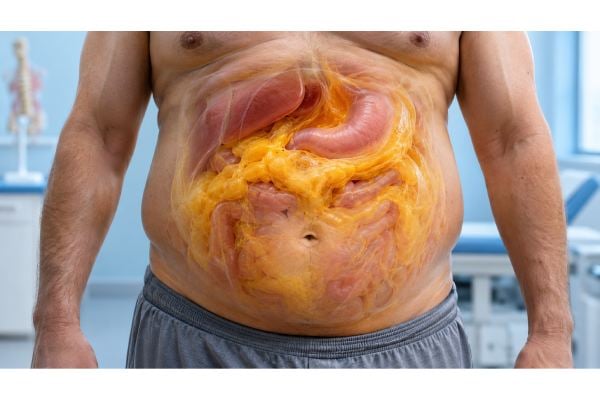
Visceral fat is the tissue stored deep within the abdomen, wrapping around vital organs like the liver and intestines. Unlike the softer subcutaneous fat you can pinch under your skin, visceral fat is biologically aggressive. It releases fatty acids and inflammatory signals into circulation, floods the liver with lipids, and drives up fasting glucose, triglycerides, and the risk of type 2 diabetes.
You cannot spot-reduce belly fat with ab exercises. However, visceral fat is highly responsive to overall weight loss and regular physical activity. A sustained calorie deficit, combined with aerobic exercise, resistance training, adequate protein, quality sleep, and reduced alcohol intake, creates the metabolic environment necessary for this tissue to shrink. While waist measurements are a practical proxy for tracking central fat rather than a direct diagnostic tool, the encouraging reality is that metabolic improvements often begin long before significant weight loss occurs. Even modest reductions in abdominal and liver fat can enhance insulin sensitivity and stabilize blood sugar, offering tangible health benefits even when body weight remains above conventional “healthy” ranges.
Table of Contents
- What Visceral Fat Is
- Why Visceral Fat Affects Blood Sugar
- How to Estimate Visceral Fat
- How to Reduce Visceral Fat
- Best Exercise for Visceral Fat
- Food, Sleep, and Alcohol
- What Improves First?
What Visceral Fat Is
Body fat is not a single, uniform tissue. Subcutaneous fat sits just beneath the skin, comprising the majority of the pinchable tissue at the abdomen, hips, thighs, and arms. In contrast, visceral adipose tissue resides deeper within the abdominal cavity, nestled around internal organs. While both types store energy, they differ fundamentally in their biological activity and their relationship to disease.
Visceral fat is metabolically hyperactive. It exhibits a high rate of lipid turnover and maintains a direct physiological connection with the liver via the portal circulation. This anatomical proximity is critical: fatty acids and signaling molecules released from visceral deposits reach the liver directly, bypassing much of the systemic dilution that affects subcutaneous releases.
This biological difference explains why two individuals with identical Body Mass Indices (BMI) can have vastly different health profiles. One person with a BMI of 27 might carry excess mass primarily around the waist, while another stores it in the hips and thighs. The former pattern carries significantly higher cardiometabolic risk. Consequently, BMI often misses critical nuances in fat distribution. It remains a useful broad screening tool, but it fails to distinguish between muscle mass and visceral adiposity. Waist-based measures provide the missing context regarding central fat accumulation.
Visceral fat also correlates with ectopic fat—lipid stored in organs or tissues not designed for large reserves, such as the pancreas, liver, and skeletal muscle. These are distinct from visceral fat but often surge together in the same metabolic environment. When subcutaneous storage capacity becomes saturated, excess lipids spill into these organs, directly interfering with insulin signaling and exacerbating metabolic dysfunction.
Why Visceral Fat Affects Blood Sugar
Visceral fat disrupts blood sugar regulation through several overlapping mechanisms, with insulin resistance serving as the primary driver. In this state, cells fail to respond effectively to insulin, forcing the pancreas to produce higher quantities of the hormone just to maintain normal glucose levels.
The process begins in the fat tissue itself. Normally, insulin suppresses lipolysis, the breakdown of stored fat into free fatty acids. When fat tissue becomes insulin resistant, this brake fails, flooding the bloodstream with excess fatty acids. The liver absorbs these lipids, using them to synthesize triglycerides, store hepatic fat, or package them into Very Low-Density Lipoprotein (VLDL) particles for transport.
Liver-specific insulin resistance is particularly damaging to fasting glucose levels. Under healthy conditions, insulin signals the liver to halt glucose production after meals and overnight. When this signal weakens due to visceral fat infiltration, the liver continues to release glucose unchecked. As a result, fasting blood sugar can rise significantly, even after hours without food.
Furthermore, visceral adipose tissue acts as an active endocrine organ, producing signaling molecules known as adipokines and inflammatory mediators. In a healthy state, these signals maintain metabolic balance. However, as adipocytes enlarge and the tissue becomes stressed, this balance tips toward chronic low-grade inflammation. Altered levels of adiponectin and increased immune-cell activity further disrupt insulin pathways, creating a vicious cycle of metabolic dysfunction.
This interplay results in a characteristic metabolic cluster that often includes:
- Higher fasting glucose and insulin levels
- Larger post-meal glucose excursions
- Elevated triglycerides
- Lower HDL cholesterol
- Fatty liver disease
- Increased blood pressure
- Heightened risk of type 2 diabetes and cardiovascular disease
This pattern overlaps extensively with insulin resistance. While genetics, sleep quality, medication use, muscle mass, and physical activity all play roles, visceral fat is a major modifiable contributor. Large observational studies and recent meta-analyses consistently link higher visceral adiposity to increased type 2 diabetes risk. Notably, new long-term follow-up data suggest that reductions in visceral fat achieved through lifestyle interventions may predict future metabolic benefits, even if some body weight is regained later.
How to Estimate Visceral Fat
The gold standard for measuring visceral fat involves imaging technologies like CT and MRI. These tools can directly visualize abdominal compartments and quantify visceral adipose tissue with precision. While invaluable in research and specific clinical scenarios, they are impractical for routine home monitoring. CT scans also involve ionizing radiation, making them unsuitable for repeated lifestyle tracking.
DEXA scans offer a middle ground by estimating regional fat distribution, though they do not measure visceral fat as directly as MRI or CT. Some newer DEXA systems provide visceral-fat estimates, but bioelectrical-impedance scales—common in consumer body-composition devices—rely on algorithms rather than direct tissue measurement. Their accuracy can fluctuate based on hydration levels and device assumptions.
For home tracking, waist circumference remains the simplest and most useful metric. To ensure repeatability, stand relaxed and locate the midpoint between the bottom of your last rib and the top of your hip bone. Wrap a flexible tape around this point and measure after a normal exhale, ensuring the tape is snug but not compressing the skin. Do not suck in your abdomen. Consistency is key: use the same tape, location, and time of day for each measurement.
A change of several centimeters over months provides a meaningful trend, whereas tiny day-to-day fluctuations often reflect bloating or minor technique variations rather than actual fat loss. An increasing waist typically signals growing abdominal fat, while a decreasing waist during weight loss usually indicates central fat reduction.
The waist-to-height ratio adds contextual depth to these measurements. A ratio below 0.5 is widely considered a practical target for healthy central adiposity in adults, essentially meaning your waist circumference should be less than half your height. The article on waist-to-height ratio and metabolic risk details when this measure offers insights beyond BMI.
No tape measurement can precisely quantify kilograms of visceral fat. Treat waist measurements as trend markers, not diagnostic scans. A robust tracking set might include:
- Body weight once or several times per week, using a consistent method
- Waist circumference every two to four weeks
- Fasting glucose or A1C if medically relevant
- Triglycerides and liver enzymes when ordered by a clinician
- Fitness markers such as walking pace or exercise duration
If your scale weight stagnates but your waist shrinks and fitness improves, your plan is likely working. Resistance training can preserve or increase lean mass while fat decreases, making scale numbers less dramatic than the actual metabolic progress.
How to Reduce Visceral Fat
The most reliable method for reducing visceral fat is creating a sustained energy deficit while preserving muscle mass. This typically involves consuming slightly fewer calories than you expend, increasing physical activity, or both.
There is no magic food, supplement, detox, or abdominal exercise that selectively removes visceral fat. Fortunately, this tissue responds well to overall weight loss. Imaging studies confirm that diet-induced weight loss reduces both visceral and liver fat, simultaneously improving insulin sensitivity.
Modest weight loss can yield significant health benefits. Losing around 5–7% of starting body weight often improves glucose levels and other cardiometabolic markers, with greater losses producing proportional benefits when safe and sustainable. For example, a person starting at 220 lb reaches the 5% threshold at approximately 11 lb—not by reaching an “ideal” body weight, but by making meaningful early progress.
The relationship between weight loss and insulin resistance is not perfectly linear. Early reductions in liver and visceral fat can improve metabolism before visible changes in body shape become apparent. This disconnect is why initial metabolic improvements often feel disproportionately positive compared to the visual progress on a scale.
Prioritize these strategies:
- Create a moderate calorie deficit that you can maintain long-term.
- Consume enough protein to support muscle retention.
- Make vegetables, legumes, whole fruit, and minimally processed foods your dietary default.
- Reduce liquid calories, refined snacks, and frequent alcohol consumption.
- Combine aerobic and resistance exercise.
- Track waist circumference and health markers, not just scale weight.
Visceral fat can decline even when total weight loss feels modest. This is particularly true for individuals starting with higher levels of liver and abdominal fat, who may see rapid early improvements in fasting glucose or triglycerides. Conversely, as weight loss continues, the pace often slows because the body becomes smaller and energy requirements decrease. A plateau does not mean previous visceral-fat losses have been erased; it simply reflects a new equilibrium.
Very aggressive dieting can accelerate weight loss but increases the risk of muscle wasting, nutrient shortfalls, fatigue, and subsequent regain. A slower, sustainable plan maintained over months is far more effective than a two-week “belly fat” challenge.
Best Exercise for Visceral Fat
Aerobic exercise holds the strongest and most consistent evidence for reducing visceral fat. Brisk walking, cycling, jogging, swimming, rowing, and dancing all qualify if they raise energy expenditure and are performed regularly. The specific activity matters less than consistency and intensity.
Recent network meta-analyses suggest that high-intensity interval training (HIIT), vigorous aerobic exercise, and combined aerobic-plus-resistance programs are particularly effective. However, this does not mean everyone should start with HIIT. The best program is the highest level of training you can recover from, perform safely, and repeat consistently.
For many adults, a strong starting framework includes:
- 150–300 minutes per week of moderate aerobic activity, or a smaller amount of vigorous activity
- Resistance training at least two days per week
- Reduced prolonged sitting throughout the day
Resistance training may not reduce visceral fat as aggressively as vigorous aerobic work in some analyses, but it remains essential for preserving muscle mass. More muscle provides a larger tissue reservoir for glucose disposal and helps maintain metabolic function during weight loss. The benefits of strength training for blood sugar extend far beyond the calories burned during the workout itself.
If you prefer steady-state aerobic work, Zone 2-style training offers a sustainable way to accumulate volume. You do not need laboratory threshold tests; a conversational pace that feels moderate serves as a practical approximation for most people.
Think of exercise volume as a foundation to build. A person currently walking 3,000 steps a day will gain more benefit from progressing toward 6,000–8,000 steps plus two simple strength sessions than from attempting a punishing interval workout once a week. Once this base exists, adding intensity can boost fitness and energy expenditure without making every session feel arduous.
HIIT can be introduced later if appropriate. For instance, after building a walking or cycling base, you might include several short, harder intervals separated by easy recovery periods. Individuals with cardiovascular disease, major joint problems, or long periods of inactivity should consult a clinician before engaging in vigorous exercise.
Do not rely on crunches or planks to “target” visceral fat. Core exercises strengthen abdominal muscles and improve functional stability, but fat loss is governed by whole-body energy balance and metabolism, not localized muscle contraction.
Food, Sleep, and Alcohol
There is no single “anti-visceral-fat” diet. Mediterranean-style, lower-carbohydrate, lower-fat, and other patterns can all work if they improve overall diet quality and create an energy deficit. Adherence matters more than debating specific macronutrient ratios.
The most impactful food changes are often straightforward:
- Replace sugary drinks with water or unsweetened beverages
- Reduce large portions of refined grains, sweets, and snack foods
- Include protein at each main meal
- Use beans, vegetables, fruit, and intact whole grains to increase fiber intake
- Choose mostly unsaturated fats from sources like olive oil, nuts, seeds, avocado, and fish
- Plan portions of calorie-dense foods rather than eating directly from packages
Protein is especially critical during weight loss because muscle loss can reduce functional capacity and complicate long-term maintenance. Spread protein intake across meals rather than concentrating it at dinner to optimize muscle synthesis throughout the day.
Alcohol can be a significant obstacle. It adds empty calories, stimulates appetite, raises triglycerides in susceptible individuals, and contributes directly to liver fat accumulation. If waist size, triglycerides, or fatty liver are concerns, reducing alcohol may yield outsized metabolic benefits.
Sleep also profoundly influences appetite and insulin sensitivity. Repeated short sleep increases hunger hormones, makes high-calorie foods more appealing, and worsens glucose regulation. Aim for a consistent sleep schedule and address possible sleep apnea if you snore loudly, experience pauses in breathing during sleep, or remain excessively sleepy during the day. The connection between sleep apnea and blood sugar is particularly relevant for individuals with central obesity.
Stress management supports these efforts indirectly by improving sleep quality, eating behavior, and exercise consistency. It does not need to be complicated. Regular walks, scheduled meals, time outdoors, social support, and realistic work boundaries can all reduce the reliance on food as a default coping mechanism.
What Improves First?
Metabolic changes often precede dramatic visual shifts. With a calorie deficit, liver glycogen and liver fat levels drop early. Fasting glucose may begin improving within days to weeks in individuals whose high blood sugar is strongly driven by hepatic insulin resistance. Triglycerides also respond relatively quickly to lower alcohol intake, improved glucose control, and reduced refined carbohydrate consumption.
Visceral fat loss becomes more apparent over weeks to months. Imaging studies show that both exercise and calorie restriction reduce this tissue, with effects accumulating as adherence continues. Recent long-term research found that a 10% reduction in visceral adipose tissue during lifestyle treatment was associated with a lower future risk of type 2 diabetes, independent of later weight changes. While this does not prove a precise causal threshold for every individual, it highlights the durability of early metabolic improvements.
A1C moves more slowly because it reflects average glucose exposure over roughly two to three months. Blood pressure, waist circumference, fitness levels, and medication needs may change on different timelines entirely.
Do not expect all fat compartments to shrink at the same rate. Genetics, sex hormones, age, starting body composition, and the magnitude of the energy deficit all influence where fat is lost first. You cannot determine from a mirror whether the fat being shed is visceral or subcutaneous.
A sensible checkpoint is eight to 12 weeks. If weight or waist circumference is falling, fitness is improving, and glucose or triglycerides are moving in the right direction, continue. If nothing changes, review calorie-dense drinks and snacks, portion sizes, weekend eating habits, step count, sleep quality, and exercise consistency before assuming your metabolism is “broken.”
Medication-assisted weight loss or metabolic surgery may also reduce visceral fat when clinically appropriate, but these treatments require individualized medical assessment and long-term follow-up. Lifestyle habits remain crucial because they support muscle mass, fitness, sleep, and weight maintenance regardless of the method used to achieve initial loss.
The core strategy is simple, even if the underlying biology is complex: reduce excess energy, build and use muscle, move often, sleep enough, and give the process time. Visceral fat is metabolically risky, but it is also highly modifiable.
References
- Lifestyle-Induced Visceral Fat Loss as a Key Target for Durable Cardiometabolic Health: MRI-Assessed 5- and 10-Year Follow-Up After 2 Clinical Trials 2026 (Clinical Study)
- Optimal exercise modality and dose for reducing visceral adipose tissue in overweight or obese adults: a network meta-analysis and dose-response study 2026 (Systematic Review)
- Association Between Body Composition and Risk of Type 2 Diabetes Mellitus: A Systematic Review and Meta-Analysis 2026 (Systematic Review)
- Effects of various exercise types on visceral adipose tissue in individuals with overweight and obesity: A systematic review and network meta-analysis of 84 randomized controlled trials 2024 (Systematic Review)
- Dose-response effects of exercise and caloric restriction on visceral adiposity in overweight and obese adults: a systematic review and meta-analysis of randomised controlled trials 2023 (Systematic Review)
Disclaimer
Waist measurements and consumer body-composition devices can estimate central adiposity but cannot directly diagnose visceral fat or metabolic disease. If you have diabetes, cardiovascular disease, severe obesity, or symptoms that limit exercise, discuss major diet or training changes with your clinician. This article is for general education and does not replace individualized medical care.