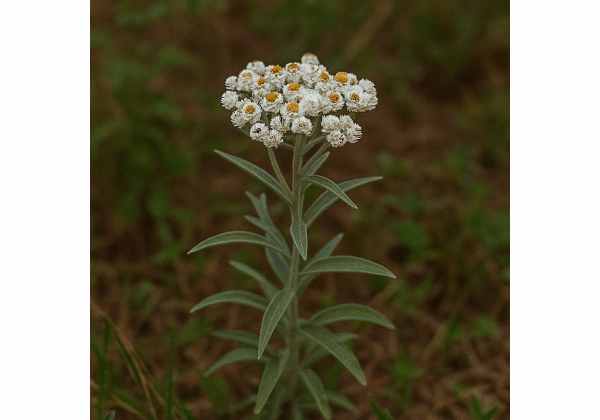
Pearly everlasting is a silvery-white wildflower with a long record of traditional use but a much thinner modern evidence base than many better-known herbs. Botanically known as Anaphalis margaritacea, it belongs to the daisy family and grows across large parts of North America and Asia. Indigenous North American traditions, regional folk medicine, and more recent ethnobotanical reports describe it as a plant used for sores, burns, bruises, coughs, rheumatic aches, diarrhea, and general inflammatory discomfort. That broad history makes it intriguing, but it also calls for restraint. Pearly everlasting is best understood as a traditional herb with plausible medicinal actions rather than a clinically proven treatment.
Modern studies suggest that the plant contains flavonoids, triterpenoids, diterpene-related compounds, and essential-oil constituents that may help explain its astringent, antimicrobial, anti-inflammatory, and antioxidant reputation. Even so, there are no strong human trials establishing clear health outcomes, ideal dosing, or long-term safety. For that reason, the most helpful way to approach pearly everlasting is with respect for its tradition, curiosity about its chemistry, and caution about overstated claims.
Core Points
- Pearly everlasting is most traditionally associated with minor skin support, especially poultices or washes for sores, burns, bruises, and swellings.
- It also has a long folk history for coughs, colds, rheumatic aches, and digestive upset, though strong human evidence is lacking.
- Traditional tea use, when chosen, is usually kept conservative at about 1 cup up to 3 times daily rather than treated as a standardized medical dose.
- People with Asteraceae allergy, pregnancy or breastfeeding concerns, or any plan to smoke the herb should avoid unsupervised medicinal use.
Table of Contents
- What pearly everlasting is and why it has been used medicinally
- Key ingredients and medicinal properties
- Pearly everlasting benefits and what the evidence actually supports
- Traditional uses for skin, lungs, and aches
- How to prepare and use pearly everlasting
- Dosage, timing, and how long to use it
- Safety, side effects, and who should avoid it
What pearly everlasting is and why it has been used medicinally
Pearly everlasting is a perennial herb in the Asteraceae family, recognized by its narrow gray-green leaves, woolly stems, and dry, pearly flower heads that hold their shape well after harvest. It is native across broad regions of North America and also occurs in parts of Asia. In the wild, it tends to favor open, sunny, somewhat dry places such as meadows, fields, roadsides, and gravelly soils. That ecology partly explains its traditional appeal: it is visible, available, resilient, and easy to gather in places where communities built working plant knowledge from what was close at hand.
Medicinally, the plant matters because it appears in more than one cultural stream. North American ethnobotanical records describe poultices for sores and swellings, tea or steam-bath use for rheumatism, and smoking or inhalation-style uses for colds. Other ethnomedicinal records from Asia and the Himalayan region describe internal use for diarrhea, pulmonary infections, ulcers, headache, and skin problems. When a plant appears repeatedly in different traditional systems for irritation, pain, cough, or minor wounds, that does not prove effectiveness by modern clinical standards, but it does suggest that people consistently observed effects worth preserving.
This herb also sits in an important herbal category: the “supportive traditional remedy.” Pearly everlasting was not historically a high-tech, narrowly targeted medicine. It was the kind of plant people used when the body seemed inflamed, sore, irritated, congested, or slow to recover. In many ways, that is still the most sensible lens for understanding it. It is not known for a single blockbuster compound or a single modern medical indication. Its medicinal interest comes from a broad pattern of use tied to mild infections, external irritation, cough, aches, and tissue discomfort.
That pattern also helps explain why modern interest is split between chemistry and tradition. The more closely researchers look at the plant, the more they find compounds that could plausibly support antimicrobial or anti-inflammatory activity. But the gap between plausible chemistry and proven benefit remains large. Pearly everlasting should therefore be approached as a traditional herb with emerging pharmacological clues, not as an evidence-settled botanical medicine.
For readers making practical decisions, this distinction is useful. If you are looking for a plant with a deep folk history for respiratory discomfort, topical first aid, and mild inflammatory complaints, pearly everlasting is genuinely interesting. If you are looking for a clinically standardized herb with strong human trials, it is not. That realism makes the plant easier to use wisely and harder to romanticize.
Key ingredients and medicinal properties
Pearly everlasting is not well studied enough to have a single “signature ingredient” in the way some mainstream herbs do. Instead, its medicinal profile appears to come from a mixed chemistry that includes flavonoids, triterpenoids, diterpene-related compounds, hydroxylactones, polyacetylenes, and volatile oil constituents. This kind of layered composition is common in traditional herbs that were valued for multiple low-intensity uses rather than one highly specialized effect.
One important phytochemical finding is the presence of flavonoids and triterpenoids in the whole plant. These groups are often associated in herbal medicine with antioxidant behavior, tissue protection, and mild anti-inflammatory action. Flavonoids in particular matter because they are frequently linked with the ability of plants to calm oxidative stress and support irritated tissues. Pearly everlasting is not as chemically famous as chamomile or green tea, but its flavonoid content gives a plausible basis for why it has been used on inflamed skin or in formulas aimed at coughs and minor irritation.
The plant’s essential oil profile adds another layer. A recent study of Anaphalis margaritacea essential oil identified a complex mixture of volatile compounds, including isocaryophyllene, caryophyllene oxide, geranyl-alpha-terpinene, alpha-pinene, gamma-muurolene, delta-cadinene, humulene, and copaene. These compounds do not prove that the plant works clinically, but they do suggest why researchers are interested in antimicrobial, anti-inflammatory, and antioxidant possibilities. In silico analysis from the same study also pointed toward potential activity related to inflammatory and oxidative pathways, though this kind of work is still many steps away from human proof.
The traditional medicinal properties usually attributed to pearly everlasting are astringent, anti-inflammatory, antimicrobial, expectorant, and soothing. Some traditions also treat it as mildly antirheumatic or antispasmodic. Astringency is one of the easier properties to understand. Astringent herbs tend to feel drying, tightening, or toning, which is why they often appear in remedies for weepy skin, minor wounds, diarrhea, and inflamed mucous membranes. Pearly everlasting’s folk uses fit that pattern closely. For readers who want a more established comparison, witch hazel as a classic astringent herb offers a clearer example of how that kind of action is traditionally understood.
Its possible antimicrobial effect is also worth noting, but only carefully. In vitro work on northern Ontario medicinal plant extracts found significant antibacterial activity from pearly everlasting flower and leaf extracts against several tested organisms. That is promising, especially for a plant long used externally. Still, an antibacterial lab result is not the same thing as a safe, effective treatment for human infection. Laboratory inhibition can tell us that a plant contains active chemistry; it does not tell us that homemade tea, oil, or poultice will solve a real-world infection.
The best summary is this: pearly everlasting has enough chemistry to justify its old medicinal reputation, but not enough clinical proof to justify confident medical claims. Its phytochemical profile supports traditional interest. It does not yet support overstatement.
Pearly everlasting benefits and what the evidence actually supports
When people search for the benefits of pearly everlasting, they usually want a direct answer. The most honest answer is that the plant has several credible traditional uses and some promising laboratory support, but very limited human evidence. That means its likely benefits need to be divided into three levels: traditional uses with good continuity, preclinical benefits with plausible mechanisms, and unproven claims that should stay modest.
The first likely benefit is support for minor irritated skin. This is where traditional use is strongest and the herb makes the most practical sense. Pearly everlasting appears repeatedly in sources describing poultices, washes, or pastes for sores, burns, bruises, contusions, sunburn, swellings, and other surface-level complaints. The chemistry also fits this use. Astringent, antimicrobial, and anti-inflammatory compounds make topical application a plausible traditional choice. For comparison, this is the same general low-risk territory in which people turn to calendula for minor skin support, though calendula has a clearer modern herbal reputation.
The second likely area is respiratory support, but with more caution. Traditional sources mention colds, coughs, pulmonary infections, asthma-like complaints, and throat irritation. Some records describe the plant as smoked, others as tea, and others as steam or warm infusion. These repeated respiratory uses suggest that pearly everlasting may have been valued as a mild expectorant, throat-soothing herb, or warming aromatic remedy. Still, this is not a well-validated modern respiratory herb. The claim that it helps cough or congestion is historically grounded, not strongly trial-backed.
The third possible benefit is mild support for inflammatory aches and rheumatic discomfort. Traditional records mention steam baths, tea use, and external applications for rheumatism, sore joints, bruises, and muscular pain. This likely reflects a combination of local soothing effect, warmth, and anti-inflammatory plant chemistry rather than a disease-modifying action. Pearly everlasting may fit minor aches or stiffness better than chronic inflammatory disease management.
Digestive use is another recurring but lower-confidence area. Some ethnomedicinal reports list the herb for diarrhea, ulcers, dyspepsia, and general stomach trouble. Astringent plants often end up in this category because they can feel settling when the gut is irritated. But there is not enough direct modern evidence to recommend pearly everlasting as a dependable digestive herb. If digestive soothing is the main goal, readers may want to compare it with a more established gentle option such as chamomile for digestive and calming support.
What should not be claimed? Pearly everlasting should not be presented as proven for infections, asthma, chronic ulcers, autoimmune disease, or major inflammatory conditions. The available evidence does not support those stronger conclusions. This herb belongs in the category of promising traditional support, not verified treatment.
That may sound cautious, but it is actually what makes the herb useful. When expectations stay close to the evidence, pearly everlasting remains interesting, practical, and believable.
Traditional uses for skin, lungs, and aches
Pearly everlasting’s traditional uses become easier to understand when grouped by body system. The largest themes are skin care, respiratory support, and aches or rheumatic complaints. This structure is more helpful than listing dozens of scattered folk uses without context.
For skin, the plant was often used externally. Poultices, washes, and pastes were applied to sores, burns, blisters, bruises, contusions, and swellings. This is a highly believable pattern because it lines up with what an astringent, mildly antimicrobial herb would traditionally do. A warm poultice or wash can support cleansing, drying, and local comfort. The logic is very similar to the way people use other old first-aid herbs: not to treat severe wounds, but to support minor, uncomplicated tissue problems.
For the lungs and upper airways, the herb was traditionally used in more varied ways. Some sources describe tea for colds or coughs. Others mention smoking dried plant material or using steam. From a historical perspective, that makes sense. Many plants with aromatic or drying qualities were smoked or steamed in older traditions. From a modern safety perspective, however, smoking the herb is not a recommendation. Traditional use and best present-day practice are not always the same. The more defensible modern interpretation is that pearly everlasting may have been valued for easing cough, loosening mucus, or relieving the heavy, damp feeling of a cold. For readers looking for a more familiar comparison, great mullein for cough and throat support is a much better-established respiratory herb in current practice.
For aches, the plant’s uses cluster around rheumatism, stiff joints, swelling, and soreness. Tea, steam, and moist applications all appear in the traditional record. This probably reflects two things working together: the plant’s chemistry and the delivery method. Heat alone can reduce stiffness, and a warming herbal compress often feels more effective than the plant compounds acting alone. In that sense, pearly everlasting may have functioned as part medicine and part therapeutic ritual.
There are also secondary traditional uses that deserve mention without overemphasis. These include diarrhea, dysentery-like complaints, ulcers, headache, and general inflammation. Some of these uses come from North American ethnobotany, others from South and Central Asian ethnomedicinal records. Their repetition suggests a plant regarded as broadly useful where tissues were irritated, inflamed, or congested.
What is most valuable here is not to force all these uses into modern disease categories. Pearly everlasting was often used according to patterns of sensation: hot and swollen skin, tight aching joints, raw throat, heavy cough, unsettled digestion. Understanding that older pattern makes the plant easier to interpret. It was not necessarily chosen because it had one proven effect. It was chosen because it seemed to calm irritation in several places at once.
That old way of using herbs can still be helpful, as long as it is translated carefully. Pearly everlasting may still fit minor skin discomfort, mild cold-season support, and temporary aches. It does not belong in place of medical care for significant disease.
How to prepare and use pearly everlasting
The most reasonable modern use of pearly everlasting begins with form. This is not a herb with a widely standardized capsule or extract market, so most people who use it work with traditional-style preparations. Those usually include infusion, decoction-like tea, poultice, wash, steam, infused oil, or salve. The form chosen should match both the tradition and the level of evidence.
Topical use is the easiest place to start. A poultice or wash is closest to the herb’s best-documented traditional role. Fresh or rehydrated dried plant material may be applied over minor bruises, sore spots, or intact irritated skin. A strained infusion can be used as a warm wash or compress. This kind of use is simpler and lower risk than taking the plant internally, especially for people who are just exploring whether the herb suits them.
Tea is the next most common form, though it deserves more restraint. Pearly everlasting tea has traditionally been used for colds, coughs, rheumatic discomfort, and digestive upset. In practical terms, it is better understood as a short-term folk infusion than as a daily wellness beverage. The herb has no well-established standardized oral regimen, and its internal use rests much more on traditional continuity than on modern clinical testing.
A few people also work with infused oil or salve, especially when using the plant for bruises, dry irritated patches, or local muscular discomfort. This can make sense because the herb’s topical tradition is broad, and oils can be more practical than wet compresses. If the skin issue is mainly dry, tight, or chafed, a salve may be more comfortable than a tea compress. If the area is hot or weepy, a lighter wash may be the better traditional match.
Steam use appears in older records as well, especially for rheumatism or congestion. This is understandable historically, but it should stay modest and sensible. Warm steam with aromatic or woolly plants was often used to loosen the body and soften congestion. In modern practice, steam should be gentle and never treated as a substitute for care when breathing symptoms are serious.
The least defensible traditional use today is smoking the herb. Historical smoking practices tell us something about how communities used plants, but they do not automatically create a present-day recommendation. Inhaling combusted plant matter for cough or colds is difficult to defend from a respiratory-health standpoint. Tradition should be respected, but not copied uncritically.
A practical decision guide looks like this:
- Use a compress, wash, or poultice for minor surface complaints.
- Use tea only for short-term, low-intensity traditional internal use.
- Avoid smoke-based use.
- Do not use homemade preparations on deep wounds, the eyes, or serious infections.
This is one of those herbs that rewards simplicity. Pearly everlasting does not need to be turned into a complex supplement protocol. It makes the most sense when used in small, traditional, low-risk ways.
Dosage, timing, and how long to use it
Dosage is the weakest and most uncertain part of pearly everlasting medicine. There is no modern standardized clinical dose, no major therapeutic monograph establishing an official daily range, and no strong human trial base from which to derive one. That means any dosing advice has to be framed as traditional-use guidance rather than evidence-based prescribing.
For external use, the dosage question is simpler. You use enough herb to make the preparation effective at the surface. A warm compress, poultice, or wash is usually applied in a quantity sufficient to cover the affected area, then repeated as needed for a short period. This is one reason topical use is the safest place to begin: response can be observed directly, and treatment can be stopped immediately if irritation develops.
For tea, modern herbal practice should stay conservative. A low-intensity traditional approach is about 1 cup per use, up to 3 times daily, for a short span rather than for weeks at a time. This is not a clinically validated dose. It is a cautious, practical range based on the fact that traditional use tends to involve modest infusions rather than concentrated extracts. People who want to try the herb internally should think in terms of “light traditional support,” not “therapeutic loading.”
Timing depends on the reason for use. If the goal is cold-season support or throat comfort, tea may make the most sense earlier in the day or between meals. If the goal is achiness or general tension, a warm infusion or external compress may be more helpful in the evening. For skin and bruise care, timing matters less than regular, brief application.
Duration is especially important. Pearly everlasting is not the kind of herb that should be taken indefinitely simply because it is traditional. Short courses make more sense:
- A few days for a mild cold-related tea.
- Several days for a bruise or sore area with topical application.
- Brief use during a flare of minor irritation rather than continuous routine use.
If symptoms last beyond that, the issue is no longer really about the herb. It becomes a question of diagnosis. Persistent cough, ongoing diarrhea, worsening sore throat, recurrent ulcers, or a wound that does not improve all need proper evaluation rather than repeated home use of an under-studied plant.
There are also two common dosing mistakes to avoid. The first is treating a weak traditional herb as though higher amounts will automatically make it more effective. The second is assuming that because dosing is not standardized, there are no limits. In reality, the lack of clear dosing data is a reason to stay more conservative, not less.
The cleanest conclusion is this: pearly everlasting has traditional preparation patterns, not validated clinical dosage rules. That is why external use, short-term internal use, and careful observation should define modern practice.
Safety, side effects, and who should avoid it
Pearly everlasting is often spoken of as a gentle traditional herb, but that should not be confused with proven safety. One of the biggest facts about this plant is that long-term human safety data are sparse. There are no major clinical programs that tell us exactly how well repeated oral use is tolerated, which interactions matter most, or what dose becomes problematic. In practical terms, that means safety has to be built from first principles: plant family, route of use, traditional context, and uncertainty.
The first major caution is allergy. Pearly everlasting belongs to the Asteraceae family, and people who react to ragweed, chamomile, calendula, or other daisy-family plants may be more likely to react here too. That does not mean everyone with seasonal allergies will react, but it does mean skin testing and cautious first use make sense, especially for topical applications.
The second caution is route. External use on intact skin is one thing. Internal use is another. Smoke inhalation is another again. Of these, smoking is the least advisable in modern practice. Even if historical records describe it for colds, inhaling burned plant material is not a reasonable health strategy for someone already dealing with respiratory irritation. A traditional record is not a safety guarantee.
Pregnancy and breastfeeding are also areas where caution is warranted. Because there is no well-developed clinical safety base, it is better to avoid internal use during pregnancy or lactation unless guided by a knowledgeable clinician. The same logic applies to young children. Traditional use in a community does not automatically translate to modern unsupervised use in infants or children.
Possible side effects are mostly those you would expect from a less-studied aromatic Asteraceae herb:
- Skin irritation or rash.
- Mouth or throat irritation in sensitive people.
- Stomach upset with internal use.
- Respiratory irritation if smoked or inhaled aggressively.
Interaction data are poor, so the safest assumption is to be cautious when combining the herb with medicines for chronic illness, especially where inflammation, immune activity, or gastrointestinal sensitivity are involved. This is not because we know a list of serious interactions. It is because we do not know enough to pretend there are none.
A few situations clearly call for avoiding self-treatment with pearly everlasting:
- Deep burns or infected wounds.
- Persistent cough, wheezing, or breathing difficulty.
- Severe diarrhea, bloody stool, or ongoing abdominal pain.
- Eye problems or attempts to use homemade preparations near the eyes.
- Chronic inflammatory disease that needs proper diagnosis and follow-up.
That last point matters most. The gentleness of an herb can be misleading. Pearly everlasting may be reasonable for minor supportive care, but it should never delay evaluation of a problem that is worsening, spreading, or refusing to resolve.
In the end, the safest view of pearly everlasting is the most balanced one: probably useful in certain traditional, low-risk contexts; insufficiently studied for confident broad medical use; and best handled with moderation, patch testing, and common sense.
References
- Ethnopharmacology of the Asteraceae family in Mexico 2021 (Review)
- Ethnomedicinal Plants and Herbal Preparations Used by Rural Communities in Tehsil Hajira (Poonch District of Azad Kashmir, Pakistan) 2024
- Herbal Arsenal against Skin Ailments: A Review Supported by In Silico Molecular Docking Studies 2022 (Review)
- Phytochemical profiling, molecular docking, and ADMET evaluation of essential oils from Anaphalis busua and Anaphalis margaritacea in Uttarakhand’s Himalayan Terrain 2024
- Flavonoids and triterpenoids from Anaphalis margaritacea 2009
Disclaimer
This article is for educational purposes only and does not replace professional medical advice, diagnosis, or treatment. Pearly everlasting has a meaningful traditional record, but modern human evidence is limited, and no standardized clinical dosage has been established. Do not use it to self-treat serious burns, infections, breathing problems, persistent diarrhea, or chronic inflammatory conditions. Because safety data are incomplete, anyone who is pregnant, breastfeeding, highly allergy-prone, taking regular medication, or considering internal use should speak with a qualified healthcare professional first.
If you found this article helpful, please share it on Facebook, X, or any platform you prefer.