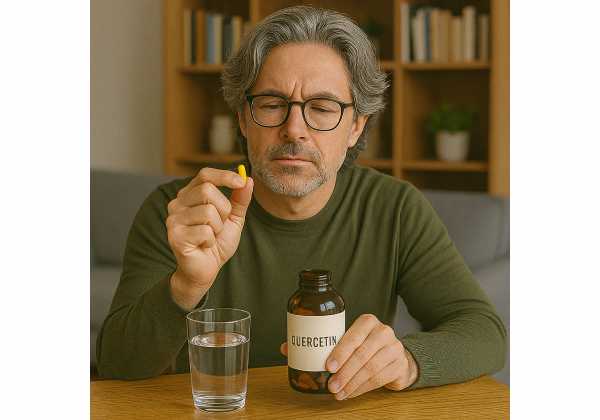
Quercetin is a plant flavonol found in onions, capers, apples, berries, tea, and many herbs. In longevity science, it draws attention for a specific reason: it interacts with pathways involved in cellular senescence, inflammation, oxidative stress, and vascular aging. It is not a proven life-extension supplement, and it does not “reverse aging.” Its most credible role is narrower and more interesting: quercetin behaves as a senotherapeutic compound in experimental models, meaning it influences senescent cells or the inflammatory signals they release.
The human evidence is still early. Some trials use quercetin alone, while others use it with dasatinib, a prescription cancer drug, as a senolytic pair. That distinction matters. Quercetin from food is low-risk for most adults. High-dose capsules, enhanced-bioavailability products, and drug-style senolytic protocols deserve a much more careful safety lens.
Table of Contents
- What Quercetin Is and Why Longevity Researchers Study It
- Senotherapeutic Mechanisms: How Quercetin Acts on Aging Cells
- Human Evidence: Promising Signals, Not Proven Longevity Benefits
- Forms, Dosing, and Bioavailability
- Safety, Side Effects, and Drug Interactions
- How to Use Quercetin Cautiously in a Longevity Plan
- Food-First Quercetin: The Low-Risk Way to Start
- When Quercetin Is Not the Right Tool
What Quercetin Is and Why Longevity Researchers Study It
Quercetin is a polyphenol, a family of plant compounds that helps plants handle sunlight, pests, and environmental stress. In humans, quercetin is studied for antioxidant signaling, inflammation control, vascular function, immune modulation, and cellular stress responses. It belongs to the flavonol subgroup, along with compounds such as kaempferol and myricetin.
The word “antioxidant” undersells it. Quercetin does not simply float through the body neutralizing free radicals like a sponge. After digestion, the body converts much of it into conjugated metabolites, including glucuronides and sulfates. These metabolites circulate at low concentrations and interact with signaling systems that regulate inflammation, detoxification enzymes, mitochondrial stress, and cell survival.
Longevity researchers focus on quercetin because it touches several aging-linked pathways at once:
- senescent cell survival pathways
- NF-kB-driven inflammatory signaling
- oxidative stress and NRF2-related defense enzymes
- endothelial function in blood vessels
- mast cell activation and histamine release
- mitochondrial stress and autophagy-related signaling
- PI3K/AKT, AMPK, and mTOR-related metabolic pathways
That breadth is useful but also risky to overinterpret. A compound that affects many pathways in a dish or animal model does not automatically create meaningful healthspan gains in humans. Longevity claims require stronger proof than pathway diagrams.
Quercetin sits between two supplement categories. In ordinary food amounts, it is a dietary polyphenol that fits naturally into a plant-rich eating pattern. In concentrated supplement form, especially at 500–1,000 mg per day or in pulse protocols, it behaves more like a pharmacologically active compound. That second category deserves the same caution people apply to other bioactive longevity interventions.
Readers who want the cellular background should understand cellular senescence and SASP signaling before treating quercetin as a simple antioxidant supplement.
Senotherapeutic Mechanisms: How Quercetin Acts on Aging Cells
Senescent cells are living cells that have stopped dividing after stress, damage, or repeated replication. Some senescent cells help wound healing and cancer protection. Others linger, resist normal cell death, and release inflammatory chemicals known as the senescence-associated secretory phenotype, or SASP.
Quercetin is called senotherapeutic because it influences senescent cells in two overlapping ways. It shows senolytic activity in some settings, meaning it helps push certain senescent cells toward apoptosis, the body’s organized cell-death process. It also shows senomorphic activity, meaning it dampens the inflammatory behavior of senescent cells without necessarily killing them.
Senolytic action: lowering the defenses of selected senescent cells
Senescent cells survive by activating anti-apoptotic pathways. These pathways act like internal bodyguards. They help damaged cells resist death even when the surrounding tissue would benefit from removing them.
Quercetin appears to weaken some of those survival systems. Experimental work links it with changes in PI3K/AKT signaling, BCL-2 family proteins, HIF-1α, p53/p21-related stress pathways, and other networks that regulate whether a damaged cell survives or dies. Its effect varies by cell type. Senescent endothelial cells, fibroblasts, preadipocytes, and immune-related cells do not all respond the same way.
This cell selectivity matters. A strong senolytic effect in one tissue does not prove the same effect in the brain, heart, liver, or joints. It also means high-dose quercetin should not be viewed as a universal cleanup tool.
Dasatinib plus quercetin, often shortened to D+Q, became prominent because the two agents appear to target different senescent cell survival networks. Dasatinib affects tyrosine kinase pathways and is a prescription oncology drug. Quercetin hits several nutrient-sensing, inflammatory, and cell-survival pathways. The pair has shown stronger senolytic signals than either compound alone in some preclinical models.
That does not make D+Q a supplement stack. Dasatinib carries real medical risks, including low blood counts, fluid retention, bleeding risk, infection risk, and heart or lung complications in susceptible people. Any protocol using dasatinib belongs in clinical research or specialist medical care, not casual self-experimentation.
Senomorphic action: calming the SASP
Quercetin’s more realistic supplement-level role is senomorphic. Senomorphic compounds reduce harmful senescent-cell signaling without clearing the cells entirely. Quercetin influences NF-kB, a major inflammatory transcription factor, and helps regulate cytokines such as IL-6, IL-1β, and TNF-α in experimental settings.
This matters because the SASP acts less like a local whisper and more like a tissue-level alarm. It recruits immune cells, changes nearby cells, degrades extracellular matrix, and contributes to chronic low-grade inflammation. Over years, this inflammatory background connects with vascular disease, insulin resistance, frailty, and cognitive decline.
A senomorphic approach has a different risk profile than aggressive senolysis. Killing senescent cells at the wrong time or in the wrong tissue might interfere with repair. Quieting excessive inflammatory signals while preserving normal repair processes sounds safer, but human trials still need to confirm timing, dose, and target groups.
For a deeper comparison, quercetin fits naturally beside senomorphic strategies that reduce SASP signaling, while D+Q belongs closer to experimental senolytic therapies.
Redox signaling, NRF2, and the hormesis problem
Quercetin influences redox balance, but more is not automatically better. Low-to-moderate stress signals help cells adapt. Exercise, heat, cold, fasting, and plant polyphenols all work partly through controlled stress responses. Over-suppressing oxidative signals around training or recovery can blunt some beneficial adaptations.
Quercetin activates or modulates NRF2-related antioxidant defenses in some models. NRF2 regulates enzymes involved in glutathione metabolism, detoxification, and cellular defense. A modest nudge can support resilience. A heavy daily antioxidant load, especially stacked with many other concentrated extracts, creates a less predictable signal.
This is why quercetin fits better as an occasional targeted supplement or food-pattern compound than as a “max dose forever” longevity product. Cellular resilience comes from rhythm: stress, response, recovery, and adaptation. Readers using heat, exercise, fasting, or other hormetic tools should also understand redox balance and antioxidant timing.
Human Evidence: Promising Signals, Not Proven Longevity Benefits
Quercetin has human studies in areas such as blood pressure, inflammation, glucose metabolism, exercise recovery, respiratory disease, and vascular function. Most trials are short, use different forms and doses, and measure biomarkers rather than long-term outcomes. That makes quercetin interesting, but not proven as a healthspan therapy.
The strongest longevity-relevant evidence comes from senescence-targeted studies, not general wellness studies. These trials fall into two groups: quercetin alone and dasatinib plus quercetin.
Quercetin alone
Quercetin-only trials show mixed but meaningful signals. Some studies report improvements in blood pressure, endothelial function, inflammatory proteins, or oxidative stress markers, especially in people with cardiometabolic risk. Effects in healthy adults often look smaller.
A notable recent trial studied people with symptomatic coronary artery disease undergoing bypass surgery. Participants received quercetin before surgery and through hospital discharge. The study reported improved endothelial relaxation and changes in vascular senescence and inflammatory pathways, with stronger benefits in men than women. That sex difference is important. It suggests quercetin’s vascular effects might depend on hormonal state, tissue context, baseline inflammation, or disease biology.
This kind of result is not a reason for everyone to start high-dose quercetin. It is a reason to study quercetin more carefully in defined groups: people with vascular inflammation, endothelial dysfunction, metabolic syndrome, or high senescence burden. Longevity supplementation works best when matched to a measurable problem, not when taken because a pathway sounds impressive.
Dasatinib plus quercetin
D+Q has been tested in small human studies involving conditions such as idiopathic pulmonary fibrosis, diabetic kidney disease, and age-related functional decline. Some studies report feasibility, tolerability, lower senescence markers, or early functional signals. Sample sizes remain small, and many studies are pilot trials.
D+Q also raises a major interpretation problem. When quercetin is paired with a potent prescription kinase inhibitor, any benefit cannot be credited to quercetin alone. The combination’s biological effect is the point. Treating those results as proof for over-the-counter quercetin capsules is a category mistake.
D+Q research does support one important idea: senescent cells are druggable in humans. It does not prove that healthy adults should run senolytic cycles at home.
Biomarkers are not the same as living longer
Quercetin research often measures hs-CRP, IL-6, endothelial function, glucose markers, lipid changes, or gene-expression patterns. These biomarkers help researchers see direction. They do not prove fewer heart attacks, less dementia, slower frailty, or longer life.
A useful longevity framework separates surrogate markers from outcomes. Lower inflammation sounds good, but the clinical meaning depends on the person, the baseline level, the reason for inflammation, and whether the change lasts. A person with untreated sleep apnea, periodontitis, abdominal obesity, or autoimmune disease should not expect quercetin to solve the underlying driver.
This is where biomarkers versus real-world outcomes becomes essential. Supplements deserve less attention than the causes of the abnormal biomarker.
Forms, Dosing, and Bioavailability
Quercetin has low and variable oral bioavailability. Plain quercetin aglycone dissolves poorly in water, and the body rapidly metabolizes it. Food matrix, gut enzymes, microbiome activity, formulation, and genetics all influence absorption.
The form on the label matters. A 500 mg capsule from one product does not necessarily produce the same blood exposure as 500 mg from another.
| Form | Typical use | Practical note |
|---|---|---|
| Quercetin aglycone | Basic capsules and powders | Common and inexpensive, but absorption is often limited. |
| Quercetin dihydrate | Many supplement products | Widely used in safety assessments and clinical studies. |
| Quercetin glycosides | Food-derived forms, especially from onions and some plants | Some glycosides absorb better than aglycone, depending on structure. |
| Phytosome or lipid-based forms | Enhanced-bioavailability products | Higher exposure is not automatically safer; lower doses might act stronger. |
| Enzymatically modified isoquercitrin | Products designed for improved absorption | Often used when bioavailability is the main concern. |
Supplement doses in human studies often range from 250 mg to 1,000 mg per day. Some senolytic research uses intermittent high-dose patterns rather than continuous daily use, especially when quercetin is paired with dasatinib. Ordinary longevity supplement use should not copy drug-trial protocols without medical supervision.
For general adults considering quercetin, a conservative pattern looks like this:
- food sources daily or near-daily
- 250–500 mg per day when supplementing
- short trial periods, such as 8–12 weeks
- avoidance of multi-extract stacks at the start
- reassessment using symptoms, blood pressure, medication tolerance, and relevant labs
Higher exposure is not always better. Enhanced-bioavailability forms raise the chance of meaningful effects and the chance of interactions. A phytosome product at a lower dose might produce more systemic exposure than a larger amount of plain quercetin.
Timing also matters. Quercetin is often taken with meals, partly to reduce stomach upset and partly because fat-containing meals can improve absorption of some polyphenols. People using quercetin around exercise should avoid assuming that pre-workout antioxidant dosing helps adaptation. Taking concentrated antioxidant polyphenols away from hard training sessions is a more cautious approach.
Quercetin stacks often include vitamin C, bromelain, zinc, resveratrol, curcumin, fisetin, or green tea extract. Stacking makes it harder to know what helps and what causes side effects. Fisetin deserves separate consideration because it is also discussed as a senolytic flavonoid; comparing it with fisetin senolytic use helps avoid mixing two experimental strategies without a reason.
Safety, Side Effects, and Drug Interactions
Quercetin from food is safe for most adults. Supplemental quercetin is usually well tolerated in short-term studies, especially around 500 mg per day. The main side effects are digestive upset, headache, tingling sensations, and nausea. Higher doses and enhanced forms raise the need for caution.
Safety has two parts: the compound itself and the context of the person taking it. A healthy adult taking no medication faces a different risk than someone using anticoagulants, immunosuppressants, chemotherapy, or multiple blood pressure and diabetes drugs.
Medication interactions deserve attention
Quercetin interacts with drug-metabolizing enzymes and transporters in laboratory and human studies. These include CYP3A4 and P-glycoprotein, two systems that influence many medications. The direction of effect is not always simple. Quercetin can inhibit, induce, or otherwise alter transport depending on dose, form, timing, and tissue.
Use extra caution with:
- warfarin and other anticoagulants
- antiplatelet drugs
- cyclosporine, tacrolimus, and other transplant-related immunosuppressants
- chemotherapy, targeted cancer drugs, and hormone-sensitive cancer therapies
- digoxin or other narrow-therapeutic-index drugs
- multiple blood pressure medications
- glucose-lowering medications when glucose runs low
- antibiotics or antivirals with known transporter interactions
The concern is not that quercetin always causes a dangerous interaction. The concern is unpredictability. A supplement that changes drug exposure by even a modest amount matters when the medication has a narrow safety margin.
Kidney, liver, pregnancy, and surgery considerations
People with kidney disease or liver disease should treat concentrated quercetin as a clinician-reviewed supplement. Many studies show no major kidney or liver signal at common doses, but that does not guarantee safety in reduced organ function.
Pregnancy and breastfeeding are poor times for experimental high-dose supplementation. Food sources are appropriate; concentrated quercetin capsules need professional guidance.
Before surgery, supplement lists should be reviewed with the surgical team. Quercetin’s potential effects on platelets, inflammation, drug metabolism, and blood pressure make disclosure important. Stopping nonessential supplements one to two weeks before planned surgery is a common precaution, but the exact plan belongs with the clinician.
Dasatinib plus quercetin is a medical protocol
D+Q should not be treated as a supplement protocol. Dasatinib is a prescription drug used in cancer care. Its risks are not theoretical. Combining it with quercetin for senolytic goals outside a trial or specialist care bypasses essential screening and monitoring.
Medical oversight for D+Q research commonly involves attention to blood counts, liver and kidney markers, medication conflicts, infection risk, fluid retention, cardiovascular history, and adverse symptoms. That is far beyond normal supplement use.
For people interested in careful self-tracking, safe self-experimentation protocols are a better starting point than copying senolytic regimens from animal studies.
How to Use Quercetin Cautiously in a Longevity Plan
Quercetin fits best as a targeted tool, not a foundation. The foundation remains sleep, resistance training, aerobic fitness, blood pressure control, healthy body composition, glucose stability, dental health, social connection, and a nutrient-dense diet.
A sensible quercetin decision starts with the reason for use. “Longevity” is too broad. Better reasons include:
- high-normal inflammation after obvious causes have been addressed
- cardiometabolic risk with low polyphenol intake
- interest in vascular function support
- mast-cell or seasonal-allergy patterns under clinician guidance
- participation in a structured clinician-supervised senescence trial
- a short, measured experiment after medication interactions are ruled out
The best candidates are adults who already have the basics in place and want a low-to-moderate-risk polyphenol trial. The weakest candidates are people trying to use quercetin as a shortcut while ignoring blood pressure, smoking, sleep apnea, insulin resistance, inactivity, or excess alcohol.
A cautious 8–12 week supplement trial might include:
- Review medications and medical conditions first.
- Choose one quercetin product rather than a large blend.
- Start with 250 mg per day with food.
- Increase only if tolerated and justified.
- Track blood pressure, sleep, digestion, headaches, bruising, and new symptoms.
- Recheck relevant labs if using it for inflammation or metabolic reasons.
- Stop if side effects, medication changes, surgery, pregnancy, or unexplained symptoms occur.
Relevant labs depend on the person. For inflammation-focused use, hs-CRP is a reasonable marker, but it rises with infections, injury, dental disease, poor sleep, and heavy training. Context matters. A broader inflammatory picture is covered in hs-CRP and inflammation markers for healthy aging.
For cardiometabolic use, better tracking often includes waist circumference, home blood pressure, fasting glucose, A1c, fasting insulin, triglycerides, HDL, ApoB, and liver enzymes. Quercetin should not distract from the interventions that reliably improve these numbers: weight loss when needed, fiber, protein, walking after meals, strength training, and lower alcohol intake.
Food-First Quercetin: The Low-Risk Way to Start
Food is the safest way to raise quercetin exposure because it packages quercetin with fiber, minerals, other polyphenols, and a normal dose range. Food sources also avoid the sudden high blood peaks that come from some capsules.
High-quercetin foods include:
- capers
- red and yellow onions
- shallots
- apples with skin
- berries
- cherries
- kale
- broccoli
- asparagus
- black tea and green tea
- dill, cilantro, and other herbs
- buckwheat
Onions are especially practical. Red onions and yellow onions provide quercetin glycosides that absorb better than many people expect from food. Cooking changes some content, but cooked onions still contribute meaningful polyphenols when eaten often.
A food-first pattern might look like this:
- onions or shallots in omelets, soups, beans, stir-fries, and salads
- apples or berries most days
- herbs used generously rather than as decoration
- tea or cocoa as a low-sugar polyphenol habit
- cruciferous vegetables several times per week
- legumes, olive oil, nuts, and colorful plants as the meal base
This pattern does more than supply quercetin. It improves fiber intake, gut microbial diversity, potassium intake, and cardiometabolic markers. People who eat few plants often gain more from changing the plate than from adding a capsule.
Polyphenol variety also matters. Quercetin is only one member of a much larger family. Berries, cocoa, coffee, tea, olive oil, herbs, spices, and colorful vegetables provide different compounds that act through overlapping but distinct pathways. A broader plan for polyphenol-rich foods is more durable than focusing on one flavonol.
When Quercetin Is Not the Right Tool
Quercetin is easy to overrate because it connects to exciting mechanisms. The stronger the mechanism sounds, the more discipline the decision needs.
Skip or delay quercetin supplementation when any of the following apply:
- You take warfarin, transplant medications, chemotherapy, or narrow-therapeutic-index drugs.
- You have upcoming surgery or a recent procedure.
- You are pregnant, breastfeeding, or trying to conceive without clinician guidance.
- You have active liver or kidney disease.
- You have unexplained bruising, bleeding, severe headaches, or new neurologic symptoms.
- You are already taking several polyphenol extracts.
- You want to combine it with dasatinib outside medical supervision.
- You have not addressed the obvious drivers of inflammation first.
Quercetin also does not replace proven therapies. It does not replace statins or other lipid-lowering therapy when cardiovascular risk is high. It does not replace blood pressure medication, diabetes care, sleep apnea treatment, smoking cessation, physical therapy, or dental infection treatment. In longevity medicine, supplements sit below diagnosis and risk control.
A useful rule is simple: quercetin deserves consideration only after the reason for use is specific enough to measure. “I want healthier blood vessels and my blood pressure, ApoB, glucose, sleep, and exercise are already being handled” is a better reason than “I heard it kills zombie cells.”
Quercetin’s most credible future is targeted use: specific doses, specific forms, specific populations, and careful outcome measures. Its current best use for most adults is less dramatic: eat quercetin-rich foods often, avoid reckless senolytic protocols, and treat concentrated capsules as active compounds that require judgment.
References
- Quercetin Reduces Vascular Senescence and Inflammation in Symptomatic Male but Not Female Coronary Artery Disease Patients 2025 (RCT)
- Senolytics dasatinib and quercetin in idiopathic pulmonary fibrosis: results of a phase I, single-blind, single-center, randomized, placebo-controlled pilot trial on feasibility and tolerability 2023 (RCT)
- Improving quercetin bioavailability: A systematic review and meta-analysis of human intervention studies 2025 (Systematic Review)
- A Pharmacokinetic Study of Different Quercetin Formulations in Healthy Participants: A Diet-Controlled, Crossover, Single- and Multiple-Dose Pilot Study 2023 (Clinical Trial)
- Risk assessment of quercetin dihydrate and rutin in food supplements – “Other substances” 2024 (Scientific Opinion)
- Quercetin as a Therapeutic Product: Evaluation of Its Pharmacological Action and Clinical Applications—A Review 2023 (Review)
Disclaimer
This article is educational and does not replace care from a qualified health professional. Quercetin supplements can interact with medications and medical conditions, especially at high doses or in enhanced-bioavailability forms. Anyone considering quercetin for senolytic or senomorphic purposes should review it with a clinician who understands their medication list, lab history, and health risks.