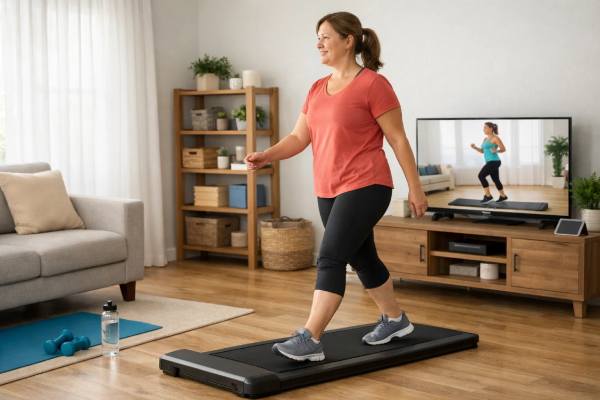
Indoor walking workouts can be a surprisingly effective way to lose weight, especially if weather, time, safety, childcare, or gym access regularly get in the way of exercise. They are low impact, beginner-friendly, easy to scale, and realistic enough to repeat several times a week. That repeatability is a big reason they work.
You do not need a treadmill to make indoor walking useful. Marching in place, hallway laps, walking-pad sessions, stair intervals, and simple side-step circuits can all raise your heart rate, add steps, and help create a calorie deficit over time. This guide covers why indoor walking works, the best home routines, how to make them more effective, and a practical weekly plan.
Table of Contents
- Why indoor walking works
- How to set up at home
- Best indoor walking workout types
- Four home walking routines
- Weekly indoor walking plan
- How to burn more and progress
- Mistakes and safety tips
Why indoor walking works
Indoor walking works for weight loss for the same reason outdoor walking does: it helps you move more often, accumulate more active minutes, and raise total daily energy expenditure. The difference is that indoor walking removes several common barriers. You do not need good weather, daylight, a safe route, or extra travel time. You can start within minutes, which makes it easier to stay consistent.
That consistency matters more than many people realize. A workout does not need to be extreme to help with fat loss. It needs to happen often enough to shift your weekly calorie balance and support a more active lifestyle. Indoor walking is especially effective for people who struggle to maintain formal exercise routines because it is simple, low stress, and easy to recover from.
Another strength is flexibility. You can use indoor walking in different ways depending on your level and schedule:
- as a full beginner cardio session
- as an active break during the workday
- as a post-meal walk
- as a lower-impact option on recovery days
- as a backup when an outdoor walk or gym session falls through
It is also a practical choice for people who do not enjoy jumping, running, or high-intensity classes. Indoor walking can still raise your heart rate, especially when you add brisk pace changes, stair work, arm drive, or longer continuous sessions.
For weight loss specifically, indoor walking helps in three ways:
- It increases calorie burn without requiring maximal effort.
- It adds steps and reduces sedentary time.
- It is easy enough to repeat, which is what makes results accumulate.
That last point is the most important. Weight loss is usually driven by what you can do repeatedly, not by the hardest workout you can survive once. Indoor walking tends to have a lower dropout risk than more punishing forms of cardio because it does not leave most people wrecked.
It also fits well with real-life fat-loss plans. You can stack short sessions through the day, use them on busy weeks, or build them into a broader routine. If you want a general overview of how step-based movement supports fat loss, walking for weight loss is a good foundation. And like all cardio, indoor walking works best when paired with a manageable calorie deficit rather than used as a license to overeat.
In short, indoor walking is not “less real” than other exercise. It is simply a more accessible form of movement. For many people, that accessibility is exactly what makes it effective.
How to set up at home
A good indoor walking setup does not need much space or equipment, but a few simple adjustments can make the workouts feel smoother and safer.
At minimum, you need:
- supportive shoes or a stable walking surface
- enough floor space to move your arms freely
- a timer or phone
- water nearby
- clothing that lets you move comfortably
If you are marching in place or doing side-to-side patterns, clear a small area so you are not worried about bumping furniture. If you are using hallway laps, remove anything that creates a tripping hazard. If you are using stairs, make sure the steps are dry, well lit, and have a handrail.
A walking pad or under-desk treadmill can also work well, especially if your goal is to add steps during the day or turn part of your work time into movement time. If that setup interests you, this guide to under-desk treadmill use can help you compare convenience and limits.
Choose the right pace for your goal
Not every indoor walk needs to feel like a workout. Some should be easy movement. Others should be brisk enough to feel like exercise.
A simple effort guide:
- Easy pace: you can talk comfortably and breathe normally.
- Moderate pace: you can talk, but you feel warmer and breathe a little harder.
- Brisk pace: conversation is shorter and effort is clearly elevated, but still controlled.
Most indoor walking for weight loss should sit in the easy-to-moderate range, with short brisk segments added as fitness improves.
Think about surface and joints
Hard indoor floors can feel repetitive on the feet and knees, especially if you are doing longer sessions in place. Shoes with some cushioning and grip usually help. If you have bad knees, hip pain, or a higher body weight, favor smoother, lower-impact patterns over fast pivots, deep stair intervals, or abrupt directional changes. If joint comfort is a major issue, low-impact cardio for bad knees can help you compare alternatives.
Make the workout easier to start
Many people fail with home exercise not because the workout is too hard, but because the start-up friction is too high. A few practical fixes help:
- leave shoes where you can grab them quickly
- save a timer on your phone
- keep one playlist or podcast ready
- decide in advance which routine you are doing
- use the same time slot several days a week
Indoor walking gets more effective when it becomes automatic. The less you have to think about setup, the more likely you are to actually do it.
Best indoor walking workout types
The best indoor walking workout is the one that matches your current fitness, home setup, and attention span. You do not need to use only one style. In fact, rotating a few formats often keeps the routine fresher and helps prevent the “same thing every day” boredom that makes home exercise fade out.
Here are the most effective indoor walking formats for weight loss.
Marching in place
This is the simplest starting point and the easiest option when space is tight. March in place with a natural arm swing, soft knees, and an upright posture. You can make it harder by lifting the knees a bit higher, increasing cadence, or adding brisk intervals.
Best for:
- total beginners
- short workouts
- quick movement breaks
- bad weather days
- small apartments
Hallway laps
If you have even a short hallway or an open living area, repeated laps can feel more natural than marching in place. Turning every few seconds is not ideal for very long sessions, but it works well for 10 to 20 minutes.
Best for:
- people who dislike standing in one place
- easy step accumulation
- post-meal walks
- low-complexity sessions
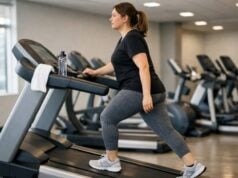
Walking-pad or treadmill sessions
A walking pad lets you keep a continuous gait pattern and makes it easier to do longer steady sessions. It is also a practical way to build more steps on workdays. It may feel less “workout-like” than intervals or stair work, but the accumulated movement can add up fast.
Best for:
- desk workers
- longer steady sessions
- step goals
- multitasking at low intensity
Low-impact walking circuits
These blend walking patterns with simple moves like step-touch, side steps, knee lifts, heel digs, and forward-back steps. This format is often more engaging than straight marching and can raise heart rate well without jumping. If you like this style, it overlaps nicely with low-impact home cardio and many no-jumping cardio routines.
Best for:
- people who get bored easily
- moderate-intensity home cardio
- music-based workouts
- low-impact variety
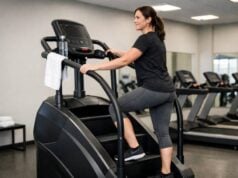
Stair intervals
If you have stairs, even a few rounds can make indoor walking much more demanding. Stairs raise effort quickly, so they are useful in small doses. They are not the best starting point for everyone, especially if you have knee pain or poor balance, but they can be very effective once basic walking fitness is in place.
Best for:
- short, hard finishers
- limited time
- people who want a stronger cardio effect
The main point is that indoor walking is broader than it sounds. It is not just pacing around the room. It can be structured, progressive, and surprisingly effective when you choose the right format for the day.
Four home walking routines
These routines are designed for different days, energy levels, and experience levels. You can use them on their own or rotate them through the week.
| Routine | Length | Effort | Best for |
|---|---|---|---|
| Easy starter walk | 10 minutes | Easy | Beginners and low-energy days |
| Brisk interval walk | 20 minutes | Moderate | Busy days and calorie burn |
| Low-impact walking circuit | 25 minutes | Moderate | Variety and home cardio |
| Steady endurance session | 30 to 40 minutes | Easy to moderate | Step building and weekly volume |
1. Easy starter walk
Use this when you are new, sore, or short on motivation.
- 2 minutes easy march in place
- 2 minutes hallway laps or in-place walk
- 1 minute side steps
- 2 minutes easy march
- 1 minute heel digs with arm swing
- 2 minutes relaxed walk to finish
This is intentionally simple. The goal is not to feel crushed. The goal is to prove that even a short home session counts.
2. Brisk interval walk
Use this when you want a more workout-like feel.
- 4 minutes easy warm-up
- 1 minute brisk walk or fast march
- 2 minutes easier recovery walk
- Repeat that cycle 5 times
- 1 minute easy cooldown
That gives you 20 minutes total. If you are using a walking pad, this format works especially well by changing speed slightly during each work interval.
3. Low-impact walking circuit
Use this when you want more variety.
Do 3 rounds of:
- 1 minute march in place
- 1 minute step-touch
- 1 minute knee lifts
- 1 minute forward-back steps
- 1 minute heel digs
- 1 minute easy walk recovery
Take 30 to 45 seconds between rounds if needed. This style often feels more engaging than straight walking while still staying low impact.
4. Steady endurance session
Use this to build weekly volume.
- 5 minutes easy start
- 20 to 30 minutes steady moderate walking
- 5 minutes easy finish
You can do this with hallway laps, a walking pad, a treadmill, or a mix of marching and laps. The main goal is continuous movement. Think of it as your indoor version of a longer outdoor walk.
These four routines cover most needs: a low-barrier start, a time-efficient interval option, a more interesting home cardio format, and a longer steady session. That is enough variety for most people to build a real routine without making the plan complicated.
Weekly indoor walking plan
A good weekly indoor walking plan should feel realistic, not heroic. Most people do better with 4 to 6 sessions per week of mixed lengths than with one or two oversized sessions followed by several inactive days.
Here is a simple 4-week framework.
| Week | Main goal | Suggested sessions | Total weekly target |
|---|---|---|---|
| 1 | Build consistency | 4 sessions of 10 to 20 minutes | 50 to 75 minutes |
| 2 | Add time | 4 to 5 sessions of 15 to 25 minutes | 75 to 100 minutes |
| 3 | Add intensity | 5 sessions with 1 to 2 brisk workouts | 100 to 130 minutes |
| 4 | Own the habit | 5 to 6 sessions of mixed lengths | 120 to 150 minutes |
A balanced week could look like this:
- Monday: 20-minute brisk interval walk
- Tuesday: 10-minute easy starter walk after a meal
- Wednesday: 25-minute low-impact walking circuit
- Thursday: Rest or light hallway laps
- Friday: 20-minute brisk interval walk
- Saturday: 30- to 40-minute steady endurance session
- Sunday: Easy walk or full rest
This structure works because it mixes easier and harder days. It also gives you a few shorter sessions that are harder to skip. That matters more than people think. A 10-minute walk that actually happens is more useful than a 45-minute walk you keep postponing.
You can also split sessions across the day. Three 10-minute indoor walks can be a better fit than one 30-minute block, especially on busy days. That is one reason short walks after meals can be so practical. If you are trying to decide how much weekly cardio to build toward, weekly cardio targets for weight loss can help you place indoor walking in the bigger picture.
A few rules make the weekly plan more sustainable:
- keep at least 1 to 2 easier days in the week
- do not make every session an interval workout
- repeat sessions you enjoy instead of constantly hunting for novelty
- increase total weekly minutes slowly
- treat missed sessions as normal, not as a reason to quit
Indoor walking works best when it becomes a pattern, not a test of motivation.
How to burn more and progress
If indoor walking starts to feel too easy, the answer is not always “walk forever.” It is better to progress deliberately so the workouts stay effective without becoming miserable.
The simplest ways to make indoor walking burn more calories are:
- walk longer
- walk faster
- shorten recovery periods
- add more arm drive
- use stairs in small doses
- add slight incline on a treadmill
- increase total weekly sessions
- reduce long standing breaks
A useful rule is to change only one or two variables at a time. For example, add 5 minutes to a steady session before also trying to make it faster. Or add one extra brisk interval before switching the whole workout to a harder effort.
Progression ideas that actually work
Here are easy upgrades once your basic plan feels manageable:
- Turn a 10-minute walk into 12 to 15 minutes.
- Add one extra work interval to your 20-minute session.
- Use a stronger arm swing during brisk segments.
- Add 2 to 4 stair climbs near the end of a routine.
- Turn one easy day into a moderate day.
- Increase total weekly indoor walking by 10 to 20 minutes.
The most effective progressions are often boringly small. That is good. Big jumps tend to create soreness and skipped sessions.
Indoor walking and calorie burn
Indoor walking will not burn as much per minute as hard running or fast cycling, but it does not need to. It becomes powerful when it raises your activity level across the week. That is why longer steady sessions and short extra walks both matter.
Many people also overlook how indoor walking fits into a full routine. It can pair with strength training, or it can act as “bonus movement” on top of a lifting plan. If you want a broader structure, a weekly workout schedule can help you place indoor walking alongside other training. And if your feet, calves, or hips get tight as volume rises, basic prep from a warm-up and recovery routine can make the next session feel much better.
Do not forget the food side
Indoor walking supports weight loss, but it does not remove the need for reasonable nutrition. A common mistake is assuming the workout “should have” burned enough to create progress while eating habits quietly cancel it out. The best results usually come from pairing indoor walking with a manageable deficit, enough protein, and meals that do not leave you constantly starving.
Progress does not need to look dramatic. It may show up first as better stamina, more daily movement, easier workouts, or improved consistency. Those are often the changes that lead to visible fat loss later.
Mistakes and safety tips
Indoor walking is beginner-friendly, but a few common mistakes make it less effective or less comfortable than it should be.
Mistake 1: making every session too hard
If you turn every home walk into a hard interval workout, you may burn out quickly. Most sessions should feel manageable enough that you could repeat them tomorrow if needed.
Mistake 2: underestimating short sessions
People often dismiss 8-, 10-, or 15-minute indoor walks as “not enough.” In reality, these are often the sessions that keep momentum alive on busy days. Several short walks per week can add up to meaningful progress.
Mistake 3: staying too casual forever
The opposite problem also happens. Some people do the same very easy pace for months and expect different results. Once the routine feels comfortable, add time, pace, or intervals gradually.
Mistake 4: poor posture and clumsy footwork
Marching with rounded shoulders, staring at the floor, or stomping heavily can make workouts feel awkward. Stand tall, keep steps light, and let your arms move naturally.
Mistake 5: using indoor walking as compensation
Indoor walking should support your routine, not become punishment for eating. That mindset usually creates a cycle of overeating and “making up for it” instead of steady habits.
Safety basics
Indoor walking is generally low risk, but keep these in mind:
- stop if you feel chest pain, faintness, or unusual shortness of breath
- use a handrail for stair work if needed
- avoid slippery socks on hard floors
- keep pets, cords, and clutter out of the way
- build up gradually if you are new, older, or deconditioned
If you have heart disease, severe joint pain, uncontrolled blood pressure, balance problems, or another condition that changes exercise safety, talk with a clinician before starting a harder plan.
The biggest long-term mistake is waiting for perfect conditions. Indoor walking is useful precisely because it works on imperfect days. It gives you a way to stay active when time is short, weather is bad, energy is mixed, or life is messy. Used that way, it becomes one of the most practical home cardio options for weight loss.
References
- WHO guidelines on physical activity and sedentary behaviour 2020 (Guideline)
- Aerobic Exercise and Weight Loss in Adults: A Systematic Review and Dose-Response Meta-Analysis 2024 (Systematic Review)
- Home-Based Indoor Physical Activity Programs for Community-Dwelling Older Adults: A Systematic Review 2024 (Systematic Review)
- Relationship of Daily Step Counts to All-Cause Mortality and Cardiovascular Events 2023 (Meta-Analysis)
- The effects of active workstations on reducing work-specific sedentary time in office workers: a network meta-analysis of 23 randomized controlled trials 2023 (Systematic Review)
Disclaimer
This article is for general educational purposes only and is not a substitute for medical advice, diagnosis, or treatment. If you have heart disease, significant balance problems, severe joint pain, or symptoms such as chest pain, dizziness, or unusual shortness of breath during exercise, speak with a qualified clinician before starting a new indoor walking plan.
If this article helped you, share it on Facebook, X, or your preferred platform so someone else can find a simple home walking routine that fits real life.