No-jumping cardio can absolutely help with weight loss. You do not need burpees, box jumps, or high-impact plyometrics to burn calories, raise your heart rate, and improve fitness. For many people, low-impact cardio is not a compromise. It is the version they can do more consistently, recover from more easily, and stick with long enough to actually lose fat.
This guide covers the best no-jumping cardio options for home and the gym, how to make low-impact workouts effective for weight loss, sample routines for different fitness levels, and how to choose the right format if you have joint pain, extra body weight, or just hate high-impact exercise.
Table of Contents
- Why no-jumping cardio can still work
- Best no-jumping cardio options
- Three no-jumping workouts to try
- How to choose the right low-impact workout
- How much no-jumping cardio you need
- How to make low-impact cardio more effective
- Mistakes and safety points
Why no-jumping cardio can still work
A lot of people assume that if a workout is low-impact, it must also be low-results. That idea sounds convincing, but it is usually wrong. Jumping is one way to make exercise harder. It is not the only way.
Weight loss happens when your overall routine helps create a calorie deficit over time. Cardio supports that by increasing energy expenditure, improving fitness, and often making it easier to stay active outside formal workouts. None of that requires repeated jumping. In fact, for many people, removing the jumping makes the plan more effective because it improves consistency.
No-jumping cardio works well for weight loss because it can be:
- Easier on the knees, hips, ankles, and lower back
- More realistic for beginners and deconditioned exercisers
- Better tolerated by people carrying extra body weight
- Easier to recover from than constant high-impact intervals
- More apartment-friendly and beginner-friendly
- Easier to do more often without feeling wrecked
That last point matters. A tough workout only helps if you can repeat it. Many people burn out on high-impact programs because soreness lingers, joints get irritated, or the sessions feel mentally punishing. Low-impact exercise often solves that problem. You may not feel as dramatic a “crushed it” sensation, but you can usually do more total work across the week.
This is especially useful if your fat-loss plan already includes walking, strength training, or steps. Cardio should help your routine, not destroy it. If every hard session leaves you limping around the house and sitting more for the next two days, the net benefit may be smaller than expected.
No-jumping cardio is also a strong option for people who want “fat-burning” workouts without buying into the myth that only all-out, sweaty, breathless sessions count. Brisk walking, cycling, rowing, swimming, elliptical intervals, fast marching, shadowboxing without hops, and low-impact circuits can all raise heart rate and burn calories. If you want one of the simplest examples, walking for weight loss already shows how effective lower-impact movement can be when it is done consistently.
The bigger picture is this: the best cardio for weight loss is not the most explosive one. It is the one you can do often enough, hard enough, and long enough to support a calorie deficit. For many people, that turns out to be low-impact cardio.
Best no-jumping cardio options
No-jumping cardio can happen on machines, in the pool, outdoors, or in your living room. The best option depends on your joints, your fitness level, your equipment, and what you will actually keep doing.
Here are some of the strongest low-impact choices.
| Option | Impact level | Intensity potential | Best for |
|---|---|---|---|
| Brisk walking | Very low | Low to moderate | Beginners, daily use, recovery days |
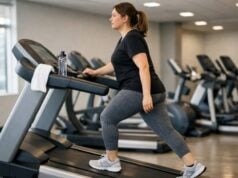
| Incline treadmill walking | Low | Moderate to high | People who want harder work without running |
| Stationary bike | Very low | Moderate to high | Joint-friendly intervals and steady cardio |
| Elliptical | Low | Moderate to high | People who want a running-like feel without impact |
| Rowing machine | Low | High | People who tolerate hinging and pulling well |
| Swimming or water exercise | Very low | Moderate to high | Those with painful joints or higher body weight |
| Marching and step-based home circuits | Low | Low to moderate | Home exercisers with no equipment |
| Low-impact shadowboxing | Low | Moderate to high | People who get bored easily |
Brisk walking is still one of the most underrated options. It is easy to scale, easy to recover from, and practical enough to become a real habit. Once you add pace, hills, or incline, it becomes much more challenging than many people expect.
Cycling is another excellent choice because it lets you work hard without pounding your joints. It is especially useful if walking for long durations bothers your knees, feet, or lower back. If that sounds like your best fit, an exercise bike workout plan for weight loss can show how to progress it beyond easy spinning.
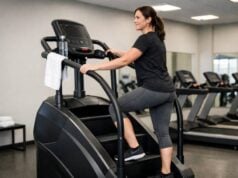
Ellipticals sit in a useful middle ground. They feel smoother than running, but can still get your heart rate up quickly if you increase resistance, stride power, or interval density. That is why many people eventually realize the answer to “best machine” depends less on calories displayed and more on what they can sustain. A guide to the best cardio machine for weight loss is helpful when you are deciding between treadmill, bike, elliptical, and StairMaster.
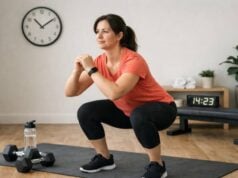
At home, no-jumping cardio usually works best when you stop trying to imitate high-impact workouts and instead use movements that suit the format. Fast marching, side steps, step jacks without jumping, squat-to-reach patterns, low-impact skaters, step taps, shadowboxing, and knee drives can all be surprisingly effective when organized well.
The best option is not always the one with the highest theoretical calorie burn. It is the one your joints tolerate, your schedule allows, and your mind does not hate.
Three no-jumping workouts to try
These workouts are designed to raise your heart rate without any jumping. They work because of pacing, work density, and exercise selection, not impact.
Workout 1: Beginner low-impact home circuit
Do each move for 40 seconds, then rest for 20 seconds. Complete 3 to 4 rounds.
- Fast march in place
- Side step with arm reach
- Sit-to-stand from a chair
- Step-back tap with alternating arms
- Standing knee drive
- Shadowboxing without bouncing
- Standing toe taps to a low step or sturdy object
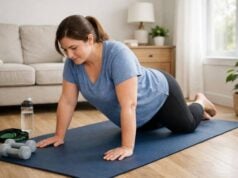
- Slow mountain climber against a wall or bench
This is a good starting point because it keeps one foot on the floor most of the time, uses simple patterns, and still lets you build rhythm and heat.
Workout 2: Incline walking intervals
- 5-minute easy warm-up
- 1 minute brisk incline walk
- 2 minutes easier flat or lower-incline walk
- Repeat 8 to 10 times
- 5-minute cool-down
This is a very effective no-jumping option for people who want a workout that feels athletic but still joint-friendlier than running. If you enjoy treadmill-based sessions, treadmill walking for weight loss makes it much easier to build a structured plan instead of randomly pressing buttons.
Workout 3: Bike or elliptical interval session
- 5-minute warm-up
- 90 seconds moderate effort
- 60 seconds hard effort
- Repeat 10 to 12 rounds
- 5-minute cool-down
The key here is honest effort on the hard interval without turning it into a sprint that destroys your form. This works well because low-impact machines let you push intensity through resistance and cadence instead of impact.
If you want a longer, steadier format, try this instead:
- Warm up for 5 minutes.
- Do 20 to 30 minutes at a pace where you are breathing harder but can still speak in short sentences.
- Cool down for 5 minutes.
That steady-state format is often easier to recover from and can be more sustainable for people doing multiple cardio days per week.
A few tips make all three workouts better:
- Keep posture tall instead of folding forward
- Use your arms on purpose, especially during marching, stepping, and shadowboxing
- Let speed come from rhythm, not flailing
- Scale the work interval before adding more complicated moves
- Stop if pain changes how you move
Many people assume low-impact means light effort. It does not. When the interval design is good and the movement quality is solid, these sessions can be surprisingly demanding.
How to choose the right low-impact workout
The right no-jumping cardio option depends less on what is “best” in general and more on what is best for your body and your situation right now.
If you are a beginner, simple usually wins. Walking, cycling, beginner elliptical sessions, and basic home circuits are easier to learn and easier to repeat than more technical options. You do not need variety on day one. You need something you can do next week too.
If you have knee pain, ankle pain, or a history of impact-related flare-ups, start with the most joint-friendly choices:
- Stationary bike
- Recumbent bike
- Elliptical
- Swimming
- Water aerobics
- Controlled walking on flat ground
For readers managing joint irritation, low-impact cardio for bad knees is often a stronger match than trying to force more aggressive conditioning.
If you are carrying a lot of extra body weight, the best first choice is often the one that feels safest and least punishing. That may be chair-supported marching, a bike, a pool, or short walking intervals. Many people in this situation push themselves into workouts that are technically possible but practically miserable. A better starting point is one that lets you accumulate more minutes with less dread. If that sounds familiar, a workout plan for obese beginners may provide a more realistic foundation.
If you get bored easily, pick options with rhythm or variation. Shadowboxing, mixed circuits, treadmill incline changes, rowing intervals, and music-based stepping tend to hold attention better than staring at a wall while pedaling.
If you live in an apartment or need a quiet option, walking pads, marching circuits, cycling, and controlled step patterns usually work better than anything with stomping or fast lateral hopping. Some people discover that the easiest way to be more active is not a formal workout at all, but structured home walking. That is where walking pad workouts for weight loss become very practical.
Also think about the “friction” factor:
- Is it easy to start?
- Is the equipment available?
- Can you do it in bad weather?
- Will pain flare afterward?
- Can you picture doing it three times per week?
Those questions matter more than the machine’s calorie display. A cardio option that fits your body and your life will beat a theoretically superior one that keeps getting postponed.
How much no-jumping cardio you need
For weight loss, more is not always better, but some structure helps. Most adults do well starting with 150 minutes per week of moderate-intensity aerobic activity, then adjusting upward if needed based on goals, recovery, and what is happening with food intake and body weight.
That does not mean you must start at 150 minutes immediately. A beginner may start with:
- 20 minutes, 3 times per week
- 15 minutes, 5 times per week
- 10-minute bouts spread across the day
What matters is building enough weekly work to make the routine meaningful.
A practical progression often looks like this:
| Weeks | Target | Example |
|---|---|---|
| 1 to 2 | 60 to 90 minutes per week | 20 to 30 minutes on 3 days |
| 3 to 4 | 90 to 120 minutes per week | 30 minutes on 3 to 4 days |
| 5 to 8 | 120 to 150 minutes per week | 30 minutes on 4 to 5 days |
| After that | 150 to 210 minutes or more if tolerated | Based on recovery and results |
If your workouts are harder interval sessions, you may not need as many total minutes as someone doing only easier steady-state work. If your cardio is very gentle, such as relaxed walking, you may benefit from more total time or faster pace.
It also helps to remember that fat loss still depends on the whole picture. No-jumping cardio supports your calorie burn, but actual weight loss still depends heavily on food intake. That is why a simple guide to creating a calorie deficit often matters as much as the workout format.
For most people, a useful weekly structure is:
- 3 to 5 cardio sessions
- 1 to 3 of them slightly harder
- The rest moderate and sustainable
- Daily steps or extra walking when possible
If you are also strength training, keep that in the plan. Cardio helps the deficit. Strength training helps preserve muscle. A guide to how often to strength train for weight loss can help you combine the two without overloading the week.
The best weekly dose is the one you can recover from and repeat. If you go from almost nothing to seven hard workouts, your body and schedule will usually protest. Build gradually.
How to make low-impact cardio more effective
If a no-jumping workout feels too easy, the answer is not automatically to add jumping. It is to improve the programming.
Low-impact cardio becomes much more effective when you manipulate a few key variables:
Move with more purpose
Many home workouts fail because the movements are technically low-impact but performed with lazy pacing. Marching can be easy or demanding depending on arm drive, knee height, posture, and speed. The same is true for step taps, shadowboxing, and biking.
Use intervals
You can make almost any low-impact modality harder by alternating work and recovery. For example:
- 40 seconds hard, 20 seconds easy
- 1 minute moderate, 1 minute hard
- 3 minutes brisk, 2 minutes easier
Intervals increase the challenge without requiring impact.
Add incline or resistance
This is especially helpful on treadmills, bikes, ellipticals, and rowers. A modest incline or higher resistance can raise heart rate quickly without changing impact.
Shorten rest, carefully
When your form stays good, slightly shorter rests can make a workout denser and more productive.
Progress over time
The body adapts fast. What felt hard in week one may feel normal by week four. Progress can come from:
- More minutes
- More rounds
- Faster pace
- Higher resistance
- Less rest
- Better range of motion and control
This is also why people sometimes think low-impact cardio “stopped working” when really the workout just stopped evolving. A good plan gradually asks a little more from you.
You can also combine modalities. A low-impact session might use 10 minutes of incline walking, 10 minutes of bike intervals, and 10 minutes of shadowboxing. That often makes longer sessions feel less repetitive.
One more point: do not confuse “more sweating” with “better fat loss.” Sweating depends on heat, hydration, and individual response. The better indicators are consistency, total weekly work, effort level, and whether the routine helps support a calorie deficit.
Finally, if your goal is body composition rather than just scale loss, low-impact cardio works best alongside strength training. That combination often outperforms cardio-only plans because it helps protect lean mass. Even a simple beginner resistance plan can make a difference there.
Mistakes and safety points
Low-impact cardio is usually easier to tolerate than jumping-heavy exercise, but it can still go wrong when people use the wrong setup or expectations.
The first mistake is assuming low-impact means effortless. Then the workout becomes a token session with no real challenge. If your heart rate barely rises and you never progress the routine, the results will be limited.
The second mistake is going too hard too quickly just because the movements feel safe. Low impact is not the same as no stress. You can still irritate knees on an elliptical, flare your hips with too much incline, or overload your lower back on a rower with poor technique.
The third mistake is using pain as the guide for intensity. Some discomfort from working hard is normal. Pain that changes your gait, shortens your stride, or makes you brace awkwardly is not. That is your cue to modify the movement, range, resistance, or duration.
Other common errors include:
- Choosing boring workouts you will not repeat
- Doing only hard interval sessions and skipping easier work
- Ignoring steps outside the workout
- Overestimating calorie burn and eating it back
- Using poor posture on bikes, rowers, or marching circuits
- Expecting low-impact cardio alone to overcome inconsistent eating
Safety-wise, start a bit easier than your motivation wants. The first goal is to prove you can recover and come back. That matters even more if you are older, very deconditioned, or returning after a long break.
Use these practical safety rules:
- Warm up for 5 minutes before harder work.
- Increase only one variable at a time: time, pace, or resistance.
- Wear supportive shoes for walking-based sessions.
- Stop and reassess if pain becomes sharp, unstable, or progressively worse.
- Talk with a clinician before starting if you have major heart, lung, metabolic, or orthopedic issues.
A final mindset point helps a lot: low-impact cardio is not “less than.” It is just another way to train. For many people, it is the format that finally makes regular exercise sustainable enough to produce real fat loss.
References
- WHO guidelines on physical activity and sedentary behaviour 2020 (Guideline)
- Aerobic Exercise and Weight Loss in Adults: A Systematic Review and Dose-Response Meta-Analysis 2024 (Systematic Review)
- Effect of exercise training on weight loss, body composition changes, and weight maintenance in adults with overweight or obesity: An overview of 12 systematic reviews and 149 studies 2021 (Review)
- About Physical Activity and Arthritis 2024 (Official Guidance)
- Adult Activity: An Overview 2023 (Official Guidance)
Disclaimer
This article is for general educational purposes only and is not a substitute for medical advice, diagnosis, or treatment. If you have significant joint pain, balance problems, a heart condition, recent surgery, or concerns about starting exercise, speak with a qualified healthcare professional before beginning a new cardio routine.
If this article helped you, share it on Facebook, X, or your preferred platform so more people can find low-impact cardio options that actually fit their bodies and goals.