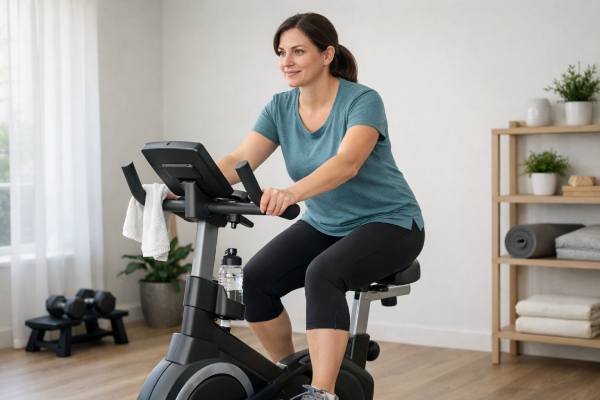
An exercise bike can be one of the best tools for weight loss, especially if you want low-impact cardio that is easy to scale and realistic to repeat several times per week. It will not magically melt fat on its own, but it can help create a calorie deficit, improve fitness, and make regular exercise feel more doable than running or jumping-based workouts.
The bigger advantage is consistency. A stationary bike lets beginners start gently, lets experienced riders train hard, and often feels more joint-friendly than many other cardio options. Below, you will see how exercise bikes help with fat loss, how many calories they can realistically burn, which type of bike to choose, and how to follow a practical workout plan that actually fits real life.
Table of Contents
- Is an exercise bike good for weight loss?
- Benefits of an exercise bike
- Calories burned on an exercise bike
- Choosing the right type of bike
- Best exercise bike workouts
- 4-week exercise bike workout plan
- How to get better results safely
Is an exercise bike good for weight loss?
Yes, an exercise bike can absolutely help with weight loss. The short version is simple: if the bike helps you burn extra calories, improve fitness, and stick to regular training without beating up your joints, it is doing its job.
The more useful answer is that the bike works best when it solves real-world problems that derail other forms of cardio. Many people know they “should” walk more, jog, or do classes, but they run into knee pain, weather issues, lack of confidence, boredom, or the simple fact that high-impact exercise feels miserable when they are just getting started. A bike removes a lot of that friction. You can ride at home, at the gym, while watching something, in short or long sessions, and without the repeated pounding of running.
That is why the bike often works better in practice than flashier options. The best cardio method for weight loss is not the one with the toughest reputation. It is the one you can do often enough to matter. If you are comparing machines more broadly, the best cardio machine for weight loss usually depends on what you can sustain, not what looks hardest on paper.
Still, the bike is not a magic shortcut. Weight loss happens when your overall energy intake stays below your overall energy expenditure for long enough. Riding helps, but it does not replace a calorie deficit. It also does not automatically produce dramatic calorie burn unless the sessions are long enough, hard enough, or frequent enough.
A bike is usually a particularly smart choice if you:
- Are new to exercise and want a simple starting point
- Need lower-impact cardio
- Want to improve fitness without running
- Prefer structured workouts with clear settings and progressions
- Need an option that feels safer and more controlled
It may be an even better choice if you have joint discomfort or a larger body size that makes impact-heavy cardio less comfortable. In those cases, training on a bike may let you accumulate far more weekly work than jogging ever would. That is a major reason cycling-based cardio shows up so often in plans for people who need low-impact cardio for bad knees or easier entry points into regular exercise.
The main limitation is that biking is not weight-bearing, so it does less for bone-loading than activities like walking or hiking. It also trains the lower body more than the upper body. But for fat loss specifically, those drawbacks are often much smaller than the benefit of being able to train consistently.
Benefits of an exercise bike
The best reason to use an exercise bike for weight loss is not just calorie burn. It is the combination of calorie burn, convenience, and repeatability. That mix is what turns a good workout into a workable routine.
Here are the main advantages.
- Low impact on joints.
Because your feet stay on the pedals and your body weight is supported, biking usually feels easier on the knees, ankles, and hips than running. That can make a huge difference for beginners, older adults, and anyone carrying extra body weight. - Easy to control intensity.
On a bike, you can raise or lower the challenge quickly through resistance, cadence, and interval structure. That makes it easier to stay in the right training zone instead of guessing. - Good for beginners and experienced exercisers.
A true beginner can pedal easily for 10 to 15 minutes. A fitter rider can do brutal intervals or longer threshold work. Few machines scale that smoothly. - Convenient and weather-proof.
You can ride early, late, during bad weather, or in short breaks during the day. That convenience often matters more than people think. - Easier recovery than high-impact cardio.
A tough bike workout can still leave you tired, but it often creates less pounding-related soreness than running. That can help you stay active the next day. - Useful for heavier individuals.
For people who find walking long distances uncomfortable at first, the bike can provide a much better cardio bridge into better fitness.
There are also smaller benefits that make a big difference over months, not days. Exercise bikes make it easier to stack short sessions, follow guided workouts, and train while distracted by music, podcasts, or a show. That sounds minor, but reducing boredom improves adherence, and adherence drives results.
The downside is that biking can become too comfortable. Because you are seated, it is easy to pedal at a relaxed pace and assume you are working harder than you are. That does not mean easy rides are useless, but it does mean you need some structure.
Another limitation is that the bike can create a false sense of progress if you focus only on sweat or the console display. People often feel they have “earned” more food after a ride, then unintentionally erase the calorie deficit. The bike helps most when it supports a bigger system that also includes sensible eating, enough daily movement, and some strength training.
That is also why the bike works especially well when paired with strength training for weight loss. Cardio helps drive energy expenditure and fitness, while strength work helps maintain muscle and performance during a calorie deficit.
Calories burned on an exercise bike
Calories burned on an exercise bike depend mostly on four things: your body weight, workout duration, resistance, and how hard you are actually riding. A lighter person doing an easy 20-minute spin will burn far less than a heavier person doing a hard 45-minute interval session.
That is why there is no one universal number.
A practical way to think about bike calorie burn is to use ranges, not exact console numbers. Many bike displays give rough estimates, and they can be useful for consistency, but they should not be treated as precise measurements. Actual burn varies with the bike, the settings, your efficiency, and how honestly you are working.
Here is a realistic rough estimate for a 30-minute session:
| Body weight | Easy ride | Moderate ride | Hard ride |
|---|---|---|---|
| 150 lb | About 125 | About 195 to 200 | About 300 |
| 200 lb | About 165 | About 260 to 265 | About 405 |
| 250 lb | About 205 to 210 | About 325 to 330 | About 505 |
These numbers are most helpful as a planning tool, not a promise. They show that the bike can burn a meaningful number of calories, especially when you ride longer or ride harder, but they also show why one ride alone rarely drives dramatic fat loss.
A few useful takeaways:
- Longer moderate rides often beat very short hard rides for total calorie burn
- Harder intervals can raise calorie burn efficiently when time is limited
- Heavier individuals generally burn more calories at the same effort
- Consistency across the week matters more than chasing a huge single-session number
It is also worth noting that “fat burning” is often misunderstood. People sometimes assume only gentle cycling burns fat, while harder rides only burn carbs. In reality, total energy expenditure across the day and week matters far more than trying to trap yourself in a perfect fat-burning zone. Both easier and harder rides can help with weight loss when they fit into a sustainable routine. If you want a broader comparison with walking, running, and other activities, calories burned by common exercises can help put the bike in context.
For most people, a good fat-loss target is not “burn the maximum calories every ride.” It is “burn enough calories this week while staying consistent, recovering well, and not getting so hungry that you overeat afterward.”
Choosing the right type of bike
Not all exercise bikes feel the same, and the right type can affect comfort, confidence, and long-term adherence more than many people expect.
The three main categories are upright bikes, recumbent bikes, and indoor cycling bikes.
Upright bike
An upright bike is the classic gym-style stationary bike. You sit more vertically, the pedals are under you, and the feel is closer to casual outdoor cycling.
This is often the best all-around option if you want:
- A comfortable middle ground between ease and challenge
- A bike that suits beginners and intermediate riders
- Enough intensity for steady rides and intervals
- A smaller learning curve than a spin-style bike
Recumbent bike
A recumbent bike has a backrest and a more reclined position with the pedals out in front. It is often the most comfortable option and can be excellent for people with balance issues, substantial deconditioning, or difficulty tolerating upright positions for long periods.
A recumbent bike is especially useful if:
- You want the lowest-intimidation starting point
- You need extra support for the back or balance
- You are significantly overweight and want a safer, more comfortable setup
- You plan to start with longer easy rides
The tradeoff is that it can feel less athletic and may encourage coasting if you are not careful with effort.
Indoor cycling or spin bike
This is the more performance-oriented style used in many cycling classes. The riding position is more aggressive, the flywheel feel is different, and it usually handles harder efforts well.
A spin bike makes sense if you:
- Like class-style workouts or interval training
- Want a more road-cycling feel
- Enjoy pushing harder and sweating more
- Already know basic bike setup
For many people, the best bike for weight loss is simply the one that feels comfortable enough to use consistently and challenging enough to keep progressing. If you enjoy guided rides and structured workouts, a spin bike may keep you more engaged. If you need comfort and confidence, a recumbent may be the clear winner. If you want a versatile middle option, an upright bike is hard to beat.
The good news is that fat loss does not depend on picking the trendiest model. It depends on the workload you can actually accumulate. That is why readers looking for programming ideas often do well with stationary bike workouts for weight loss rather than obsessing over whether one bike style burns slightly more calories than another.
Best exercise bike workouts
The best exercise bike workout for weight loss depends on how much time you have, how fit you are, and how well you recover. You do not need every ride to be hard. In fact, most people get better results when they use a mix of steady rides, easier recovery rides, and one or two harder sessions each week.
Here are the main workout styles that work well on a bike.
Steady moderate rides
This is the most underrated option for fat loss. A steady ride at a moderate effort is sustainable, easy to repeat, and often burns a solid number of calories without wrecking recovery.
A good target is an effort where:
- You can still speak in short sentences
- Breathing is elevated but controlled
- You finish feeling worked, not destroyed
These rides are especially helpful for beginners and for building weekly volume.
Zone 2 rides
Zone 2 cycling is a little easier than what many people imagine when they hear “workout,” but it can be very effective for building aerobic fitness and supporting weight loss without huge fatigue costs. If you like the idea of longer, controlled sessions, Zone 2 cardio for weight loss is a smart fit for the bike.
Interval rides
Intervals are ideal when time is limited. They let you alternate hard efforts with easier recovery periods, which can raise training quality and make short sessions more effective.
A simple beginner interval example:
- Warm up for 5 minutes
- Ride hard for 30 seconds
- Recover easy for 90 seconds
- Repeat 6 to 8 times
- Cool down for 5 minutes
You can also use longer intervals, such as 2 minutes hard and 2 minutes easy.
Sprint-style sessions
These are very hard and best used sparingly. They are not necessary for most beginners and can backfire if they make you overly sore, overly hungry, or too tired to train again soon.
Mixed rides
Many people enjoy rides that combine a moderate base with a few short pushes. This feels less monotonous than pure steady-state work and less intimidating than full intervals.
The most practical fat-loss setup is usually:
- 2 to 3 moderate or Zone 2 rides
- 1 interval ride
- Optional easy recovery spin if you enjoy it
That balance tends to work better than doing hard intervals every time you get on the bike. It is also a better long-term strategy than turning cardio into punishment. If you are trying to decide whether the bike should be mostly easier or harder work, HIIT vs. steady-state cardio for fat loss is the right comparison to keep in mind: both can work, but the best choice is the one you can recover from and repeat.
4-week exercise bike workout plan
This beginner-friendly plan is built for weight loss, habit formation, and steady improvement. It assumes you are new to structured bike training or returning after a long break. You can do it on an upright, recumbent, or spin bike.
Use effort levels like this:
- Easy: very comfortable, warm-up pace
- Moderate: breathing harder, but still controlled
- Hard: challenging, focused effort you cannot hold forever
| Week | Sessions | What to do |
|---|---|---|
| 1 | 3 rides | 2 moderate rides of 20 to 25 minutes, 1 easy ride of 15 to 20 minutes |
| 2 | 3 to 4 rides | 2 moderate rides of 25 to 30 minutes, 1 interval ride, optional 1 easy ride |
| 3 | 4 rides | 2 moderate rides of 30 minutes, 1 interval ride, 1 easy recovery ride |
| 4 | 4 rides | 1 longer moderate ride of 35 to 40 minutes, 2 standard rides, 1 interval ride |
Here is how to structure the sessions.
Moderate ride
- 5-minute easy warm-up
- 15 to 30 minutes moderate pace
- 3 to 5-minute easy cool-down
Beginner interval ride
- 5-minute warm-up
- 6 rounds of 30 seconds hard and 90 seconds easy
- 5-minute cool-down
In week 3 or 4, you can progress to 8 rounds or use longer work periods like 1 minute hard and 2 minutes easy.
Easy recovery ride
- 15 to 20 minutes at a relaxed pace
- Keep resistance light
- The goal is movement, not exhaustion
A practical weekly layout could look like this:
- Monday: Moderate ride
- Wednesday: Interval ride
- Friday: Moderate ride
- Saturday or Sunday: Easy or longer moderate ride
If that feels like too much, start with three sessions and add time before adding more days. If it feels too easy after two weeks, increase only one variable at a time: duration, resistance, or number of intervals. Do not raise everything at once.
This matters because the best weight-loss plan is not the one that looks hardest on day one. It is the one you are still following in week six and week twelve. That is also why it helps to zoom out and think in weekly totals. If you need a wider framework for planning sessions across your week, how much cardio per week for weight loss and weekly workout schedule for weight loss help you slot bike work into a bigger routine.
How to get better results safely
A bike can be extremely effective for weight loss, but a few common mistakes quietly reduce results.
Mistake 1: riding too easy every time
Comfortable rides have a place, but if every session feels like a gentle warm-up, progress stalls. You need enough resistance, enough cadence, or enough duration to create real training stress.
Mistake 2: riding too hard every time
The opposite problem is just as common. People discover intervals, go all-out every ride, then end up exhausted, sore, ravenous, or inconsistent. One or two harder sessions per week is usually enough for most people.
Mistake 3: ignoring bike setup
Seat height, handlebar position, and posture matter. A poor setup can irritate the knees, hips, neck, or low back. As a simple rule, your knee should still have a slight bend at the bottom of the pedal stroke, and you should not feel crammed or overreaching.
Mistake 4: counting exercise calories too aggressively
Even when the bike helps a lot, it is easy to eat back the benefit. People often reward themselves after a workout without realizing it. The bike works best when it supports a consistent eating pattern rather than trying to compensate for overeating.
Mistake 5: using the bike instead of doing everything else that matters
Bike sessions help, but they are not the whole plan. Better results usually come when cycling is paired with:
- Adequate protein
- A manageable calorie deficit
- Enough daily movement outside workouts
- Strength training to help preserve muscle
- Sufficient sleep and recovery
That is why the bike pairs so well with a calorie deficit for weight loss and a simple lifting routine. Cardio adds energy expenditure. Strength training helps protect lean mass. Daily movement fills the gap between workouts.
A few final tips make the bike more effective:
- Increase ride time before making every workout harder
- Track minutes, not just calories
- Keep at least one ride each week comfortable
- Use music, classes, or entertainment if boredom is your main barrier
- Reassess every few weeks based on energy, hunger, and consistency
Most importantly, choose the version of biking you can keep doing. The best exercise bike routine is not the most intense one. It is the one that still fits your knees, schedule, motivation, and recovery next month.
References
- Aerobic Exercise and Weight Loss in Adults: A Systematic Review and Dose-Response Meta-Analysis 2024 (Systematic Review)
- 2024 Adult Compendium of Physical Activities: A third update of the energy costs of human activities 2024 (Review)
- Exercise training in the management of overweight and obesity in adults: Synthesis of the evidence and recommendations from the European Association for the Study of Obesity Physical Activity Working Group 2021 (Review)
- WHO guidelines on physical activity and sedentary behaviour 2020 (Guideline)
Disclaimer
This article is for general educational purposes only and is not a substitute for medical advice, diagnosis, or treatment. If you have heart disease, uncontrolled blood pressure, dizziness, severe joint pain, or another medical condition that affects exercise tolerance, speak with a qualified clinician before starting a harder cycling program.
If this article helped you, please share it on Facebook, X, or your preferred platform so someone else can use it to build a smarter weight-loss routine.