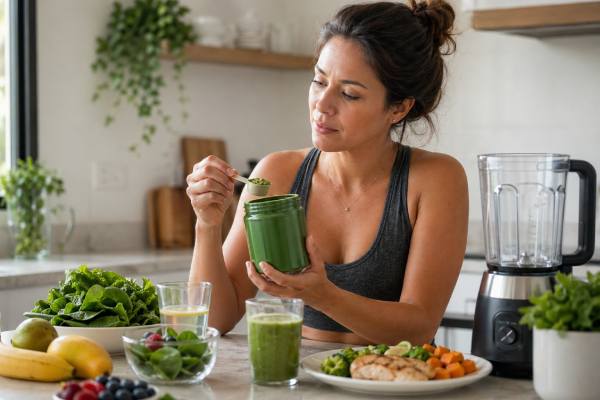
Greens powders are unlikely to cause meaningful weight loss on their own. They can be a convenient way to add some plant-based nutrients to your routine, but they are not a shortcut around the basics that actually move body weight: a sustainable calorie deficit, enough protein and fiber, consistent eating habits, sleep, movement, and time.
That does not make them useless. Some people find greens powders helpful when life gets messy, produce intake drops, or healthy routines feel harder to maintain. The key is knowing what they can realistically do, what they cannot do, and how to avoid paying premium prices for impressive marketing and very average results.
Table of Contents
- What greens powders actually are
- Can greens powders cause weight loss?
- When they might still be worth using
- Ingredients that matter more than marketing
- Safety, side effects, and who should be careful
- How to choose a better greens powder
- The most practical way to use one
What greens powders actually are
“Greens powder” is a marketing term, not a tightly defined scientific category. Most products blend dried vegetable powders, grasses, algae, fruit extracts, herbs, probiotics, digestive enzymes, and sweeteners into one scoop. Common label ingredients include spinach, kale, wheatgrass, barley grass, spirulina, chlorella, broccoli, beetroot, green tea extract, and small amounts of fiber.
That variety is part of the appeal. One tub promises vegetables, antioxidants, gut support, energy, detox, immunity, and metabolism support all at once. The problem is that “contains many healthy-sounding things” is not the same as “delivers a clinically meaningful dose of any one thing.” Many products use proprietary blends or long ingredient lists that make the formula look stronger than it really is.
A serving is also very different from eating actual vegetables. Whole foods provide water, chewing resistance, bulk, and fullness. Those factors matter for appetite control. A scoop mixed into water may contain plant compounds, but it usually does not create the same satisfaction as a big salad, roasted vegetables, fruit, beans, or soup. That distinction matters a lot for anyone trying to lose fat or hold steady during maintenance.
Greens powders also vary wildly from brand to brand. Some are mostly dehydrated produce. Some lean heavily on stimulants or herbal extracts. Some are basically flavored “wellness” blends with small token amounts of greens. Others are closer to a multinutrient drink mix than a true produce substitute.
The biggest mindset mistake is treating a greens powder as a health upgrade simply because it looks clean and plant-based. In real life, a product like this sits somewhere between convenience tool, placebo-support habit, and expensive insurance policy. It is not the nutritional equal of eating enough vegetables, and it is not automatically a scam either. Its value depends on what problem you are trying to solve.
Can greens powders cause weight loss?
Usually, no. Greens powders do not have a unique fat-burning effect that reliably makes body fat come off. If a product helps someone lose weight, the effect is usually indirect.
For example, a greens powder might help if it replaces a higher-calorie drink, nudges someone toward a more structured morning routine, or gives them a convenient option on days when breakfast would otherwise become a pastry and sweet coffee. In that case, the weight-loss benefit comes from fewer calories or better consistency, not from “superfoods” melting fat.
This is especially important when progress has slowed. A plateau is more often explained by a smaller real-world calorie deficit, weekend drift, liquid calories, stress eating, lower daily movement, water retention, or simple impatience than by a lack of micronutrients. If your scale is stuck, fixing your calorie deficit or working through a plateau decision tree is usually more useful than buying another supplement.
| Goal | What a greens powder may help with | Why it often falls short | What matters more |
|---|---|---|---|
| Lose body fat | May support a lower-calorie routine if it replaces something more calorie-dense | It does not create automatic fat loss by itself | Calorie balance, adherence, and time |
| Feel fuller | Some products add a little fiber | Most servings do not match the bulk and satiety of whole foods | Protein, fiber, food volume, and regular meals |
| Improve energy | Some products include caffeine or green tea extract | That is stimulation, not fat loss | Sleep, total intake, and smart caffeine use |
| Cover nutrition gaps | Can add some vitamins, minerals, or plant compounds | It still does not replace a consistently good diet | Meals built around real food |
| Break a plateau | May help only if it improves routine and decision-making | It does not solve hidden calories or shrinking deficits | Better tracking, movement, and appetite management |
There is also a psychological angle that gets overlooked. Supplements can create a false sense of progress. After buying something expensive and “clean,” people may feel as though they have already taken the important action. That can reduce urgency around the boring but effective behaviors: portion control, shopping habits, meal planning, protein intake, sleep, and step count.
So the honest answer is simple: greens powders can support weight loss only when they improve the habits that actually drive weight loss. They do not replace those habits, and they do not outperform them.
When they might still be worth using
A greens powder can still be useful in a narrow, practical sense. Convenience matters, especially during busy weeks, travel, maintenance phases, or periods when decision fatigue is high and diet quality slips. A supplement that helps you stay more consistent may have real value even if it is not physiologically powerful.
The best case for a greens powder is not “this helps me burn fat faster.” It is more like: “This keeps my routine from falling apart.” That is a different standard, and it is a better one.
A greens powder may be reasonable if:
- you regularly go long stretches without produce
- you travel often and your food environment is unpredictable
- you need a low-friction cue that starts a better morning routine
- you use it instead of a sugary coffee drink or random snack
- you genuinely like it and it helps you stay more organized
It may also help some people during maintenance or slow-fat-loss phases because it reduces the all-or-nothing thinking that often shows up when life gets busy. Instead of saying, “I ate poorly today, so the day is ruined,” a person may keep more structure in place with a simple routine. That can be useful, but again, the advantage is behavioral.
Where greens powders become less useful is when they crowd out better tools. If your main issue is fullness, high-volume eating will usually do more than a greens drink. If your breakfast is chaotic, a filling smoothie with protein, fruit, and actual fiber is often a better investment because it can function as a real meal rather than a symbolic one.
There is also a cost question. Many greens powders are expensive enough that, over a month, the same money could buy frozen berries, salad kits, Greek yogurt, eggs, beans, oats, or a higher-quality protein product. For fat loss, those foods often deliver more satiety per dollar and a clearer return on investment.
A useful rule is this: keep a greens powder in the “nice-to-have” category unless it is solving a specific convenience problem you actually have.
Ingredients that matter more than marketing
If you do buy a greens powder, the label matters more than the branding. The front of the package usually sells a story. The back of the package tells you whether that story has substance.
The first ingredient type worth noticing is fiber. Fiber can help with fullness, digestion, and appetite control, but many greens powders contain only a small amount per serving. A product that includes meaningful fiber is more likely to help with fat-loss routines than one that leans on “detox” language. If appetite control is your main goal, dedicated fiber supplements for weight loss or simply eating more beans, berries, oats, potatoes, and vegetables may make a bigger difference.
The second category is stimulants, especially caffeine and green tea extract. These ingredients may make you feel more energized and can slightly affect appetite or thermogenesis in some people, but that is not the same as durable fat loss. They can also create side effects that users mistake for the product “working,” such as jitters, a racing heart, nausea, or reduced appetite followed by rebound hunger later. If you are sensitive to stimulants, read up on caffeine for weight loss before assuming more is better.
Then there are the broad “wellness extras”: digestive enzymes, probiotics, adaptogens, mushrooms, antioxidant blends, and botanicals. Some of these ingredients are interesting. Some may be helpful in the right context. But in many greens powders they are added in small, unclear amounts that make the product sound more advanced than it is. A long list can signal ambition, not effectiveness.
Another thing to watch is whether the serving actually delivers enough of anything to matter. A label may boast 40 or 60 ingredients, but if the full scoop is only a few grams, each individual ingredient may be present in tiny quantities. That does not mean it has zero value, but it does mean you should be skeptical of sweeping promises.
Claims like these deserve extra caution:
- “burns fat”
- “boosts metabolism”
- “detoxes the body”
- “alkalizes”
- “crushes cravings”
- “replaces vegetables”
- “clinically proven” with no clear product-specific evidence
The products most likely to disappoint are often the ones promising the widest range of benefits. In weight management, ingredients with modest, believable roles are more trustworthy than ingredients marketed as doing everything at once.
One more practical point: a greens powder with no protein is not doing much to protect muscle or keep you full. A greens drink can fit into a routine, but it should not be confused with a real meal. For fat loss, the hierarchy is still protein, fiber, food volume, and overall calories first. Everything else is secondary.
Safety, side effects, and who should be careful
Most healthy adults can tolerate many greens powders reasonably well, but “natural” does not automatically mean low-risk. Multi-ingredient supplements are tricky because the ingredient list may be long, the doses may be unclear, and the interactions may not be obvious.
The most common problems are relatively mild: bloating, gas, nausea, cramping, loose stools, or feeling overly full when taken on an empty stomach. Those effects are more likely if a product contains fiber, sugar alcohols, magnesium, probiotics, or concentrated plant extracts.
Stimulant-heavy formulas deserve more caution. If a greens powder includes caffeine, green tea extract, guarana, yerba mate, or other energizing blends, it can worsen anxiety, palpitations, shakiness, reflux, poor sleep, or headaches. That matters because bad sleep and rebound hunger can make fat loss harder, not easier.
Certain groups should be especially careful:
- people taking blood thinners, because vitamin K intake and herbal ingredients can complicate management
- people with heart rhythm issues, uncontrolled blood pressure, or stimulant sensitivity
- people with kidney disease or medically restricted diets
- people who are pregnant or breastfeeding
- people taking multiple medications for diabetes, thyroid disease, mood, or digestion
- anyone with a history of supplement-related side effects
Another practical concern is label quality. A supplement may contain less of an ingredient than expected, more than expected, or ingredients not clearly disclosed. That does not mean every product is unsafe, but it is a reminder that supplements are not regulated like prescription drugs before they hit the market.
The safer mindset is to treat greens powders like optional tools, not harmless food in powder form. If you have a medical condition, take regular medication, or are using several supplements at once, bring the exact product to your clinician or pharmacist. A five-minute review can save a lot of guesswork.
Also remember that some red flags show up only after you start taking a product. Stop using it and get medical advice if you develop chest symptoms, severe GI distress, faintness, unusual swelling, allergic symptoms, or a strong worsening of sleep, anxiety, or blood pressure control.
How to choose a better greens powder
If you want to try one, do not shop by influencer enthusiasm or the size of the ingredient list. Shop by clarity.
A better product usually has a shorter list of exaggerated promises and a clearer list of actual amounts. Use this filter:
- Decide what job you want it to do.
Is this for convenience, travel, produce insurance, or replacing a higher-calorie morning habit? If you cannot define the job, it is easier to overpay. - Learn to read supplement labels.
Look for serving size, total calories, fiber, stimulant content, sweeteners, and whether ingredients are fully disclosed instead of hidden inside a proprietary blend. - Check for stimulant load.
If the product contains caffeine or energizing botanicals, make sure you are not unintentionally stacking it with coffee, pre-workout, or fat burners. - Prioritize third-party testing.
Independent testing does not guarantee that a product will help you lose weight, but it does improve the odds that the label reflects what is actually inside. - Compare cost against real-food alternatives.
Ask what the monthly price could buy in frozen produce, fruit, yogurt, oats, beans, eggs, or a quality protein powder. - Avoid “detox” and miracle language.
The louder the claims, the more cautious you should be.
Taste and routine fit matter too. The best supplement is the one you can use consistently without turning it into a source of stress, expense, or side effects. If you hate the flavor, forget to take it, or feel worse on it, it is not helping.
It is also smart to test one product at a time. Do not start a greens powder, fat burner, probiotic, magnesium, fiber supplement, and new coffee routine all in the same week. If something goes wrong, you will have no idea what caused it.
The most practical way to use one
The most realistic way to use a greens powder is as a support tool, not a fat-loss engine.
If you choose one, attach it to a behavior that already matters. For example, use it as part of a breakfast routine that also includes enough protein intake for weight loss, or keep it as a travel backup so a disrupted schedule does not turn into an all-day convenience-food spiral. That is a sensible role.
What it should not do is create permission to ignore the bigger picture. A greens drink does not cancel out restaurant overeating, frequent liquid calories, low protein, poor sleep, or chronically inconsistent meals. It also does not make up for believing every product label. Staying alert to weight loss claims and red flags is part of using supplements well.
For most people, the practical verdict is this:
- greens powders can be convenient
- some formulas may offer modest nutritional or routine-support value
- they are not a reliable standalone weight-loss strategy
- they are usually less powerful than whole foods, protein, fiber, and calorie control
- they make the most sense when used to support consistency, not to replace fundamentals
That distinction matters even more when you are near goal weight, stuck in a plateau, or trying to maintain results. At that stage, small habits count, but expensive “health halo” products can distract from the habits that count most.
References
- Dietary Supplements for Weight Loss – Health Professional Fact Sheet 2022 (Fact Sheet)
- Effects of dietary fibre on metabolic health and obesity 2024 (Review)
- Does green tea catechin enhance weight-loss effect of exercise training in overweight and obese individuals? a systematic review and meta-analysis of randomized trials 2024 (Systematic Review and Meta-analysis)
- Label Accuracy of Weight Loss Dietary Supplements Marketed Online With Military Discounts 2024 (Case Series)
- Weight Loss Product Notifications 2025 (FDA Safety Page)
Disclaimer
This article is for general educational purposes only. Greens powders and other weight-loss supplements can affect appetite, digestion, sleep, medications, and certain medical conditions, so they are not a substitute for personalized medical advice, diagnosis, or treatment. If you have a health condition, take prescription medication, or develop side effects, speak with a qualified clinician before using them.
If this article helped, consider sharing it on Facebook, X, or your preferred platform so someone else can make a more informed choice about greens powders and weight loss.