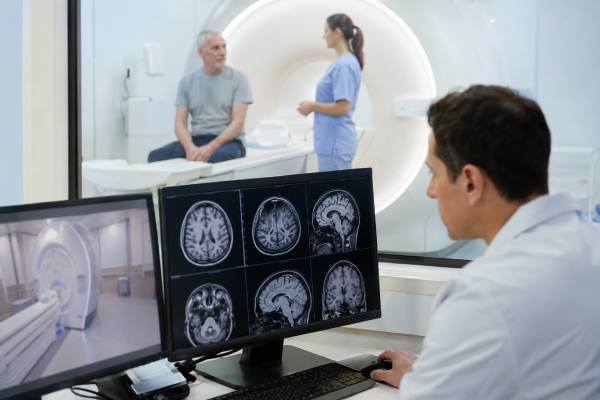
A brain MRI is one of the most detailed imaging tests used to look at the brain and nearby structures inside the head. Doctors may order it when symptoms suggest a problem involving brain tissue, blood vessels, inflammation, fluid spaces, tumors, injury, infection, or certain neurologic diseases.
MRI is powerful, but it is not a general “scan for everything.” It does not diagnose most mental health conditions by itself, and a normal MRI does not always mean symptoms are imaginary or unimportant. The value of the test depends on the question being asked, the symptoms, the timing, and whether MRI is the right imaging tool compared with CT, PET, EEG, lab testing, or cognitive assessment.
Table of Contents
- How Brain MRI Works
- What a Brain MRI Shows
- When Brain MRI Is Ordered
- MRI With Contrast
- What Happens During the Test
- How Brain MRI Results Are Interpreted
- Limits of Brain MRI
- Safety and Urgent Symptoms
How Brain MRI Works
A brain MRI uses a strong magnetic field, radio waves, and computer processing to create detailed images of the brain. Unlike CT scans and X-rays, MRI does not use ionizing radiation.
During the scan, the MRI machine collects information from hydrogen atoms in body tissues, especially water and fat. A computer turns that information into cross-sectional images. These images can be viewed in different planes, such as from the front, side, or top of the head, and can highlight different tissue characteristics.
MRI is especially useful for soft tissues. That matters in brain imaging because the brain, nerves, blood vessels, cerebrospinal fluid, and inflammatory changes can be difficult to evaluate with less detailed imaging. MRI can show subtle differences between gray matter, white matter, fluid, blood products, scar tissue, swelling, and abnormal tissue growth.
A standard brain MRI usually includes several image types, often called sequences. Each sequence emphasizes different information. For example:
- T1-weighted images are useful for anatomy and for seeing enhancement after contrast.
- T2-weighted images highlight fluid and many forms of swelling or tissue injury.
- FLAIR images suppress normal fluid signal so that certain brain lesions stand out more clearly.
- Diffusion-weighted imaging can help identify recent ischemic stroke and some infections or highly cellular tumors.
- Susceptibility-sensitive sequences can show tiny blood products, calcification, or microbleeds.
- MR angiography or venography may be added to evaluate arteries or veins.
The specific protocol depends on why the MRI was ordered. A scan for new seizures may not use the same exact protocol as a scan for multiple sclerosis, a pituitary tumor, memory loss, dizziness, stroke symptoms, or follow-up after brain surgery.
A brain MRI is sometimes compared with a brain CT scan. CT is faster and often preferred first in emergencies such as major head trauma or suspected acute bleeding. MRI usually gives more detail for many non-emergency brain conditions, but it takes longer, is more sensitive to motion, and may not be safe for every implanted device.
What a Brain MRI Shows
A brain MRI can show the brain’s structure, fluid spaces, nearby nerves, blood vessels, skull base, eyes, inner ears, and surrounding soft tissues. It is most useful when the clinical question involves anatomy, tissue injury, inflammation, abnormal growth, or changes in blood flow.
A brain MRI may help identify or monitor many types of findings, including:
- Brain tumors, masses, cysts, or areas of abnormal enhancement
- Stroke, old infarcts, or patterns of reduced blood flow
- Bleeding, microbleeds, or older blood products
- Multiple sclerosis plaques and other white matter lesions
- Brain inflammation, encephalitis, or complications of infection
- Abscesses and some forms of meningitis-related complications
- Hydrocephalus or abnormal enlargement of the brain’s fluid spaces
- Structural changes linked with dementia or prior injury
- Pituitary, skull base, optic nerve, or cranial nerve abnormalities
- Vascular problems when paired with MR angiography or venography
- Traumatic brain injury findings that may not be visible on CT
- Congenital malformations or developmental brain differences
| Finding type | What it may help evaluate | Important limitation |
|---|---|---|
| White matter spots | Migraine-related changes, small vessel disease, demyelination, inflammation, prior injury | Small spots are common and often nonspecific |
| Restricted diffusion | Recent ischemic stroke, some infections, highly cellular tumors | Timing and symptoms are essential for interpretation |
| Abnormal enhancement | Tumor, inflammation, active demyelination, infection, blood-brain barrier disruption | Enhancement patterns are clues, not a diagnosis by themselves |
| Volume loss | Aging-related change, dementia patterns, prior injury, chronic neurologic disease | Mild atrophy can be difficult to interpret without clinical context |
| Ventricular enlargement | Hydrocephalus, brain volume loss, pressure-related fluid changes | Symptoms and comparison with prior scans matter |
MRI findings are interpreted in context. A small incidental cyst, tiny old scar, or nonspecific white matter change may have little to do with the symptoms that led to the scan. On the other hand, a subtle finding can be meaningful if it matches the symptom pattern, exam findings, and timing.
MRI can also help monitor known conditions. For example, it may be repeated to track multiple sclerosis activity, tumor growth or treatment response, hydrocephalus, vascular malformations, postoperative changes, or complications after stroke. In memory evaluations, MRI may help identify vascular injury, shrinkage patterns, masses, normal pressure hydrocephalus, or other structural causes. More specialized imaging may be considered in some cases, including brain imaging for memory loss when cognitive symptoms need a broader workup.
When Brain MRI Is Ordered
Doctors usually order brain MRI when symptoms, examination findings, or medical history raise concern for a structural or neurologic cause. The test is most useful when the result could change diagnosis, treatment, monitoring, or the need for specialist care.
Common reasons for ordering a brain MRI include new or changing neurologic symptoms. These may include weakness on one side of the body, numbness, trouble speaking, vision changes, balance problems, unexplained fainting, new seizures, persistent dizziness with neurologic signs, or a severe headache with concerning features.
Brain MRI may also be ordered for:
- Headaches with red flags, such as sudden onset, neurologic deficits, cancer history, immune suppression, papilledema, or a major change from the person’s usual pattern
- New seizures or changes in seizure pattern
- Suspected multiple sclerosis or other demyelinating disease
- Memory loss, cognitive decline, or rapidly worsening confusion
- Brain fog with neurologic signs or another reason to suspect a brain disorder
- Suspected tumor, infection, inflammation, or abscess
- Follow-up of a known brain lesion
- Pituitary or hormonal symptoms that suggest a pituitary mass
- Hearing loss, tinnitus, vertigo, or facial nerve symptoms when an inner ear or cranial nerve cause is suspected
- Stroke symptoms when MRI is appropriate for the situation
- Prior abnormal CT findings that need more detailed evaluation
MRI is not automatically ordered for every headache, mood change, anxiety symptom, concentration problem, or episode of brain fog. Many common symptoms are first evaluated with history, physical and neurologic exam, medication review, sleep assessment, blood tests, mental health screening, or cognitive testing. For example, trouble concentrating may come from ADHD, anxiety, depression, sleep deprivation, substance use, thyroid disease, anemia, medication effects, or stress. MRI is considered when there are signs that imaging is likely to add useful information.
In emergency settings, CT may be chosen first because it is fast, widely available, and effective for detecting many urgent problems such as acute bleeding, skull fracture, or major mass effect. MRI may follow when more detail is needed. The choice between MRI and CT depends on timing, stability, suspected diagnosis, contraindications, and local availability. A more focused comparison is covered in MRI vs CT for brain symptoms.
MRI may also be part of a broader diagnostic pathway. A person with memory loss may need cognitive screening, lab testing, medication review, and possibly MRI. A person with episodes of altered awareness may need MRI plus an EEG test. A person with suspected Alzheimer’s disease may need MRI to assess structure, while PET imaging or fluid biomarkers may be considered in selected cases. MRI is often one piece of the answer, not the whole workup.
MRI With Contrast
MRI contrast is used when doctors need to see blood-brain barrier changes, abnormal enhancement, blood vessel detail, inflammation, infection, or tumor characteristics more clearly. The most common MRI contrast agents contain gadolinium.
A brain MRI may be ordered without contrast, with contrast, or both without and with contrast. The decision depends on the suspected condition. Many routine scans begin without contrast because non-contrast sequences can show anatomy, old injury, many strokes, bleeding products, fluid spaces, and many white matter abnormalities. Contrast is added when it is likely to answer a specific question.
Contrast may be especially helpful when evaluating:
- Brain tumors, metastases, or tumor recurrence
- Meningitis complications, abscess, or certain infections
- Active inflammation or demyelination
- Pituitary tumors and some skull base lesions
- Cranial nerve abnormalities
- Blood-brain barrier disruption
- Postoperative or post-treatment changes
- Some vascular abnormalities
Gadolinium contrast is given through an IV. Most people tolerate it well. Some notice a brief cool sensation, metallic taste, nausea, or discomfort at the IV site. Allergic-like reactions are uncommon but can occur. Severe reactions are rare, but radiology teams screen for prior contrast reactions and have protocols for managing them.
Kidney function matters because gadolinium is cleared mainly through the kidneys. Modern lower-risk gadolinium agents have made serious kidney-related complications much less common than they were with older higher-risk agents, but people with severe kidney disease, dialysis, kidney transplant history, or acute kidney injury need careful review before contrast is given. The radiology team may check recent kidney function blood tests or choose a non-contrast protocol when appropriate.
Pregnancy and breastfeeding are handled carefully. MRI without contrast may be used during pregnancy when the expected benefit outweighs the concern, but gadolinium is generally avoided unless it is essential. Breastfeeding guidance may vary by institution, but many modern recommendations do not require stopping breastfeeding after standard gadolinium contrast. People who are pregnant, may be pregnant, or breastfeeding should tell the ordering clinician and MRI staff before the scan.
Contrast is not a sign that the doctor thinks the problem is more serious. It simply means the radiologist or ordering clinician believes enhancement information may improve the scan’s diagnostic value.
What Happens During the Test
A brain MRI is usually painless, but it requires lying still in a narrow scanner while the machine makes loud tapping or knocking sounds. Most brain MRI exams take about 20 to 60 minutes, depending on the protocol and whether contrast is used.
Before the scan, you will complete a safety questionnaire. This is not a formality. MRI magnets are always on, and metal objects or certain devices can be dangerous. The MRI team will ask about pacemakers, defibrillators, aneurysm clips, cochlear implants, neurostimulators, implanted pumps, shrapnel, metal fragments, surgical hardware, prior injuries involving metal, and other devices.
You may be asked to change into MRI-safe clothing. Jewelry, watches, hairpins, removable dental work, hearing aids, credit cards, phones, keys, and other metal items must stay outside the scanner room. Some makeup, hair products, medication patches, glucose monitors, or body piercings may also need special handling.
During the scan, your head rests in a cradle or coil that helps collect the images. Padding may be used to reduce movement. You will usually have earplugs or headphones because MRI noise can be loud. The technologist can see and hear you, and most scanners provide a call button.
The hardest part for many people is staying still. Motion can blur MRI images, especially during longer sequences. If you move, some pictures may need to be repeated. People with tremor, severe pain, claustrophobia, confusion, or difficulty lying flat should tell the ordering clinician or imaging center ahead of time. Options may include extra padding, breaks between sequences, a wider-bore scanner, an open MRI in selected cases, or medication for anxiety when medically appropriate.
If contrast is needed, an IV is placed in the hand or arm. Some images are taken before contrast, then contrast is injected, and additional images are taken afterward. The contrast portion is usually only one part of the exam.
After the scan, most people can return to usual activities right away. If you took a sedative, you may need someone to drive you home and you should follow the instructions given by the facility.
How Brain MRI Results Are Interpreted
A radiologist interprets the MRI and sends a report to the clinician who ordered the test. The report describes the findings, compares them with prior scans when available, and usually includes an impression that summarizes the most important conclusions.
A brain MRI report often includes technical details, such as whether contrast was used and which sequences were performed. It may describe normal structures, abnormal signal, enhancement, mass effect, bleeding, fluid spaces, blood vessels, sinuses, or skull base findings. The impression section is usually the most useful part for patients, but the full report may contain important nuance.
Common report phrases can be confusing. For example, “nonspecific white matter changes” means small signal changes are present but do not point to one diagnosis by themselves. They can be associated with migraine, aging, high blood pressure, diabetes, prior inflammation, small vessel disease, demyelination, or other causes. The meaning depends on age, risk factors, symptoms, lesion pattern, and whether the findings change over time.
“Incidental finding” means something was seen that may not be related to the symptoms. Incidental findings can include small cysts, benign-appearing developmental variations, sinus disease, tiny old scars, or mild volume changes. Some need no follow-up. Others need repeat imaging or referral, especially if they are large, uncertain, growing, or located in a sensitive area.
“Normal brain MRI” is often reassuring, but it does not rule out every cause of symptoms. Migraine, many seizure disorders, concussion symptoms, early neurodegenerative disease, functional neurologic symptoms, depression, anxiety, ADHD, sleep disorders, and many metabolic problems can exist with a normal structural MRI. A normal scan may narrow the differential diagnosis rather than end the evaluation.
When results are abnormal, the next step depends on the finding. Some abnormalities require urgent treatment, while others need comparison imaging, blood tests, lumbar puncture, neurologic exam, neuropsychological testing, EEG, PET imaging, or specialist referral. For a broader look at next steps, abnormal brain scan or cognitive test results explains how follow-up decisions are usually made.
Limits of Brain MRI
Brain MRI is detailed, but it cannot answer every brain, cognitive, or mental health question. It is best at showing structure and selected tissue characteristics, not every aspect of brain function, behavior, mood, attention, or lived symptoms.
MRI does not diagnose most psychiatric conditions on its own. Depression, anxiety disorders, ADHD, bipolar disorder, PTSD, OCD, and autism are diagnosed mainly through clinical evaluation, symptom history, developmental history, functional impairment, standardized screening or diagnostic tools, and sometimes collateral information. Brain imaging can be useful when symptoms suggest a neurologic condition, unusual presentation, new focal deficits, seizures, cognitive decline, or another medical cause, but a routine MRI is not a stand-alone mental health test. This distinction is explored further in MRI and mental illness diagnosis.
MRI also has limits in concussion. Many mild traumatic brain injuries do not show visible changes on standard MRI, especially when symptoms involve headache, dizziness, fatigue, sleep disruption, light sensitivity, and concentration problems without structural damage. MRI may be considered when symptoms are worsening, focal neurologic signs are present, or the injury history raises concern for bleeding or another complication.
A normal MRI does not rule out epilepsy. Some seizure disorders have no visible lesion on standard MRI. EEG, seizure description, witness history, medication response, and neurologic evaluation may be more important. In other cases, MRI can identify a structural cause of seizures, such as scarring, malformation, tumor, prior stroke, or hippocampal sclerosis.
MRI can also produce ambiguous findings. Small white matter spots, mild atrophy, tiny cysts, or subtle asymmetry may not have a clear meaning. This uncertainty can create anxiety, especially when the report uses technical language. The key question is not simply “Is anything abnormal?” but “Does the finding explain the symptoms, require treatment, or need follow-up?”
Different MRI machines and protocols can also affect what is seen. A high-quality epilepsy protocol, pituitary protocol, internal auditory canal protocol, or multiple sclerosis protocol may detect findings that a basic brain MRI could miss. Conversely, a more sensitive scan can find more incidental abnormalities that do not require treatment.
MRI is most useful when it is ordered for a specific reason and interpreted alongside the person’s symptoms, exam, history, risk factors, and other test results.
Safety and Urgent Symptoms
Brain MRI is generally safe for many people, but MRI safety depends on proper screening, device review, and clear communication with the imaging team. The magnet is powerful enough to move unsafe metal objects and interfere with some implanted or wearable devices.
Before the scan, tell the MRI team if you have or may have:
- A pacemaker, defibrillator, loop recorder, or heart valve
- Aneurysm clips, vascular coils, stents, or filters
- Cochlear implants or hearing devices
- Deep brain stimulation, spinal cord stimulation, or vagus nerve stimulation devices
- Insulin pumps, medication pumps, glucose monitors, or other wearable electronics
- Metal fragments from welding, military injury, or prior trauma
- Surgical implants, joint replacements, plates, screws, or rods
- Tattoos or permanent makeup, especially if large or metallic pigments were used
- Pregnancy, possible pregnancy, severe kidney disease, or prior contrast reaction
- Severe claustrophobia, inability to lie flat, or need for sedation
Many implants are MRI-conditional rather than automatically unsafe. That means they can be scanned only under specific conditions, such as a certain magnet strength, body position, scan setting, or waiting period after implantation. The MRI facility may need the device model, implant card, operative note, or manufacturer information before deciding whether the scan can proceed.
The scan itself is not usually painful. Possible discomforts include noise, warmth, anxiety, IV discomfort, or stiffness from lying still. Burns are rare but possible, especially if skin touches skin in a loop, if metal-containing clothing is worn, or if conductive items are not removed. Following the technologist’s positioning and clothing instructions helps reduce risk.
Some symptoms should not wait for a routine outpatient MRI appointment. Seek urgent medical evaluation, or emergency care when appropriate, for:
- Sudden weakness, numbness, facial droop, speech trouble, or vision loss
- Sudden severe headache, especially “worst headache” or thunderclap onset
- New seizure, repeated seizures, or seizure with injury or prolonged confusion
- Head injury with worsening headache, vomiting, confusion, drowsiness, or neurologic changes
- Fever with stiff neck, severe headache, confusion, or rash
- New confusion, agitation, hallucinations, or major behavior change with medical concern
- Loss of consciousness, severe dizziness with neurologic signs, or trouble walking
- Suicidal thoughts, risk of self-harm, or risk of harming someone else
In urgent situations, the first test may not be MRI. Emergency clinicians often choose the fastest safe pathway, which may include CT, blood tests, neurologic examination, medication, lumbar puncture, EEG, or hospital observation. For more detailed safety guidance around emergency warning signs, see when to go to the ER for neurological or mental health symptoms.
References
- Brain MRI. 2024 (Patient Information).
- ACR Appropriateness Criteria® Headache: 2022 Update. 2023 (Guideline).
- ACR Appropriateness Criteria® Cerebrovascular Diseases-Stroke and Stroke-Related Conditions. 2024 (Guideline).
- ACR Appropriateness Criteria® Dementia: 2024 Update. 2025 (Guideline).
- Use of Intravenous Gadolinium-Based Contrast Media in Patients With Kidney Disease: Consensus Statements from the American College of Radiology and the National Kidney Foundation. 2021 (Consensus Statement).
- ACR Manual on MR Safety. 2026 (Manual).
Disclaimer
This article is for general educational purposes only and is not a substitute for professional medical advice, diagnosis, or treatment. Brain MRI decisions should be made with a qualified clinician who can assess symptoms, exam findings, medical history, device safety, and whether urgent evaluation is needed.
Please share this article on Facebook, X formerly Twitter, or any platform where it may help someone understand brain MRI more clearly.