When people think about catching a respiratory virus indoors, they often focus on surfaces, hand sanitizer, or whether someone nearby looks sick. Those things still matter, but they do not tell the whole story. In many real-world settings, risk also depends on the air itself: how long people share it, how crowded the room is, how much virus is being released, and whether fresh or cleaned air is replacing what others exhale. That is why ventilation has become such an important part of staying well in homes, offices, schools, gyms, and other shared spaces. It is not a magic shield, and it cannot erase every risk. But cleaner indoor air can lower the concentration of airborne virus particles and make transmission less likely, especially when it is combined with other sensible habits. This article explains how ventilation works, what changes matter most, how to choose useful equipment, and where the limits are.
Core Points
- Better ventilation lowers the buildup of airborne virus particles and can reduce indoor transmission risk.
- Clean air strategies often improve comfort and indoor air quality beyond infection control alone.
- Ventilation works best as a layered measure, not as a replacement for staying home when sick or using masks in high-risk settings.
- A practical target in many shared indoor spaces is to increase clean air delivery through open windows, HVAC improvements, or portable air cleaners.
- Carbon dioxide monitors can help flag stale, crowded rooms, but they do not directly measure virus levels or prove a space is safe.
Table of Contents
- How airborne viruses build up
- What better ventilation changes
- Home fixes with biggest payoff
- Cleaner air in shared spaces
- Filters cleaners and add-ons
- Limits tradeoffs and room clues
How airborne viruses build up
Airborne transmission sounds abstract until you picture what happens in a real room. People breathe, talk, laugh, cough, sing, and exercise. Each of those activities releases particles of different sizes into the air. Some are large enough to fall quickly. Others are small enough to stay suspended long enough to spread through shared room air, especially when people spend time together indoors. That means infection risk is not only about whether you stand within arm’s reach of someone sick. It is also about whether you are sharing a poorly refreshed pocket of air for twenty minutes, an hour, or an entire workday.
This helps explain why some environments feel much riskier than others even when they look similar on the surface. A quiet, spacious room with few people and strong airflow is not the same as a crowded conference room with closed windows, long meetings, and stale air. Occupancy, time, activity level, and air exchange all interact. Singing, shouting, heavy exercise, and long stays push risk upward because they increase the amount of potentially infectious aerosol in the room or the amount another person inhales. That is one reason outbreaks have often been linked to rehearsals, restaurants, gyms, classrooms, break rooms, buses, and other places where people remain together indoors.
The important shift is to stop thinking about indoor infection risk as a simple yes-or-no event. It is closer to a concentration problem. The more virus-containing particles that accumulate in the air, and the longer people inhale them, the higher the chance of transmission. Cleaner air reduces that buildup. It does not need to eliminate every particle to matter. Even lowering the total concentration can change the odds in your favor.
This is also where ventilation stands apart from surface-focused strategies. Wiping a table may reduce contact risk from that surface, but it does little for the air a group has been sharing for an hour. In many settings, cleaner air matters more than constant disinfecting when the main concern is respiratory spread. That does not make hand hygiene irrelevant. It means indoor air deserves its own place in prevention planning.
A useful way to think about it is simple: every room has an air budget. People keep adding exhaled air and particles to that budget. Ventilation, filtration, and air cleaning remove or dilute them. If removal lags behind what occupants are adding, risk rises. If clean air is delivered steadily enough, the room becomes safer, often without anyone noticing except that it feels less stuffy.
What better ventilation changes
Ventilation lowers risk by diluting and removing contaminated indoor air. That can happen by bringing in outdoor air, exhausting indoor air, filtering recirculated air, or using other methods that add “clean air” to the room. The main idea is not complicated: when virus particles are less concentrated in the air, each breath contains less of them. Over time, that can reduce the chance that someone inhales an infectious dose.
This is why people often talk about clean air changes per hour, or ACH. The number is a way of describing how quickly air in a room is being refreshed or cleaned. In practical terms, more clean air generally means faster dilution of what people exhale. In public guidance for shared indoor spaces, a target of around 5 or more clean air changes per hour is often used as a useful benchmark. That does not have to come from one source alone. It can be a combination of outdoor air, HVAC filtration, and portable air cleaning. The point is delivery of cleaner air, not obsession with a single mechanical route.
Ventilation also works differently from distance. Distance helps most at close range, especially when someone is coughing or speaking directly toward you. Ventilation helps with the shared-air problem that develops over time across the room. That is why both can matter. A room can feel spacious and still have poor air turnover. On the other hand, a smaller room with good airflow and lower occupancy may be safer than it first appears.
It is also worth being realistic about what ventilation can and cannot do. It lowers airborne risk; it does not guarantee zero transmission. If someone with a high viral load is speaking face-to-face with you at close range, cleaner room air may not fully offset that exposure. Likewise, ventilation does not replace vaccination, staying home when sick, or masks in higher-risk situations. Instead, it works best as one layer in a broader plan. That layered view is more useful than the fantasy of a single perfect intervention.
The benefits extend beyond virus control. Better ventilation can lower stuffiness, carbon dioxide buildup from exhaled breath, odors, and some indoor pollutants. That does not mean every ventilation improvement will feel dramatic. Some changes are quiet and invisible. But over time, they can make indoor spaces less stagnant and less favorable to airborne spread.
For people interested in the broader prevention picture, simple illness-prevention habits still matter. The key difference is that ventilation acts on the environment itself. Instead of asking each person to behave perfectly at every moment, it improves the room for everyone in it. That makes it one of the most durable ways to lower shared risk indoors.
Home fixes with biggest payoff
Most people do not need an engineering degree to improve air in their home. They need a short list of changes that are practical, affordable, and worth the effort. The most effective home strategy depends on the season, the building, and what you are trying to manage, but the basics are straightforward.
Start with outdoor air when conditions allow. Opening windows on opposite sides of a room or home can create cross-ventilation that moves stale air out and fresh air in. Even cracking windows during a visit can help, especially when more people are indoors than usual. Bathroom fans and kitchen exhaust fans that vent outdoors can also support air movement. Box fans or window fans can strengthen that effect when used thoughtfully. The goal is not to create a wind tunnel. It is to prevent exhaled air from lingering.
If your home has central heating and cooling, run it in a way that supports filtration during gatherings or illness in the household. Continuous fan operation can move more air through the filter than an “auto” setting that cycles only when heating or cooling calls for it. If your system can handle it, a higher-efficiency filter can improve particle capture. In many homes, that means a MERV 13 filter or the highest rated filter the system can safely accommodate without airflow problems. If you are unsure, an HVAC technician can help you avoid the common mistake of installing a filter that is too restrictive for the equipment.
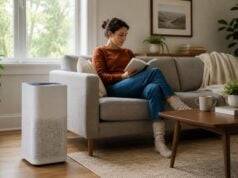
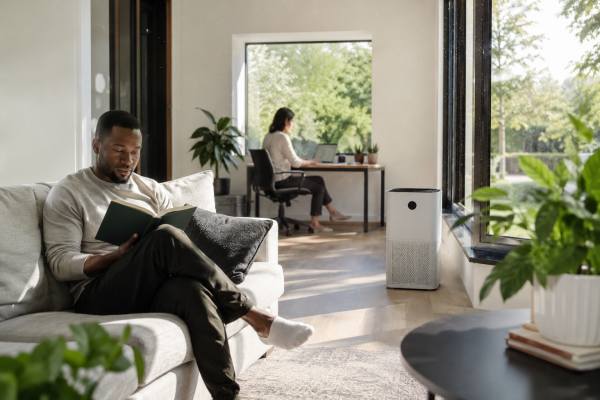
Portable air cleaners are often the most useful home upgrade when outdoor ventilation is limited by weather, wildfire smoke, outdoor pollution, security concerns, or noise. A properly sized portable unit in the room where people gather most can make a meaningful difference. Bedrooms, living rooms, and home offices are common priorities. If someone in the household is sick, placing a portable cleaner in the isolation room or the main shared space can be more helpful than moving it around unpredictably.
A few home realities matter too. Ventilation is not the same thing as comfort. On cold, hot, humid, or smoky days, opening windows may not be the best choice. During wildfire season, for example, more outdoor air can worsen indoor conditions, and filtration may become the better tool. That is where wildfire smoke protection changes the strategy. Humidity also matters. Very dry air can irritate the nose and throat, while excessive dampness encourages mold and other indoor problems. If you want the humidity side explained in more detail, indoor moisture balance and infection risk is worth a look.
Home ventilation does not need to be perfect to help. The biggest win is usually consistency: better airflow during gatherings, smarter filtration through the HVAC system, and one or two well-placed portable cleaners used where people actually spend time.
Cleaner air in shared spaces
Shared indoor spaces are where ventilation becomes both more important and more complicated. In homes, you can usually decide when to open windows or run a cleaner. In schools, offices, gyms, restaurants, clinics, and community buildings, air quality depends on building design, maintenance, occupancy, and how the space is used from hour to hour. The same room may be relatively low risk in the morning and much riskier by late afternoon if the crowd is larger, the doors stay closed, and nobody adjusts the system.
The most important concept in these spaces is clean air per person. A large room is not automatically safe if it is densely occupied. A smaller room is not automatically dangerous if it is well ventilated and lightly occupied. Occupancy is part of the equation because every extra person adds exhaled air. Lower density often improves effective ventilation per person even when the HVAC system itself does not change. That is why staggered meetings, larger rooms, shorter gatherings, hybrid attendance, and outdoor breaks can all lower risk without major renovations.
Schools and workplaces benefit from a layered building strategy. Existing HVAC systems should be maintained properly, filters changed on schedule, supply and exhaust balanced, and blocked vents corrected. Portable cleaners can be placed in rooms that are crowded, poorly ventilated, or used for long periods. These are often conference rooms, classrooms, music rooms, waiting areas, break rooms, and reception spaces. In some settings, moving an activity outdoors or relocating it to a larger room produces more benefit than any gadget.
Behavior still matters in shared air. Cleaner air lowers background risk, but it does not erase the importance of staying home when actively ill, especially during the most contagious phase of a respiratory infection. It also does not cancel out close-range exposure during prolonged face-to-face contact. In a crowded, high-risk setting, a well-fitted mask can add meaningful protection even when ventilation is good. The air strategy should match the setting rather than rely on slogans.
One practical mistake is assuming that because a building has vents, the air must be fine. Some systems are poorly maintained. Some rooms receive weak airflow. Some buildings were never designed for the current number of occupants or the way the rooms are now used. Another mistake is treating air quality as a one-time project. It is closer to maintenance than decoration. Filters age, occupancy changes, and systems drift from optimal settings.
Cleaner shared air is not just for pandemics. It can reduce the spread of ordinary winter respiratory viruses too. That makes ventilation one of the rare public-health improvements that remains useful even when headlines move on.
Filters cleaners and add-ons
Not all air-cleaning tools deserve equal confidence. Some are straightforward and well supported. Others are oversold, confusing, or poorly matched to the room. The most useful place to start is with the difference between ventilation and filtration. Ventilation brings in or exchanges air. Filtration removes particles from air that is already moving through a system. In practice, many spaces need both.
For central HVAC systems, the most practical upgrade is often a better filter, commonly MERV 13 or the highest level the system can handle safely. That can improve removal of fine particles from recirculated air. For rooms without strong HVAC support, portable air cleaners are usually the best add-on. A good portable unit should be sized to the room, not chosen by brand popularity alone. The key number is clean air delivery rate, or CADR. If the device is undersized for the room, even a high-quality filter will not move enough air to matter much. If it is oversized but kept on a whisper-quiet low setting because the noise is annoying, real-world performance may also disappoint.
Placement matters more than many buyers expect. A portable cleaner works best where airflow is not blocked and where people spend the most time. Tucking it behind a sofa, curtain, or desk reduces usefulness. Bedrooms, classrooms, offices, and living rooms are often better targets than hallways or corners no one occupies.
Then there are the add-on technologies. Some can help in specific professional settings, but they require more caution in consumer spaces. Upper-room germicidal ultraviolet systems and certain in-duct UV applications can be valuable when designed and installed correctly. But they are not casual plug-and-play purchases, and performance depends on room configuration, airflow, and safe installation. Ionizers, ozone generators, and loosely described “active” air-cleaning technologies deserve skepticism. If a device makes grand claims without clear performance data or may generate lung-irritating byproducts, it is not a smart first choice. For most people, a solid filter and enough airflow beat flashy technology.
That is why HEPA and portable air cleaner basics are usually more useful than shopping for exotic features. The same caution applies to devices marketed around ions or plasma; air ionizer claims often sound stronger than the evidence supporting them.
A sensible buying checklist looks like this:
- Match the unit to room size.
- Prefer clear CADR information over vague marketing language.
- Make sure replacement filters are affordable and available.
- Consider noise, because a unit you cannot tolerate will not stay on.
- Avoid devices that intentionally generate ozone.
The best equipment is not the most futuristic. It is the equipment that reliably delivers clean air in the room you actually use.
Limits tradeoffs and room clues
Ventilation is powerful, but it is not limitless. People often want one number or one device that will tell them whether a room is safe. Indoor air does not work that neatly. Risk depends on multiple variables at once: the number of people present, how long they stay, whether someone infectious is there, what they are doing, how the air mixes, and what other protections are in place. Cleaner air lowers risk, but it cannot promise certainty.
Carbon dioxide monitors are a good example of both usefulness and limitation. In occupied indoor spaces, rising carbon dioxide usually means exhaled breath is accumulating faster than fresh air is diluting it. That can make CO2 a helpful clue that a room is stuffy or under-ventilated for the number of people in it. But CO2 is not a virus detector. A low reading does not prove nobody infectious is present, and a higher reading does not mean transmission is inevitable. Filtration can reduce particles without changing CO2 much. A room can also have decent average readings but still poor mixing in certain zones. So a monitor is best used as a warning light, not a guarantee.
Tradeoffs matter too. More outdoor air is not always better in every condition. During wildfire events, severe outdoor pollution, very high humidity, extreme cold, or extreme heat, aggressively opening windows may create new problems. In those moments, filtration and air cleaning may be the smarter path. Noise is another tradeoff. Portable cleaners work better at higher speeds, but many people turn them down because of sound. Energy use, maintenance, and comfort also shape what people will stick with over time.
There is also the human tendency to outsource all judgment to the building. A room with good ventilation is still risky if a clearly ill person is speaking loudly in close contact for an hour. A room with moderate ventilation may be fairly acceptable for a short, quiet visit with a few people. Context matters. That is why air strategies pair well with common-sense decisions about crowding, duration, and whether to postpone gathering when someone is sick. Cleaner air supports immune resilience, but it does not replace it.
Finally, ventilation should be understood as a health-supportive baseline, not an emergency-only fix. Good indoor air reduces respiratory spread risk, and it can also make spaces more tolerable, less stale, and less burdened by some indoor pollutants. In many buildings, it is one of the most practical environmental upgrades available. If outdoor air quality is poor where you live, it also helps to understand the larger context of air exposure and immune stress so you know when to ventilate more and when to shift toward filtration.
The best question is not “Is this room perfectly safe?” It is “Is this room being managed in a way that meaningfully lowers risk?” Ventilation is often one of the clearest ways to answer yes.
References
- Taking Steps for Cleaner Air for Respiratory Virus Prevention | Respiratory Illnesses | CDC 2025 (Guidance)
- Ventilation and Respiratory Viruses | US EPA 2025 (Guidance)
- Guide to Air Cleaners in the Home | US EPA 2026 (Guidance)
- Reducing Transmission of Airborne Respiratory Pathogens: A New Beginning as the COVID-19 Emergency Ends – PMC 2024 (Review)
- Roadmap to improve and ensure good indoor ventilation in the context of COVID-19 2021 (Guideline)
Disclaimer
This article is for general educational purposes and is not a substitute for medical advice, building-specific engineering guidance, or occupational safety assessment. Ventilation needs vary by room size, occupancy, HVAC design, outdoor air quality, climate, and the health needs of the people using the space. If you have severe respiratory symptoms, high-risk medical conditions, mold or moisture problems, or concerns about workplace or school air quality, seek advice from an appropriate clinician or qualified building professional.
If this article helped you understand cleaner indoor air, share it on Facebook, X, or your preferred platform so others can use it too.