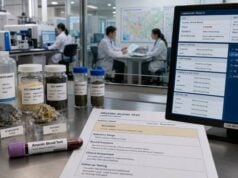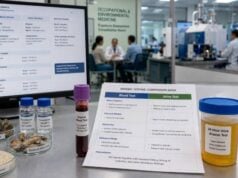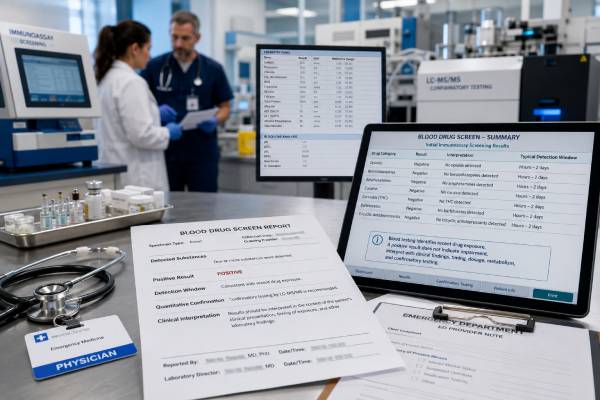
A blood drug screen test looks for selected drugs, medications, alcohol, or drug metabolites in a blood sample. It is most useful when the timing of exposure matters, such as suspected overdose, impaired driving investigation, emergency evaluation, workplace or legal follow-up, or medication monitoring. Blood testing usually reflects more recent use than urine testing because many drugs leave the bloodstream faster than they leave urine. That makes blood helpful for linking a result to current symptoms, but it also means a drug can be missed if the sample is collected too late.
A positive result does not automatically prove addiction, misuse, impairment, or the exact dose taken. The meaning depends on the drug, the test method, the cutoff, the time since use, prescribed medications, and the person’s clinical condition. Unexpected results often need confirmation with a more specific method such as liquid chromatography-tandem mass spectrometry.
- A blood drug screen usually detects recent drug exposure, often within hours to 1–2 days, depending on the substance.
- Blood is more useful than urine when clinicians need to compare drug levels with current symptoms.
- A positive screen may be presumptive, meaning it may need confirmation before major medical, legal, or employment decisions.
- Common targets include alcohol, cannabinoids, cocaine, amphetamines, opioids, benzodiazepines, barbiturates, and selected prescription drugs.
- A negative result does not rule out all drug use because the test only detects substances included in that panel.
- Urgent care is needed for severe sleepiness, slow breathing, chest pain, seizures, confusion, fainting, or suspected overdose.
Table of Contents
- What a Blood Drug Screen Measures
- When Blood Drug Testing Is Used
- Common Drugs on Blood Drug Screens
- Blood Detection Windows
- Positive, Negative, and Inconclusive Results
- False Positives, False Negatives, and Confirmation
- Blood vs Urine, Saliva, and Hair Testing
- What to Do After a Blood Drug Screen Result
What a Blood Drug Screen Measures
A blood drug screen measures whether selected drugs or drug-related compounds are present in whole blood, serum, or plasma. The exact sample type depends on the laboratory and the reason for testing. Whole blood is often used in forensic toxicology because it better reflects drug distribution in the body at the time of collection. Serum or plasma may be used in many hospital and clinical laboratory settings.
The word “screen” can be confusing. In some settings, it means a broad first-pass test that looks for common drug classes. In other settings, it may refer more generally to a toxicology panel that includes both screening and definitive methods. The report may list drug classes, individual drugs, metabolites, or numeric concentrations.
A drug class result groups related substances together. For example, an “opiates” screen may mainly detect morphine-like compounds, while a separate test may be needed for oxycodone, methadone, buprenorphine, tramadol, or fentanyl. A “benzodiazepines” screen may detect some drugs in that class better than others. For that reason, the name of the panel matters as much as the result.
Blood testing may look for:
- Parent drugs, such as cocaine, diazepam, fentanyl, methamphetamine, or THC.
- Metabolites, which are breakdown products made as the body processes a drug.
- Alcohols and toxic alcohols, such as ethanol, methanol, isopropanol, or ethylene glycol.
- Therapeutic medications, such as lithium, digoxin, antiseizure medicines, transplant medicines, or antibiotics.
- Drug combinations, especially when overdose, poisoning, or mixed substance exposure is suspected.
A broader toxicology blood test panel may include drugs, alcohols, poisons, and selected medication levels rather than only common recreational substances.
A blood drug screen does not test for every possible drug. New synthetic drugs, designer benzodiazepines, many fentanyl analogs, some novel stimulants, and uncommon sedatives may be missed unless the laboratory specifically includes them. A clinician may need to call the lab when a person’s symptoms strongly suggest intoxication but the initial screen is negative.
When Blood Drug Testing Is Used
Blood drug testing is chosen when recent exposure, current symptoms, or a measurable concentration is important. Urine is more common for routine screening because it is easier to collect and often stays positive longer. Blood is more useful when timing and clinical correlation matter.
In emergency care, a blood drug screen may be ordered for confusion, coma, agitation, seizures, abnormal breathing, low blood pressure, suspected poisoning, or unexplained behavior changes. Results can help clinicians identify sedatives, stimulants, opioids, alcohol, or medication toxicity. Testing is only one part of care. Treatment often begins before results return if the person is unstable.
Blood testing is also used after accidents, injuries, or suspected impaired driving. In these settings, the time of blood draw is important because concentrations may rise or fall quickly. Alcohol and many drugs change over time as absorption, distribution, metabolism, and elimination continue.
For alcohol, an ethanol blood test measures blood alcohol concentration directly. Unlike many drug screens, ethanol results are often reported as a numeric value, such as g/dL, mg/dL, or mmol/L, depending on the country and laboratory.
Blood drug testing may also be used in medication monitoring. Some drugs need blood levels because the useful dose and toxic dose are close together. Examples include lithium, digoxin, phenytoin, valproic acid, carbamazepine, phenobarbital, vancomycin, tacrolimus, and cyclosporine. This type of testing is different from a misuse screen because the purpose is usually dose safety and treatment effectiveness.
A therapeutic drug monitoring panel focuses on prescribed medicines and compares measured levels with expected therapeutic or toxic ranges. Timing matters. A trough level, peak level, or random level can mean different things depending on the medication.
Blood testing may also be used when urine is not reliable or available. This can happen when a person cannot produce urine, is on dialysis, has extremely dilute urine, or when sample adulteration is a concern. Blood collection is observed and harder to substitute, but it is invasive and requires trained personnel.
Common Drugs on Blood Drug Screens
Blood drug screen panels vary widely. A hospital emergency panel, forensic panel, workplace-related panel, and pain-management panel may include different substances. The report should be read as a list of what was tested, not as a complete statement about everything that could be in the body.
Common categories include the following.
| Drug or drug class | Examples | What a positive result may suggest | Important limitation |
|---|---|---|---|
| Alcohol | Ethanol | Recent alcohol intake or intoxication, depending on level and symptoms | Level changes over time; clinical impairment varies by tolerance and context |
| Cannabinoids | THC, THC metabolites | Recent cannabis exposure, especially if active THC is present | Detection and impairment do not match perfectly, especially in frequent users |
| Stimulants | Amphetamine, methamphetamine, MDMA, cocaine | Recent stimulant exposure; possible agitation, high heart rate, or high blood pressure | Some medications and compounds can complicate screening interpretation |
| Opioids and opiates | Morphine, codeine, heroin markers, oxycodone, fentanyl, methadone, buprenorphine | Recent opioid exposure or medication use | Many opioid screens do not detect every opioid unless ordered specifically |
| Benzodiazepines | Diazepam, alprazolam, lorazepam, clonazepam, temazepam | Sedative or anti-anxiety medication exposure; possible impaired alertness | Class screens vary in how well they detect different benzodiazepines |
| Barbiturates | Phenobarbital, butalbital | Exposure to seizure medicines, headache medicines, or sedatives | Long-acting drugs can remain detectable longer than short-acting drugs |
| Other medications | Tricyclic antidepressants, anticonvulsants, lithium, digoxin | Medication exposure, overdose risk, or therapeutic monitoring need | Usually requires targeted testing rather than a generic drug screen |
Opioid interpretation needs extra care. Heroin, morphine, codeine, hydrocodone, oxycodone, fentanyl, methadone, and buprenorphine are not interchangeable on testing. Some are natural opiates, some are semisynthetic opioids, and others are synthetic opioids. A screen labeled “opiates” may not reliably detect synthetic opioids. If fentanyl exposure is possible, fentanyl or norfentanyl should be included specifically.
Benzodiazepines also require careful reading. Diazepam, chlordiazepoxide, nordiazepam, temazepam, and oxazepam share related metabolic pathways. Alprazolam, clonazepam, and lorazepam may require methods that detect their specific metabolites. A negative class screen does not always rule them out.
Cannabis testing is another common source of misunderstanding. Blood may contain active THC, inactive metabolites, or both. Active THC is more closely tied to recent use, but levels can be difficult to interpret in frequent users because THC can redistribute from body fat and may persist longer than expected. A positive cannabinoid result does not automatically prove current impairment.
For suspected overdose, targeted tests may be more useful than a broad drug screen. For example, suspected acetaminophen overdose needs an acetaminophen blood test, because early treatment decisions depend on the measured level and time since ingestion. Salicylate, lithium, digoxin, and toxic alcohol levels also require specific measurement.
Blood Detection Windows
Blood detection windows are usually shorter than urine detection windows. Many drugs are measurable in blood for hours to a few days, while urine may remain positive longer because metabolites concentrate there. The exact window depends on the drug, dose, route, frequency of use, metabolism, kidney and liver function, body composition, and the test’s cutoff.
A detection window is not the same as an impairment window. A person may test positive after the strongest effects have faded, or may be impaired before a drug has reached its peak blood concentration. Some drugs also produce active metabolites that continue to affect the body after the parent drug falls.
The following estimates are general and should not replace the laboratory’s interpretive guide.
| Substance | Typical blood detection window | Notes for interpretation |
|---|---|---|
| Ethanol | Usually hours | Blood alcohol concentration falls as the body metabolizes alcohol; timing of draw is critical. |
| THC | Often several hours to about 1 day; longer in some frequent users | Active THC suggests recent exposure, but level-to-impairment interpretation is difficult. |
| Cocaine | Parent drug often hours; metabolites may last longer | Benzoylecgonine and other metabolites can extend detectability beyond cocaine itself. |
| Amphetamine or methamphetamine | Often about 12–48 hours; sometimes longer | Prescription stimulants, illicit stimulants, and some related compounds require specific identification. |
| MDMA | Often about 1–2 days | Hydration, overheating, sodium abnormalities, and mixed drug use can affect risk more than the screen alone shows. |
| Short-acting opioids | Often hours to about 1 day | Heroin markers, morphine, codeine, oxycodone, and hydrocodone need careful metabolite interpretation. |
| Fentanyl and some synthetic opioids | Often 1–2 days, but variable | Must be included in the panel; many older opiate screens miss fentanyl. |
| Benzodiazepines | Hours to several days, depending on the drug | Long-acting benzodiazepines and active metabolites may remain detectable longer. |
| Barbiturates | Variable; phenobarbital can last days | Short-acting and long-acting barbiturates behave very differently. |
For alcohol, the blood level can often be interpreted more directly than many drug screens because the measured concentration is linked to known physiologic effects. Even so, tolerance, food intake, time since drinking, body size, sex, liver function, and co-use of sedatives all affect symptoms.
For cannabis, blood testing is more complicated. Infrequent use, frequent use, inhaled products, edible products, high-potency concentrates, and time since use can produce different blood patterns. Edibles may have delayed effects, so symptoms can worsen after the test is drawn if absorption is still occurring.
For medication monitoring, the detection window is less important than the expected level at a specific time. A lithium blood test, for example, is commonly interpreted against a therapeutic range and the timing of the last dose. A digoxin blood test also depends on dose timing, kidney function, potassium level, and symptoms.
Positive, Negative, and Inconclusive Results
A positive blood drug screen means the drug, metabolite, or drug class was detected at or above the test’s reporting threshold. It does not automatically identify why the drug is present. A positive result may come from a prescribed medication, emergency medication, recreational use, accidental exposure, poisoning, or medication error.
A positive result should be interpreted with four pieces of information:
- What exactly was tested. A panel may include drug classes, individual drugs, or both.
- How the test was performed. Immunoassay screening and mass spectrometry confirmation have different strengths.
- When the sample was collected. Timing affects whether the level reflects absorption, peak effect, or elimination.
- What the person took or may have been exposed to. Prescriptions, over-the-counter medicines, supplements, hospital medications, and illicit substances can all matter.
A negative result means the tested substance was not detected above the cutoff. It does not prove that no drug was used. The drug may not have been part of the panel, the level may have fallen below detection, the sample may have been collected too late, or the test may not detect that specific compound well.
An inconclusive, indeterminate, or invalid result means the laboratory could not report a clear positive or negative. Causes include specimen problems, interfering substances, insufficient sample, instrument limitations, or results near the cutoff. The next step may be repeat collection, confirmation testing, or a more targeted panel.
Numeric results need context. A concentration may be reported in ng/mL, mcg/L, mg/L, mg/dL, or mmol/L. For some drugs, a numeric value has a recognized therapeutic or toxic range. For many substances of misuse, the number is harder to translate into dose or impairment because drug tolerance, timing, route, and individual metabolism vary.
For antiseizure medicines, results are often interpreted as medication monitoring rather than a misuse screen. A person taking carbamazepine, phenytoin, or valproic acid may need a targeted test like a carbamazepine blood test or related anticonvulsant level to evaluate dose safety, side effects, or seizure control.
False Positives, False Negatives, and Confirmation
False positives and false negatives are possible with drug testing, especially when the first test is an immunoassay. Immunoassays use antibodies that react with a target drug or drug class. They are fast and useful for screening, but they can cross-react with similar compounds. They can also miss drugs that do not match the antibody well.
A false positive means the screen suggests a drug is present when definitive testing does not confirm it. This can happen because of cross-reactivity, medication interference, food exposure, laboratory error, or a result near the cutoff. Some cold medicines, antidepressants, antipsychotics, antibiotics, weight-loss medications, and over-the-counter products have been reported to interfere with certain assays, depending on the test design.
A false negative means the result is negative even though the drug was used or present. Common reasons include:
- The drug was not included in the panel.
- The blood sample was drawn after the detection window had passed.
- The level was below the cutoff.
- The screen detects one drug in a class better than another.
- The laboratory method was not designed for a new synthetic drug or metabolite.
- The sample type was not ideal for the clinical question.
Confirmation testing uses a more specific method, usually gas chromatography-mass spectrometry or liquid chromatography-tandem mass spectrometry. These methods can identify individual compounds with much greater specificity than most screens. They may also provide quantitative levels.
Confirmation is especially important when a result may affect medical treatment, employment, driving privileges, legal status, child custody, sports participation, or a controlled-substance prescription. It is also useful when the result conflicts with the person’s history or clinical picture.
A practical example is an opioid result. A class-based screen may show “opiates positive,” but definitive testing can distinguish morphine, codeine, hydrocodone, hydromorphone, oxycodone, oxymorphone, fentanyl, norfentanyl, methadone, or buprenorphine when those analytes are included. That difference can change the interpretation completely.
Another example is benzodiazepine testing. A screen may not reliably detect every prescribed benzodiazepine. If a person is prescribed lorazepam or clonazepam and the screen is negative, definitive testing for the relevant drug and metabolite may be needed before assuming nonadherence.
The same principle applies to antibiotic and transplant drug monitoring. For example, a vancomycin blood test is interpreted with timing, kidney function, dosing history, and the treatment target. A generic drug screen would not replace that targeted monitoring.
Blood vs Urine, Saliva, and Hair Testing
Blood is only one possible specimen for drug testing. The best specimen depends on the question being asked. A test used to evaluate current intoxication may not be the best test to document past exposure, and a test used for workplace screening may not answer an emergency medical question.
| Specimen | Best use | Typical strength | Typical limitation |
|---|---|---|---|
| Blood | Recent exposure, acute symptoms, overdose, impaired driving, therapeutic levels | Can compare drug concentration with current clinical condition | Shorter detection window; invasive collection |
| Urine | Routine screening, adherence monitoring, exposure history over recent days | Longer detection window and higher metabolite concentrations | Usually does not show dose, timing, or impairment |
| Oral fluid | Recent use screening when observed, noninvasive collection is useful | Often closer to blood timing than urine | Not all drugs are reliably detected; collection method matters |
| Hair | Longer-term exposure pattern | Can reflect weeks to months of exposure | Does not show recent impairment; affected by hair growth, treatment, and contamination issues |
Urine is common because it is easy to collect, relatively inexpensive, and often positive longer than blood. That longer window is helpful for detecting past exposure, but it also makes timing harder. A urine result may remain positive after the person is no longer intoxicated.
Blood is more useful when the clinician needs to understand whether a drug may be contributing to current symptoms. For example, a sedative level drawn during severe drowsiness may be more informative than a urine result collected later. Blood is also preferred for many therapeutic drug levels because dosing decisions require a concentration that can be compared with expected ranges.
Oral fluid is useful in some observed testing settings because collection is less invasive than blood and harder to substitute than urine. Its timing often resembles blood more than urine, but drug recovery depends on the collection device, oral contamination, saliva production, and the substances included.
Hair testing has the longest look-back period, but it is not a good test for acute intoxication. Hair may help document repeated or past exposure, but it cannot reliably identify exactly when a drug was used or whether the person was impaired at a specific moment.
Blood, urine, oral fluid, and hair results should not be treated as interchangeable. The same person may test positive in urine and negative in blood, especially if drug use occurred days earlier. That pattern may make sense because the blood window can close while urine metabolites remain detectable.
What to Do After a Blood Drug Screen Result
A blood drug screen result should be reviewed with the ordering clinician, the laboratory report, and the reason the test was ordered. The safest next step depends on whether the result was expected, whether symptoms are present, and whether the finding could affect treatment or legal decisions.
Seek urgent medical care or emergency services right away if drug exposure is possible and any of these occur:
- Slow, shallow, or stopped breathing
- Blue lips or gray skin
- Severe sleepiness or inability to wake up
- Chest pain, severe headache, or fainting
- Seizure
- Extreme agitation, overheating, or confusion
- Repeated vomiting
- Suicidal thoughts or intentional overdose
- Possible exposure to toxic alcohols, cyanide, carbon monoxide, or unknown chemicals
For unexpected positive results, do not assume the explanation before reviewing the full medication and exposure history. Bring a list of prescriptions, over-the-counter medicines, supplements, recent emergency medications, anesthesia, dental procedures, poppy seed products, CBD or cannabis products, and any known workplace or environmental exposures.
For unexpected negative results, ask whether the tested panel included the drug of concern. If fentanyl, buprenorphine, oxycodone, clonazepam, lorazepam, ketamine, gabapentin, synthetic cannabinoids, or designer stimulants are relevant, the laboratory may need to run a specific test.
Questions that can help clarify a report include:
- Was this an immunoassay screen, definitive mass spectrometry test, or both?
- Which exact drugs and metabolites were included?
- What cutoff was used?
- Was the result qualitative or quantitative?
- What sample type was tested: whole blood, serum, or plasma?
- When was the blood drawn compared with the suspected exposure?
- Could prescribed or hospital-administered medication explain the result?
- Is confirmation recommended before decisions are made?
For medication monitoring, follow the clinician’s timing instructions before repeat testing. Some levels should be drawn just before the next dose, while others require a specific number of hours after a dose. Taking the medicine at the wrong time before the blood draw can make a safe level look too high or too low.
A blood drug screen is most useful when it is treated as one piece of evidence. Symptoms, vital signs, medication records, timing, sample type, test method, and confirmation results all affect the final meaning.
References
- Drug Testing | Choose the Right Test 2026 (Clinical Guidance)
- Drug Testing 2026 (Review)
- Executive Summary: American Association of Clinical Chemistry Laboratory Medicine Practice Guideline-Using Clinical Laboratory Tests to Monitor Drug Therapy in Pain Management Patients 2018 (Guideline)
- Mass Spectrometry in Clinical Laboratory: Applications in Therapeutic Drug Monitoring and Toxicology 2024 (Review)
- Drug testing in the era of new psychoactive substances 2022 (Review)
- Detection times of drugs of abuse in blood, urine, and oral fluid 2004 (Review)
Disclaimer
Blood drug screen results can affect medical care, employment, legal decisions, and personal safety, so they should be interpreted by a qualified clinician, toxicologist, laboratory professional, or medical review officer when the result is important. This information is for general education and does not replace emergency care, professional medical advice, or legal guidance. Seek urgent help for suspected overdose, severe intoxication, dangerous symptoms, or intentional self-harm.