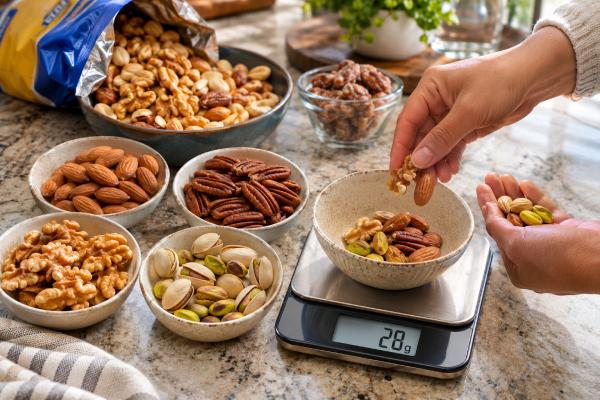
Nuts are one of the simplest foods to add for heart health because they replace less helpful snacks while providing unsaturated fats, fiber, plant protein, minerals, and bioactive compounds. The strongest evidence is not that one “super nut” prevents heart disease, but that regular nut intake as part of an overall healthy diet is associated with lower cardiovascular risk and modest improvements in blood lipids. A practical portion is about 1 ounce, or 28 g, on most days.
Walnuts stand out for plant omega-3 alpha-linolenic acid, almonds and pistachios are rich in unsaturated fats and fiber, and peanuts offer similar nutritional value at a lower price even though they are technically legumes. The best nut is usually the one you enjoy, can afford, and will eat instead of refined snacks or foods high in saturated fat. Preparation matters too. Salted, sugar-coated, chocolate-covered, and heavily flavored nuts can turn a heart-healthy food into a sodium or calorie trap. Portion size matters because nuts are energy-dense even though they are filling.
Table of Contents
- Why nuts support heart health
- Best nuts for different goals
- How much to eat
- Raw, roasted, salted, and nut butters
- Common mistakes
- How to use nuts in real meals
- Who needs extra caution
Why nuts support heart health
Nuts help most when they improve the overall pattern of the diet. Their fats are largely monounsaturated and polyunsaturated rather than saturated. Replacing butter, fatty processed meat, pastries, or chips with nuts can improve the type of fat you eat while adding fiber and plant protein.
Randomized trials show that nut intake can modestly lower LDL cholesterol, total cholesterol, triglycerides, and apolipoprotein B. Blood-pressure effects are smaller and less consistent, but nuts also contribute magnesium, potassium, arginine, and antioxidant compounds that support vascular function.
Long-term observational evidence points in the same direction. Recent meta-analyses associate higher nut consumption with lower risks of coronary heart disease, overall cardiovascular disease, cardiovascular death, and all-cause mortality. An umbrella review found that roughly 28 g/day of nuts was associated with lower cardiovascular risk compared with no intake, although observational studies cannot prove that nuts alone caused the difference.
The mechanism is broader than cholesterol. Nuts may help by:
- replacing saturated fat with unsaturated fat;
- adding soluble and insoluble fiber;
- providing plant sterols that reduce cholesterol absorption;
- supplying magnesium and potassium;
- supporting satiety, which can make weight control easier;
- improving post-meal glucose and lipid handling when they replace refined carbohydrate snacks.
Nuts are not cholesterol medicine, and adding them on top of an already excessive diet will not erase other risk factors. Their value comes from substitution. If a handful of almonds replaces cookies, the dietary change is larger than the almonds alone. If the same almonds are added after a full meal without replacing anything, the benefit may be smaller and calorie intake rises.
This substitution idea also applies to cooking fats. Heart-healthy fats work best when they replace sources of saturated and trans fat rather than simply increasing total calories.
Best nuts for different goals
No single nut wins every category. Most tree nuts and peanuts have favorable nutrient profiles, and variety makes it easier to get different nutrients.
| Nut | Useful feature | Good choice for | Watch for |
|---|---|---|---|
| Walnuts | High in alpha-linolenic acid, a plant omega-3 | Adding omega-3-rich plant fat | Easy to overpour because pieces are light |
| Almonds | Fiber, vitamin E, monounsaturated fat | Snacks, oatmeal, salads | Flavored versions can be salty or sugary |
| Pistachios | Fiber, potassium, unsaturated fat | Portion-aware snacking | Salted shells can add substantial sodium |
| Peanuts | Affordable plant protein and unsaturated fat | Budget-friendly daily use | Peanut butter may contain added sugar or palm oil |
| Pecans | Monounsaturated fat and polyphenols | Replacing butter-rich toppings | Candied pecans are a dessert, not the same food |
| Hazelnuts | Monounsaturated fat and vitamin E | Yogurt, fruit, grain bowls | Chocolate-hazelnut spreads are usually sugar-rich |
| Cashews | Creamy texture, magnesium, unsaturated fat | Sauces and dairy-free cooking | Roasted salted versions can be sodium-dense |
Walnuts get extra attention because they provide alpha-linolenic acid, or ALA. The body can convert a small amount of ALA to the longer-chain omega-3 fats EPA and DHA, but the conversion is limited. Walnuts are therefore a valuable plant source of omega-3 fat, not a direct substitute for fatty fish or prescription EPA when those are clinically indicated.
Almonds and pistachios are convenient for people focused on cholesterol because they combine unsaturated fats with fiber and plant sterols. Peanuts should not be dismissed because they are legumes botanically. In nutrition studies they are often grouped with nuts because their macronutrient profile and culinary use are similar.
Brazil nuts deserve a separate note. They are exceptionally high in selenium, and the amount varies widely. Eating several every day can push selenium intake unnecessarily high, so they are better used in small amounts rather than as the main daily nut.
How much to eat
A standard serving is about 1 ounce, or 28 g. That is roughly a small handful. The exact count varies because nuts differ in size: an ounce might be around 23 almonds, 14 walnut halves, 18 cashews, or about 49 pistachio kernels.
You do not need to count every nut. The point is to make a one-ounce portion visually familiar. Pre-portioning is especially useful if you eat from large containers while working, watching television, or driving.
A practical pattern is 1 ounce on most days or several servings spread across the week. Studies examining cardiovascular outcomes often find benefits with regular intake rather than occasional large portions.
Nuts are calorie-dense—commonly around 160 to 200 calories per ounce—but that does not mean they automatically cause weight gain. Their protein, fat, fiber, and physical structure promote satiety, and not all of the energy measured in a laboratory is necessarily absorbed from intact nuts. Controlled studies generally do not show the weight gain people might predict from the calorie number alone when nuts are incorporated sensibly into the diet.
The easiest calorie strategy is replacement. Swap a 200-calorie pastry, chips, or candy snack for a 160- to 180-calorie serving of nuts rather than adding nuts after the original snack. At breakfast, use nuts instead of bacon or a large amount of butter. On a salad, replace croutons and cheese-heavy toppings with a smaller amount of nuts.
If your goal is lowering LDL, nuts work best as one component of a broader pattern that also includes soluble fiber, vegetables, legumes, and unsaturated oils. Foods that help lower cholesterol can be combined rather than treated as competing options.
Raw, roasted, salted, and nut butters
Raw and dry-roasted nuts can both fit a heart-healthy diet. Roasting changes flavor, texture, and some heat-sensitive compounds, but it does not turn nuts into an unhealthy food. The bigger difference is what gets added during processing.
Dry-roasted nuts are roasted without much added oil. Oil-roasted versions may absorb some oil, though the type and amount vary. If the ingredient list says nuts, salt, and perhaps a heart-healthy oil, the product can still be reasonable.
Salt matters for people with hypertension. A serving of heavily salted nuts can contain several hundred milligrams of sodium. “Lightly salted” may be a good compromise if unsalted nuts are unappealing, but compare Nutrition Facts panels rather than relying on marketing language. If blood pressure is a priority, sodium and blood-pressure guidance can help put the snack into your daily total.
Sweet coatings change the equation more dramatically. Honey-roasted nuts, pralines, candied pecans, and chocolate-covered nuts can contain significant added sugar and sometimes extra saturated fat. They can be enjoyable foods, but they should not be counted nutritionally as equivalent to plain nuts.
Nut butter can be an excellent option when the ingredient list is simple. Look for products containing nuts alone or nuts plus a modest amount of salt. Separation of oil is normal in natural nut butter; stirring it back in is not a problem.
Added oils are not automatically harmful. A peanut butter containing a small amount of canola oil is still very different from one where sugar and saturated tropical fat make up a significant part of the product. The Nutrition Facts panel and ingredient order tell you more than “natural” or “no-stir” on the label.
Two tablespoons of nut butter is roughly equivalent to a one-ounce serving of nuts in energy, but it is easier to overserve. Measuring occasionally can recalibrate what two tablespoons looks like.
Common mistakes
The most common mistake is assuming that because nuts are healthy, portion size no longer matters. A cup of nuts can contain several times the calories of a standard serving. That may be appropriate for someone with high energy needs, but it can quietly undermine a weight-loss plan.
Other common errors include:
- Choosing “nut products” that are mostly sugar. Chocolate spreads, nut clusters, brittle, and many granolas may contain more added sugar than nuts.
- Ignoring sodium. Large servings of salted nuts can add a meaningful sodium load.
- Using coconut as if it were nutritionally identical to tree nuts. Coconut is much higher in saturated fat and has a different lipid effect.
- Adding nuts without replacing less helpful foods. Substitution produces more meaningful dietary improvement.
- Assuming all trail mix is heart-healthy. Many mixes are heavy in candy, sweetened dried fruit, yogurt coatings, or salty snacks.
- Relying on nuts to “fix” very high LDL. Severe hypercholesterolemia often requires medication and evaluation for genetic causes.
Another mistake is focusing too narrowly on one nut. Eating walnuts every day while the rest of the diet is dominated by processed meat, refined grains, and sugary drinks will not create a protective dietary pattern. Variety is useful because different nuts contribute different micronutrients and flavors, making the habit easier to sustain.
Be skeptical of claims that soaking or activating nuts dramatically improves cardiovascular benefits. Soaking may change texture and can be useful in recipes, but there is no strong evidence that it is necessary for heart health. Likewise, expensive “sprouted” nut products are not required to obtain the core benefits seen in nutrition research.
How to use nuts in real meals
The best way to make nuts a habit is to attach them to meals you already eat. They should solve a practical problem—adding crunch, replacing a less helpful fat, or creating a filling snack.
At breakfast, add chopped walnuts or almonds to oatmeal, unsweetened yogurt, or fruit. This works particularly well because oats provide beta-glucan soluble fiber while nuts provide unsaturated fat. The combination targets LDL through different dietary mechanisms.
At lunch, add pistachios, almonds, or walnuts to salads or grain bowls. A tablespoon or two can provide texture without turning the meal into a calorie bomb. Nuts also work well with beans and vegetables in Mediterranean-style meals.
For snacks, pair a measured portion with fruit. An apple plus 1 ounce of peanuts or almonds is more filling than fruit alone for many people because the fat and protein slow eating and increase satiety.
At dinner, use chopped nuts as a coating for fish or chicken, or blend cashews into a sauce that replaces heavy cream. Toasting nuts in a dry skillet can intensify flavor, so a smaller amount may feel more satisfying.
Simple combinations include:
- oatmeal + berries + walnuts;
- plain yogurt + fruit + pistachios;
- apple + peanut butter;
- lentil salad + almonds;
- roasted vegetables + tahini and chopped nuts;
- whole-grain toast + natural peanut or almond butter.
If you are building a broader heart-focused diet, the best foods for overall heart health can help place nuts alongside vegetables, whole grains, legumes, fish, and unsaturated oils.
Who needs extra caution
Nut allergy is the clearest exception. Tree-nut and peanut allergies can cause severe reactions, including anaphylaxis. People with a diagnosed allergy should follow individualized medical advice and should not experiment with related nuts without guidance.
Young children and adults with swallowing problems also face a choking risk from whole nuts. Nut butter spread thinly or finely ground nuts may be safer depending on age and clinical circumstances.
People with chronic kidney disease may need individualized guidance on potassium, phosphorus, and protein. Nuts are nutrient-dense, but the right amount depends on kidney function and the rest of the diet.
If you take warfarin, nuts generally do not pose the vitamin K issue that leafy greens do, but any major dietary change should be discussed if your anticoagulation has been difficult to stabilize. People with digestive conditions may also need smaller portions or ground forms if whole nuts trigger symptoms.
For weight loss, nuts can still fit well, but use a defined portion and replace another food. Their satiety is an advantage only if total intake remains appropriate.
The practical heart-health message is simple: choose mostly unsalted or lightly salted nuts, eat roughly a small handful at a time, rotate types for variety, and use them to replace less favorable snacks and saturated fats. Walnuts, almonds, pistachios, pecans, hazelnuts, cashews, and peanuts can all earn a place. Consistency and substitution matter more than finding a perfect nut.
Shopping choices can make the daily habit easier. On a nutrition label, compare serving size, sodium, added sugar, and saturated fat rather than assuming every package of nuts is equivalent. “Honey roasted,” “candied,” “chocolate covered,” and some savory coatings can add enough sugar, sodium, or saturated fat to change the role of the food. Dry-roasted or oil-roasted nuts can still fit; roasting itself does not erase the unsaturated fats and fiber.
For nut butter, look for a short ingredient list. Peanuts or almonds plus a little salt is simple. Added sugar is not automatically disqualifying, but products with a large amount of sugar or palm/coconut fat are less useful as a direct replacement for whole nuts. A standard portion of nut butter is about 2 tablespoons, which is easy to exceed when eating from the jar.
Cost does not predict heart benefit. Peanuts are often much cheaper than tree nuts and still provide unsaturated fat, protein, fiber, magnesium, and plant sterols. Buying larger bags of plain nuts, using store brands, or mixing peanuts with walnuts can lower cost without sacrificing the basic nutritional pattern.
Think in weekly substitutions. Replacing chips with pistachios twice, a pastry with almonds twice, and butter on toast with peanut butter several mornings can shift fat quality without requiring a rigid “nut prescription.” The calories are also easier to manage when the nuts take another food’s place.
Variety is useful but not mandatory. If walnuts are too expensive, almonds bother your teeth, or pistachios are hard to find, choose another unsalted or lightly salted nut you can eat consistently. The evidence supports the category more strongly than any claim that one nut is uniquely protective. The best routine is a sensible portion, repeated often, in place of a less favorable food.
A measured portion also makes shopping and meal planning easier.
Storage is another practical detail. The unsaturated fats in nuts can become rancid with heat, light, and time. Buy amounts you will use, keep containers sealed, and refrigerate or freeze larger quantities if they will sit for months. Fresh nuts should taste clean and nutty, not bitter, paint-like, or stale. Better storage does not make nuts more “cardioprotective,” but it reduces waste and makes a regular heart-healthy habit easier to maintain.
Nuts are also a useful example of why food effects depend on what gets replaced. If a person adds 200 calories of nuts every day without changing anything else, total energy intake may rise. If the same serving replaces chips, cookies, processed meat, or a butter-heavy snack, the change improves fat quality and usually adds fiber and micronutrients at the same time.
That substitution principle helps with weight goals. People trying to lose weight do not need to avoid nuts, but free-pouring from a large bag can make portions hard to judge. Put one serving in a bowl, close the package, and pair the nuts with fruit or plain yogurt if you want more volume. The combination is often more filling than a small refined snack with a similar calorie count.
Sodium deserves perspective too. Salted nuts can still be nutritious, but a heavily salted product may be a poor fit for someone with high blood pressure who already eats a high-sodium diet. Compare brands because sodium varies widely. Lightly salted options can be a practical middle ground if completely unsalted nuts are unappealing.
For cholesterol, do not expect one handful to create an obvious change in a week. The lipid effect in trials is generally modest and develops as part of a repeated dietary pattern. A repeat lipid panel after a sustained period is more useful than trying to judge benefit by energy, appetite, or how “healthy” the snack feels.
References
- Nut consumption and risk of cardiovascular disease events and all-cause mortality: A systematic review and dose-response meta-analysis of prospective cohort studies 2026 (Systematic Review)
- Tree Nut and Peanut Consumption and Risk of Cardiovascular Disease: A Systematic Review and Meta-Analysis of Randomized Controlled Trials 2023 (Systematic Review)
- Nuts and seeds consumption and risk of cardiovascular disease, type 2 diabetes and their risk factors: a systematic review and meta-analysis 2023 (Systematic Review)
- Consumption of Nuts and Seeds and Health Outcomes Including Cardiovascular Disease, Diabetes and Metabolic Disease, Cancer, and Mortality: An Umbrella Review 2022 (Systematic Review)
- Does Medication Status Impact the Effectiveness of Nuts in Altering Blood Pressure and Lipids? A Systematic Review and Meta-Analysis 2025 (Systematic Review)
Disclaimer
This article provides general nutrition information and does not replace individualized medical or dietary advice. People with nut allergies, chronic kidney disease, swallowing problems, or specialized medical diets should discuss nut choices and portions with an appropriate healthcare professional.