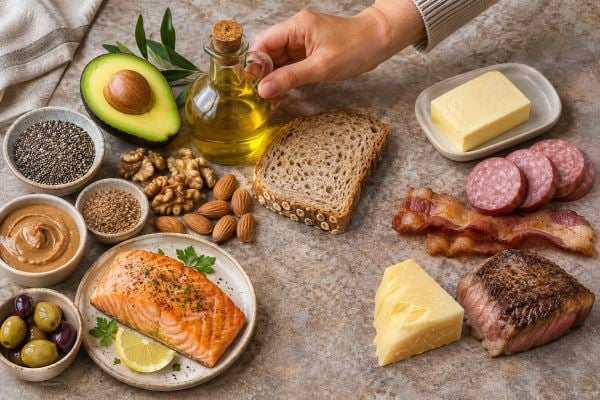
The healthiest approach to dietary fat is not to avoid fat—it is to replace fats that raise LDL cholesterol with foods rich in unsaturated fats. Olive and other liquid plant oils, nuts, seeds, avocados, and fish can fit a heart-supportive eating pattern. Butter, coconut and palm oils, fatty and processed meats, and many baked or fried foods are more concentrated sources of saturated fat and are better treated as smaller or less frequent choices.
What replaces saturated fat matters. Swapping butter for olive oil is different from swapping it for refined crackers, sugary cereal, or other low-fiber carbohydrates. Evidence and major cardiovascular nutrition guidance generally favor replacing saturated fat with polyunsaturated and monounsaturated fats, along with whole grains and plant proteins. The full food pattern matters too: a handful of nuts brings fiber and minerals along with fat, while a pastry may combine saturated fat, refined flour, added sugar, and sodium. Understanding those tradeoffs makes “healthy fat” advice much more practical than simply counting total grams of fat.
Table of Contents
- The Main Types of Dietary Fat
- Why Unsaturated Fats Are the Best Default
- What to Know About Saturated Fat
- Foods to Choose More Often
- Fats and Foods to Limit
- How to Make Heart-Healthy Fat Swaps
- Common Questions About Fat and Heart Health
The Main Types of Dietary Fat
Dietary fats contain different mixtures of fatty acids. The three categories that matter most in everyday food choices are unsaturated fat, saturated fat, and trans fat.
Monounsaturated fats are abundant in olive oil, avocado, peanuts, and many nuts. Polyunsaturated fats include omega-6 and omega-3 fatty acids and are found in foods such as soybean, canola, sunflower, and corn oils; walnuts and seeds; and fish. These unsaturated fats are usually liquid at room temperature when they come from oils.
Saturated fats are found in higher amounts in butter, ghee, coconut oil, palm oil, fatty cuts of meat, processed meats, full-fat dairy foods, and many desserts. A food does not contain only one type of fat. Olive oil, for example, is mostly monounsaturated but also contains some saturated and polyunsaturated fat.
Industrial trans fats are produced when oils are partially hydrogenated. They raise LDL cholesterol and can lower HDL cholesterol, so they have been removed or heavily restricted from the food supply in many countries. Small amounts of naturally occurring trans fats are present in meat and dairy from ruminant animals, but partially hydrogenated oils are the type most clearly targeted by public-health policy.
Total fat is not the main issue for cardiovascular health. The source and replacement nutrient matter more. A diet can be moderate or relatively high in fat and still support cardiovascular health when most of the fat comes from unsaturated sources within a minimally processed dietary pattern.
Why Unsaturated Fats Are the Best Default
Replacing saturated fat with unsaturated fat generally lowers LDL cholesterol, a causal driver of atherosclerotic cardiovascular disease. Polyunsaturated fats have the strongest evidence for LDL reduction when they replace saturated fat, while monounsaturated fats also fit well in heart-healthy patterns.
This replacement idea is crucial. If you remove 100 calories of butter and replace them with 100 calories of olive oil, the fatty-acid profile improves. If you replace the butter with 100 calories of refined starch and added sugar, cardiovascular benefit is much less likely. That is why nutrition guidance has moved away from blanket “low-fat” advice.
Unsaturated-fat foods also arrive in useful food packages. Nuts and seeds provide fiber, plant protein, magnesium, and phytosterols. Fish supplies protein and, in fatty species, the long-chain omega-3 fats EPA and DHA. Olive oil is rich in monounsaturated fat and contains phenolic compounds, particularly in extra-virgin varieties.
Omega-6 fats, especially linoleic acid from many plant oils, are sometimes described as something to avoid because they can be used in biochemical pathways that also produce inflammatory molecules. That simplified argument does not reflect the overall human evidence. When omega-6-rich polyunsaturated oils replace saturated fats, LDL cholesterol generally falls, and major cardiovascular guidance supports that substitution. You do not need to pursue a specific omega-6-to-omega-3 ratio; it is more useful to eat fish or other omega-3 sources while using unsaturated plant oils in place of butter and tropical oils.
A Mediterranean-style pattern is a familiar example: olive oil as a main added fat, nuts and seeds, fish, legumes, vegetables, fruit, and whole grains, with less butter, processed meat, and highly processed snack food. You do not have to follow a named diet to use the same principle. For broader food choices, see the best foods for overall heart health.
What to Know About Saturated Fat
Saturated fat remains a debated topic because observational studies, randomized trials, food sources, and replacement nutrients can produce different-looking results. The practical consensus from major cardiovascular guidance is still to limit saturated fat and replace it mainly with unsaturated fats rather than refined carbohydrate.
A useful target for the general population is to keep saturated fat below about 10% of daily calories. Some cardiovascular organizations recommend a lower target—around 5%–6% of calories—for people who need substantial LDL cholesterol lowering. On a 2,000-calorie diet, 10% of calories is about 22 g of saturated fat; 6% is about 13 g.
Those numbers are not a reason to micromanage every gram. They show how quickly saturated fat can add up. Two tablespoons of butter contain roughly 14 g of saturated fat. Coconut oil is also highly saturated, despite its plant origin. Cheese, pizza, pastries, ice cream, fatty meat, and creamy sauces can contribute meaningful amounts throughout the day.
If you use labels, compare saturated fat per serving rather than total fat alone. A product with 12 g of total fat and only 1–2 g saturated fat may be mostly unsaturated, while another with the same total fat could contain 7–8 g saturated fat. Also check the serving size. A label can look favorable until you realize you usually eat two or three servings at once.
Food context adds nuance. Fermented dairy foods such as yogurt may not have the same cardiometabolic associations as butter, even when both contain saturated fat. Likewise, replacing a processed meat with nuts changes much more than fatty-acid composition: it changes sodium, fiber, protein source, and other nutrients. That is why the best advice combines nutrient targets with food-based choices.
If you want a direct comparison of fatty-acid types, saturated versus unsaturated fat and heart risk explains the replacement principle in more detail.
Foods to Choose More Often
The easiest strategy is to build meals around naturally unsaturated-fat foods instead of trying to “add healthy fat” on top of an unchanged diet.
Olive and other liquid plant oils
Extra-virgin olive oil is a strong everyday choice for dressings, sautéing, roasting, and finishing foods. Prospective studies and randomized-trial evidence support olive oil as part of a Mediterranean-style eating pattern, although no single oil works like a medication.
Canola, soybean, sunflower, safflower, and corn oils also provide mostly unsaturated fats. Seed oils are sometimes portrayed online as inherently inflammatory, but replacing saturated fat with polyunsaturated plant oils generally improves LDL cholesterol and is supported by cardiovascular evidence.
Use oil as a replacement, not an unlimited supplement. One tablespoon contains about 120 calories, so pouring large amounts onto an already calorie-dense meal can make weight management harder. A measured teaspoon or tablespoon is useful when you are learning portions. The goal is not to minimize calories from healthy fats at all costs, but to let those fats replace less favorable sources rather than simply stacking extra energy on top.
Nuts and seeds
Walnuts, almonds, pistachios, peanuts, pecans, hazelnuts, chia, flax, and other seeds provide unsaturated fat plus other beneficial nutrients. A practical serving is about 1 ounce, or 28 g, of nuts. Choose unsalted or lightly salted versions when sodium is a concern.
Nut intake has consistently been associated with favorable lipid changes, and walnuts provide the plant omega-3 alpha-linolenic acid. See the best nuts for heart health and sensible portions for more detail.
Fish and seafood
Fatty fish such as salmon, sardines, trout, herring, and mackerel provide EPA and DHA. Eating fish also often replaces red or processed meat, creating a double advantage in the meal pattern. Aim for variety and choose preparation methods such as baking, grilling, poaching, or air-frying rather than deep-frying.
Omega-3 supplements are not nutritionally identical to eating fish, and high-dose prescription omega-3 products are used for specific medical indications such as very high triglycerides. For the distinction, see EPA, DHA, and omega-3s for heart health.
Avocado, olives, and soy foods
Avocado and olives are concentrated sources of monounsaturated fat. Soybeans, tofu, tempeh, and edamame provide unsaturated fat along with plant protein. These foods can replace cheese, processed meats, or creamy sauces in meals rather than simply adding extra calories.
Fats and Foods to Limit
The foods worth limiting are those that make it easy to consume a lot of saturated fat or industrial trans fat while offering little fiber or other protective nutrition.
Common examples include:
- Butter, ghee, lard, and shortening.
- Coconut and palm oils used as major everyday fats.
- Fatty cuts of beef, pork, and lamb.
- Bacon, sausage, salami, and other processed meats.
- Heavy cream and large portions of high-fat cheese.
- Pastries, doughnuts, cookies, and desserts made with butter, shortening, or tropical oils.
- Fried fast foods and packaged snacks with high saturated-fat content.
“Limit” does not have to mean “never.” Frequency and portion size matter. A small amount of butter on occasion is different from cooking every meal in butter and using cheese and fatty meat as daily staples.
Coconut oil deserves special attention because its health halo can be misleading. It raises LDL cholesterol more than unsaturated plant oils. If you enjoy the flavor, use it occasionally rather than treating it as the default cooking fat.
Processed foods can hide saturated fat even when they do not taste obviously fatty. Read the Nutrition Facts label and compare products within the same category. A granola bar, frozen meal, plant-based dessert, or coffee creamer can contain coconut or palm oil and contribute several grams of saturated fat per serving.
Trans fat labeling also has a quirk: in the United States, a serving can sometimes list 0 g trans fat when the amount is below the labeling threshold. Checking the ingredient list for “partially hydrogenated oil” is therefore useful, although these ingredients are now far less common.
How to Make Heart-Healthy Fat Swaps
The most effective changes are direct substitutions that you can repeat. Focus on the food you are replacing, not just the “healthy” food you are adding.
| Instead of | Try | Why the swap helps |
|---|---|---|
| Butter on vegetables | Olive oil + herbs | More unsaturated fat, less saturated fat |
| Bacon at breakfast | Nuts, seeds, avocado, or beans | Less processed meat; more fiber and unsaturated fat |
| Creamy dressing | Olive-oil vinaigrette | Shifts the fat profile toward monounsaturated fat |
| Chips | Unsalted nuts | Adds fiber, protein, and unsaturated fat |
| Fatty red meat | Fish, lentils, tofu, or skinless poultry | Reduces saturated fat and diversifies protein |
| Ice cream most nights | Yogurt with fruit and nuts | Can reduce saturated fat and added sugar depending on the yogurt |
| Coconut oil as default | Olive, canola, or other liquid plant oil | Lower saturated-fat content |
One useful kitchen rule is “liquid plant oil first.” For most sautéing, roasting, marinades, and dressings, start with olive, canola, or another unsaturated plant oil. Use butter or coconut oil mainly when their specific flavor is important.
At restaurants, you rarely know exact grams of saturated fat, so use food patterns instead of perfect calculations. Choose grilled fish or lean protein more often than fried or heavily marbled meat, ask for olive-oil-based dressing when available, add beans or vegetables, and treat creamy sauces and cheese-heavy toppings as accents. One meal does not determine your cholesterol; the repeatable pattern does.
Another rule is “pair fat with fiber.” Nuts with fruit, olive oil on vegetables, tahini with beans, or avocado on whole-grain toast provide a more complete food package than fat-rich snack foods based on refined flour.
If lowering LDL is a priority, combine fat swaps with soluble fiber from oats, barley, beans, lentils, psyllium, fruit, and vegetables. foods that help lower cholesterol work through several complementary mechanisms rather than fat quality alone.
Common Questions About Fat and Heart Health
Is olive oil safe for cooking?
Yes. Olive oil is suitable for many home-cooking temperatures, including sautéing and roasting. Extra-virgin olive oil also supplies polyphenols. You do not need to reserve it only for cold use. As with any oil, avoid repeatedly overheating it until it smokes.
Do I need a low-fat diet to lower cholesterol?
Not necessarily. LDL reduction depends strongly on the type of fat and the overall dietary pattern. A diet containing nuts, seeds, olive oil, avocado, and fish can contain a moderate amount of total fat while still being heart supportive. The goal is to reduce saturated fat and replace it with unsaturated fat and high-quality carbohydrate or plant protein.
Are all animal fats unhealthy?
No food category is that simple. Fish is an important source of unsaturated omega-3 fats. Dairy foods differ from one another, and lean unprocessed meat can fit in a balanced diet. The practical pattern is to emphasize plants and seafood and keep fatty and processed meats less frequent. Portion size and cooking method still matter, so judge the whole meal rather than deciding whether a food is “good” or “bad” from its fat source alone.
Should I choose “fat-free” products?
Only when the whole product makes sense. Some fat-free foods replace fat with refined starch, added sugar, or sodium. Compare the ingredient list and Nutrition Facts panel. Plain low-fat yogurt, for example, can be useful, while a fat-free dessert with a large amount of added sugar is not automatically heart healthy.
Can healthy fats raise triglycerides?
Any calorie source can contribute to weight gain if total intake consistently exceeds needs, and excess weight can raise triglycerides. However, high triglycerides are often strongly influenced by added sugars, refined carbohydrates, alcohol, diabetes, and overall calorie excess. Replacing saturated fat or refined carbohydrate with appropriate amounts of unsaturated fat can fit well in a triglyceride-lowering pattern. For specific guidance, see diet changes that help lower triglycerides.
The bottom line is simple: choose mostly unsaturated fats from minimally processed foods, use liquid plant oils in place of solid fats, and treat saturated-fat-rich foods as smaller or less frequent parts of the diet. The replacement matters more than the word “fat” on the label, and small swaps repeated daily can meaningfully change the overall pattern over months and years.
References
- Cardiometabolic benefits of replacing saturated fatty acids with unsaturated fatty acids 2026 (Review)
- Effect of Interventions Aimed at Reducing or Modifying Saturated Fat Intake on Cholesterol, Mortality, and Major Cardiovascular Events : A Risk Stratified Systematic Review of Randomized Trials 2026 (Systematic Review)
- Saturated Fat Intake and the Prevention and Management of Cardiovascular Disease in Adults: An Academy of Nutrition and Dietetics Evidence-Based Nutrition Practice Guideline 2023 (Guideline)
- Saturated fat, the estimated absolute risk and certainty of risk for mortality and major cancer and cardiometabolic outcomes: an overview of systematic reviews 2023 (Review)
- Olive oil intake and cardiovascular disease, cancer, and all-cause mortality: a systematic review and dose-response meta-analysis of prospective cohort studies 2024 (Systematic Review)
- Popular Dietary Patterns: Alignment With American Heart Association 2021 Dietary Guidance: A Scientific Statement From the American Heart Association 2023 (Position Statement)
Disclaimer
This article provides general nutrition education and is not individualized medical or dietary advice. People with cardiovascular disease, very high LDL cholesterol, severe hypertriglyceridemia, food allergies, or other medical conditions may need personalized guidance from a clinician or registered dietitian. Do not stop prescribed lipid-lowering medication based on dietary changes alone.