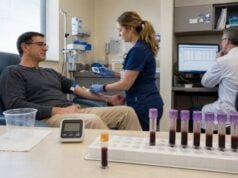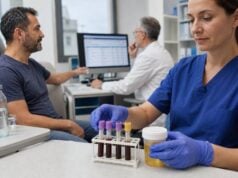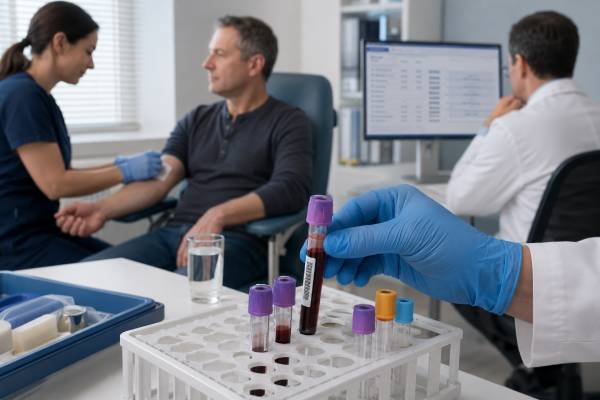
A copeptin blood test helps evaluate the body’s vasopressin system when excessive thirst, excessive urination, abnormal sodium, or a suspected water-balance disorder needs clarification. Copeptin is released in the same precursor molecule as arginine vasopressin, also called antidiuretic hormone or ADH. Because vasopressin is difficult to measure reliably, copeptin provides a more stable laboratory marker of its release. The test is used most often to distinguish arginine vasopressin deficiency, formerly called central diabetes insipidus, from arginine vasopressin resistance, formerly called nephrogenic diabetes insipidus, and primary polydipsia. A random result may answer a narrow question, but many patients need a controlled stimulation test with hypertonic saline or arginine. Interpretation depends on serum sodium, plasma osmolality, urine osmolality, hydration, kidney function, symptoms, medications, and the exact laboratory method.
- Copeptin is a stable surrogate marker released with vasopressin.
- A single random value does not diagnose every polyuria-polydipsia disorder.
- A markedly high baseline value can support vasopressin resistance in the correct setting.
- Hypertonic saline-stimulated copeptin is highly accurate but requires close sodium monitoring.
- Arginine stimulation is simpler, although its diagnostic gray zone is wider.
- Results must be interpreted with urine volume, osmolality, sodium, and clinical context.
Table of Contents
- What Copeptin Measures
- Why the Test Is Ordered
- Test Types and Preparation
- Results and Diagnostic Patterns
- Factors That Affect Results
- Next Steps After Testing
- Questions and Urgent Symptoms
What Copeptin Measures
Copeptin is the C-terminal portion of pre-provasopressin, the precursor protein produced in hypothalamic neurons. That precursor is processed into three products: vasopressin, neurophysin II, and copeptin. They are released from the posterior pituitary circulation in broadly equimolar amounts. Copeptin has no established water-retaining action of its own, but its concentration reflects activation of the vasopressin system.
Vasopressin helps the kidneys conserve water. When plasma becomes more concentrated or circulating volume falls, vasopressin binds V2 receptors in the kidney collecting ducts. This moves aquaporin-2 water channels to the cell surface, allowing water to return to the bloodstream. Urine becomes more concentrated and its volume falls. When the body has excess water, vasopressin secretion is suppressed, allowing dilute urine to be excreted.
Direct vasopressin testing is technically difficult. The peptide is unstable, binds to platelets, circulates at low concentrations, and is vulnerable to preanalytical handling errors. Copeptin is more stable in collected blood and easier to measure with validated immunoassays. It therefore functions as an ADH surrogate rather than as a separate pituitary hormone test.
The terminology for diabetes insipidus has changed in many endocrine publications. Arginine vasopressin deficiency, or AVP deficiency, describes inadequate hormone production or release and corresponds to central diabetes insipidus. Arginine vasopressin resistance, or AVP resistance, describes reduced kidney response and corresponds to nephrogenic diabetes insipidus. These terms reduce confusion with diabetes mellitus, which is a glucose disorder.
Copeptin secretion responds to more than osmolality. Nausea, pain, stress, low blood pressure, infection, and acute illness can raise it. Kidney clearance also matters. For that reason, a value cannot be interpreted as a simple yes-or-no measure of posterior pituitary function without knowing why and how the sample was obtained.
A direct ADH test may still be available in some centers, but copeptin is generally preferred when a validated assay and protocol are accessible. The two tests should not be assumed to share cutoffs or reference intervals.
Why the Test Is Ordered
The main indication is polyuria-polydipsia syndrome: unusually high urine output accompanied by persistent thirst or high fluid intake. Adults often report waking repeatedly to urinate, carrying water continuously, or passing very pale urine. Children may have heavy wet diapers, new bed-wetting, poor growth, irritability, dehydration, or a strong preference for water.
True polyuria must be distinguished from urinary frequency. A person with bladder irritation may urinate often but pass small amounts. Clinicians commonly confirm 24-hour urine volume or use a carefully recorded intake-output chart. In adults, more than about 3 liters per day is often considered polyuria, although body-size-based thresholds such as more than 50 milliliters per kilogram per day are more precise. In children, age and weight matter.
Before copeptin testing, common causes of high urine output are assessed. These include uncontrolled diabetes mellitus, high calcium, low potassium, diuretic therapy, osmotic agents, chronic kidney disease, recovery from urinary obstruction, and excessive solute intake. Urine that is not hypotonic points away from a primary vasopressin disorder.
Copeptin testing may be ordered when clinicians need to distinguish among:
- AVP deficiency: the hypothalamus or posterior pituitary does not release enough vasopressin.
- AVP resistance: the kidneys do not respond adequately despite appropriate or increased vasopressin release.
- Primary polydipsia: excessive water intake suppresses the vasopressin system and can impair urine-concentrating ability over time.
- Partial disorders: some vasopressin secretion or kidney response remains, making traditional testing less decisive.
- Postoperative water-balance disturbance: thirst and urine output change after pituitary or neurosurgery.
Causes of AVP deficiency include pituitary surgery, head injury, tumors in the hypothalamic-pituitary region, infiltrative or inflammatory disease, infection, genetic conditions, and autoimmune disease. Some cases remain idiopathic after evaluation. AVP resistance can result from lithium, high calcium, low potassium, chronic tubulointerstitial kidney disease, obstruction, or inherited receptor and aquaporin disorders.
A copeptin result can also support evaluation of hypernatremia when the urine is unexpectedly dilute. In a patient whose plasma is already strongly hyperosmolar, the physiologic stimulus is present without an artificial challenge. Low copeptin with dilute urine supports inadequate vasopressin release, whereas high copeptin with dilute urine suggests kidney resistance.
The test is not a stand-alone screening test for vague fatigue, headache, or pituitary disease. Nor does an elevated copeptin result by itself diagnose heart failure, sepsis, kidney disease, or another acute condition. Although copeptin has been studied as a stress and prognostic biomarker, the interpretation described here concerns water-balance disorders.
Test Types and Preparation
The correct protocol depends on the clinical question. A laboratory may offer a copeptin assay without offering a supervised stimulation test, so the ordering clinician should verify local availability, sample handling, assay platform, and interpretation before scheduling.
Baseline or Random Copeptin
A baseline sample is collected without deliberate stimulation. It is most useful when the result is expected to be very high, particularly in suspected AVP resistance, or when hypernatremia already provides strong osmotic stimulation. Low or intermediate baseline values often overlap between AVP deficiency and primary polydipsia, so they may not settle the diagnosis.
The blood draw is straightforward, but the surrounding conditions should be recorded. Recent fluid intake, intravenous fluids, nausea, acute stress, blood pressure, sodium, plasma osmolality, kidney function, and current medicines can change the result.
Hypertonic Saline-Stimulated Copeptin
Hypertonic saline raises plasma sodium and osmolality in a controlled setting, stimulating vasopressin and copeptin release. Blood sodium is checked frequently, and copeptin is measured after the target sodium concentration is reached. Water is then given, often with intravenous glucose solution, to lower sodium safely.
This test has high diagnostic accuracy for distinguishing AVP deficiency from primary polydipsia, including partial forms. It must be performed by an experienced team because sodium can rise rapidly. Significant heart disease, uncontrolled hypertension, seizure risk, or other conditions may affect eligibility. The exact protocol and stopping rules vary by center.
Patients may be asked to avoid eating, smoking, strenuous exercise, and excess drinking for a defined period. Medicines that alter sodium, kidney water handling, or vasopressin action require individualized instructions. Desmopressin should never be stopped without direct medical guidance because abrupt withdrawal can cause major water loss and hypernatremia.
Arginine-Stimulated Copeptin
Intravenous arginine provides a nonosmotic stimulus. Copeptin is measured before and at specified times after the infusion, commonly including a 60-minute sample. Arginine testing is generally easier and does not intentionally raise sodium to the same degree. Nausea, flushing, altered taste, headache, and local infusion reactions can occur.
Recent head-to-head evidence found hypertonic saline stimulation more accurate overall. Arginine remains useful where hypertonic saline is unsuitable or impractical, but results near the cutoff need caution. Newer studies have proposed lower and upper decision limits that create an indeterminate zone rather than forcing every result into a binary category.
Water Deprivation With or Without Copeptin
Traditional water deprivation evaluates whether urine concentrates as fluids are withheld, followed in many protocols by desmopressin. It requires repeated weight, urine, sodium, and osmolality measurements and can be difficult to interpret in partial AVP deficiency or chronic primary polydipsia. Copeptin may be added, but simple overnight deprivation does not create the same standardized osmotic stimulus as monitored hypertonic saline.
Preparation instructions must come from the testing center. Unsupervised water restriction is unsafe in suspected AVP deficiency because severe dehydration and hypernatremia can develop. Patients should report pregnancy, kidney or heart disease, seizures, recent vomiting or diarrhea, and all prescription and nonprescription medicines.
Results and Diagnostic Patterns
There is no single universal copeptin normal range that answers every diagnostic question. Results are usually reported in picomoles per liter, but reference data and decision thresholds depend on the assay and protocol. A value drawn at baseline cannot be compared directly with a value after hypertonic saline or arginine.
The following patterns summarize commonly used adult research thresholds. The testing center’s validated method takes priority.
| Clinical setting | Typical copeptin pattern | Interpretation in the correct context |
|---|---|---|
| Baseline, hypotonic polyuria | More than about 21.4 pmol/L | Strongly supports AVP resistance |
| Hypernatremia with dilute urine | Low or inappropriately modest | Supports AVP deficiency |
| Hypertonic saline stimulation | At or below about 4.9 pmol/L at adequate sodium stimulation | Supports AVP deficiency |
| Hypertonic saline stimulation | Above the validated cutoff | Supports primary polydipsia when other causes are excluded |
| Arginine stimulation | Low response | Supports AVP deficiency, but protocol-specific cutoffs and a gray zone apply |
| Any protocol | Unexpected elevation during acute illness or reduced kidney function | May reflect stress or clearance rather than a primary water-balance diagnosis |
A baseline copeptin above about 21.4 pmol/L has shown excellent discrimination for AVP resistance in cohorts with confirmed hypotonic polyuria. The kidney is failing to respond, so endogenous vasopressin release is high. This threshold should not be applied to a person who has not established hypotonic polyuria or who is acutely ill, dehydrated, or has reduced kidney function.
For hypertonic saline testing, a stimulated value at or below approximately 4.9 pmol/L has commonly supported AVP deficiency when plasma sodium reaches the protocol target. Some publications and laboratories use assay-adjusted thresholds. Adequate stimulation is essential: a low result is not meaningful if sodium and osmolality did not rise enough.
Primary polydipsia generally produces an appropriate stimulated copeptin response because the vasopressin system is intact. Chronic excess drinking can wash out the kidney’s medullary concentration gradient, so urine may remain relatively dilute during early testing even when hormone release is preserved. This is one reason stimulated copeptin can outperform urine concentration alone.
Arginine interpretation is evolving. The original adult studies used a single cutoff around 3.8 pmol/L at 60 minutes. A larger direct comparison found lower accuracy than hypertonic saline, especially near that value. Later analyses proposed a low threshold with high specificity for AVP deficiency and a higher threshold with high specificity for primary polydipsia, leaving an intermediate range for repeat or alternative testing. The laboratory report should state the protocol and decision limits used.
Partial AVP deficiency can produce overlapping results. A patient may concentrate urine somewhat, respond partially to desmopressin, and have a stimulated copeptin value near the cutoff. Diagnosis then integrates symptom history, measured urine volume, serum sodium, plasma and urine osmolality, MRI findings, anterior pituitary function, and repeated observations.
No result should be interpreted from the number alone. A coherent report should answer four questions:
- Was hypotonic polyuria confirmed?
- Was the sample baseline or stimulated, and was stimulation adequate?
- What were sodium, plasma osmolality, and urine osmolality at the relevant time?
- Does the copeptin pattern fit AVP deficiency, AVP resistance, primary polydipsia, or an indeterminate state?
A full diabetes insipidus hormone test panel is often more informative than an isolated copeptin value because it shows the relationship between hormone release and kidney water handling.
Factors That Affect Results
Hydration is an intended determinant of copeptin. Heavy drinking before a baseline sample can suppress it, while dehydration can raise it. This physiologic sensitivity is useful during a standardized test but creates noise during an unstructured blood draw.
Acute nausea is a potent nonosmotic stimulus. Pain, surgery, low blood pressure, fever, severe infection, hypoglycemia, and psychological stress may also increase vasopressin and copeptin. A high value during an emergency should not automatically be labeled AVP resistance.
Kidney function affects interpretation. Copeptin concentrations may rise as estimated glomerular filtration falls, and kidney disease itself can reduce urine-concentrating ability. The combination may imitate or obscure a vasopressin disorder. Creatinine and the clinical kidney history should be reviewed.
Medicines can change urine output, sodium, or vasopressin action. Important examples include:
- lithium, which can cause AVP resistance;
- diuretics, which alter sodium and volume;
- glucocorticoids, because cortisol deficiency and replacement affect water clearance;
- carbamazepine, chlorpropamide, and some antidepressants, which can enhance antidiuretic effects;
- demeclocycline and certain antiviral or chemotherapy drugs, which can impair kidney response;
- desmopressin, which directly replaces vasopressin activity.
High calcium and low potassium can impair the kidney’s response to vasopressin. Hyperglycemia and sodium-glucose cotransporter-2 inhibitors can cause osmotic diuresis, producing high urine volume without hypotonic urine. Urea, mannitol, and high-protein tube feeding can do the same.
Pregnancy changes vasopressin metabolism because placental vasopressinase increases hormone breakdown. Gestational AVP deficiency is uncommon but can present with sudden thirst and polyuria, particularly when liver clearance of vasopressinase is impaired. Pregnancy-specific specialist assessment is needed; diagnostic protocols that deliberately change sodium require careful risk assessment.
Laboratory methods are not interchangeable. Different assays may have calibration differences, lower detection limits, and protocol-specific evidence. A result from one platform should not be reclassified using a cutoff validated for another without laboratory guidance.
Preanalytical handling is easier than for vasopressin but still matters. Incorrect tube type, delayed processing beyond local limits, sample mislabeling, or collection at the wrong stimulation time can invalidate interpretation. A surprising result should prompt review of the entire test record before a diagnosis is made.
Next Steps After Testing
When results support AVP deficiency, evaluation turns to cause, severity, and safe treatment. A pituitary MRI with attention to the hypothalamus, stalk, and posterior pituitary is often performed. Anterior pituitary hormones may be checked because tumors, inflammation, trauma, surgery, and infiltrative disease can affect multiple axes. In children and young adults, the underlying differential diagnosis is especially broad, and interval imaging may be needed when initial findings are inconclusive.
Desmopressin can reduce urine output and thirst in AVP deficiency. The dose and route are individualized. The major treatment risk is water retention and hyponatremia, particularly when fluid intake continues after the antidiuretic effect begins. Patients need clear instructions about thirst-guided drinking, dose timing, planned aquaresis in some regimens, sick-day management, and symptoms of low sodium.
When AVP resistance is supported, treatment focuses on the cause. Lithium may need adjustment or replacement in coordination with the prescribing clinician. Calcium and potassium abnormalities are corrected, obstruction is treated, and kidney disease is addressed. Dietary solute reduction and selected medicines can reduce urine volume in some patients. Desmopressin is usually less effective than in complete AVP deficiency, although partial responses occur in selected disorders.
Primary polydipsia requires a different approach. Desmopressin can be dangerous because it may prevent excretion of voluntarily consumed water and cause severe hyponatremia. Management addresses behavioral, psychiatric, medication-related, or hypothalamic drivers of drinking and uses a supervised fluid plan rather than abrupt restriction.
An indeterminate stimulated result is not a failed evaluation. Options include reviewing whether stimulation was adequate, repeating the test with a more accurate protocol, using an alternative stimulus, reassessing measured urine output, or following sodium and osmolality over time. Results near a decision boundary should be treated as probabilities, not certainties.
After pituitary surgery, water balance can change in phases. Early AVP deficiency may be followed by inappropriate antidiuresis and later by recurrent deficiency. Urine output, thirst, sodium, and fluid intake need repeated review; one copeptin measurement cannot predict every phase. New polyuria after discharge should be reported promptly.
Patients should keep the laboratory report, including assay name, stimulation protocol, sodium values, sampling times, and cutoff. This information is more useful for future clinicians than a note that simply says “copeptin normal” or “copeptin abnormal.”
Questions and Urgent Symptoms
Useful questions for the ordering clinician include:
- Was true hypotonic polyuria documented before this test?
- Is this a baseline, hypertonic saline-stimulated, arginine-stimulated, or water-deprivation result?
- Which assay and cutoff did the laboratory validate?
- Did sodium and osmolality reach the required target?
- What were my urine osmolality and urine volume at the same time?
- Could kidney function, nausea, stress, calcium, potassium, glucose, or medicines affect the value?
- Does the pattern favor AVP deficiency, AVP resistance, primary polydipsia, or an indeterminate result?
- Do I need pituitary MRI or testing of other pituitary hormones?
- What should I do about drinking and desmopressin before future tests?
Urgent assessment is needed when excessive urination is accompanied by inability to drink, repeated vomiting, severe weakness, confusion, unusual sleepiness, seizures, or fainting. These can indicate dangerous hypernatremia and dehydration. Infants, older adults, people with impaired thirst, and anyone unable to access water can deteriorate quickly.
A person taking desmopressin should seek prompt advice for worsening headache, nausea, vomiting, confusion, marked drowsiness, muscle cramps, or seizures because these may signal hyponatremia. Fluid instructions during illness should come from the treating team.
Copeptin has made the evaluation of difficult polyuria-polydipsia cases more accurate, but its strength comes from standardized stimulation and paired measurements. The safest interpretation combines the result with sodium, plasma and urine osmolality, kidney function, medication history, and the patient’s actual pattern of thirst and urine output. When findings conflict, repeat testing under a documented protocol is safer than forcing a diagnosis from one borderline number.
References
- Enhancing diagnostic tools for vasopressin deficiency 2025 (Review)
- Arginine or Hypertonic Saline–Stimulated Copeptin to Diagnose AVP Deficiency 2023 (Clinical Trial)
- Approach to the Patient: “Utility of the Copeptin Assay” 2022 (Clinical Review)
- Copeptin analysis in endocrine disorders 2023 (Review)
- Central and nephrogenic diabetes insipidus 2025 (Review)
- A post-hoc internal validation of arginine-stimulated copeptin cut-offs for diagnosing AVP deficiency (central diabetes insipidus) 2025 (Research Article)
Disclaimer
This article provides general education and does not diagnose a water-balance disorder or replace a supervised endocrine evaluation. Copeptin thresholds are assay- and protocol-specific and must be interpreted with sodium, osmolality, kidney function, medications, hydration, and clinical findings. Never restrict water or stop desmopressin for testing unless the responsible medical team gives explicit instructions.