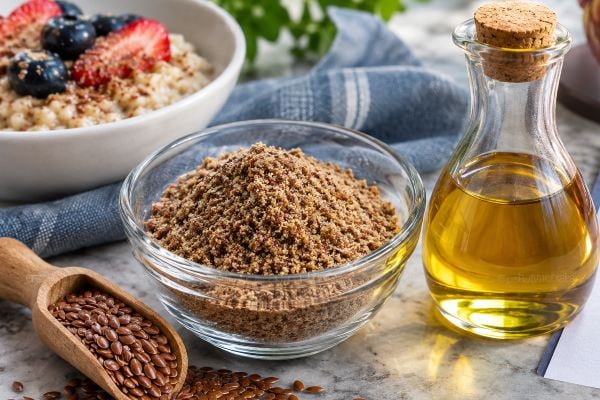
For lowering LDL cholesterol, ground flaxseed is usually a better choice than flax oil. Ground flax contains soluble and insoluble fiber, lignans, protein, and alpha-linolenic acid (ALA), a plant omega-3 fat. Flax oil supplies ALA but removes nearly all the fiber and most lignans. That difference matters because randomized-trial meta-analyses show whole or ground flaxseed can reduce LDL cholesterol, while flax oil has not consistently produced the same LDL-lowering effect. Flaxseed may also modestly lower blood pressure, especially when used regularly for several months. Flax oil can still be a useful unsaturated-fat food and a concentrated source of ALA, but it should not be treated as a substitute for ground flax if cholesterol reduction is the goal. A practical starting amount is 1 tablespoon of ground flaxseed per day, increasing toward 2 tablespoons if tolerated. Add it to oatmeal, yogurt, smoothies, or baked foods and drink enough fluid. People with swallowing problems, bowel narrowing, or certain medication issues should ask a clinician before using large amounts of flax fiber.
Table of Contents
- Ground Flax vs Flax Oil at a Glance
- Which Lowers LDL Cholesterol Better?
- Blood Pressure and Other Heart Benefits
- How Much Ground Flax to Use
- When Flax Oil Makes Sense
- Side Effects, Interactions, and Safety
- The Best Choice for Your Goal
Ground Flax vs Flax Oil at a Glance
Ground flaxseed and flax oil come from the same seed, but nutritionally they are very different foods.
| Feature | Ground flaxseed | Flax oil |
|---|---|---|
| Soluble and insoluble fiber | Yes | Essentially none |
| Lignans | High | Very low unless added back |
| ALA omega-3 fat | Yes | Concentrated source |
| Protein | Yes | No meaningful amount |
| Evidence for LDL lowering | Stronger | Inconsistent/limited |
| Calories per tablespoon | Roughly 35–40 | Roughly 120 |
| Best use | Fiber, LDL, bowel regularity, overall nutrition | Replacing less healthy fats, concentrated ALA |
Ground flax is simply flaxseed milled into small particles. Grinding matters because whole seeds can pass through the digestive tract partly intact, reducing access to their oils, lignans, and fiber. You can buy pre-ground flax meal or grind whole seeds shortly before use.
Flax oil is produced by pressing the seed. It contains mostly fat, including a large proportion of ALA. ALA is an essential omega-3 fatty acid, meaning the body cannot make it. Some ALA is converted to the longer-chain omega-3 fats EPA and DHA, but conversion is limited, especially for DHA.
That makes flax oil nutritious, but it does not give you the full seed. If you pour flax oil over oatmeal, you gain ALA but not the soluble fiber that can help lower LDL.
The difference is similar to comparing an intact food with one isolated component. For general cardiovascular nutrition, the intact or minimally processed version often provides a broader mix of useful compounds. The same principle underlies the value of flaxseed and chia seeds for heart health.
Which Lowers LDL Cholesterol Better?
Ground or whole flaxseed has the better evidence for lowering LDL. A 2021 systematic review that directly compared flax products found that whole flaxseed lowered LDL cholesterol by about 10.5 mg/dL on average in people with dyslipidemia-related conditions. Lignan supplements also lowered LDL. Flax oil did not show the same consistent lipid-lowering pattern.
That result makes biological sense. Ground flax attacks cholesterol through several components at once.
Soluble fiber helps remove cholesterol
Some flax fiber forms a gel-like material in the intestine. Soluble fiber can bind bile acids and increase their excretion. The liver then uses cholesterol to make more bile acids, which can help reduce circulating LDL.
This is the same basic reason oats, barley, beans, and psyllium can improve cholesterol. If LDL reduction is a major goal, flax can be one part of a broader soluble-fiber strategy for lowering LDL.
Lignans may add metabolic effects
Flaxseed is unusually rich in lignan precursors. Gut bacteria convert these plant compounds into enterolignans, which may influence lipid metabolism, inflammation, and hormone signaling. Lignans are not the main reason to eat flax, but they are one difference between the seed and purified oil.
ALA improves the fat profile of the diet
Both ground flax and flax oil contain ALA. Replacing butter, coconut fat, or other saturated-fat sources with unsaturated fats generally helps LDL cholesterol. Flax oil can contribute to that substitution. However, simply adding oil on top of an unchanged diet adds calories without necessarily improving LDL.
That is why “add a supplement” and “replace a less healthy fat” are not the same intervention.
Do not expect medication-sized LDL changes
A drop of around 5–15 mg/dL can be useful, but a person starting at LDL 190 mg/dL still has severe hypercholesterolemia after a 10 mg/dL reduction. Ground flax is an adjunct, not a replacement for risk-based medical therapy. If levels remain high despite diet, review the causes and treatment options for persistently high LDL cholesterol.
Blood Pressure and Other Heart Benefits
Flaxseed may also reduce blood pressure. A 2023 meta-analysis of 33 randomized trials involving more than 2,400 participants found average reductions of about 3.2 mmHg systolic and 2.6 mmHg diastolic. Larger effects appeared in some subgroups, including trials lasting more than 20 weeks and those using at least 30 g of flaxseed per day, although study results were highly variable.
A 2025 meta-analysis in people with cardiovascular risk factors also identified about 30 g/day as the intake associated with the largest observed blood-pressure changes in its dose-response analysis. That does not mean everyone needs 30 g or that 30 g is a guaranteed optimal dose. It provides a research-based reference point.
Potential mechanisms include improved endothelial function, ALA, lignans, fiber-related metabolic effects, and changes in inflammatory signaling.
Ground flax may help several risk factors at once
Unlike flax oil, ground flax adds fiber and bulk. That can increase fullness and support bowel regularity. It may make meals more satisfying, which can indirectly help weight management. It also contributes magnesium and other micronutrients.
Flaxseed is not a major protein food, but two tablespoons add a few grams of plant protein and fiber with relatively little effort.
ALA is useful, but it is not fish oil
ALA itself is associated with cardiovascular nutrition, and the body can convert some to EPA and DHA. The conversion is limited, so flax oil should not be assumed to provide the same physiological exposure as EPA- and DHA-rich fish or algae oil.
That does not make ALA unimportant. It means “omega-3” is a category rather than one substance. Ground flax can help people who eat little or no fish obtain an essential omega-3 precursor, while also supplying the fiber that oil lacks.
Blood pressure still requires proper monitoring
If you have hypertension, do not adjust medication because you started flaxseed. Dietary changes can interact with treatment over time, so measure pressure consistently and review trends with your clinician. A structured home blood-pressure monitoring schedule is more useful than isolated readings.
How Much Ground Flax to Use
A practical starting amount is 1 tablespoon of ground flaxseed daily, then increase to 2 tablespoons if your digestive system tolerates it. Two tablespoons are roughly 14–20 g depending on how the product is measured. Research trials often use 20–30 g/day, and some use more.
You do not need to begin at a full research dose. Fiber is easier to tolerate when increased gradually.
Good ways to use ground flax include:
- stirring it into oatmeal or overnight oats;
- adding it to yogurt or cottage cheese;
- blending it into a smoothie;
- mixing it into soups or stews after cooking;
- adding it to whole-grain muffin or pancake batter; and
- combining it with breadcrumbs for a coating.
Drink normal adequate fluids, especially as fiber intake rises. Flax absorbs water and expands.
Ground is better than whole for nutrient access
Whole flaxseed can add texture and some fiber, but many seeds may pass through intact. Grinding exposes the interior, making ALA and lignans more available. If cholesterol lowering is the goal, choose ground flax or chew whole seeds very thoroughly.
Storage matters
Whole flaxseed is relatively stable because the seed coat protects the oil. Once ground, more surface area is exposed to oxygen. Store ground flax in a tightly sealed container, preferably in the refrigerator or freezer, especially if you buy a large bag.
Rancid flax smells or tastes distinctly bitter, sharp, or paint-like. Discard it rather than trying to mask the flavor.
Give it enough time
Do not expect a meaningful cholesterol result after three days. Many nutrition interventions need several weeks. If you are making a deliberate LDL-lowering change, keep the rest of the diet reasonably stable and recheck lipids on the timetable your clinician recommends, often after roughly 6–12 weeks for a substantial diet or treatment change.
Flax works best when combined with other changes rather than used in isolation. A plan that also includes oats, beans, nuts, vegetables, olive or canola oil, and less saturated fat resembles the broader approach in lowering cholesterol with diet and exercise.
When Flax Oil Makes Sense
Flax oil makes sense when you want a concentrated plant source of ALA or an unsaturated oil for cold foods. It is not the first choice when your main goal is LDL lowering.
A tablespoon of flax oil supplies roughly 7 g of ALA, although exact amounts vary. That is much more ALA than a tablespoon of ground seed. It can be useful for people who eat little ALA from walnuts, chia, flax, canola oil, or soy foods.
Use flax oil in:
- salad dressings;
- dips or hummus;
- drizzles over cooked vegetables;
- yogurt or smoothies; or
- foods after cooking.
Flax oil is highly unsaturated and oxidizes easily. Keep it refrigerated after opening, follow the manufacturer’s storage directions, and use it within the recommended time.
Do not use it as a high-heat frying oil
Flax oil is generally better for cold or low-heat uses than for searing, deep frying, or repeated high-temperature cooking. Choose more heat-stable oils such as olive, avocado, or canola oil for those purposes.
Oil adds calories quickly
One tablespoon of oil contains about 120 calories. If you simply add two tablespoons daily without replacing another food, that is roughly 240 extra calories. For someone trying to lose weight, those calories can offset the intended benefit.
The best use is replacement: swap flax oil for butter or a saturated-fat dressing rather than adding it on top of the same diet.
Side Effects, Interactions, and Safety
Ground flaxseed is safe for most adults in food amounts, but the fiber can cause gas, bloating, loose stools, or constipation if intake rises too quickly or fluid intake is inadequate.
Start small if your usual diet is low in fiber. One teaspoon to one tablespoon daily for several days can be easier than jumping directly to 30 g.
Swallowing or bowel problems need caution
Because flax absorbs water and increases bulk, people with significant swallowing difficulty, bowel obstruction, severe intestinal narrowing, or some gastrointestinal disorders should ask a clinician before using high-fiber flax products. Do not swallow a large amount of dry ground flax without fluid.
Medications may need spacing
Fiber can slow or reduce absorption of some oral medicines. A simple conservative approach is to avoid taking a large flax dose at exactly the same time as important medications unless a pharmacist says the combination is fine. The appropriate spacing depends on the drug.
Flax may modestly lower blood pressure and glucose. For most people, that is not dangerous, but anyone using antihypertensive or diabetes medication should watch for symptomatic low readings when making several lifestyle changes at once.
Flax has also been studied for effects on platelet function, but routine food intake is not equivalent to an anticoagulant. People taking warfarin or other blood thinners do not necessarily need to avoid flax, but large supplement-style changes should be discussed with the prescribing team, particularly before surgery.
Pregnancy and hormone-sensitive conditions
Flax lignans have weak phytoestrogen activity. Ordinary food amounts are commonly eaten, but high-dose supplement use during pregnancy or in people with complex hormone-sensitive conditions should be discussed with a clinician rather than assumed safe from food data alone.
The Best Choice for Your Goal
Choose the form based on the problem you want to solve.
For LDL cholesterol: ground flax is the clear first choice because it provides fiber and lignans in addition to ALA, and direct comparisons favor whole flax over oil.
For blood pressure: ground flax has the most practical evidence base, often in doses around 20–30 g/day used for weeks to months. It should complement, not replace, proven hypertension treatment. A broader flaxseed blood-pressure dosing guide can help translate research amounts into food servings.
For constipation or fiber: choose ground flax. Flax oil contains essentially no fiber.
For a concentrated source of ALA: flax oil can be useful, especially if it replaces butter or another saturated fat. Ground flax still provides ALA, just in a smaller amount per tablespoon.
For the most complete food: ground flax wins. It preserves more of what the original seed contains.
A simple heart-healthy approach is to use 1–2 tablespoons of ground flax most days and rely on olive or canola oil as the main cooking oils. Use flax oil only if you specifically want the extra ALA and enjoy it in cold foods.
Whole seeds, ground flax, and flax meal are not identical in practice
Whole flaxseeds are nutritious, but their hard seed coat can pass through the digestive tract partly intact. Grinding improves access to the fiber, lignans, and fat inside the seed, which is why most cholesterol-focused trials and practical recommendations favor ground or milled flax. “Flax meal” usually means ground seed, although some products have had part of the oil removed; check the nutrition panel if the fat and calorie content seems much lower than expected.
You can buy pre-ground flax or grind whole seeds in a clean coffee or spice grinder. Store ground flax in a tightly closed container in the refrigerator or freezer if you use it slowly. The unsaturated fats can oxidize over time, so discard a product that develops a distinctly bitter, paint-like, or rancid smell. Flax oil is even more oxidation-prone and should generally be refrigerated after opening and used by the manufacturer’s date. It is better for dressings, yogurt, smoothies, or finished foods than for high-heat frying.
For cholesterol, give the routine enough time to judge it fairly. Use a consistent amount for several weeks, keep the rest of the diet reasonably stable, and recheck lipids on the schedule your clinician recommends. If LDL remains well above the level appropriate for your cardiovascular risk, increasing flax indefinitely is not the answer. Food strategies can support treatment, but they should not delay medication when medication is indicated.
Then judge success by meaningful outcomes: LDL, blood pressure, diet quality, weight trend when relevant, and how sustainable the routine feels. The best heart-health food is not the one with the most impressive label; it is the one that improves the overall pattern you can maintain.
References
- Efficacy of flaxseed in reducing blood pressure among patients with cardiovascular risk factors: A systematic review and meta-analysis of parallel randomized controlled trials 2025 (Systematic Review)
- Flaxseed Lowers Blood Pressure in Hypertensive Subjects: A Meta-Analysis of Randomized Controlled Trials 2024 (Systematic Review)
- Effect of flaxseed supplementation on blood pressure: a systematic review, and dose-response meta-analysis of randomized clinical trials 2023 (Systematic Review)
- Impact of flaxseed supplementation on lipid profile and liver enzymes in patients with non-alcoholic fatty liver disease: Systematic review and meta-analysis of randomized controlled trials 2024 (Systematic Review)
- The effect of flaxseed supplementation on anthropometric indices, blood pressure, and lipid profile in diabetic patients: A GRADE-assessed systematic review and meta-analysis of randomized controlled trials 2025 (Systematic Review)
- Comparisons of the effects of different flaxseed products consumption on lipid profiles, inflammatory cytokines and anthropometric indices in patients with dyslipidemia related diseases: systematic review and a dose-response meta-analysis of randomized controlled trials 2021 (Systematic Review)
Disclaimer
This article is for general education and is not individualized medical advice. Ground flaxseed and flax oil should not replace prescribed treatment for high cholesterol, high blood pressure, diabetes, or cardiovascular disease. Ask a clinician or pharmacist before making large flaxseed changes if you have swallowing or bowel problems, take medicines whose absorption is important, use anticoagulants, or are pregnant.